Why Your Canned Food Shipment Was Detained by FDA
If your canned food shipment is currently on hold at the U.S. border, time and accuracy both matter. This guide explains every common reason for FDA detention of canned food shipments, what to do right now, and how to prevent it from happening again.
Detention vs Refusal — What FDA Hold Actually Means
When FDA detains a canned food shipment, the product is stopped at the port of entry and placed under FDA review. The importer receives a formal Notice of Action specifying the reason. Understanding the distinction between detention and refusal determines your available options.
Detention
The shipment is held for review. The importer has the opportunity to provide documentation, testimony, or corrective action to address the issue and have the shipment released. Many detentions are resolved without the product being refused. Acting quickly with complete, accurate documentation is critical.
Refusal
FDA has determined the shipment is not admissible. The importer must re-export the product, destroy it, or bring it into compliance under FDA supervision. Refusal is more serious than detention and harder to reverse. Repeated refusals can lead to FDA Import Alert status for the facility.
FDA Import Alert (DWPE)
The most serious outcome. An FDA Import Alert subjects all future shipments from the facility to Detention Without Physical Examination (DWPE) — automatic detention at the border without review. Resolving Import Alert requires a formal corrective action program and FDA acceptance before shipments can resume.
Why FDA Detains Canned Food Shipments
Missing or Invalid FCE Registration
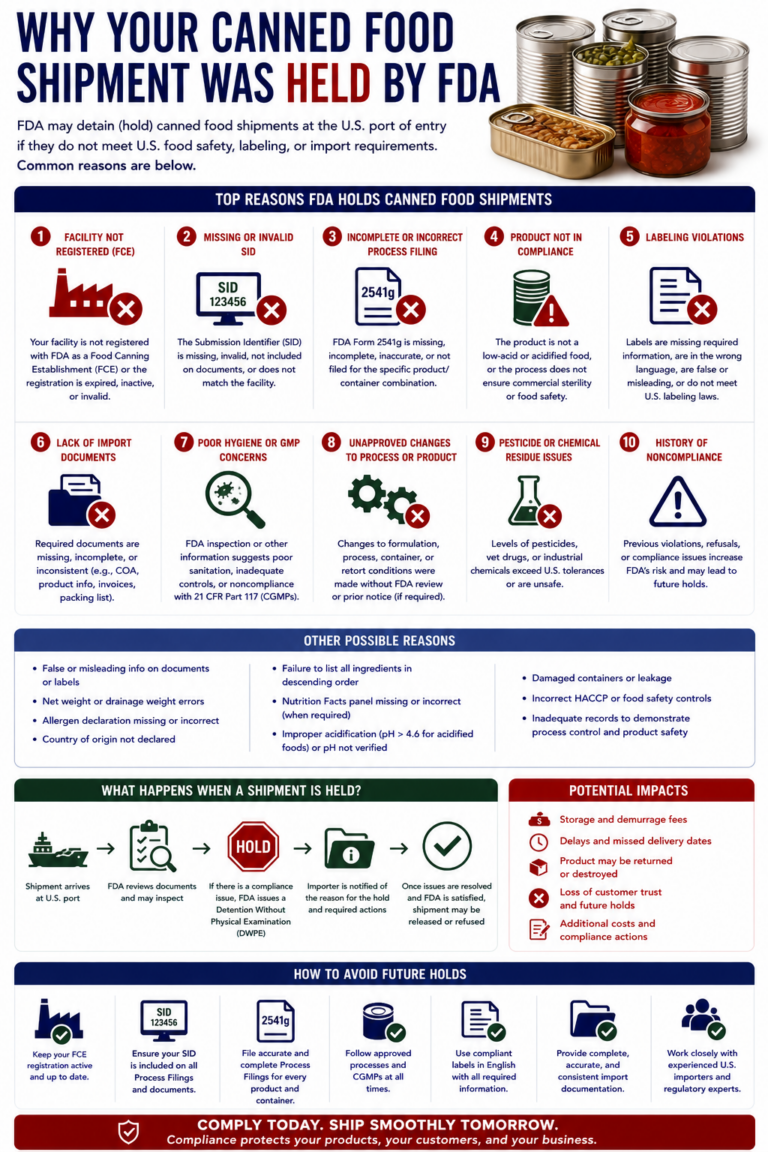
An FCE (Food Canning Establishment) number is required for all facilities producing thermally processed low-acid canned foods (LACF) or acidified foods for U.S. export. FDA verifies FCE registration at import entry. If the facility has no FCE number, if the FCE number is not listed correctly on the entry, or if the registration has been cancelled, the shipment will be detained immediately. FCE registration must be completed through FDA's eFiling system before any LACF or acidified food shipment departs.
Missing or Incorrect SID (Scheduled Process) Filings
A SID (Scheduled Process Identifier) must be on file with FDA for each specific product and process variation being exported. FDA checks whether the product being imported has a valid, matching SID. Common SID problems that cause holds include: no SID filed at all, SID filed without proper Process Authority validation, SID that does not match the specific product formulation or container size, and SID for a different product version than what is being shipped. Each distinct formulation and container combination requires its own SID.
Product Misclassification
Misclassification occurs when a facility or importer incorrectly categorizes a product — treating an acidified food as naturally high-acid and skipping FCE and SID requirements, or treating a LACF product as refrigerated. Misclassification is especially common with sauces, condiments, and canned vegetable products where the actual finished equilibrium pH has not been tested. When FDA examines the shipment and finds the product was exported without required process filings, detention or refusal follows.
Labeling Violations
Labeling issues are an independent cause of FDA holds — a shipment with valid FCE and SID filings can still be detained due to non-compliant labels. Common labeling violations that trigger holds include: labels that do not match the product formulation or filed SID, missing or incorrectly formatted Nutrition Facts panels, undeclared allergens, incorrect product identity or standard of identity violations, non-English labels, and missing responsible party information. Labels must align with the filed process and meet all 21 CFR Part 101 requirements.
No Process Authority Validation
FDA requires that all scheduled processes for LACF and acidified foods be established by a qualified Process Authority — a person with established expertise in thermal processing or acidification. SID filings submitted without proper Process Authority validation may not be accepted by FDA. If a shipment arrives under a SID that was filed without Process Authority backing, or if the Process Authority used was not qualified for the specific product type, the shipment is at risk of detention.
FDA Prior Notice Errors
FDA Prior Notice must be filed before every canned food shipment arrives at a U.S. port of entry. Common Prior Notice problems that cause holds include: Prior Notice not filed at all, product description that does not match the actual shipment, manufacturer or facility information that does not match FDA registration records, wrong arrival port or estimated arrival date, and data inconsistencies between Prior Notice and the CBP entry. Even minor data mismatches can trigger an FDA hold regardless of FCE/SID compliance status.
FSVP Documentation Gaps
The U.S. importer must maintain a Foreign Supplier Verification Program (FSVP) for all imported food products including canned foods. FDA inspectors can check FSVP compliance as part of import review. Missing FSVP records, hazard analysis that does not adequately address the specific biological risks of LACF products (including Clostridium botulinum), lack of supplier verification documentation, and DUNS Number mismatches can all contribute to increased FDA scrutiny and potential holds.
Random FDA Examination
FDA may select canned food shipments for random examination or sampling as part of routine import surveillance — regardless of the facility's compliance history. In random examination holds, the detention is not caused by a specific violation. Compliant shipments selected for random examination are typically released more quickly, but having complete, organized documentation — FCE registration, SID filings, Prior Notice confirmation, FSVP records — ready before shipment significantly speeds up the review and release process.
FDA Canned Food Shipment Hold — Cause, Resolution & Timeline
| Cause of Hold | How to Resolve | Typical Timeline | Risk of Refusal |
|---|---|---|---|
| Missing FCE Registration | Register facility as Food Canning Establishment through FDA eFiling system | Days (registration) + SID filing required | High — shipment cannot be released until FCE + SID in place |
| Missing or Incorrect SID | Engage Process Authority, validate process, submit SID through eFiling | Weeks — Process Authority validation required | High — no valid SID means no release |
| Labeling Violation | Correct labels under FDA supervision or relabel in bonded warehouse | Days to weeks depending on violation severity | Medium — relabeling may allow release |
| Prior Notice Error | File amended or new Prior Notice with correct data | Days — if corrected quickly | Low to medium — correctable if addressed fast |
| FSVP Gap | Provide FSVP documentation to FDA inspector | Days — if records are available | Low — documentation issue, not product safety issue |
| Product Misclassification | Conduct pH/water activity testing, complete FCE + SID if required | Weeks — testing and filing required | High — shipment held until correct filings confirmed |
| FDA Import Alert (DWPE) | Formal corrective action program, FDA acceptance required | Months — structured resolution process | Very High — all shipments blocked until resolved |
| Random Examination | Provide complete documentation, allow FDA sampling if required | Days — if documentation is organized and complete | Low — no violation, routine review |
What to Do Right Now If Your Canned Food Shipment Is Detained
Step 1 — Get the Official Detention Notice
Contact your customs broker immediately to obtain the official FDA Notice of Action. This document specifies the exact reason for the detention, the products affected, the FDA district office handling the case, and your response options and deadlines. Do not attempt to resolve the hold without reading this document carefully — the stated reason determines the correct corrective action.
Step 2 — Gather All Compliance Documentation
Collect every piece of compliance documentation related to the shipment: FCE registration confirmation, SID filing acknowledgments, FDA Food Facility Registration, U.S. Agent designation, Prior Notice confirmation number, FSVP records, product labels, commercial invoice, packing list, and bill of lading. Having all documentation organized immediately accelerates the response process.
Step 3 — Identify the Specific Compliance Gap
Match the reason stated in the detention notice to the documentation you have. If FCE registration is the issue, confirm whether the facility has an FCE number and whether it was correctly provided on the entry. If SID is the issue, confirm whether a valid SID exists for the specific product and container size. If Prior Notice is the issue, review the filed data against the actual shipment. Do not guess — an incorrect response wastes time and can worsen the situation.
Step 4 — Respond to FDA Quickly and Accurately
Provide FDA with the correct documentation or take the required corrective action as quickly as possible. For Prior Notice errors, file an amended notice. For FCE/SID issues, begin the filing process immediately. For labeling issues, coordinate with your customs broker about relabeling under FDA supervision. Every day of delay increases storage costs and the risk the shipment will be refused rather than released.
Step 5 — Coordinate Between Importer and Exporter
Many FDA holds require simultaneous action by both the U.S. importer and the foreign manufacturer. FCE registration and SID filings are the responsibility of the foreign facility. FSVP and Prior Notice are the importer's responsibility. U.S. Agent communications reach the foreign facility. Ensure both parties are in contact and acting on their respective obligations simultaneously to avoid sequential delays.
Step 6 — Get Expert Help If the Issue Is Complex
If the hold involves FCE or SID filing issues, Product Authority coordination, Import Alert status, or labeling violations requiring relabeling under FDA supervision — consider working with an FDA compliance specialist immediately. The complexity and timeline of these issues makes professional support cost-effective compared to extended storage costs and the risk of outright refusal.
How to Prevent FDA Holds on Canned Food Shipments
Most FDA holds on canned food shipments are entirely preventable. The compliance steps that prevent holds must all be completed before the first shipment departs — not after a hold occurs.
How FDA Registration Assistance Resolves and Prevents Canned Food Holds
FDA Registration Assistance works with importers and foreign manufacturers to both resolve active FDA holds on canned food shipments and build the compliance programs that prevent future detentions.
Hold Diagnosis
We review the FDA detention notice, existing compliance documentation, and shipment records to identify exactly what caused the hold and what specific corrective action is required — so time is not wasted responding to the wrong issue.
FCE & SID Filing
We manage FCE registration and coordinate with qualified Process Authorities to prepare and submit SID filings — getting valid process filings on file with FDA as quickly as possible so the detained shipment can be released.
Prior Notice Correction
We identify Prior Notice data errors and file corrected or amended Prior Notice submissions through the appropriate FDA channel — a fast fix when Prior Notice is the sole cause of the hold.
Label Review & Correction
We review labels against FDA requirements and the filed SID, identify all compliance gaps, and provide specific correction guidance — including coordination on relabeling procedures if the shipment is already in a bonded warehouse.
FSVP Documentation
We help U.S. importers establish or complete FSVP programs for canned food suppliers — producing records that demonstrate compliance to FDA and prevent FSVP-related holds from recurring.
Import Alert Resolution
If the facility has been placed on FDA Import Alert, we develop formal corrective action plans, manage FDA communications, and work to lift DWPE status so shipments can resume.
Canned Food Shipment on Hold? Get Expert Help Now.
FDA Registration Assistance resolves active FDA holds on canned food shipments and builds the compliance programs that prevent future detentions — FCE registration, SID filings, FDA Food Facility Registration, U.S. Agent service, FSVP compliance, label review, Prior Notice correction, and Import Alert resolution.
Contact us immediately at info@fdaregistrationassistance.com or call +1 (928) 275-8333. Every day counts when a shipment is on hold.
Frequently Asked Questions — Why FDA Detains Canned Food Shipments
1. Why was my canned food shipment detained by FDA?
The most common reasons FDA detains canned food shipments are missing or invalid FCE (Food Canning Establishment) registration, missing or incorrect SID (Scheduled Process) filings, labeling violations, FDA Prior Notice errors, missing or insufficient FSVP documentation, product misclassification, and random FDA examination. Identifying the specific cause from the FDA detention notice is the first step to resolution.
2. What is the difference between a detention and a refusal at the U.S. border?
A detention means FDA has placed the shipment on hold for review — the importer has an opportunity to provide documentation or take corrective action to get the shipment released. A refusal means FDA has determined the shipment is not admissible and the product must be re-exported, destroyed, or brought into compliance under FDA supervision. Detention often can be resolved; refusal is more serious and harder to reverse.
3. How long does an FDA hold on a canned food shipment last?
Duration depends on the cause and how quickly the importer responds. Prior Notice errors may be resolved within a few days. FCE or SID problems can take weeks because new filings require Process Authority validation. FDA Import Alert situations can extend to months. Responding quickly with correct documentation is critical to minimizing hold duration and costs.
4. What is FCE registration and why does a missing FCE cause a hold?
An FCE (Food Canning Establishment) number identifies a facility that produces thermally processed low-acid canned foods or acidified foods for U.S. export. FDA verifies FCE registration at import entry. If the facility does not have a valid FCE number or if the number on the entry does not match FDA records, the shipment will be detained or refused immediately.
5. What is a SID filing and how does a missing SID cause a hold?
A SID (Scheduled Process Identifier) is a detailed technical filing describing how a specific canned food product is processed to ensure safety. FDA checks whether a valid SID is on file for the specific product being imported. If no SID has been filed, if the SID does not match the product, or if the SID was filed without proper Process Authority validation, the shipment can be detained or refused.
6. Can labeling issues alone cause a canned food shipment to be detained?
Yes. Labeling violations are an independent basis for FDA to detain a shipment. Common labeling issues that cause holds include labels that do not match the filed SID, missing or incorrect Nutrition Facts panels, undeclared allergens, incorrect product identity, non-English labels, and missing responsible party information. A product with valid FCE and SID filings can still be detained for labeling violations.
7. What Prior Notice errors cause canned food shipment holds?
Common Prior Notice errors that cause holds include failure to file Prior Notice at all, incorrect product description, manufacturer information that does not match the facility's FDA registration, wrong arrival port or date, and data that does not match the CBP entry. Even small discrepancies can trigger an FDA hold regardless of FCE and SID compliance status.
8. What FSVP problems cause canned food shipment holds?
U.S. importers of canned foods must maintain a Foreign Supplier Verification Program (FSVP). Missing FSVP records, inadequate hazard analysis, lack of supplier verification documentation, and DUNS Number mismatches can all contribute to holds or increased FDA scrutiny of the shipment during import review.
9. What is product misclassification and how does it cause a hold?
Product misclassification occurs when a facility or importer incorrectly categorizes a product — for example, treating an acidified food as naturally high-acid and skipping required FCE and SID filings. When FDA examines the shipment and finds the product was exported without required process filings, detention or refusal follows. Classification must be based on actual laboratory pH and water activity testing.
10. Can a shipment be detained for random FDA examination even if everything is compliant?
Yes. FDA may select shipments for random examination or sampling regardless of compliance history. In these cases the detention is not caused by a violation. Compliant shipments selected for random examination are typically released more quickly, but having complete and organized documentation ready before shipment significantly speeds up the review and release process.
11. What should I do immediately when my canned food shipment is detained?
First contact your customs broker to obtain the official FDA detention notice specifying the reason for the hold. Then gather all compliance documentation — FCE registration, SID filings, FDA Food Facility Registration, Prior Notice confirmation, FSVP records, product labels, and entry documents. Respond to FDA's requests as quickly as possible with accurate, complete documentation. Do not guess or respond to the wrong issue.
12. Can I fix FCE or SID problems after a shipment has already been detained?
Yes, but it takes time. FCE registration can be completed relatively quickly through FDA's eFiling system. However, SID filings require Process Authority validation — a process that can take several weeks. The detained shipment cannot be released until valid SID filings are on file with FDA. In some cases the shipment may need to be held in a bonded warehouse while compliance is resolved.
13. What is FDA Import Alert and how is it different from a routine hold?
A routine hold applies to a specific shipment pending documentation review. An FDA Import Alert applies to all future shipments from a specific facility — subjecting them to automatic detention without physical examination (DWPE) until the underlying compliance issue is formally resolved. Import Alert is far more serious and requires a structured corrective action process.
14. What is Detention Without Physical Examination (DWPE)?
Detention Without Physical Examination (DWPE) is triggered by an FDA Import Alert. When a facility is on Import Alert, FDA detains all shipments from that facility at the border without physically examining the product — based solely on the facility's compliance history. The importer must demonstrate through a formal corrective action process that the underlying compliance problem has been corrected before DWPE status can be lifted.
15. How do I get a shipment released from FDA hold?
To get a canned food shipment released, address the specific reason cited in the detention notice. For FCE or SID issues, valid filings must be submitted and accepted by FDA. For labeling issues, corrected labels may need to be applied under FDA supervision. For Prior Notice errors, an amended Prior Notice must be filed. For FSVP issues, documentation must be made available. Working with an FDA compliance specialist significantly speeds up the release process.
16. What are the costs associated with an FDA hold on a canned food shipment?
FDA holds on canned food shipments generate significant costs including storage and warehousing fees, customs bond costs, customs broker handling fees, relabeling costs if labels are non-compliant, Process Authority fees if new SID filings are required, lost sales due to delayed delivery, and potential contractual penalties to buyers. Prevention through proper compliance is always less expensive than resolving a hold.
17. Does FDA notify the importer when a shipment is detained?
Yes. When FDA detains a shipment it issues a formal Notice of Action to the importer of record. This notice specifies the reason for the detention and the importer's options — providing documentation to contest the detention, bringing the shipment into compliance, re-exporting the shipment, or destroying the product. The importer typically has a specific timeframe to respond.
18. Can the exporter in the foreign country help resolve an FDA hold?
Yes. Many FDA holds require coordination between the U.S. importer and the foreign manufacturer. FCE registration and SID filings are the responsibility of the foreign facility. Process Authority coordination must be arranged by the facility. FSVP and Prior Notice are the importer's responsibility. Both parties typically need to act simultaneously to resolve a hold quickly and minimize storage costs.
19. What documentation should always be ready before shipping canned foods to the U.S.?
Before any canned food shipment departs, the following should be confirmed and ready: valid FCE number for the producing facility, accepted SID filings for each product and process variation, current FDA Food Facility Registration, U.S. Agent designation, completed FSVP records, FDA-compliant product labels, Prior Notice confirmation number, and CBP entry documentation.
20. How can I prevent my canned food shipment from being detained in the future?
Prevention requires completing all required compliance steps before the first shipment departs: FCE registration, SID filings with proper Process Authority validation, FDA Food Facility Registration and U.S. Agent designation, FSVP establishment, label review, and accurate Prior Notice before every shipment. All steps must be in place before the product leaves the country of origin.
21. Do all canned foods require FCE and SID filings?
No. FCE and SID filing requirements apply specifically to thermally processed low-acid canned foods (LACF) with a finished equilibrium pH above 4.6 and water activity above 0.85, and to acidified foods acidified to a pH of 4.6 or below. Naturally high-acid products and products with a water activity of 0.85 or below are generally exempt. However, all canned food facilities still need FDA Food Facility Registration and all canned food shipments require Prior Notice.
22. Can importing under a different importer of record help release a detained shipment?
No. The FDA hold is tied to the product and the producing facility, not the importer of record. Changing the importer of record does not resolve the underlying compliance issue and does not cause FDA to release the shipment. The only way to resolve the hold is to address the specific compliance deficiency identified in the FDA detention notice.
23. What is the role of the U.S. Agent when a canned food shipment is detained?
The U.S. Agent for the foreign facility serves as FDA's domestic point of contact and may receive notices or inquiries related to detained shipments. When a hold is triggered by facility registration or SID filing issues, the U.S. Agent plays a key role in facilitating communication between FDA and the foreign facility and coordinating corrective filings. A non-responsive U.S. Agent can significantly delay the release process.
24. Can FDA Registration Assistance help resolve an active FDA hold on my canned food shipment?
Yes. FDA Registration Assistance helps importers and exporters resolve active FDA holds on canned food shipments — identifying the specific cause, correcting FCE or SID filings, coordinating with Process Authorities, reviewing and correcting labels, addressing Prior Notice issues, managing FSVP documentation, and resolving FDA Import Alert status.
25. Why should I work with FDA Registration Assistance if my canned food shipment is detained?
FDA holds on canned food shipments involve technically complex compliance requirements — FCE registration, SID filing, Process Authority validation, FSVP documentation, and Prior Notice coordination — that are difficult to navigate without regulatory expertise. FDA Registration Assistance has helped 1,000+ companies across 135+ countries resolve FDA compliance issues with 15+ years of combined experience. Working with an experienced specialist minimizes hold duration, reduces costs, and prevents the same issue from recurring.