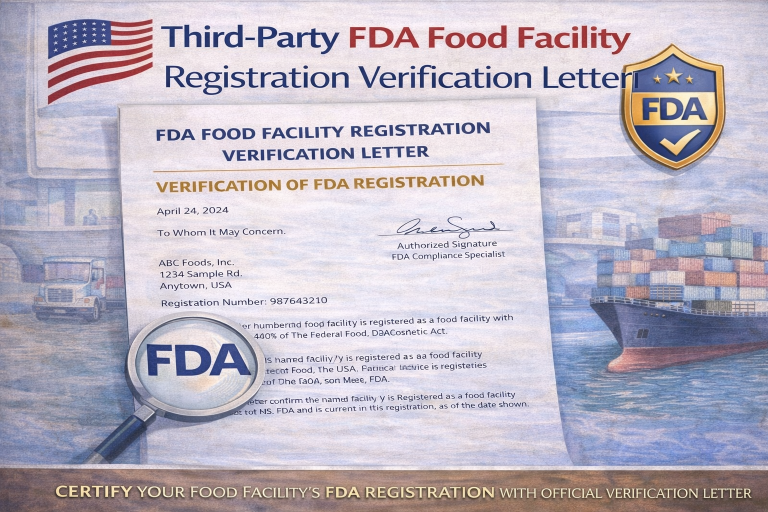
Third-Party FDA Food Facility Registration Verification Letter
This guide explains exactly why FDA doesn't issue certificates, what a proper verification letter must contain, who requests them, how Amazon and retailer compliance programs use them, and why the biennial renewal status is the most important field in the letter.
Why FDA Doesn't Issue Certificates — and What It Does Instead
Many food companies come from regulatory environments — the EU, China, Southeast Asia — where domestic health authorities issue formal product approval certificates or facility registration certificates. The U.S. FDA system works differently. FDA Food Facility Registration is a database entry, not a credentialing process. The registration number itself is the credential.
When a facility completes registration through FDA's FURLS (Food Facility Registration) system, FDA assigns a 10-digit registration number and enters the facility into its database. FDA does not follow up with a certificate, confirmation letter, or formal document of any kind. The registration is simply active in the system.
The verification letter supplements the public database by providing a signed, dated attestation from the regulatory firm or U.S. Agent that managed the registration — confirming that the registration is active, correctly entered, and currently renewed. This is the document that Amazon, importers, retailers, and distributors accept in lieu of an FDA-issued certificate that doesn't exist.
What a Proper FDA Verification Letter Must Include
A verification letter that is missing key fields will be rejected by Amazon's compliance program, importers, or retailers. Every field in the table below has a specific compliance purpose:
| Field | Why It Matters |
|---|---|
| Registered facility legal name | Must match the name in FDA's FURLS database exactly. Discrepancies between the letter and the FURLS record cause rejection during cross-referencing. |
| Complete facility address | Must match the registered address. Foreign facilities with multiple addresses must use the address on file with FDA — not a different branch or mailing address. |
| 10-digit FDA registration number | The primary identifier. Partners use this to look up the facility directly in FURLS to independently confirm the letter's accuracy. |
| Registration status — Active or Expired | An expired registration invalidates the letter entirely. The status must reflect the current FURLS database status, not a historical registration date. |
| Biennial renewal status and next renewal window | Food Facility Registration renews every 2 years (October–December of even-numbered years). Letters that don't confirm renewal currency are treated as stale by sophisticated compliance programs. |
| FDA activity codes | Confirms what the facility does — Manufacture, Process, Pack, or Hold. Activity codes must match the facility's actual operations or the registration is technically incomplete. |
| U.S. Agent name and contact information | Required for foreign facilities. Importers and Amazon often cross-reference the U.S. Agent information as part of FSVP supplier verification. The U.S. Agent must be current — a U.S. Agent that is no longer serving the facility creates a compliance gap. |
| Date of verification | Shows when the status was last confirmed against FURLS. Undated letters or letters more than 12 months old may not be accepted without re-verification. |
| Issuing firm name, signature, and contact | Third-party letters must clearly identify the issuing firm — not FDA. Self-issued letters from the registered facility itself are typically not accepted by Amazon or major retailers. |
Who Asks for FDA Verification Letters — and Why
Amazon & eCommerce Platforms
Amazon Seller Central requires food product sellers to submit FDA compliance documentation as part of its product compliance programs. Amazon accepts third-party verification letters from recognized regulatory consulting firms. Letters must confirm the manufacturing facility is registered and that the registration is currently renewed. An expired or outdated letter can result in product listing suspension.
U.S. Importers — FSVP Documentation
U.S. importers subject to FSVP requirements under 21 CFR Part 1 Subpart L must document their foreign suppliers' FDA compliance. A verification letter from the foreign supplier's U.S. Agent or regulatory firm is one way to document supplier FDA registration as part of the FSVP supplier verification record. During FDA inspections, FSVP records with verification letters demonstrate proactive supplier compliance documentation.
Retailers — Supplier Onboarding
Major U.S. grocery retailers — Whole Foods Market, Walmart, Target, Kroger, Sprouts, Trader Joe's, Costco — have supplier compliance programs requiring FDA registration documentation before approving new food brands. Verification letters provide the signed documentation these programs require. Requirements vary by retailer but a properly formatted letter from the U.S. Agent is generally accepted across all major retail compliance portals.
Distributors & Co-Packers
Food distributors, brokers, and co-packing operations often require FDA registration verification before accepting a new supplier or brand. This is particularly true for distributors that supply national retail chains and must demonstrate their supplier compliance to their retail customers. A verification letter from the U.S. Agent provides the documentation distributors need.
Private Label & Contract Manufacturers
Contract manufacturers producing private label food products for U.S. brands require FDA registration documentation as part of their own compliance obligations. Before accepting a new production run, contract manufacturers may request verification that the brand's facility (or their own co-manufacturing facility) is properly FDA-registered for the product categories involved.
Banks & Trade Finance
Letters of credit and trade finance instruments for food imports sometimes require FDA compliance documentation as a condition of payment. Export credit agencies and international trade finance providers may request verification of FDA registration as part of compliance due diligence for food export transactions. A verification letter from the U.S. Agent provides the documentation needed for these financial instruments.
Why Biennial Renewal Status Is the Most Important Field in the Letter
The most common reason a verification letter fails to satisfy a compliance program is not a missing field — it's an expired registration. FDA Food Facility Registration expires if not renewed during the Biennial Renewal window (October 1 – December 31 of every even-numbered year). An expired registration is not active. A verification letter based on an expired registration is not valid documentation — it is worse than useless because it suggests compliance where none exists.
What "Active" Means
An active registration means the facility completed its most recent biennial renewal during the applicable October–December window. The registration is in FDA's FURLS database as active, the U.S. Agent is current, and the facility is legally permitted to export food to the United States. A verification letter for an active registration is valid documentation.
What "Expired" Means
An expired registration means the facility missed its biennial renewal window. The registration is listed as expired in FURLS. Exporting food from a facility with an expired registration is a prohibited act under 21 U.S.C. § 331. A verification letter cannot be issued for an expired registration — the registration must be re-activated first. Sophisticated compliance programs at Amazon and major retailers cross-reference the FURLS database to confirm letter accuracy.
This is why verification letters from the managing U.S. Agent are more reliable than letters from unrelated parties — the U.S. Agent tracks renewal schedules, knows when the next renewal window opens, and can immediately confirm whether the registration is currently active. FDA Registration Assistance notifies all registered facilities in advance of biennial renewal windows and manages renewals automatically as part of the complete Food Facility Registration service.
Need an FDA Food Facility Registration Verification Letter?
FDA Registration Assistance issues professionally formatted verification letters based on confirmed, current registration data — accepted by Amazon, importers, retailers, and distributor compliance programs. For facilities not yet registered, we complete the Food Facility Registration first and issue the verification letter once the registration is active in FDA's FURLS system.
Contact us at info@fdaregistrationassistance.com or call +1 (928) 275-8333. 1,000+ clients. 135+ countries. 15+ years of FDA regulatory experience.
Frequently Asked Questions — FDA Food Facility Registration Verification Letters
1. Does the FDA issue an official registration certificate for Food Facility Registration?
No. FDA does not issue official certificates or letters for Food Facility Registration. The result of completing FDA registration is an active registration number in FDA's FURLS database — not a certificate. The registration number is the credential, and anyone can verify it at accessdata.fda.gov. Third-party verification letters from regulatory firms are the industry-standard way to document FDA registration for business compliance purposes.
2. What is a third-party FDA Food Facility Registration verification letter?
A signed document issued by a regulatory consulting firm or U.S. Agent confirming a facility's active FDA registration status. It is not issued by FDA — it is issued by the firm that manages or has verified the registration. It documents the registration number, active status, biennial renewal currency, and U.S. Agent information in a format accepted by Amazon, importers, retailers, and distributors.
3. Why do companies need an FDA verification letter?
Many business partners require signed proof of FDA registration before completing supplier onboarding or accepting shipments. Requestors include Amazon and eCommerce platforms; U.S. importers for FSVP records; grocery retailers (Whole Foods, Walmart, Target, Kroger, Sprouts); distributors and co-packers; and customs brokers for import documentation.
4. Is an FDA verification letter required for Amazon food sellers?
Yes, in most cases. Amazon Seller Central requires food sellers to submit FDA compliance documentation. Amazon accepts third-party verification letters from recognized regulatory firms confirming that the manufacturing facility is registered with FDA and that the registration is current. Expired or outdated verification documentation can result in product listing suspension.
5. What information must a proper FDA verification letter contain?
A proper letter must include: registered facility legal name (exactly as in FURLS); complete facility address; 10-digit FDA registration number; active/expired registration status; biennial renewal status and next renewal window; FDA activity codes; U.S. Agent name and contact (for foreign facilities); date of verification; and issuing firm name and signature. Missing any of these fields risks rejection.
6. Can I verify my FDA registration status myself without a letter?
Yes. FDA's public FURLS database at accessdata.fda.gov allows anyone to search for a facility's registration by number, name, or address. However, most business compliance programs require a signed letter rather than a database screenshot. The FURLS lookup serves as independent confirmation that the letter's information is accurate.
7. Why is biennial renewal status important in a verification letter?
An expired registration invalidates the letter entirely. FDA Food Facility Registration must be renewed every two years — October 1 through December 31 of even-numbered years. Sophisticated compliance programs at Amazon and major retailers cross-reference FURLS to confirm registration is currently active. A verification letter from the managing U.S. Agent provides assurance that renewals are being tracked.
8. What is the FDA registration number format?
FDA Food Facility Registration numbers are 10-digit numbers assigned by FDA through the FURLS system. The registration number is the primary facility identifier, must appear in every FDA Prior Notice filing, and is referenced in all verification letters. It is the number compliance partners use to independently verify registration status in FDA's public database.
9. Can a food company issue its own verification letter?
A company can issue its own letter but self-issued letters are typically not accepted by Amazon, importers, or retailers. The value of a third-party letter comes from the issuing firm's independence and direct access to registration data. Most compliance programs explicitly require third-party issued documentation — not self-attestation.
10. Who can legitimately issue an FDA verification letter?
The U.S. Agent designated for the facility's FDA registration, or the regulatory consulting firm that manages the registration. These parties have direct access to the registration record, track biennial renewal schedules, and can confirm current active status from FURLS. Letters from unrelated third parties with no connection to the registration carry no independent basis for attestation.
11. How does an FDA verification letter differ from the registration number itself?
The registration number is the digital credential — a number in FDA's database anyone can look up. The verification letter is a human-readable signed document confirming the number is active, correctly assigned, and currently renewed. Some compliance programs accept the registration number alone; others require a signed letter. Letters are particularly important when FURLS has not yet updated to reflect a recent registration or renewal.
12. Is an FDA verification letter the same as an FDA certificate of registration?
No — and the distinction matters. An FDA certificate of registration does not exist. A properly formatted verification letter states clearly that it is issued by the regulatory firm, not by FDA, and references the registration number that can be independently verified in FURLS. Describing a verification letter as an "FDA certificate" or "FDA-issued document" is inaccurate and potentially fraudulent.
13. Do importers need FDA verification letters from their foreign suppliers?
Often yes. U.S. importers subject to FSVP requirements under 21 CFR Part 1 Subpart L must document foreign supplier FDA compliance as part of supplier verification. A verification letter from the foreign supplier's U.S. Agent confirms the supplier is FDA-registered and actively maintained — contributing to a complete FSVP documentation package during FDA inspections.
14. Do retailers and distributors require FDA verification letters?
Many major U.S. retailers have supplier compliance systems requiring FDA registration documentation before approving new food suppliers — including Whole Foods Market, Walmart, Target, Kroger, and Sprouts. Food brands seeking retail placement must typically provide FDA registration documentation, and a signed verification letter is the standard accepted format across most retail compliance portals.
15. How does an FDA verification letter support FSVP documentation?
A verification letter from the foreign supplier's U.S. Agent confirming active FDA registration is one component of FSVP supplier verification documentation. Combined with other verification activities (audit results, certificates of analysis, supplier questionnaires), it contributes to a complete FSVP record demonstrating ongoing supplier compliance monitoring.
16. What happens if the verification letter contains incorrect information?
A letter with incorrect information — wrong registration number, wrong facility name, expired status — will be rejected by Amazon, importers, or retailers. Beyond rejection, inaccurate documentation creates compliance risk in FSVP records. FDA Registration Assistance issues letters based on confirmed, current FURLS data — not estimates or self-reported facility information.
17. How quickly can FDA Registration Assistance provide a verification letter?
For facilities registered through FDA Registration Assistance, verification letters are typically issued the same business day or within 24 hours. For facilities not currently managed by FDA Registration Assistance, status is first confirmed through FURLS, which may take an additional 24–48 hours before the letter is issued.
18. Can a verification letter be used if the registration has expired?
No. A verification letter cannot be issued for an expired registration — the registration must first be re-activated through the FURLS system. Food Facility Registration expires if the facility misses the biennial renewal window (October 1 – December 31 of even-numbered years). FDA Registration Assistance manages all renewals to prevent expiration and issues updated letters following each renewal.
19. Does FDA Registration Assistance provide verification letters for facilities registered by other companies?
Yes. FDA Registration Assistance can confirm active status for any facility using FDA's public FURLS database and issue a verification letter based on confirmed status. For facilities not currently managed by FDA Registration Assistance, the firm can also take over U.S. Agent and registration management, providing ongoing verification letter support as part of a full compliance service.
20. Is the FDA FURLS database always current?
Generally yes, but brief processing delays occur following new registrations, renewals, or updates. A freshly submitted registration or renewal may not appear in FURLS immediately. In these cases, a verification letter from the managing U.S. Agent — based on submission confirmation — documents registration status while FURLS processes the update. This is particularly relevant in the weeks following the biennial renewal window each December.
21. What is different about a verification letter for a foreign vs. domestic facility?
For domestic U.S. facilities, the letter confirms facility name, address, registration number, activity codes, and renewal status. For foreign facilities, it also confirms the U.S. Agent name and contact information — because U.S. Agent designation is a required element of foreign facility registration under 21 CFR Part 1. Importers and Amazon specifically require confirmation of the current U.S. Agent for foreign supplier verification.
22. Can Amazon deactivate a food listing if the verification letter is outdated?
Yes. Amazon's compliance programs are ongoing and may request updated FDA documentation at any time, particularly around the biennial renewal window. Sellers with expired registrations or outdated verification documentation risk product listing suspension. FDA Registration Assistance manages biennial renewals and provides updated verification letters following each renewal to ensure continuous Amazon compliance.
23. Is a verification letter required for FDA Prior Notice?
No. FDA Prior Notice requires the facility's active registration number in the filing — not a verification letter. The verification letter is a business compliance document for partner and platform documentation. It is separate from the regulatory filings FDA requires for importing food into the United States.
24. What happens for facilities not yet registered that need a verification letter?
FDA Registration Assistance first completes the Food Facility Registration — typically within 24–48 hours — and then issues the verification letter once the registration is active in FURLS. Registration, U.S. Agent designation, DUNS Number procurement, and the verification letter are all handled as a single integrated process.
25. How do I request an FDA Food Facility Registration verification letter?
Contact FDA Registration Assistance at info@fdaregistrationassistance.com or call +1 (928) 275-8333. Provide your facility name, FDA registration number if already registered, and the name of the organization requesting the letter. FDA Registration Assistance will confirm active status and issue the letter — typically within one business day for registered facilities.