How to Register an FDA Food Facility
The steps at a glance — and where to get the complete food facility registration guide.
Key Takeaways
- The steps — DUNS → FURLS account → facility info → U.S. Agent (foreign) → submit → number.
- Free — $0 FDA fee; DUNS is also free.
- A number, not a certificate — beware fake "FDA certificates."
- Foreign facilities add a U.S. Agent; otherwise the steps are the same.
- Renew biennially (even years, Oct–Dec) — it's ongoing.
- Registration ≠ approval. Full detail in the registration guide.
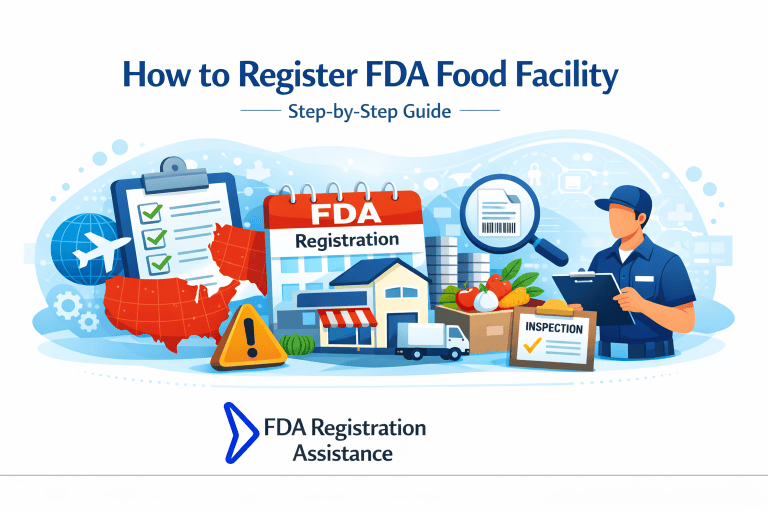
How to Register, at a Glance
- Get a DUNS number. Free from Dun & Bradstreet; must match your facility name/address exactly. Often the slowest step — start early.
- Create an FURLS account. At access.fda.gov — see what FURLS is.
- Enter your facility information. In the Food Facility Registration Module (name/address, owner/operator, activity, product categories, emergency contact) — see documents needed.
- Designate a U.S. Agent if your facility is foreign — see U.S. Agent.
- Submit & receive your number. FDA issues a registration number (not a certificate), then you renew biennially.
The Full Guide & Related Pages
Register Your Food Facility
FDA Registration Assistance completes your food facility registration end-to-end — obtaining or verifying your DUNS, setting up the FURLS registration, serving as your U.S. Agent for foreign facilities, and managing biennial renewals — with our service fee kept separate from the $0 government fee, and clear that FDA issues a number (not a certificate) and that registration isn't approval. Start with the full registration guide.
Contact us at info@fdaregistrationassistance.com or call +1 (928) 275-8333. An independent compliance firm serving 1,000+ companies across 135+ countries, with 15+ years of experience.
Frequently Asked Questions — Registering a Food Facility
1. How do I register a food facility with FDA?
In short: (1) obtain a DUNS number (free, from Dun & Bradstreet) as your unique facility identifier; (2) create an FDA Industry Systems (FURLS) account; (3) enter your facility information in the Food Facility Registration Module; (4) designate a U.S. Agent if your facility is foreign; and (5) submit to receive your FDA registration number. Registration is free from FDA. For the full walkthrough, fee details, and 2026 renewal, see our food facility registration guide.
2. How much does it cost to register a food facility?
The FDA fee is $0 - food facility registration, updates, biennial renewal, and cancellation are all free. Obtaining a DUNS number is also free. The only cost is a service fee if you have a firm handle it for you. Be cautious of anyone charging a "government fee" for this free registration. See our food facility registration guide for the full cost breakdown.
3. Do I need a DUNS number to register?
Yes - FDA requires a DUNS number as the Unique Facility Identifier for food facility registration. It's free from Dun & Bradstreet, but it must match your registering facility's name and address exactly, and it can take time to obtain if you don't already have one. Getting the DUNS is often the first (and slowest) step, so start it early. See our food facility registration guide.
4. Where do I actually register?
Through FDA Industry Systems (FURLS) - specifically the Food Facility Registration Module - at access.fda.gov. You create an account, then complete your facility's registration there. It's done entirely online; there's no paper form or in-person step required. See our FURLS explainer for how the system works, and our food facility registration guide for the registration itself.
5. Does a foreign facility register the same way?
Yes, with one addition: a foreign food facility must designate a U.S. Agent as part of its registration. The steps are otherwise the same (DUNS, FURLS account, facility info, submit). You don't travel to the U.S. - it's all done online, and a firm like ours can complete it and serve as your U.S. Agent together. See our U.S. Agent page and food facility registration guide.
6. What do I receive after registering?
An FDA registration number - not a certificate. FDA doesn't issue an official "registration certificate," so your number in FDA's system is the genuine proof. Be wary of anyone selling an "FDA registration certificate." Once registered, your facility is in FDA's system and you can operate/import (subject to your product also being compliant). See our registration guide and verification page.
7. How long does registration take?
The registration submission itself is quick once you have a valid DUNS and your facility details ready. The main thing that adds time is obtaining a DUNS if you don't have one. We won't quote a fixed "FDA turnaround," because the DUNS step varies, but the registration is completed promptly when you're ready. See our food facility registration guide for what to prepare.
8. What information do I need to register?
Typically: your facility name and physical address (matching your DUNS), the owner/operator details, the type of activity and food product categories, an emergency contact, your DUNS number, and (for foreign facilities) the U.S. Agent. Our documents-needed page lists exactly what to gather so the registration goes smoothly the first time.
9. Do I have to renew, and how?
Yes - food facility registration renews every two years (biennially), during October 1-December 31 of each even-numbered year (2026 is a renewal year). You renew in the same FURLS account. Missing the window means your registration expires. So registration is ongoing, not one-time. See our food facility registration guide for the renewal detail.
10. Do I register my food products too?
No - you register the facility, not individual food products. FDA doesn't register or approve most food products; instead, your product must be compliant (labeling, ingredients, no illegal claims). A few narrow categories (like low-acid canned/acidified foods) have extra product/process filings, but there's no general food-product registration. See our food product registration explainer.
11. Does registering mean my food is FDA-approved?
No. Registration is administrative - it puts your facility in FDA's system so you can operate/import. It is not FDA "approval," and FDA doesn't approve food. So being registered means registered, not approved. Using "FDA approved" or "FDA registered" as a marketing badge that implies approval is misleading. See our what-is-FDA-registration explainer.
12. Can I register the facility myself?
Yes - because it's free and done online, a straightforward domestic facility can self-register. A firm earns its fee on the harder parts: obtaining/matching a DUNS, serving as U.S. Agent for a foreign facility, keeping renewals on track, or registering multiple facilities. If your situation is simple, you may not need help; if it's not, that's where a service saves time. See our food facility registration guide.
13. What if my facility details change after registering?
You must update your registration when key information changes (address, owner/operator, U.S. Agent, etc.) - updates are free and made in your FURLS account. Keeping the registration accurate matters, because an outdated record (or a DUNS mismatch) can cause problems at renewal or import. We can manage updates as part of maintaining your registration.
14. Is "food facility registration" the same as "FDA establishment registration"?
Food facility registration is the food-program version of FDA establishment registration. Drug, device, and cosmetic programs each have their own registration with different rules and fees. So "how to register an FDA food facility" is specifically the food process; our establishment registration overview compares it with the other programs. See our food facility registration guide for food specifics.
15. Where's the full step-by-step guide?
See our food facility registration fee and cost guide - it's the complete resource, covering the steps, the $0 FDA fee, DUNS, the U.S. Agent requirement, the 2026 biennial renewal, and the number-not-certificate point. This page is a short overview of how to register; that guide has the full detail.
16. How does FDA Registration Assistance help me register?
We complete your food facility registration end-to-end: obtaining or verifying your DUNS, setting up the FURLS registration, serving as your U.S. Agent for foreign facilities, and managing biennial renewals - keeping our service fee separate from the $0 government fee and being clear that FDA issues a number (not a certificate) and that registration isn't approval. We're an independent compliance firm serving 1,000+ companies across 135+ countries with 15+ years of experience. Contact info@fdaregistrationassistance.com or +1 (928) 275-8333, or start with our food facility registration guide.