
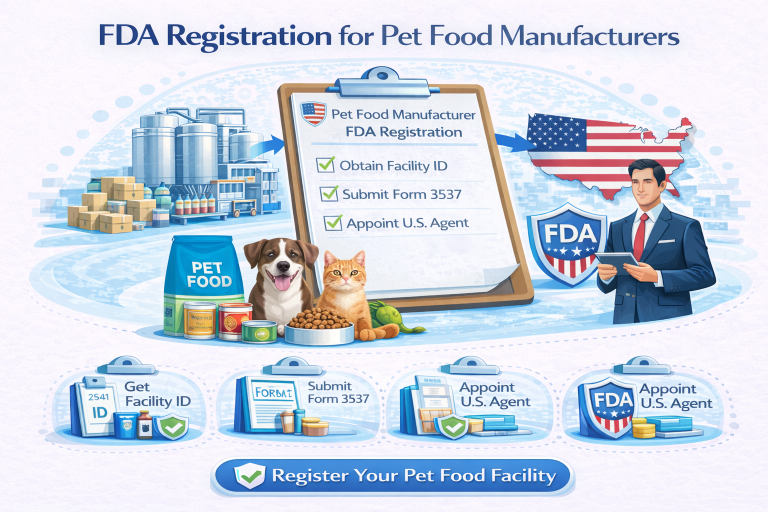
FDA Registration for Pet Food Manufacturers
This guide covers every FDA requirement for pet food manufacturers and importers — facility registration, Preventive Controls for Animal Food, low-acid canned food rules for wet food, labeling and ingredient standards, "complete and balanced" and "human grade" claims, Salmonella hazards, Prior Notice, and the U.S. Agent requirement.
Key Takeaways
- Pet food is regulated as animal food. Facilities must complete FDA Food Facility Registration, renew it biennially, and — if foreign — designate a U.S. Agent.
- By law, pet food must be safe, made under sanitary conditions, free of harmful substances, and truthfully labeled.
- Preventive Controls for Animal Food (21 CFR Part 507) requires CGMPs plus a hazard analysis and risk-based preventive controls in a written food safety plan.
- Canned and wet pet food must also meet the low-acid canned food rules (21 CFR Part 113) — including establishment registration and scheduled process filing.
- Ingredients must be approved additives, GRAS, or AAFCO-defined; "complete and balanced" and "human grade" claims have specific requirements, and disease claims can make a product an unapproved animal drug.
- Salmonella is a leading cause of pet food recalls — raw and freeze-dried products get the most scrutiny.
- FDA charges $0 to register; complete service is $858.
Pet Food Categories & Their Key FDA Requirements
Every pet food facility shares the same core registration and preventive-controls framework, but specific processing types trigger added requirements. FDA also regulates ingredients: many common ones (meat, poultry, grains) need no pre-approval, while additives, vitamins, minerals, and preservatives must be GRAS (21 CFR 582/584) or approved food additives (21 CFR 570/571/573).
| Pet Food Type | Reference | Key Added Requirements |
|---|---|---|
| Dry / Extruded | 21 CFR 507 | Food Facility Registration plus Preventive Controls for Animal Food — CGMPs, hazard analysis, and process/sanitation controls, with Salmonella a key hazard. |
| Wet / Canned | 21 CFR 113 | Must meet low-acid canned food (LACF) regulations: register the establishment (Food Canning Establishment number) and file scheduled processes. Acidified foods fall under 21 CFR 114. |
| Raw / Freeze-Dried | 21 CFR 507 | Highest pathogen scrutiny (Salmonella, Listeria) because there is no full cook step. Robust, validated preventive controls and handling instructions are expected. |
| Treats & Chews | 21 CFR 507 | Same animal-food rules; a frequent source of Salmonella recalls, so sanitation and pathogen controls are critical. |
| Nutritional Supplements | 21 CFR 570+ | Ingredients must be approved additives, GRAS, or AAFCO-defined. Nutrient and wellness claims must be truthful; disease claims are not permitted. |
| Medicated / Functional | Animal drug rules | Products that treat or prevent disease, or contain an animal drug, fall outside the food framework and are regulated as animal drugs / medicated feed with separate requirements. |
Pet Food Labeling Is Regulated at Two Levels
Pet food labeling is enforced by both FDA (federal) and state feed-control officials (whose rules are usually based on the AAFCO model). Note that AAFCO has no legal authority of its own — it publishes model regulations and ingredient definitions that states adopt and enforce.
FDA Federal Requirements
Proper identification of the product; a net quantity statement; the name and place of business of the manufacturer or distributor; and a listing of all ingredients from most to least by weight. All label text must be truthful and not misleading.
State / AAFCO-Based Requirements
Most states add a guaranteed analysis (minimum protein and fat, maximum fiber and moisture), a nutritional adequacy statement, and feeding directions. Requirements vary by state, so labels are often reviewed against the AAFCO model.
Claims That Carry Specific Requirements
"Complete & Balanced"
A nutritional adequacy claim meaning the product is a pet's sole diet. Must be substantiated by meeting an AAFCO nutrient profile or passing an AAFCO feeding trial.
"Human Grade"
A defined, hard-to-substantiate term: every ingredient and the finished product must be produced under human food rules (21 CFR Part 117), not just the animal food rules.
Disease / Health Claims
A claim to treat, prevent, or cure disease makes the product an unapproved animal drug. Nutrition and general wellness statements are allowed only if truthful and not misleading.
Preventive Controls & the Salmonella Problem
Under FSMA's Preventive Controls for Animal Food rule (21 CFR Part 507), most pet food facilities must follow CGMPs and, unless exempt, run a hazard analysis with risk-based preventive controls. The hazard that dominates the pet food category is Salmonella — one of the most common reasons pet foods and treats are recalled, and a risk to the people who handle the product as well as to pets.
Highest-Risk Products
Raw and freeze-dried foods, treats, and chews carry the most Salmonella and Listeria risk because they lack a full cook step. These categories need validated process controls, sanitation, and often environmental monitoring.
What a Food Safety Plan Covers
A written plan identifies hazards (biological, chemical, physical, and nutrient-related), defines preventive controls, and specifies monitoring, corrective actions, verification, and recordkeeping — prepared or overseen by a preventive controls qualified individual.
How to Register a Pet Food Facility with the FDA
The registration itself runs through FDA's FURLS system; the category-specific work happens alongside it. Here's the full path:
Confirm registration applies
Verify your facility manufactures, processes, packs, or holds pet food (animal food) for U.S. consumption. Both domestic and foreign facilities must register.
Obtain a DUNS Number
Procure or verify the DUNS Number FDA uses as the Unique Facility Identifier to confirm your facility's legal identity and location.
Designate a U.S. Agent (foreign facilities)
Foreign facilities must name a U.S. Agent physically present in the U.S. and reachable during business hours.
Submit Food Facility Registration
File through FURLS, selecting the correct animal food activities and product categories for your facility.
Address category-specific requirements
Establish a Part 507 food safety plan; for canned or wet food, complete low-acid canned food establishment registration and scheduled process filing; and confirm labeling and ingredient compliance.
Manage biennial renewal
Renew every even-numbered year (Oct 1–Dec 31) so the registration never lapses and shipments keep moving.
Ready to Export Pet Food to the United States?
FDA Registration Assistance provides Food Facility Registration for pet food facilities, U.S. Agent designation, pet food label review against FDA and AAFCO-based requirements, guidance on Preventive Controls for Animal Food and low-acid canned food filings, Prior Notice support, and Biennial Renewal management — for pet food companies worldwide.
Contact us at info@fdaregistrationassistance.com or call +1 (928) 275-8333. Trusted by pet food companies in 75+ countries. 15+ years of FDA regulatory experience.
Frequently Asked Questions — FDA Registration for Pet Food
1. Do pet food manufacturers need FDA registration?
Yes. Any facility that manufactures, processes, packs, or holds pet food for U.S. consumption must complete FDA Food Facility Registration under 21 CFR Part 1 before products can enter the market. Pet food is regulated as animal food. Foreign facilities must also designate a U.S. Agent, and registration renews every two years.
2. Is pet food regulated as food by the FDA?
Yes — as animal food under the FD&C Act. Like human food, it must be safe to eat, produced under sanitary conditions, contain no harmful substances, and be truthfully labeled. FDA does not approve pet food products before market, but the food and its ingredients must meet these standards.
3. What is FSMA Preventive Controls for Animal Food?
Codified at 21 CFR Part 507, it requires registered animal food facilities to follow CGMPs and, unless exempt, to run a hazard analysis with risk-based preventive controls in a written food safety plan. It is the animal-food counterpart to the human-food rule (21 CFR Part 117) and applies to most pet food manufacturers.
4. Does canned or wet pet food have extra requirements?
Yes. Canned and hermetically sealed low-acid pet foods must meet the low-acid canned food rules (21 CFR Part 113), which means registering the establishment (a Food Canning Establishment number) and filing scheduled processes with FDA. Acidified foods fall under 21 CFR Part 114. These are in addition to Food Facility Registration.
5. What are the FDA labeling requirements for pet food?
Labeling is regulated at two levels. FDA requires product identification, a net quantity statement, the manufacturer or distributor's name and address, and an ingredient list from most to least by weight. Many states add AAFCO-based elements — a guaranteed analysis, a nutritional adequacy statement, and feeding directions.
6. What must appear on a pet food label?
Federally: product identity, net quantity, manufacturer/distributor name and place of business, and ingredients in descending order by weight. State/AAFCO rules commonly add a guaranteed analysis, a nutritional adequacy statement (e.g., "complete and balanced"), and feeding directions. All claims must be truthful and not misleading.
7. What does "complete and balanced" mean?
It signals the product is intended as a pet's sole diet. Under AAFCO model rules adopted by many states, the claim must be substantiated by meeting an established AAFCO nutrient profile or by passing an AAFCO feeding trial. Using it without meeting one of those bases is misbranding.
8. Can pet food be labeled "human grade"?
Only with documentation. "Human grade" is an AAFCO-defined term requiring every ingredient and the finished product to be produced under human food rules (21 CFR Part 117) in a facility making human-edible food. Because most pet food is made under the animal food rules, the claim requires added human-food compliance.
9. Which ingredients are allowed in pet food?
Ingredients must be safe and functional. Many (meat, poultry, grains) need no pre-approval; others — minerals, vitamins, flavorings, preservatives, processing aids — must be GRAS (21 CFR 582/584) or approved food additives (21 CFR 570/571/573). Colorings must be approved. AAFCO-defined ingredients are widely used.
10. Can pet food make health or disease claims?
No. A claim to treat, prevent, or cure a disease makes the product an unapproved animal drug that can't be marketed without FDA approval. Truthful, non-misleading nutrition and wellness statements are acceptable. Medicated feeds and products containing animal drugs have separate requirements.
11. Is Salmonella a concern in pet food?
Yes — it's one of the most common reasons pet foods and treats are recalled, and it risks both animals and the people who handle the product. FDA scrutinizes raw and freeze-dried foods and treats especially. Preventive controls should specifically address Salmonella through validated process controls, sanitation, and monitoring.
12. Do raw or freeze-dried pet foods face extra scrutiny?
Yes. Without a full cook step, they carry higher Salmonella and Listeria risk and get close FDA attention. These products need robust, validated preventive controls, often carry handling instructions, and warrant a especially thorough hazard analysis under 21 CFR Part 507.
13. Do foreign pet food manufacturers need a U.S. Agent?
Yes. Every foreign facility that registers must designate a U.S. Agent — physically present in the U.S. and reachable during business hours, not a mailbox or answering service. Registration can't be completed without one.
14. Do domestic U.S. pet food facilities need to register?
Yes. Both domestic and foreign facilities handling pet food for U.S. consumption must register. Domestic facilities don't need a U.S. Agent (FDA can reach them directly) but must still register and renew biennially.
15. Do pet treat and chew manufacturers need FDA registration?
Yes. Treats, chews, and dental products are animal food, so their facilities must register. They're a frequent source of Salmonella recalls, so pathogen controls and sanitation matter especially here.
16. Do pet food warehouses need to register?
Generally yes, if they hold pet food for U.S. distribution. Facilities that manufacture, process, pack, or hold animal food are subject to registration, with limited exemptions. A review of the facility's activities confirms whether registration applies.
17. Do contract manufacturers and co-packers need to register?
Yes. Contract manufacturers and co-packers operate registered facilities. A brand owner without its own facility may not need to register, but the co-packer's registration doesn't cover every requirement — private-label and contract arrangements should be reviewed to confirm who registers.
18. Does FDA require Prior Notice for pet food imports?
Yes. Every shipment requires FDA Prior Notice under 21 CFR Part 1 Subpart I before arrival, referencing the manufacturer's active registration number. Without a registered facility, the importer can't submit Prior Notice and the shipment can be refused.
19. What FSVP requirements apply to pet food importers?
U.S. importers must maintain an FSVP for each foreign supplier under 21 CFR Part 1 Subpart L. The hazard analysis should address Salmonella (especially raw/freeze-dried), nutrient toxicities or deficiencies, and chemical and physical hazards, with verification commensurate with the hazards.
20. How often must pet food registration be renewed?
Every two years, during the biennial window from October 1 to December 31 of each even-numbered year. If a facility doesn't renew, the registration is considered expired and products can be refused at U.S. ports.
21. What happens if my facility is not registered?
Your importer can't submit Prior Notice, your shipment can be refused at the port, and your products can't be legally distributed in the U.S. An unregistered or expired facility effectively can't access the U.S. pet food market until registration is completed or restored.
22. How much does registration cost for a pet food manufacturer?
FDA charges $0 in government fees. FDA Registration Assistance charges $858 for the complete service — registration, DUNS Number procurement, U.S. Agent designation for foreign facilities, and Biennial Renewal management.
23. How long does FDA pet food registration take?
With the required information and a valid DUNS Number ready, registration can often be completed through FURLS within a few business days. It takes longer if a DUNS Number must first be obtained, details need correcting, or category-specific steps like low-acid canned food filings are involved.
24. Does AAFCO regulate pet food?
No. AAFCO has no legal authority of its own — it develops model regulations, ingredient definitions, and nutrient profiles that many states adopt and enforce. FDA regulates pet food federally as animal food, while state officials enforce state labeling laws based largely on the AAFCO model.
25. What animal food categories does registration cover?
Dog and cat food (dry, wet/canned, raw, freeze-dried), treats and chews, nutritional supplements, bird food, aquatic and reptile feed, horse and livestock feed, and exotic animal food — any product FDA regulates as animal food. Each shares the same core framework, with added rules for specific processing types.
26. How does FDA Registration Assistance help pet food manufacturers?
FDA Registration Assistance provides complete FDA compliance — Food Facility Registration ($858 complete service), U.S. Agent designation, pet food label review against FDA and AAFCO-based rules, guidance on Preventive Controls for Animal Food and low-acid canned food filings, Prior Notice support, and Biennial Renewal management — for pet food companies in 75+ countries.
27. How do I get started with FDA registration for my pet food?
Contact FDA Registration Assistance at info@fdaregistrationassistance.com or call +1 (928) 275-8333. Share your facility location, the pet food types you produce, and your DUNS Number if you have one, and your registration, U.S. Agent designation, and renewals are handled end to end. Complete service: $858.
