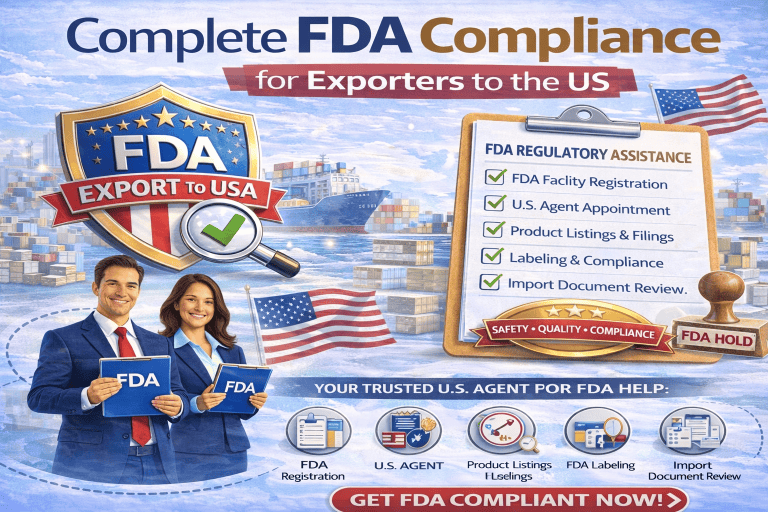
Complete FDA Compliance for Exporters to the United States
This guide explains the complete FDA compliance structure for foreign exporters across all regulated product categories — what each registration requires, the U.S. Agent obligation, Prior Notice for food shipments, U.S. labeling requirements, the renewal calendar, and the most common mistakes that cause import detentions.
The Complete FDA Compliance Matrix for Foreign Exporters
| Product Category | Registration Required | CFR Citation | Renewal Frequency | Additional Requirements |
|---|---|---|---|---|
| Food, beverages, dietary supplements, pet food | FDA Food Facility Registration + U.S. Agent | 21 CFR Part 1 Subpart H | Every 2 years (biennial) — Oct 1–Dec 31 of even years | Prior Notice before every shipment; LACF/acidified food: additional FCE + SID required; label compliance under 21 CFR Part 101 |
| Pharmaceuticals and drugs | Drug Establishment Registration + U.S. Agent + Drug Listing | 21 CFR Part 207 | Annually — Oct 1–Dec 31 every year | NDA/ANDA or OTC monograph compliance for drug approval; labeling per drug requirements; U.S. Agent active inspection facilitation role |
| Medical devices | Device Establishment Registration + U.S. Agent + Device Listing | 21 CFR Part 807 | Annually — Oct 1–Dec 31 every year | 510(k) clearance or PMA approval for applicable device classes; Quality System Regulation (21 CFR Part 820); U.S. Agent active inspection role |
| Cosmetics and personal care | MoCRA Facility Registration + U.S. Agent + Product Listing | MoCRA § 607 & § 608 of FD&C Act | Facility: annually Oct 1–Dec 31; Product listing update: Jul 1–Dec 31 | Serious adverse event reporting within 15 business days; safety substantiation; INCI ingredient names in product listing |
The U.S. Agent — Required for Every Foreign Facility in Every Product Category
Every foreign facility registered with FDA — food, drug, device, or cosmetics — must designate a U.S. Agent. This is the only compliance requirement that applies exclusively to foreign facilities (domestic facilities have no equivalent U.S. Agent obligation):
What the U.S. Agent Does
Receives FDA communications on behalf of the foreign facility — including inspection notices, Warning Letters, and Form 483 inspectional observations. For drug establishments (21 CFR 207.69) and device establishments (21 CFR 807.40), the U.S. Agent also actively assists FDA in scheduling inspections of the foreign facility. Listed in FDA’s registration database by name, U.S. address, phone, and email.
What Happens Without a Valid U.S. Agent
A foreign facility without a valid, active U.S. Agent has an incomplete FDA registration. FDA cannot communicate with the foreign facility through official channels. Shipments from facilities with invalid U.S. Agent designations may be detained at U.S. ports. Import Alerts can be placed on firms where FDA cannot reach the U.S. Agent. U.S. Agent information must be updated within 60 days of any change.
FDA Prior Notice — Required Before Every Food Shipment to the United States
Every foreign food exporter — regardless of product type, origin country, or shipment size — must ensure FDA Prior Notice is filed before each food shipment arrives at a U.S. port under 21 CFR Part 1 Subpart I:
🚢 Ocean Shipments
8 hours before arrival at the U.S. port. Most ocean food imports. Prior Notice must include the correct FDA facility registration number and the correct FDA product code for the food being shipped.
✈️ Air Shipments
4 hours before arrival for most air food imports. Air food cargo requires faster Prior Notice filing. Errors in Prior Notice filed this close to arrival have minimal time for correction.
🚚 Road Shipments
2 hours before arrival at the U.S. land border. Applies to food imports from Canada and Mexico by truck. Road Prior Notice has the shortest deadline and the most common filing errors.
Prior Notice is typically filed by the U.S. customs broker on the importer’s behalf — but the Prior Notice must include the foreign exporter’s FDA registration number. If the registration number is wrong or missing, FDA’s OASIS system will flag the shipment for detention. The foreign exporter bears indirect responsibility by ensuring its FDA registration number is accurate and current.
Why Home Country Labels Are Almost Never FDA-Compliant
One of the most common causes of food import detention for foreign exporters is a non-compliant product label. Home country labels are designed for home country regulatory requirements — which almost never satisfy U.S. FDA requirements:
What Home Country Food Labels Typically Get Wrong
✗ Wrong serving size — home country labels use home country serving sizes; U.S. requires the FDA RACC (Reference Amount Customarily Consumed) under 21 CFR Part 101.12
✗ Pre-2020 Nutrition Facts format — outdated format missing Added Sugars, Calories from Fat still listed
✗ Missing sesame allergen declaration — sesame is only a major allergen in the U.S. since January 2023; home country labels may not declare it
✗ No English text — all required label information must appear in English under 21 CFR Part 101.15
✗ No U.S. distributor name and address — required under 21 CFR Part 101.5 with qualification (“Imported by” or “Distributed by”)
What U.S. FDA Food Labels Must Include
✓ Statement of identity — common or usual name on the Principal Display Panel
✓ Net quantity — in both U.S. customary and metric units, in the lower 30% of PDP
✓ Nutrition Facts panel — 2020 FDA format; U.S. RACC serving size; Added Sugars mandatory; Calories in large bold type
✓ Ingredient list — descending order by weight; INCI names for cosmetics
✓ Allergen declarations — all 9: milk, eggs, fish, shellfish, tree nuts, peanuts, wheat, soybeans, sesame
✓ Manufacturer/distributor name and U.S. address — with “Imported by” qualification if needed
✓ English language — all required elements must appear in English
The FDA Registration Renewal Calendar for Foreign Exporters
Renewal frequencies differ by product category — missing any renewal results in automatic registration cancellation and blocked shipments:
Oct 1–Dec 31
Even-numbered years only
Oct 1–Dec 31
Every year without exception
Oct 1–Dec 31
Every year without exception
Product listing update: Jul 1–Dec 31
Every year
FDA Registration Assistance manages all renewal obligations for foreign exporter clients — tracking each product category’s renewal window and submitting renewals automatically.
7 FDA Compliance Mistakes That Get Foreign Exporters’ Shipments Detained
Ready to Export to the United States with Full FDA Compliance?
FDA Registration Assistance provides complete FDA compliance for foreign exporters across all product categories — Food Facility Registration, Drug Establishment Registration, Device Establishment Registration, MoCRA Cosmetics, U.S. Agent services, Prior Notice guidance, label review, import detention response, and renewal management. 1,000+ clients. 135+ countries. 15+ years of FDA regulatory experience.
Contact us at info@fdaregistrationassistance.com or call +1 (928) 275-8333.
Frequently Asked Questions — FDA Compliance for Exporters to the United States
1. What FDA compliance is required for foreign manufacturers exporting to the United States?
Depends on product category. Food manufacturers: Food Facility Registration under 21 CFR Part 1 Subpart H + U.S. Agent + Prior Notice. Drug manufacturers: Drug Establishment Registration under 21 CFR Part 207 + U.S. Agent + Drug Listing. Device manufacturers: Device Establishment Registration under 21 CFR Part 807 + U.S. Agent + Device Listing. Cosmetics manufacturers: MoCRA Facility Registration + U.S. Agent + Product Listing. All must comply with U.S. FDA labeling requirements — not home country labels.
2. Does the FDA treat foreign manufacturers the same as domestic manufacturers?
Yes. FDA applies the same registration, labeling, and safety compliance requirements to foreign manufacturers as to domestic U.S. manufacturers. There is no foreign company exemption. The only additional requirement for foreign facilities is the mandatory U.S. Agent designation — a domestic requirement that applies to foreign registrants only.
3. What is a U.S. Agent and why do foreign exporters need one?
A U.S. Agent is a person or company physically located in the United States designated by a foreign facility as FDA’s official domestic contact. The U.S. Agent receives FDA communications (inspection notices, Warning Letters, Form 483 observations) and assists FDA in scheduling inspections. Must be physically U.S.-located — a P.O. box alone is not sufficient. Required for all foreign facilities in all product categories. FDA Registration Assistance provides U.S. Agent services.
4. What is FDA Prior Notice and which foreign exporters must file it?
FDA Prior Notice under 21 CFR Part 1 Subpart I is required before every food import: 8 hours for ocean, 4 hours for air, 2 hours for road. Must include the foreign exporter’s correct FDA facility registration number and the correct FDA product code. Filed by the customs broker on the importer’s behalf — but errors in Prior Notice cause port holds that directly affect the exporter’s shipment.
5. What FDA registration is required for food exporters?
Food Facility Registration under 21 CFR Part 1 Subpart H: renewed every 2 years (biennial) — October 1–December 31 of even years. U.S. Agent required. For LACF (canned vegetables, soups, meats) and acidified foods (pickled products, salsa, hot sauce): additional FCE registration + SID filing required. See the FCE and SID guide.
6. What FDA registration is required for pharmaceutical exporters?
Drug Establishment Registration under 21 CFR Part 207: renewed annually — October 1–December 31 every year. U.S. Agent required with active inspection facilitation role. Drug Listing required for each marketed drug product. NDA, ANDA, or OTC monograph compliance required for the drug itself.
7. What FDA registration is required for medical device exporters?
Device Establishment Registration under 21 CFR Part 807: renewed annually — October 1–December 31 every year. U.S. Agent required with active inspection facilitation role. Device Listing required for each device. 510(k) clearance or PMA approval for applicable device classes. Quality System Regulation (21 CFR Part 820) compliance required.
8. What FDA requirements apply to cosmetic exporters?
MoCRA Facility Registration (Section 607 of FD&C Act): renewed annually October 1–December 31. Product Listing with INCI ingredient names: updated annually July 1–December 31. U.S. Agent required. Serious adverse event reports to FDA within 15 business days. Safety substantiation for all cosmetic products.
9. Do foreign exporters need FDA approval before selling in the United States?
FDA does not pre-approve most food, cosmetics, or dietary supplements. Registration is a compliance filing, not an approval. Drugs typically require NDA/ANDA or OTC monograph compliance (pre-market authorization). Medical devices may require 510(k) clearance or PMA approval depending on classification. Registration is necessary but not sufficient for full FDA compliance.
10. What happens when a foreign exporter’s shipment is detained at a U.S. port?
FDA issues a Notice of FDA Action (Form FDA 2535a) specifying the charge and response deadline. For food shipments, the response deadline is typically 10 working days under 21 CFR Part 1.94. If resolved: shipment released. If not: shipment refused — must be re-exported or destroyed. See the full import detention guide.
11. What is DWPE and how does it affect foreign exporters?
Detention Without Physical Examination means FDA automatically detains shipments without inspecting them — triggered by Import Alert listing, expired registration, or Prior Notice errors. Once on an Import Alert, every future shipment is automatically detained. Import Alert removal requires demonstrating the underlying compliance problem is corrected.
12. What are the labeling requirements for products exported to the United States?
All FDA-regulated products must comply with U.S. FDA labeling requirements — not home country requirements. For food: statement of identity, net quantity in U.S. and metric units, Nutrition Facts in 2020 FDA format with U.S. RACC serving size, ingredient list, allergen declarations for all nine FALCPA/FASTER Act allergens including sesame, manufacturer/distributor name and U.S. address, all required text in English.
13. What is the renewal calendar for foreign exporter FDA registrations?
Food Facility Registration: every 2 years (biennial) — October 1–December 31 of even years. Drug Establishment Registration: annually — October 1–December 31. Medical Device Establishment: annually — October 1–December 31. MoCRA Cosmetics facility: annually — October 1–December 31; product listing update: July 1–December 31. Missing any renewal = automatic cancellation.
14. Does a foreign exporter need to register separately for each product they export?
Facility registration covers the entire facility — not individual products. However, drug listings and device listings are separate filings covering individual products. For cosmetics, each product must be listed individually with INCI ingredient names. New product categories may require updates to existing facility registrations within 60 days under 21 CFR 1.234.
15. What is the most common reason foreign food exporters have shipments detained?
Most common: facility registration expired or never filed (OASIS flags automatically); Prior Notice not filed or contains errors including wrong FDA registration number; active Import Alert; missing FCE and SID for LACF or acidified foods (Import Alert 36-07 or 36-08); and labeling violations — misbranding from home country labels without English or required U.S. label elements.
16. Can foreign exporters register with FDA themselves without a compliance firm?
Yes — technically. But foreign exporters commonly make registration errors (wrong activity codes, missing U.S. Agent information, wrong entity registered) that cause import detentions just as effectively as failing to register. FDA Registration Assistance ensures registration is submitted correctly with right activity codes, food product categories, and active U.S. Agent designation — from initial registration through all renewals.
17. What is the difference between FDA registration and FDA approval for foreign exporters?
Registration means the facility is in FDA’s regulatory system as required by law — not product approval. FDA does not pre-approve food, dietary supplements, or cosmetics. Drugs require NDA/ANDA or OTC monograph compliance. Medical devices may require 510(k) or PMA. Registration is necessary but not sufficient for full FDA compliance.
18. Do foreign exporters need products tested by FDA-accredited laboratories?
No general pre-market testing requirement exists. However: FSVP (the U.S. importer’s obligation) may require supplier verification including product testing. Import Alert removal for contamination requires negative test results from FDA-accredited labs. Dietary supplement importers should have certificates of analysis. Some product categories have specific testing requirements in FDA regulations.
19. What is the FSVP requirement and how does it affect foreign exporters?
FSVP (Foreign Supplier Verification Program) is a U.S. importer obligation under 21 CFR Part 1 Subpart L — not a foreign exporter obligation. However, FSVP directly affects foreign exporters because U.S. buyers must conduct FSVP supplier verification activities. Foreign exporters may be asked to provide: current FDA facility registration documentation; third-party audit reports; product testing certificates of analysis. Foreign exporters who cannot provide FSVP documentation risk losing U.S. customer relationships.
20. What languages must foreign exporter product labels use for the U.S. market?
All required FDA label information must appear in English under 21 CFR Part 101.15. Bilingual labels are permitted — home country language plus English. Labels with only the home country language are non-compliant misbranding violations. FDA detains food shipments with labels lacking required English text.
21. Does a foreign exporter’s home country certification (CE mark, ISO, etc.) satisfy FDA requirements?
No. CE marks, ISO certifications, and home country food safety authority certifications do not substitute for FDA compliance. A medical device with CE mark still requires FDA 510(k) clearance or PMA approval for U.S. distribution. A food product certified by a home country authority still requires FDA facility registration and FDA-compliant labeling. U.S. FDA compliance is an independent regulatory framework.
22. What are the most common compliance mistakes foreign exporters make?
Assuming home country regulatory approval covers FDA compliance; not registering before first export shipment; missing the registration renewal deadline; using home country labels without English or U.S.-required elements; no U.S. Agent or inactive U.S. Agent; Prior Notice filed with wrong FDA registration number; no FCE and SID for LACF or acidified foods.
23. How long does FDA registration take for foreign exporters?
FDA Food Facility Registration is typically confirmed within 24–48 hours of proper submission through FURLS. Drug and device establishment registrations process similarly when submitted correctly. The registration itself is fast — errors or incomplete submissions cause delays. FDA Registration Assistance ensures registrations are submitted accurately and confirmed promptly.
24. How does FDA Registration Assistance help foreign exporters?
Complete FDA compliance for foreign exporters: Food Facility Registration, Drug Establishment Registration, Device Establishment Registration, MoCRA Cosmetics, U.S. Agent services, Prior Notice guidance, label review, import detention response, and renewal management. 1,000+ clients. 135+ countries. 15+ years.
25. How do I get started with FDA compliance for exporting to the United States?
Contact FDA Registration Assistance at info@fdaregistrationassistance.com or call +1 (928) 275-8333. Provide your company name, country of origin, product types, any existing FDA registration information, and any specific compliance concerns (prior detention, Import Alert, labeling questions). FDA Registration Assistance will assess your specific regulatory obligations and develop a complete FDA compliance program.