Do Baby Skincare Products Require FDA Registration?
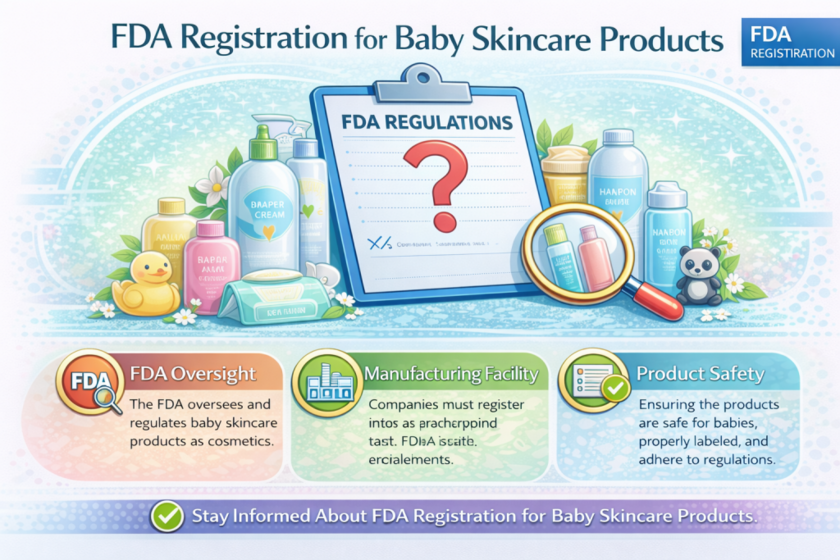
Baby skincare products sold in the United States are regulated by the FDA and are typically classified as cosmetics under the Modernization of Cosmetics Regulation Act (MoCRA). Products such as baby lotions, creams, oils, washes, and diaper rash protectants fall into this category when they are intended to cleanse, moisturize, or protect the skin without making therapeutic claims.
Although the FDA does not approve cosmetic products before they are marketed, companies must comply with MoCRA requirements, including facility registration, product listing, safety substantiation, labeling compliance, and adverse event reporting.
FDA Registration Assistance helps baby care brands meet all FDA requirements, ensuring their products are compliant and ready for distribution in the U.S. market.
When Baby Skincare Products Are Considered Cosmetics vs Drugs
Classification depends on the intended use and claims. Products such as baby lotions, oils, and gentle cleansers are typically regulated as cosmetics.
However, products marketed to treat or prevent conditions, such as diaper rash treatments, eczema relief, or medicated skin protectants, may be classified as over-the-counter drugs. These products must comply with FDA drug regulations, including drug establishment registration and Drug Facts labeling.
Proper classification is essential to avoid compliance issues and regulatory complications.
FDA Cosmetic Facility Registration for Baby Skincare Products
All facilities that manufacture or process baby skincare products must be registered with the FDA. This requirement applies to both domestic and foreign facilities.
Foreign manufacturers must appoint a U.S. Agent who serves as the official point of contact with the FDA. Facility registration must be renewed every two years to remain active.
Failure to register can result in shipment delays or refusal of entry into the United States.
FDA Product Listing Requirements for Baby Skincare Products
Each baby skincare product must be listed with the FDA. This includes every formulation and variation being sold in the U.S. market.
Product listing submissions must include the product name, ingredient list, manufacturer information, and product category. Accurate and complete submissions are essential to maintaining compliance.
Responsible Person Requirement
MoCRA requires every cosmetic product to have a designated Responsible Person. This entity is responsible for ensuring compliance with FDA regulations.
The Responsible Person must maintain safety documentation, ensure labeling accuracy, and manage adverse event reporting.
Safety Substantiation for Baby Skincare Products
Safety is especially critical for baby skincare products. Companies must maintain adequate safety substantiation demonstrating that their products are safe for use on infants.
This may include ingredient safety data, toxicological assessments, dermatological testing, and other supporting documentation. The FDA requires companies to have this information available if requested.
Adverse Event Reporting Requirements
Under MoCRA, companies must report serious adverse events associated with baby skincare products to the FDA within fifteen business days.
Companies must also maintain adverse event records for six years. Proper documentation and reporting are essential for compliance.
Labeling Requirements for Baby Skincare Products
Labels must comply with FDA cosmetic labeling requirements. This includes a complete ingredient declaration, net quantity of contents, and the name and address of the manufacturer or distributor.
Labels must not be misleading, especially when products are marketed for sensitive or infant use. Claims must accurately reflect the product’s intended cosmetic purpose.
Common Compliance Issues for Baby Skincare Brands
Many companies assume that baby products are exempt from FDA regulations, which is incorrect. Others fail to properly classify products, especially when therapeutic claims are involved.
Incomplete facility registration, missing product listings, and inadequate safety documentation are also common issues.
These mistakes can lead to shipment delays, import refusals, and regulatory action.
How FDA Registration Assistance Supports Baby Skincare Compliance
FDA Registration Assistance provides full-service support for companies manufacturing or selling baby skincare products. Services include FDA cosmetic facility registration, product listing, U.S. Agent and Responsible Person services, labeling review, and ongoing compliance support.
With experience supporting over 1,000 clients across more than 135 countries, FDA Registration Assistance ensures that your products meet all FDA requirements and are ready for the U.S. market.
Frequently Asked Questions (FAQ)
1. Do baby skincare products require FDA approval?
No. The FDA does not approve cosmetics, but compliance with MoCRA is required.
2. Are all baby skincare products considered cosmetics?
Not all. Products with therapeutic claims may be classified as drugs.
3. Do foreign manufacturers need FDA registration?
Yes. Foreign facilities must register and appoint a U.S. Agent.
4. What happens if I do not register my facility?
You may face shipment delays, import refusals, or enforcement actions.
5. Do I need to list each baby skincare product?
Yes. Each formulation must be listed with the FDA.
6. What is the Responsible Person requirement?
It requires designating an entity responsible for compliance and safety.
7. What is safety substantiation?
It is documentation proving that your product is safe for use.
8. Are natural baby products exempt from FDA rules?
No. All cosmetic products must comply regardless of claims.
9. What labeling requirements apply?
Labels must include ingredients, net quantity, and manufacturer details.
10. How are adverse events handled?
Serious adverse events must be reported within fifteen business days.
11. How often must facility registration be renewed?
Every two years.
12. Can baby skincare products be classified as drugs?
Yes. If they make treatment or prevention claims.
13. Can I sell baby skincare products online without compliance?
No. Non-compliant products may be restricted or removed.
14. How do I determine product classification?
It depends on intended use and marketing claims.
15. Can a compliance service handle everything for me?
Yes. A regulatory partner can manage the full process.
Ensure Your Baby Skincare Products Are Fully FDA Compliant
If you are manufacturing or selling baby skincare products in the United States, compliance with MoCRA is essential to avoid delays, import issues, and regulatory risks. FDA Registration Assistance provides a complete, end-to-end solution for FDA cosmetic compliance, including facility registration, product listing, U.S. Agent services, and ongoing support. Contact FDA Registration Assistance today to ensure your baby skincare products are fully compliant and ready for the U.S. market.