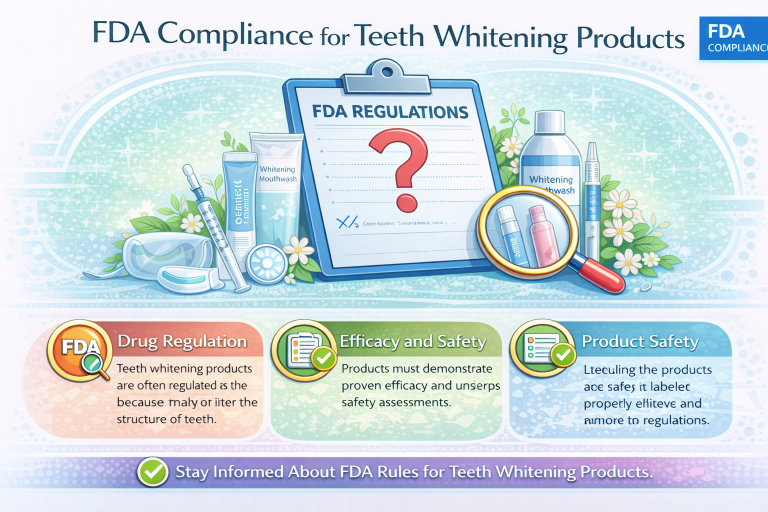
FDA Compliance for Teeth Whitening Products
This guide covers the full three-way classification decision for teeth whitening products, the specific claims that convert a cosmetic into a drug, the peroxide OTC monograph gap, LED device classification, MoCRA compliance costs, and the INCI labeling requirement most imported whitening brands miss.
Cosmetic, OTC Drug, or Medical Device — How FDA Classifies Teeth Whitening Products
Intended use — as expressed in labeling and marketing — determines everything. The same hydrogen peroxide gel can be a cosmetic or a drug depending entirely on the claims on the box. Here is the full classification map for every common whitening product type:
| Product Type | Classification | FDA Framework | Key Requirements |
|---|---|---|---|
| Whitening strips (appearance claims only) | Cosmetic | MoCRA | Facility registration $849/yr, product listing $200/product, INCI labeling, safety substantiation, CSCAR reporting |
| Whitening trays / gels (cosmetic claims) | Cosmetic | MoCRA | Facility registration, product listing, INCI labeling, safety substantiation |
| Whitening pens / paint-on gel | Cosmetic | MoCRA | Facility registration, product listing, INCI labeling |
| Whitening toothpaste (no fluoride, appearance claims) | Cosmetic | MoCRA / 21 CFR Part 701 | Facility registration, product listing, INCI labeling. Cosmetic ingredient list, not Drug Facts panel. |
| Whitening toothpaste with fluoride | Cosmetic + OTC Drug | MoCRA + 21 CFR Part 355 | Both MoCRA registration AND Drug Establishment Registration; Drug Facts panel required; drug listing in SPL format |
| Whitening product with drug claims | OTC Drug | 21 CFR Part 207 | Drug Establishment Registration, drug listing (SPL), Drug Facts labeling. Claims like "treats sensitivity," "kills bacteria," "remineralizes enamel" trigger this classification. |
| Professional-strength peroxide bleaching system | OTC Drug / Review Required | No final OTC monograph | No finalized FDA OTC bleaching monograph. Regulatory review required for high-concentration professional products. Individual analysis needed. |
| LED whitening device (therapeutic claims) | Medical Device | 21 CFR Part 807 | Device Establishment Registration, device listing, possible 510(k). Appearance-only LED accessories may not be medical devices — intended use determines this. |
| Chlorine dioxide whitening products | Special Review | FDA safety concerns | FDA has issued safety warnings about chlorine dioxide in whitening products. Thorough regulatory analysis required before U.S. distribution. |
The OTC Bleaching Monograph — What FDA Has (and Hasn't) Decided
This is the most important regulatory nuance in the teeth whitening category — and it is almost never explained clearly. FDA proposed an OTC monograph for tooth bleaching/whitening agents decades ago. That monograph was never finalized. This means there is no final FDA regulation specifying approved active ingredients, concentrations, or labeling requirements for OTC bleaching agents.
The practical implication: FDA has generally exercised enforcement discretion for low-concentration consumer OTC whitening products with hydrogen peroxide or carbamide peroxide and appearance-only claims. Most mainstream whitening strips and consumer gels have operated in this space without formal OTC monograph compliance because no final monograph exists.
However, this does not mean peroxide whitening products are unregulated. They remain subject to:
MoCRA (If Cosmetic Claims)
If marketed with appearance-only claims, the product is a cosmetic subject to MoCRA — facility registration, product listing, INCI labeling, safety substantiation, and CSCAR adverse event reporting. The absence of a finalized OTC bleaching monograph does not exempt the product from MoCRA.
Drug Classification (If Therapeutic Claims)
If the labeling includes any therapeutic claim, FDA's enforcement discretion for cosmetic whitening products does not apply. The product becomes an OTC drug requiring Drug Establishment Registration, drug listing, and Drug Facts labeling — regardless of the absence of a finalized monograph.
Professional Products — Higher Risk
Professional-strength bleaching products with higher peroxide concentrations are in a more ambiguous regulatory position. FDA has not finalized an OTC monograph covering these concentrations. Companies distributing professional-strength whitening systems in the United States should have their regulatory status individually evaluated.
Which Claims Make Your Whitening Product a Drug?
This is where most whitening brands get into compliance trouble. The formulation may be identical — the same hydrogen peroxide gel — but the label copy determines the regulatory category. Any claim that suggests the product treats, prevents, cures, or mitigates a disease or physiological condition converts a cosmetic whitening product into an OTC drug:
✓ Cosmetic Claims — Permitted
"Whitens teeth" · "Removes surface stains" · "Brightens your smile" · "Visibly whiter teeth in X days" · "Removes coffee and wine stains" · "Enamel-safe formula" · "Dentist recommended" · "For a whiter, brighter smile"
These describe cosmetic appearance effects. MoCRA applies.
✗ Drug Claims — Trigger OTC Drug Registration
"Treats tooth sensitivity" · "Kills bacteria" · "Fights gum disease" · "Remineralizes enamel" · "Prevents cavities" · "Strengthens enamel" · "Rebuilds tooth structure" · "Clinically proven to improve oral health" · "Anti-bacterial" · "Reduces plaque"
These describe physiological effects or treat/prevent disease. Drug Establishment Registration required.
Label copy for whitening products must be reviewed before printing. A single prohibited claim on an otherwise cosmetic product requires Drug Establishment Registration for the manufacturing facility, drug listing in SPL format, and a Drug Facts panel on the label. FDA Registration Assistance conducts label claims reviews for whitening brands before any regulatory filings are made.
MoCRA Requirements and Costs for Cosmetic Whitening Products
For teeth whitening products classified as cosmetics, the MoCRA framework applies in full. FDA charges $0 in government fees. FDA Registration Assistance charges:
Example: A whitening brand with one manufacturing facility and four products (strips, pen, tray gel, mouthwash) pays $849 + 4 × $200 = $1,649 in year one. Annual renewal thereafter: $849 + $200 per any new product added.
Full MoCRA Compliance Checklist for Cosmetic Whitening Brands
Annual Facility Registration
Every facility manufacturing or processing cosmetic whitening products for U.S. distribution must register annually through the Cosmetics Direct portal. Foreign facilities must designate a U.S. Agent. Annual renewal window: every year (unlike food facility biennial renewal).
Individual Product Listing
Each cosmetic whitening product must be listed individually with FDA. The listing includes the product name, category, responsible person, manufacturing facility registration number, and full ingredient list using INCI names. Listings must be updated when formulations change.
INCI Labeling
All cosmetic whitening product labels must use INCI (International Nomenclature of Cosmetic Ingredients) names for every ingredient under 21 CFR Part 701.3. "Hydrogen Peroxide," "Carbamide Peroxide," "Glycerin" — these are the correct INCI designations. Trade names, abbreviations, or common names are not compliant.
Safety Substantiation & CSCAR
Safety substantiation must document that the whitening product is safe at its intended use concentrations. Serious adverse events — significant gum irritation, chemical burns, allergic reactions — must be reported to FDA within 15 business days under CSCAR. Annual aggregate reports are also required.
Get Your Teeth Whitening Products Fully FDA-Compliant
FDA Registration Assistance provides classification review, MoCRA cosmetic facility registration ($849/year), product listing ($200/product), U.S. Agent designation, INCI label review, drug claims review, Drug Establishment Registration for OTC drug whitening products, and device registration consultation — for teeth whitening brands in 135+ countries.
Contact us at info@fdaregistrationassistance.com or call +1 (928) 275-8333. 1,000+ clients. 15+ years of FDA regulatory experience.
Frequently Asked Questions — FDA Compliance for Teeth Whitening Products
1. Are teeth whitening products regulated by the FDA?
Yes. All teeth whitening products sold in the United States are FDA-regulated. Most consumer whitening strips, pens, and gels with appearance-only claims are cosmetics under MoCRA. Whitening toothpastes with fluoride are OTC drug combination products. Products making therapeutic claims are OTC drugs. LED devices with therapeutic claims may be medical devices.
2. Is a teeth whitening product a cosmetic, OTC drug, or medical device?
Intended use as stated in labeling and marketing determines classification. Appearance-only claims → cosmetic (MoCRA). Therapeutic claims or drug active ingredients (fluoride) → OTC drug. Light/heat devices with therapeutic claims → medical device. Classification review before launch is essential — the same formulation becomes a different regulatory category based on label copy.
3. Do teeth whitening products with hydrogen peroxide require drug approval?
Not necessarily. FDA proposed but never finalized an OTC monograph for tooth bleaching agents. FDA has generally exercised enforcement discretion for low-concentration consumer whitening products with appearance-only claims. However, products with therapeutic claims or professional-strength concentrations require individual regulatory analysis. The absence of a finalized monograph does not mean products are unregulated — MoCRA applies to cosmetic whitening products regardless.
4. Does a whitening toothpaste with fluoride need Drug Establishment Registration?
Yes. Fluoride is an OTC drug active ingredient under the Anticaries Drug Products monograph at 21 CFR Part 355. A fluoride whitening toothpaste is a cosmetic/OTC drug combination product requiring Drug Establishment Registration, drug listing in SPL format, a Drug Facts panel, and MoCRA cosmetic facility registration. Both frameworks must be satisfied simultaneously.
5. What MoCRA requirements apply to cosmetic teeth whitening products?
Annual facility registration ($849/year through FDA Registration Assistance); individual product listing ($200/product); safety substantiation; serious adverse event reporting within 15 business days (CSCAR); and FDA-compliant labeling with INCI ingredient names. Foreign facilities must designate a U.S. Agent. FDA charges $0 in government fees.
6. What claims make a teeth whitening product a drug instead of a cosmetic?
Drug claims that reclassify a cosmetic whitening product: "treats tooth sensitivity," "kills bacteria," "fights gum disease," "remineralizes enamel," "prevents cavities," "strengthens enamel," "rebuilds tooth structure," "anti-bacterial," "reduces plaque." Permitted cosmetic claims: "whitens teeth," "removes surface stains," "brightens your smile," "enamel-safe," "dentist recommended."
7. Are LED whitening devices medical devices?
Depends on intended use and claims. An LED light accessory sold with appearance-only claims may not be a medical device. An LED device making therapeutic claims (treats sensitivity, kills oral bacteria, treats dental conditions) or using light energy intended to affect tooth structure is more likely a medical device requiring Device Establishment Registration and potentially 510(k) premarket notification.
8. Are chlorine dioxide whitening products safe to sell in the United States?
FDA has issued safety concerns about chlorine dioxide in teeth whitening products. Chlorine dioxide may raise drug or adulteration concerns depending on concentration and intended use. A thorough regulatory analysis of the ingredient's status is required before U.S. distribution. FDA has taken enforcement actions against products with unsupported safety claims involving chlorine dioxide.
9. What labeling is required on cosmetic teeth whitening products?
Under 21 CFR Part 701: product identity on the Principal Display Panel; net quantity; manufacturer/distributor name and address; complete ingredient list using INCI names in descending order; and required warnings. Labels must be in English. Non-INCI ingredient names are a labeling violation.
10. What labeling is required on OTC drug teeth whitening products?
OTC drug whitening products — including fluoride whitening toothpastes — must carry a Drug Facts panel under 21 CFR Part 201.66 with: active ingredient(s) and purpose; uses; warnings; directions; other information; and inactive ingredients. A cosmetic ingredient list is not a substitute for a Drug Facts panel.
11. What is INCI and why is it required for whitening products?
INCI — International Nomenclature of Cosmetic Ingredients — is the standardized naming system required for cosmetic ingredient declarations under 21 CFR Part 701.3. "Hydrogen Peroxide," "Carbamide Peroxide," "Glycerin" are the correct INCI designations. Trade names or common names for ingredients make the product misbranded.
12. What is the MoCRA adverse event reporting requirement for whitening products?
Under MoCRA CSCAR, serious adverse events from cosmetic whitening products — significant gum irritation, chemical burns, allergic reactions requiring medical intervention — must be reported to FDA within 15 business days. Annual aggregate safety reports are also required. This applies to all MoCRA cosmetic whitening products.
13. Do teeth whitening products need safety substantiation?
Yes. MoCRA requires the responsible person to maintain adequate evidence that each cosmetic whitening product is safe at its intended use concentrations under reasonably foreseeable conditions. For peroxide-based systems, safety substantiation should include documentation of concentration, exposure time, and clinical or consumer safety data. Records must be available to FDA upon request.
14. Is a teeth whitening product the same regulatory category in the EU and the U.S.?
No. The EU restricts hydrogen peroxide in whitening products above 0.1% to professional dispensing, with specific concentration limits for consumer use. The U.S. has no finalized OTC bleaching monograph and FDA has generally exercised enforcement discretion for consumer products with appearance-only claims. EU compliance does not substitute for FDA compliance. Both must be addressed independently.
15. Do professional-use teeth whitening products have different FDA requirements?
Professional-strength bleaching products with higher peroxide concentrations are in a more ambiguous regulatory position than consumer OTC products. There is no finalized FDA OTC bleaching monograph. Professional-use whitening systems are not exempt from FDA labeling, facility registration, or safety requirements and should have their regulatory status evaluated individually.
16. Can a teeth whitening product be both a cosmetic and a drug?
Yes. A fluoride whitening toothpaste is both a cosmetic (for the whitening function) and an OTC drug (for the fluoride anticaries function). It must comply simultaneously with MoCRA cosmetic requirements (facility registration, product listing, INCI labeling) and OTC drug requirements (Drug Establishment Registration, drug listing, Drug Facts panel).
17. What is the cost of MoCRA compliance for a teeth whitening brand?
FDA charges $0. FDA Registration Assistance charges $849/year for Cosmetic Facility Registration (including U.S. Agent and annual renewal) and $200 per product listing. Example: one facility, four products = $849 + 4 × $200 = $1,649 in year one. See the full MoCRA cost breakdown.
18. Do foreign teeth whitening manufacturers need a U.S. Agent?
Yes — potentially twice. Foreign facilities manufacturing cosmetic whitening products under MoCRA must designate a U.S. Agent for MoCRA registration. Foreign facilities manufacturing OTC drug whitening products (fluoride toothpaste) must designate a separate U.S. Agent for Drug Establishment Registration under 21 CFR Part 207.69. FDA Registration Assistance provides U.S. Agent services for both.
19. What are the most common FDA compliance failures for teeth whitening brands?
Most common: drug claims on cosmetic whitening labels without drug registration; non-INCI ingredient names on cosmetic labels; fluoride whitening toothpaste without Drug Facts labeling and drug registration; LED devices with therapeutic claims without device registration; not completing MoCRA facility registration or product listing before U.S. distribution; failing to report serious adverse events within 15 business days; and assuming EU compliance transfers to FDA.
20. What happens if a teeth whitening product is imported without proper FDA compliance?
Non-compliant whitening products can be detained or refused at U.S. ports of entry. Grounds for refusal include: unregistered manufacturing facility; misbranded product (wrong labeling format, non-INCI names, drug claims without drug registration); or adulterated product. FDA can also issue Warning Letters and seek injunctions against non-compliant cosmetic or drug manufacturers.
21. Are teeth whitening pens and strips subject to MoCRA?
Yes. Whitening pens and whitening strips marketed as cosmetics with appearance-only claims are subject to full MoCRA: facility registration ($849/year), individual product listing ($200/product), safety substantiation, adverse event reporting, and INCI-compliant labeling. Each distinct formulation requires its own product listing.
22. What is the responsible person under MoCRA for whitening products?
The responsible person is the manufacturer, packer, or distributor whose name appears on the cosmetic label under 21 CFR Part 701.12. For private label whitening brands, the brand owner whose name is on the label is typically the responsible person, accountable for MoCRA compliance including product listing, safety substantiation, and adverse event reporting.
23. Can whitening products make "enamel safe" or "dentist recommended" claims?
"Dentist recommended" is a testimonial claim — permitted if truthful and substantiated. "Enamel safe" is a safety-related claim — permitted if not misleading and substantiated. Neither alone converts a cosmetic product into a drug. However, "strengthens enamel," "rebuilds enamel," and "remineralizes enamel" describe physiological effects on tooth structure and are drug claims that trigger drug regulation.
24. How does FDA Registration Assistance help teeth whitening brands?
FDA Registration Assistance provides classification review, MoCRA facility registration ($849/year), product listing ($200/product), U.S. Agent designation, INCI labeling review, drug claims review, Drug Establishment Registration for OTC drug whitening products, and device registration consultation — for brands in 135+ countries. 1,000+ clients. 15+ years of experience.
25. How do I get started with FDA compliance for my teeth whitening products?
Contact FDA Registration Assistance at info@fdaregistrationassistance.com or call +1 (928) 275-8333. Provide your product descriptions, current labeling, active ingredients, and facility location. FDA Registration Assistance will classify your products, identify all applicable requirements, and handle every compliance step.