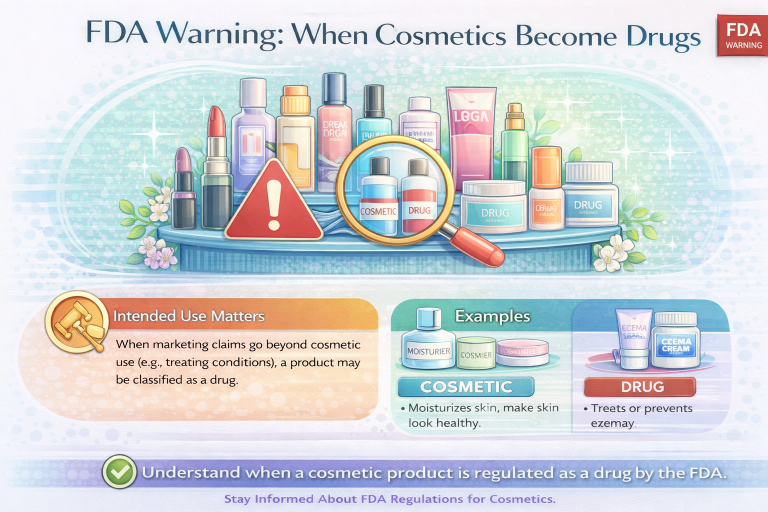
FDA Warning: When Cosmetics Become Drugs
The claims that reclassify a cosmetic as an unapproved drug, why FDA looks past your label, and the warning letters that follow — with how to stay on the cosmetic side.
Key Takeaways
- The claim reclassifies the product — treat/prevent, or affect structure/function = drug.
- An unchanged product can become a drug — it's the intended use, not the formula.
- FDA reads your whole website — not just the label; social and influencer posts count.
- The result is an unapproved new drug — misbranded, and a warning-letter magnet.
- Registration doesn't fix a drug claim — MoCRA won't legalize it.
- Stay cosmetic by claiming appearance — "reduces the appearance," not "stimulates collagen."
Structure/Function or Disease = Drug
A cosmetic is intended to cleanse or beautify. A drug is intended to diagnose, cure, mitigate, treat, or prevent disease, or to affect the structure or function of the body (FD&C §201(g)) — even if it also affects appearance. If a product makes that kind of claim and isn't recognized as safe and effective for it, it's an unapproved new drug (§201(p)) that needs an approved application (§505(a)) to be sold legally.
The Claims That Flip a Cosmetic Into a Drug
| Cosmetic-safe (appearance / cleansing) | Drug-triggering (treat / structure-function) |
|---|---|
| Reduces the appearance of wrinkles | Stimulates/boosts collagen; removes wrinkles |
| Improves the look of skin; adds radiance | Activates stem cells; boosts cell renewal / "youth proteins" |
| Brightens the look; evens the appearance of tone | Lightens skin; treats hyperpigmentation/melasma |
| Moisturizes; soothes the feel of skin | Treats acne, eczema, rosacea, psoriasis (any condition) |
| Cleanses; controls odor | Antibacterial / antimicrobial; "kills germs" |
| Conditions hair; adds shine | Treats dandruff; promotes hair/eyelash growth; hair restoration |
| Smooths the look of skin | Reduces cellulite / stretch marks; heals wounds/scars |
FDA Reads Your Whole Website — Not Just the Label
FDA determines a product's intended use from every consumer-facing communication, not only the package:
- Product labeling — the physical label and packaging
- Your website — product pages, ingredient stories, blog/FAQ copy
- Social media & influencers — posts, captions, briefs you commission
- Press releases & distributor/retail materials
What Happens — the Warning Letter & Beyond
- Unapproved new drug & misbranded — the legal status the claim creates
- FDA Warning Letter — published on FDA's site, requiring corrective action
- Import refusal / detention — for foreign products flagged at the border on their claims
- Seizure, injunction, marketplace removal — if unresolved
- FTC exposure — for unsubstantiated advertising claims, separately
The Same Line, Across Products
| Category | Cosmetic | Drug (flips it) |
|---|---|---|
| Anti-aging skincare | "Reduces the appearance of wrinkles" | "Boosts collagen" |
| Whitening/brightening | "Brightens the look" | "Lightens skin / treats dark spots" (hydroquinone) |
| Deodorant | "Controls odor" | "Reduces sweat" (antiperspirant) |
| Sunscreen / SPF | — | Always a drug |
| Hair / beard | "Adds shine, conditions" | "Promotes growth / treats dandruff" |
How to Keep Your Product a Cosmetic
- Claim appearance, not physiology — "visibly smoother," "looks firmer," not "rebuilds" or "stimulates"
- Avoid condition names — no acne, eczema, rosacea, hyperpigmentation as things you "treat"
- Avoid treat/cure/prevent/heal — and antibacterial/antimicrobial
- Review the whole presentation — label, website, social, influencer content, for consistency
- Skip drug actives — unless you intend to be a drug and take the drug pathway
- Drop "cosmeceutical," "medical-grade" — no legal status, and they invite scrutiny
Get Your Claims Reviewed
FDA Registration Assistance reviews your claims across the label, website, and marketing against the cosmetic/drug line, flags anything that would reclassify your product as a drug, and helps you either bring it back within cosmetic bounds or move onto the correct drug pathway — then handles the resulting registration (MoCRA for cosmetics, drug establishment registration for drugs). Catching a drug claim before FDA does is far cheaper than a warning letter.
Contact us at info@fdaregistrationassistance.com or call +1 (928) 275-8333 for a quote. An independent compliance firm serving 1,000+ companies across 135+ countries, with 15+ years of experience.
Frequently Asked Questions — When Cosmetics Become Drugs
1. When does a cosmetic become a drug?
The moment it's intended to treat or prevent a condition, or to affect the body's structure or function - even if it also affects appearance. Under the FD&C Act (Section 201(g)), that intended use makes the product a drug. If it isn't generally recognized as safe and effective for that use, it's an "unapproved new drug" that can't be legally marketed without an approved application. The product itself may be unchanged; it's the claim (the intended use) that reclassifies it.
2. What kinds of claims turn a cosmetic into a drug?
Three broad groups. Structure/function or mechanism-of-action claims: "stimulates collagen," "boosts cell renewal," "activates stem cells," "increases collagen production." Disease or condition claims: "treats acne, eczema, rosacea, psoriasis," or naming a medical/skin condition. And specific treatment claims FDA has cited: wrinkle removal, dandruff treatment, hair restoration, eyelash growth, cellulite or stretch-mark reduction, wound healing, "kills bacteria," "reduces inflammation." Any of these makes the product a drug.
3. Isn't "reduces wrinkles" just a normal cosmetic claim?
It depends on how it's said. FDA's own guidance: a product that makes lines and wrinkles look less noticeable by moisturizing or hiding them is a cosmetic ("reduces the appearance of wrinkles"). But a product intended to remove wrinkles or increase the skin's production of collagen is a drug (or a device), because it claims to affect the skin's structure/function. So "reduces the appearance" is cosmetic; "removes wrinkles" or "boosts collagen" is a drug claim. The exact wording matters.
4. Does FDA only look at my product label?
No - and this surprises a lot of brands. FDA determines a product's intended use from every consumer-facing communication: the physical label, your website, social media posts, influencer briefs, press releases, and distributor materials. Brands routinely receive warning letters for claims that appear only on their website, not on the package. So a compliant label doesn't protect you if your website says "clinically proven to stimulate collagen." The whole presentation has to be consistent and cosmetic.
5. What happens if my cosmetic makes a drug claim?
The product is treated as an unapproved new drug and misbranded. FDA typically issues a Warning Letter (published on its website) requiring corrective action; unresolved, it can lead to import refusal/detention, product seizure, injunction, and marketplace removal. FDA maintains a dedicated list of warning letters for "drug claims made for products marketed as cosmetics." Beyond FDA, the FTC can act on unsubstantiated advertising claims. It's a reputational and legal problem, not just paperwork.
6. Can I fix it by registering the product as a cosmetic?
No. Cosmetic registration (MoCRA) doesn't cure a drug claim - if the product is a drug because of its claims or actives, registering it as a cosmetic doesn't make it legal; it's still an unapproved drug. The fix is either to bring the claims back within cosmetic bounds (appearance/cleansing) or to take the product through the drug pathway. Registration is a step for a product that's lawfully a cosmetic to begin with; it isn't a shield for a drug claim.
7. Are chemical peels or "active" skincare a problem?
They can be. In 2024, FDA issued warning letters to companies selling chemical peels (TCA and glycolic acid) marketed with treatment claims, deeming them unapproved new drugs and flagging real injury reports (burns, wounds). "Active," "clinical," "medical-grade," and mechanism-of-action language push products toward drug status. Strong actives plus treatment/structure-function claims are exactly what draws enforcement - the claims, and sometimes the product itself, cross the line.
8. What are examples across product types?
Anti-aging: "boosts collagen" (drug) vs "reduces the appearance of wrinkles" (cosmetic). Whitening: "lightens skin/treats hyperpigmentation" (drug; hydroquinone lighteners are unapproved drugs) vs "brightens the look" (cosmetic). Sunscreen/SPF: always a drug. Deodorant: "reduces sweat" (antiperspirant drug) vs "controls odor" (cosmetic). Hair: "promotes growth"/"treats dandruff" (drug) vs "adds shine" (cosmetic). Antibacterial anything: a drug. Same product, different category based on the claim.
9. Is "cosmeceutical" a real category?
No. "Cosmeceutical" is a marketing term with no legal status under U.S. law - a product is either a cosmetic, a drug, or both. Calling something a "cosmeceutical" doesn't create a middle category or reduce obligations; if it makes drug claims, it's a drug regardless of the label. The same goes for "medical-grade" and "clinical" - these words can actually invite scrutiny by signaling drug-like intent.
10. Do "clinically proven" or ingredient callouts create drug claims?
They can, depending on what they say. "Clinically proven to stimulate collagen" is a drug claim because of what's being claimed (a structure/function effect), not the word "clinically" alone. Highlighting an ingredient with a mechanism ("retinol rebuilds the skin barrier") can also cross the line. The safe approach is to keep efficacy language tied to appearance ("visibly smoother," "looks firmer") rather than physiological mechanisms.
11. What if my product genuinely does affect the skin?
If a product truly is intended to affect the structure/function of the skin or treat a condition, then it is a drug, and the honest path is the drug pathway - not dressing it as a cosmetic. That may mean an OTC monograph (where one exists, e.g., acne, sunscreen) or an approved application. Trying to sell a genuine drug as a cosmetic is exactly what generates warning letters. Deciding this early determines which (very different) compliance route you're on.
12. How do I keep my product a cosmetic?
Keep claims to appearance and cleansing: "moisturizes," "softens," "smooths," "reduces the appearance of," "brightens the look of," "adds shine." Avoid treatment/prevention words (treat, cure, heal, prevent), disease/condition names (acne, eczema), and structure/function/mechanism language (stimulates, boosts, rebuilds, activates). Review the whole presentation - label, website, social, influencer content - for consistency, and avoid drug actives unless you intend to be a drug.
13. Does this apply to imported/foreign cosmetics?
Yes, and it's a frequent trap. A claim that's routine on an EU-notified cosmetic can reclassify that same product as an unapproved drug the moment it enters U.S. commerce - even with an unchanged formula. FDA flags shipments at the border based on the product's claims (including website claims), so foreign brands should scrub all their U.S.-facing communications against the U.S. cosmetic/drug line before shipping. Home-market claim norms don't transfer.
14. Where can I see FDA's warning letters?
FDA publishes them. There's a dedicated page, "Warning Letters Address Drug Claims Made for Products Marketed as Cosmetics," listing many firms and the specific claims cited, plus the broader warning-letter database. Reviewing them is instructive: the cited claims (collagen stimulation, acne/eczema treatment, wrinkle removal, dandruff, hair/eyelash growth) show exactly where the line is - and that FDA quotes companies' own websites and social posts back to them.
15. Can a product be both a cosmetic and a drug?
Yes - many are. An SPF moisturizer, an antiperspirant-deodorant, an anti-dandruff shampoo, and a fluoride toothpaste are all drug/cosmetic combinations. They must meet the drug requirements for the drug part (monograph, Drug Facts, drug registration) and the cosmetic requirements for the cosmetic aspects. "Both" isn't a loophole - it's more obligations, not fewer - but it's a legitimate, well-defined status, unlike an undisclosed drug claim on a "cosmetic."
16. How does FDA Registration Assistance help?
We review your product's claims across the label, website, and marketing against the cosmetic/drug line, flag anything that would reclassify it as a drug, and help you either bring it back within cosmetic bounds or move it onto the correct drug pathway. Then we handle the resulting registration - MoCRA for cosmetics, or drug establishment registration and listing for drugs. Catching a drug claim before FDA does is far cheaper than a warning letter. We're an independent compliance firm serving 1,000+ companies across 135+ countries with 15+ years of experience. Contact info@fdaregistrationassistance.com or +1 (928) 275-8333.