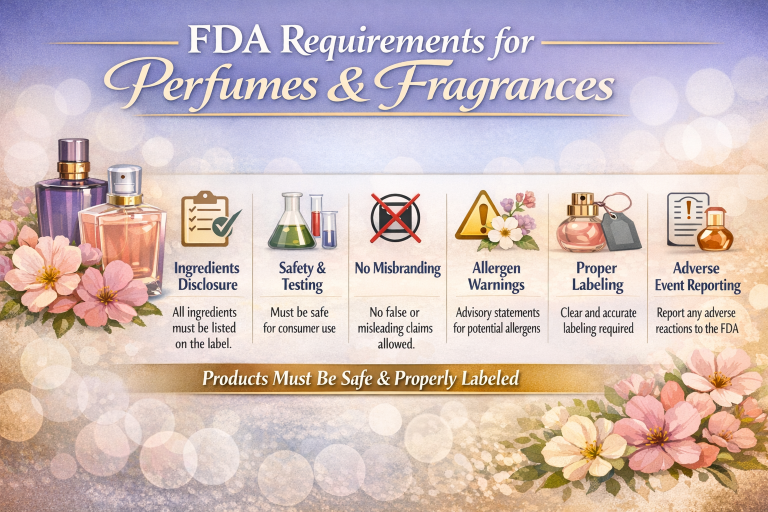
FDA Requirements for Perfumes and Fragrances
Perfumes, Colognes, Body Sprays, fragrance oils, and scented cosmetic products are usually regulated by FDA as cosmetics when they are intended to cleanse, beautify, promote attractiveness, or alter appearance. However, labeling, claims, ingredients, facility registration, product listing, safety substantiation, imports, and MoCRA requirements can all affect whether a fragrance product is compliant for the U.S. market.
What Perfume bzrands Should Review
Perfumes and Fragrances are Usually Cosmetics, but Compliance Still Matters
Most Perfumes are Cosmetics
A Perfume or Fragrance product is generally treated as a cosmetic when it is used to make the body smell pleasant or enhance personal attractiveness. FDA Cosmetic requirements can apply even when the product is not a Drug or Medical product.
Claims can Change the Pathway
Claims about treating anxiety, improving sleep disorders, relieving pain, curing skin conditions, disinfecting, killing bacteria, or providing therapeutic effects may create drug or other regulatory concerns beyond ordinary cosmetic fragrance positioning.
MoCRA changed Cosmetics Compliance
The Modernization of Cosmetics Regulation Act expanded FDA cosmetic requirements, including facility registration, product listing, adverse event reporting, safety substantiation, and other obligations for many cosmetic companies.
Perfume Compliance is More Than a Beautiful Label
Many Fragrance companies focus on scent profile, bottle design, packaging, influencer marketing, and online sales before reviewing FDA cosmetic compliance. This can create problems when products are imported, listed on Amazon, distributed to retailers, reviewed by buyers, or questioned because of claims, missing label elements, ingredient declaration issues, or MoCRA-related requirements.
A perfume may seem simple, but the compliance review can involve multiple questions. Is the product a cosmetic or a drug based on the claims? Is the facility subject to cosmetic facility registration? Does the responsible person need to submit product listing information? Is the label compliant? Are fragrance components declared correctly? Are warning statements needed? Are safety records available? Are import documents aligned with the product category?
FDA Registration Assistance helps perfume, fragrance, cosmetic, and personal care companies review U.S. FDA requirements before importing, labeling, listing, distributing, or selling products in the United States.
FDA Requirements Perfume and Fragrance Companies Should Understand
Cosmetic Classification
Perfumes, colognes, body sprays, and fragrance mists are usually cosmetics when marketed for fragrance, beauty, attractiveness, or personal grooming. If the product claims to treat, prevent, cure, diagnose, or affect a body function in a therapeutic way, it may move beyond cosmetic classification.
MoCRA Facility Registration
Many cosmetic manufacturing or processing facilities are subject to FDA cosmetic facility registration requirements under MoCRA, unless an exemption applies. Foreign cosmetic facilities may need proper U.S. market support and accurate facility information.
Cosmetic Product Listing
Responsible persons for covered cosmetic products may need to submit cosmetic product listing information to FDA. Product listing can require product category, ingredients, responsible person information, and label-related information.
Ingredient Declaration
Cosmetic labels generally require ingredient declaration. Fragrance and flavor may be declared using the terms “fragrance” or “flavor,” but the overall label must still be truthful, not misleading, and compliant with cosmetic labeling rules.
Safety Substantiation
Cosmetic companies are responsible for ensuring their products are safe when used as directed or customarily used. Under MoCRA, responsible persons must maintain adequate safety substantiation for cosmetic products.
Adverse Event Responsibilities
Responsible persons have obligations related to serious adverse event reporting and recordkeeping. Fragrance products may raise sensitivity, irritation, allergy, or misuse concerns that companies should monitor appropriately.
Perfume and Fragrance Compliance Issues Compared
| Compliance Area | What FDA Looks At | Common Mistake | Recommended Review |
|---|---|---|---|
| Product Classification | Intended use, claims, directions, website content, product name, advertising, and consumer perception. | Using therapeutic claims while assuming the product remains only a cosmetic. | Review label, website, Amazon listing, ads, and marketing content before launch. |
| Facility Registration | Whether the facility manufactures or processes cosmetic products for U.S. distribution. | Assuming small brands never have MoCRA obligations. | Review facility role, exemptions, manufacturer, processor, and brand owner responsibilities. |
| Product Listing | Responsible person, product category, ingredients, and label-related information. | Importing or selling without confirming whether listing is required. | Identify responsible person and product listing needs before distribution. |
| Labeling | Identity statement, net quantity, responsible firm, ingredient declaration, warnings, directions, and required information. | Creating luxury packaging that omits required cosmetic label elements. | Review artwork before printing bottles, boxes, inserts, and outer cartons. |
| Claims | Drug-like, medical, antimicrobial, anxiety, sleep, pain, hormone, disease, or therapeutic claims. | Using wellness or aromatherapy claims that suggest treatment or physiological effects. | Rewrite claims to fit cosmetic positioning where appropriate. |
| Import Readiness | Manufacturer, product identity, ingredient list, label, responsible person, country of origin, and shipment documents. | Shipping products before reviewing labels and FDA cosmetic obligations. | Review compliance before booking freight or sending goods to Amazon/FBA. |
Perfume and Fragrance Label Requirements
Perfume labels must be designed for beauty and compliance. A luxury bottle, box, or outer carton may still need required cosmetic label elements. The exact layout depends on packaging size, product form, claims, distribution model, and whether information appears on the container, outer packaging, or both.
Official FDA Resources for Perfumes and Fragrances
FDA provides official cosmetic resources for fragrance ingredients, labeling, MoCRA requirements, and cosmetic safety responsibilities. Perfume companies should rely on official FDA sources and obtain professional review before importing or launching in the United States.
FDA Fragrance and Cosmetic Labeling Resources
FDA provides information about fragrances in cosmetics and cosmetic labeling requirements, including label elements and ingredient declaration principles.
MoCRA and Cosmetic Requirements
MoCRA introduced major updates for cosmetic companies, including requirements involving facility registration, product listing, adverse event reporting, safety substantiation, and additional FDA authority.
Fragrance Claims That Can Create FDA Risk
Perfume and Fragrance marketing often uses emotional, wellness, sensual, mood, and lifestyle language. Some of this can be acceptable depending on context, but claims that imply treatment, prevention, diagnosis, mitigation, or physiological effect may create drug or other regulatory concerns.
What Can Happen if Perfume Compliance is Ignored?
Common Mistakes Perfume and Fragrance Brands Make
Assuming Perfumes Do Not Need FDA Review
Many perfumes are cosmetics, and cosmetics are regulated by FDA. Even when premarket approval is not required, companies remain responsible for compliant labeling, safety, claims, and applicable MoCRA obligations.
Printing luxury Packaging Before Label Review
Fragrance packaging can be expensive to correct. Labels, boxes, inserts, and outer cartons should be reviewed before printing so required information is not missing from the finished product.
Using Drug-Like Aromatherapy Claims
Aromatherapy language can become risky when it suggests treatment or physiological effects. Claims should be reviewed across labels, websites, Amazon listings, social media, and advertisements.
Confusing Cosmetic Listing with FDA Approval
Cosmetic facility registration or product listing does not mean FDA approved the perfume. Companies should avoid claiming or implying FDA approval unless FDA has actually approved the product under an applicable pathway.
When Should Perfume Companies Review FDA Requirements?
Perfume and Fragrance companies should review FDA requirements before importing, manufacturing, labeling, listing, launching on Amazon, onboarding retailers, printing packaging, or making wellness claims. Early review helps avoid costly packaging changes, import delays, rejected retail submissions, and incorrect product positioning.
FDA Registration Assistance for Perfume and Fragrance Companies
FDA Registration Assistance helps perfume, fragrance, cosmetic, and personal care companies understand FDA requirements before entering the U.S. market. We assist with MoCRA-related support, cosmetic facility registration, cosmetic product listing, U.S. Agent-related guidance when applicable, label review, claims review, ingredient review, import documentation review, and compliance strategy.
Cosmetic Registration
We help companies review whether cosmetic facility registration or product listing applies under MoCRA and help organize information needed for compliance filings.
Fragrance Label Review
We review fragrance labels, boxes, inserts, claims, ingredient declarations, warnings, and responsible firm information before products are printed or imported.
Import and Amazon Support
We help fragrance companies prepare for import review, Amazon documentation requests, retailer compliance checks, and U.S. market launch requirements.
Need FDA compliance help for Perfumes or Fragrances?
FDA Registration Assistance helps Perfume and Fragrance companies with Cosmetic Facility Registration, Product Listing, MoCRA compliance, Label Review, Claims Review, Ingredient Review, Import Documentation, and Amazon or Retailer Compliance Support.
FDA Registration Assistance is located in Miami, Florida, USA and assists cosmetic companies nationwide and internationally. We have helped 1,000+ companies across 135+ countries with 15+ years of combined regulatory experience. Contact us at info@fdaregistrationassistance.com.
Frequently Asked Questions about FDA Requirements for Perfumes and Fragrances
1. Are Perfumes regulated by FDA?
Yes. Perfumes and fragrances are generally regulated by FDA as cosmetics when they are intended to make the body smell pleasant, promote attractiveness, or be used for ordinary cosmetic purposes.
2. Does FDA approve Perfumes before sale?
FDA generally does not approve cosmetic products such as perfumes before sale. However, companies are still responsible for ensuring that products are safe, properly labeled, and compliant with applicable FDA cosmetic requirements.
3. Do Perfume companies need MoCRA Registration?
Many cosmetic manufacturing or processing facilities may need cosmetic facility registration under MoCRA unless an exemption applies. Perfume companies should review facility role, product type, business size, and distribution activity before assuming they are exempt.
4. Do Perfumes need Cosmetic Product Listing?
Covered cosmetic products may require product listing with FDA under MoCRA. The responsible person should evaluate whether listing applies and prepare accurate product, ingredient, label, and business information.
5. What Label information is required for Perfumes?
Perfume labels may need a statement of identity, net quantity, responsible firm information, ingredient declaration, warnings or directions when appropriate, and other required cosmetic label elements depending on the packaging and product presentation.
6. Can Fragrance ingredients be listed as “Fragrance”?
Cosmetic labeling rules allow fragrance ingredients to be declared using the term “fragrance” in many cases. However, the label must still be truthful, not misleading, and compliant with applicable cosmetic labeling requirements.
7. Are Fragrance allergens required on U.S. Cosmetic Labels?
MoCRA includes changes related to fragrance allergen labeling, and FDA is developing related requirements. Perfume companies should monitor FDA updates and prepare for more ingredient transparency as FDA implements these rules.
8. Can a Perfume become a Drug?
Yes. If a perfume is marketed with claims to treat, prevent, cure, diagnose, or affect body functions in a therapeutic way, FDA may view the product as a drug rather than only a cosmetic.
9. Are Aromatherapy Perfumes Regulated Differently?
Aromatherapy products may remain cosmetics when claims are limited to scent or ordinary cosmetic use. However, claims about treating anxiety, insomnia, pain, depression, illness, or physiological conditions can create drug concerns.
10. Do Fragrance Oils need FDA Compliance?
Fragrance oils may be subject to FDA cosmetic requirements if intended for application to the body as a cosmetic. If the oil is for candles, diffusers, or non-body use, other regulatory considerations may apply outside ordinary cosmetic labeling.
11. Do Imported Perfumes need FDA Review?
Imported perfumes may be reviewed for FDA compliance at entry. Labels, product identity, manufacturer information, claims, ingredients, responsible person details, and cosmetic compliance documentation should be prepared before shipment.
12. Can FDA detain Imported Perfumes?
Yes. FDA may detain cosmetic imports if they appear adulterated, misbranded, improperly labeled, unsafe, or otherwise noncompliant. Import documentation and labels should be reviewed before the products arrive.
13. Does Amazon require FDA Compliance for Perfumes?
Amazon may request compliance documentation for cosmetic products, including perfumes and fragrances. Sellers should prepare labels, ingredient information, responsible firm details, and applicable cosmetic compliance documentation before listing.
14. Can I say my Perfume Relieves Stress?
Stress-related claims should be reviewed carefully. General lifestyle language may be different from claims that the product treats anxiety, medical stress conditions, or physiological symptoms. The exact wording and context matter.
15. Can I say my Fragrance is Antibacterial?
Antibacterial, antimicrobial, disinfecting, sanitizing, or germ-killing claims can create drug, pesticide, or other regulatory concerns. These claims should not be used casually on perfume products without regulatory review.
16. What is Safety Substantiation for Perfumes?
Safety substantiation means having adequate support showing that the cosmetic product is safe under labeled or customary conditions of use. This may involve formulation review, ingredient safety data, supplier information, testing, and other documentation.
17. Do Perfume Labels need Warnings?
Warnings may be needed depending on the product, ingredients, flammability, intended use, packaging, directions, and foreseeable misuse. Perfume brands should review warning language before printing packaging.
18. Are Alcohol-based Perfumes regulated by FDA?
Alcohol-based perfumes intended for body application are generally regulated as cosmetics by FDA. Other federal, state, transportation, flammability, and hazardous material considerations may also apply depending on the product and shipping method.
19. What is the responsible person for Cosmetic Products?
The responsible person is typically the manufacturer, packer, or distributor whose name appears on the cosmetic product label. The responsible person has certain obligations under MoCRA, including product listing and adverse event responsibilities when applicable.
20. Can FDA Registration Assistance review Perfume Labels?
Yes. FDA Registration Assistance can review perfume labels, boxes, ingredient declarations, net quantity, responsible firm information, warnings, directions, and claims before products are printed, imported, or sold.
21. Can FDA Registration Assistance help with MoCRA?
Yes. FDA Registration Assistance helps cosmetic companies review MoCRA-related requirements, facility registration, product listing, responsible person obligations, safety substantiation, labeling, and compliance documentation.
22. What documents are needed for Perfume Compliance Review?
Useful documents include the product label, box artwork, ingredient list, formula information, product claims, website copy, Amazon listing, manufacturer information, responsible person details, country of origin, and import documents if applicable.
23. Is FDA cosmetic registration the same as FDA Approval?
No. Cosmetic facility registration or product listing is not FDA approval. Companies should not say or imply that FDA approved a perfume because it was registered or listed.
24. When should Perfume Brands review FDA Compliance?
Perfume brands should review FDA compliance before printing labels, importing products, launching online, sending products to Amazon, onboarding retailers, making claims, or submitting cosmetic registration or listing information.
25. Why work with FDA Registration Assistance?
FDA Registration Assistance has helped 1,000+ companies across 135+ countries with 15+ years of combined regulatory experience. We help perfume and fragrance companies understand FDA cosmetic requirements, avoid labeling mistakes, and prepare for U.S. market compliance.