FDA Registration for Flour & Grain Products

FDA registration for flour and grain
FDA Food Import Compliance
Last updated:

FDA Registration for Flour & Grain Products

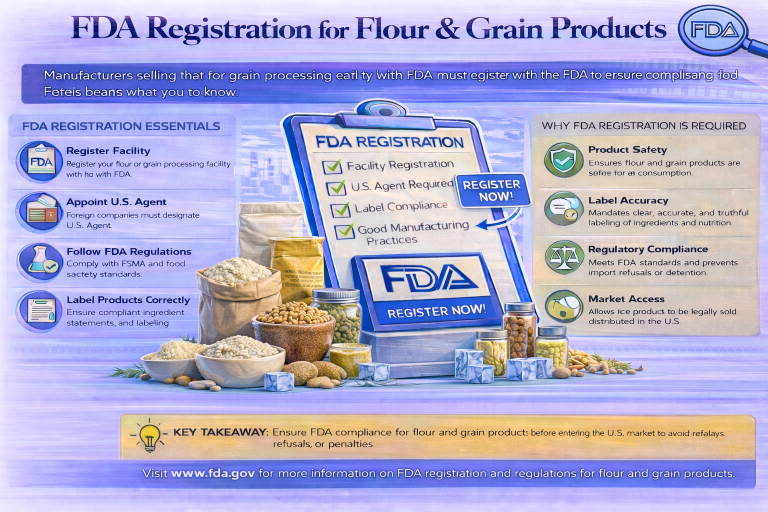
Yes — flour and grain products require FDA compliance before entering the United States. Any foreign facility that manufactures, mills, processes, packs, or holds wheat flour, cornmeal, rice flour, oats, barley, quinoa, or other grain products for U.S. consumption must register with FDA and designate a U.S. Agent. U.S. importers must maintain a Foreign Supplier Verification Program (FSVP). Labels must include a Nutrition Facts panel, allergen declarations — including wheat as a major allergen — and full disclosure of enrichment or fortification. FDA Prior Notice is required before every shipment arrives. Failure to meet any of these requirements can result in shipment detention or refusal at the U.S. border.

Flour and grain products are regulated as conventional foods under FDA jurisdiction. Whether you are exporting wheat flour from Europe, rice flour from Asia, or quinoa from South America, FDA registration, labeling compliance, and FSVP obligations apply before your products can legally enter U.S. commerce.

Compliance Checklist

Before Shipping Flour & Grains to the U.S.

FDA Food Facility Registration for the foreign production facility.
U.S. Agent designation with a physical U.S. address.
— DUNS Number / Unique Facility Identifier (UFI) on file.
— FDA-compliant label with Nutrition Facts panel and allergen declarations.
FSVP compliance for U.S. importer.
— FDA Prior Notice filed before shipment arrives.
— CBP customs entry, duties, and import documentation.
Quick Facts

FDA Regulation of Flour & Grain Products

Regulated as Conventional Food

Wheat flour, cornmeal, rice flour, oats, barley, rye, sorghum, millet, quinoa, buckwheat, and other milled or whole grain products are regulated as conventional foods under FDA jurisdiction — subject to facility registration, labeling, and safety requirements.

Wheat Is a Major Allergen

Under the Food Allergen Labeling and Consumer Protection Act (FALCPA), wheat is one of nine major food allergens and must be clearly declared on every product label — either in the ingredient list or in a separate "Contains: Wheat" statement.

Enriched Flour Has Standards of Identity

FDA has established standards of identity for enriched flour under 21 CFR Part 137. Enriched flour must contain required levels of thiamine, riboflavin, niacin, folic acid, and iron. Products labeled as enriched must meet these standards or face misbranding citations.

Overview

FDA Requirements for Importing Flour & Grain Products

To legally import or sell flour and grain products in the United States, a complete FDA compliance program must be in place before the first shipment leaves the country of origin. Requirements apply to the foreign manufacturing facility, the U.S. importer, and the product label — and they are enforced independently at the U.S. border by FDA and CBP.

The foreign production facility must be registered with FDA through the FURLS portal under 21 CFR 1.225–1.243. Registration requires a DUNS Number as a Unique Facility Identifier and the designation of a U.S. Agent physically located in the United States. Registration must be renewed every two years during the October–December biennial renewal window.

The U.S. importer must maintain a Foreign Supplier Verification Program (FSVP) that includes hazard analysis, supplier verification activities, and ongoing recordkeeping. For grain products, FSVP hazard analysis should address biological hazards such as mycotoxins and pathogens, chemical hazards including pesticide residues and heavy metals, and physical hazards such as foreign material.

Product labels must comply with FDA food labeling regulations including 21 CFR Parts 101 and 137. Allergen declarations are mandatory for wheat-containing products. FDA Prior Notice must be filed before every import shipment arrives in the United States.

Step-by-Step Guide

How to Get FDA Compliant for Flour & Grain Imports

1. Register the Foreign Facility with FDA

Any foreign facility that manufactures, mills, processes, packs, or holds flour or grain products for U.S. consumption must register through the FURLS portal. Registration requires facility name, address, contact details, product categories, and DUNS Number. The registration must be renewed biannually during Oct–Dec of even-numbered years.

2. Designate a U.S. Agent

Every foreign facility must designate a U.S. Agent physically located in the United States with a real street address — P.O. Boxes are not accepted. The U.S. Agent must be available to receive FDA communications, respond to inspection requests, and relay information between FDA and the facility.

3. Obtain Your DUNS Number

FDA requires a Unique Facility Identifier (UFI) — typically a DUNS Number issued by Dun & Bradstreet — on every food facility registration and renewal. If your facility does not have one, FDA Registration Assistance can help obtain it as part of the registration process.

4. Review Product Labels for Compliance

Flour and grain product labels must include a properly formatted Nutrition Facts panel, accurate product identity (e.g., "Enriched Wheat Flour"), complete ingredient list, net quantity, and allergen declarations. Wheat must be declared as a major allergen. Enriched products must meet FDA standards of identity under 21 CFR Part 137.

5. Establish FSVP for the U.S. Importer

U.S. importers must maintain an FSVP program under 21 CFR Part 1, Subpart L. For grain products this includes hazard analysis covering mycotoxins, pathogens, pesticide residues, heavy metals, and foreign material — plus ongoing supplier verification and recordkeeping.

6. File FDA Prior Notice Before Every Shipment

Prior Notice must be submitted to FDA before flour and grain shipments arrive in the United States. The notice must include accurate product description, manufacturer, shipper, importer, arrival port, and entry information. Errors in Prior Notice are a leading cause of shipment delays and detentions for grain products.

Compliance Overview

FDA Requirements for Flour & Grain Products at a Glance

RequirementWho It Applies ToWhat It CoversCommon Mistake
FDA Food Facility RegistrationForeign facility (mill, processor, packer, warehouse)Mandatory registration under 21 CFR 1.225–1.243. Must include DUNS Number and be renewed biennially Oct–Dec.Assuming the facility is exempt, or letting registration lapse by missing the biennial renewal window.
U.S. Agent DesignationAll foreign registered facilitiesA physically located U.S. contact for FDA inspections, communications, and emergencies. Required for all foreign facilities.Using a P.O. Box or non-responsive agent that cannot be reached by FDA.
FSVPU.S. importerHazard analysis, supplier verification, and recordkeeping under 21 CFR Part 1, Subpart L. Covers biological, chemical, and physical hazards.Assuming the foreign supplier's certifications substitute for a documented FSVP program.
Allergen LabelingAll wheat-containing productsWheat must be declared as a major allergen under FALCPA — in the ingredient list or a separate "Contains: Wheat" statement.Using ambiguous ingredient names that do not clearly identify wheat as an allergen.
Nutrition Facts PanelMost packaged flour and grain productsMust comply with 21 CFR Part 101. Enriched products must list added nutrients. Format must match FDA requirements.Using foreign-market Nutrition Facts formats that do not meet U.S. requirements.
FDA Prior NoticeAll import shipmentsMust be filed before every shipment arrives. Requires accurate product, manufacturer, shipper, and arrival data.Filing Prior Notice with incorrect manufacturer or product information that does not match the shipment.
Standards of IdentityEnriched flour productsFDA standards of identity under 21 CFR Part 137 specify required nutrient levels for enriched flour, bromated flour, and related products.Labeling a product as "enriched" without meeting the nutrient levels required by FDA standards of identity.
Risk Section

Why Flour & Grain Shipments Get Flagged by FDA

Flour and grain products are among the food categories FDA monitors closely due to contamination risks, allergen concerns, and labeling complexity. Understanding the most common causes of detention helps importers prevent costly delays.

⚠️ Import Alert Risk: Facilities with a history of mycotoxin contamination, undeclared allergens, or repeated labeling violations may be placed on FDA import alert — meaning all shipments are subject to detention without physical examination (DWPE) until the issue is resolved. Import alert removal assistance is available.

Contamination Concerns

Mycotoxins such as aflatoxin and deoxynivalenol (DON) are a primary FDA concern for grain products. FDA sets action levels and closely monitors imports for these contaminants. Products from facilities with a contamination history may face automatic detention.

Undeclared Allergens

Wheat is a major allergen under FALCPA. Failure to declare wheat clearly on labels — including in blended grain products, seasoned flour mixes, or products processed on shared equipment — is one of the most common causes of FDA enforcement action for grain products.

Labeling Non-Compliance

Foreign-market labels frequently do not meet U.S. requirements. Common issues include missing or incorrectly formatted Nutrition Facts panels, incorrect net quantity declarations, missing importer statements, and enrichment disclosures that do not comply with 21 CFR Part 137 standards of identity.

Missing or Expired Registration

If the producing facility's FDA registration has expired, been cancelled due to a missed biennial renewal, or was never obtained, all shipments from that facility are subject to refusal at the U.S. border. Registration status is verified at entry and must be active at the time of shipment.

Prior Notice Errors

Prior Notice filed with incorrect manufacturer information, wrong product description, or mismatched shipper data triggers FDA review and can delay or prevent entry. The data in Prior Notice must match the label, invoice, and CBP entry exactly.

FSVP Gaps

Importers who have not established a documented FSVP program — or who rely on foreign supplier certifications alone — are exposed to FDA enforcement at inspection. FSVP records must be maintained and available for FDA review at any time.

Product Coverage

Flour & Grain Products Covered by FDA Compliance Requirements

FDA food facility registration, FSVP, labeling, and Prior Notice requirements apply broadly across flour and grain product categories. The following products are subject to full FDA import compliance:

Wheat Products

All-purpose flour, bread flour, cake flour, pastry flour, whole wheat flour, semolina, durum flour, spelt flour, kamut flour, enriched wheat flour, self-rising flour, and bromated flour are subject to FDA registration, allergen labeling, and standards of identity requirements.

Corn & Rice Products

Cornmeal, corn flour, masa harina, hominy grits, rice flour, white rice flour, brown rice flour, glutinous rice flour, and rice starch are regulated as conventional foods and require FDA facility registration, FSVP, and compliant labeling.

Ancient Grains & Specialty Flours

Quinoa flour, buckwheat flour, sorghum flour, millet flour, teff flour, amaranth flour, oat flour, barley flour, rye flour, and chickpea flour all require FDA food facility registration and full import compliance regardless of grain type or country of origin.

Our Services

FDA Registration Assistance for Flour & Grain Importers

FDA Registration Assistance provides a complete compliance solution for flour and grain manufacturers, millers, exporters, and U.S. importers. We handle every FDA requirement so your products can enter the U.S. market without delays, detentions, or border refusals.

FDA Food Facility Registration

We register your foreign flour or grain facility with FDA through FURLS, obtain your DUNS Number where needed, and manage all biennial renewal filings so your registration never lapses.

U.S. Agent Services

We serve as your designated FDA U.S. Agent — physically located in the United States — providing a responsive point of contact for FDA inspections, communications, and emergency notifications.

FSVP Compliance

We build and maintain your FSVP program including hazard analysis specific to flour and grain product risks, supplier verification documentation, and ongoing recordkeeping.

Label & Allergen Review

We review your product labels for FDA compliance — checking Nutrition Facts panel formatting, allergen declarations, enrichment disclosures, ingredient list accuracy, net quantity, and standards of identity compliance under 21 CFR Part 137.

Prior Notice Coordination

We help importers and brokers ensure FDA Prior Notice is filed accurately before every shipment, with data that matches the label, invoice, and CBP entry — preventing the filing errors that most commonly delay grain shipments.

Import Alert Resolution

If your facility or products are on FDA import alert, we develop corrective action plans and regulatory strategies to resolve the import alert and restore your ability to ship into the United States.

FDA Registration Assistance

Ready to Import Flour & Grain Products into the U.S.?

FDA Registration Assistance handles every compliance requirement for flour and grain importers — FDA food facility registration, U.S. Agent service, FSVP compliance, label review, Prior Notice coordination, and import alert resolution.

We have helped 1,000+ companies across 135+ countries with 15+ years of combined regulatory experience. Contact us at info@fdaregistrationassistance.com or call +1 (928) 275-8333.

FAQ

Frequently Asked Questions — FDA Registration for Flour & Grain Products

1. Do flour and grain products require FDA registration?

Yes. Any facility that manufactures, mills, processes, packs, or holds flour or grain products for U.S. consumption must register with FDA. Foreign facilities must also designate a U.S. Agent. Without registration, products cannot legally enter the United States.

2. Is a U.S. Agent required for flour and grain imports?

Yes. Any foreign facility exporting flour or grain products to the United States must designate a U.S. Agent as part of FDA food facility registration. The U.S. Agent must be physically located in the United States and available to respond to FDA communications at any time.

3. What labeling requirements apply to flour and grain products?

Products must include a properly formatted Nutrition Facts panel, accurate product identity statement, complete ingredient list, net quantity declaration, and allergen declarations. Enriched or fortified products must disclose all added nutrients. Wheat must be declared as a major allergen under FALCPA.

4. Is wheat considered a major allergen under FDA regulations?

Yes. Wheat is one of nine major food allergens under the Food Allergen Labeling and Consumer Protection Act (FALCPA). It must be clearly declared on product labels — either within the ingredient list using the word "wheat" or in a separate "Contains: Wheat" statement.

5. Do I need FSVP for flour and grain imports?

Yes. U.S. importers must maintain a Foreign Supplier Verification Program (FSVP) including hazard analysis covering mycotoxins, pathogens, pesticide residues, and foreign material, plus supplier verification activities and ongoing recordkeeping.

6. Is FDA Prior Notice required for flour and grain shipments?

Yes. Prior Notice must be submitted to FDA before any flour or grain product shipment arrives in the United States. Missing or inaccurate Prior Notice can result in shipment refusal or detention at the U.S. border.

7. What are mycotoxins and why does FDA monitor them in grain products?

Mycotoxins are toxic compounds produced by molds that commonly contaminate grains during growth, harvest, or storage. FDA sets action levels for aflatoxin and deoxynivalenol (DON) in grain products and actively monitors imports. Shipments that exceed action levels will be refused entry.

8. Do enriched flour products have additional FDA requirements?

Yes. FDA has established standards of identity for enriched flour under 21 CFR Part 137. Enriched flour must contain required minimum levels of thiamine, riboflavin, niacin, folic acid, and iron. Products labeled as "enriched" that do not meet these standards are subject to misbranding citations.

9. Does organic grain certification replace FDA registration?

No. USDA organic certification does not replace FDA food facility registration, U.S. Agent designation, FSVP compliance, Prior Notice, or FDA labeling requirements. Both regulatory frameworks apply independently and must each be satisfied before importing organic grain products.

10. Can FDA detain or refuse flour and grain shipments?

Yes. FDA can detain or refuse shipments of flour and grain products if facility registration is missing or expired, Prior Notice is not filed or contains errors, labeling is non-compliant, allergens are undeclared, or contamination concerns exist. Facilities with prior violations may be placed on FDA import alert.

11. How often does FDA food facility registration need to be renewed for grain facilities?

FDA food facility registration must be renewed during the biennial renewal window — October 1 through December 31 of every even-numbered year. Missing this window results in automatic cancellation of the registration and loss of U.S. import authorization until re-registration is completed.

12. Do gluten-free grain products have additional FDA requirements?

Yes. Products labeled "gluten-free" must comply with FDA's gluten-free labeling rule under 21 CFR 101.91, which requires that the product contains less than 20 parts per million (ppm) of gluten. This applies to all grain products making a gluten-free claim, including oats, rice, corn, and other naturally gluten-free grains processed in shared facilities.

13. What is the DUNS Number and is it required for flour and grain facility registration?

A DUNS Number is a unique 9-digit identifier issued by Dun & Bradstreet that FDA requires as the Unique Facility Identifier (UFI) on every food facility registration and renewal. If your facility does not have one, FDA Registration Assistance can help obtain it as part of the registration process.

14. Do warehouses and storage facilities holding grain products need FDA registration?

Yes. Any facility that holds flour or grain products for consumption in the United States — including warehouses, grain elevators, fulfillment centers, and cold storage facilities — must register with FDA unless a specific exemption applies.

15. What is the 60-day update rule and how does it apply to grain facilities?

Under 21 CFR 1.234, any change to facility information — including address, ownership, U.S. Agent, or product categories — must be reported to FDA within 60 calendar days of the change. Failing to update within 60 days puts the facility's registration out of compliance and can trigger import refusals.

16. Do flour and grain products need to comply with FSMA Preventive Controls?

Yes. Domestic manufacturers and processors of flour and grain products that meet the applicable size thresholds are subject to FSMA Preventive Controls for Human Food under 21 CFR Part 117. This requires a written food safety plan, hazard analysis, preventive controls, monitoring procedures, and recordkeeping.

17. Can I sell flour and grain products on Amazon if I import them?

Amazon requires food sellers — including importers of flour and grain products — to demonstrate FDA compliance before listing products. This includes active FDA food facility registration for the producing facility, compliant product labeling, and FSVP compliance. See our guide on FSVP for Amazon sellers.

18. Is the importer or the foreign supplier responsible for FDA compliance?

Both parties have obligations. The foreign facility is responsible for FDA food facility registration and U.S. Agent designation. The U.S. importer is responsible for FSVP compliance and Prior Notice. Neither party can rely solely on the other — compliance gaps on either side can result in shipment detention.

19. What should I do if my flour or grain shipment is detained by FDA?

If a shipment is detained, the importer typically has an opportunity to provide evidence that the product is not in violation, or to bring the product into compliance before entry. If the facility is on import alert, a more formal corrective action process is required. FDA Registration Assistance can assist with import alert resolution.

20. Do private label flour and grain brands need FDA registration?

Yes. While the private label brand owner may not be the manufacturer, the manufacturing or holding facility must be registered with FDA. The U.S. importer selling under a private label must also maintain FSVP compliance for the foreign supplier producing the product.

21. Are whole grain claims regulated by FDA?

Yes. FDA has guidance on whole grain labeling, and the term "whole grain" or "100% whole grain" must accurately reflect the product's grain composition. Products making whole grain claims that do not meet the implied standard risk misbranding citations. Additionally, any health claims associated with whole grains must comply with FDA authorized health claim regulations.

22. Do flour and grain products require a HACCP plan?

Flour and grain products are not subject to mandatory seafood or juice HACCP rules, but they are subject to FSMA Preventive Controls requirements for most domestic processors. Importers should also ensure their FSVP hazard analysis addresses the key hazards for grain products including mycotoxins, pathogens such as Salmonella, and pesticide residues.

23. What is FDA's action level for aflatoxin in grain products?

FDA has set an action level of 20 parts per billion (ppb) for total aflatoxins in grains and grain products intended for human consumption. For corn destined for animal feed, the action level varies by species. Products that exceed the action level may be refused entry or subject to enforcement action.

24. How long does FDA food facility registration take for a flour or grain facility?

When all required information is provided accurately, FDA food facility registration is typically confirmed within 24 to 48 hours. Errors, missing information, or DUNS Number issues can delay the process. FDA Registration Assistance ensures accurate filings to achieve the fastest possible turnaround.

25. Why should I use FDA Registration Assistance for flour and grain compliance?

FDA Registration Assistance has helped 1,000+ companies across 135+ countries with 15+ years of combined regulatory experience. We handle FDA food facility registration, U.S. Agent service, FSVP compliance, label review, Prior Notice guidance, and import alert resolution — so your flour and grain products enter the U.S. market without delays, refusals, or compliance gaps.

HM
Reviewed By Hector Matos, Senior Regulatory Compliance Specialist  ·  15+ years FDA compliance experience  ·  Last updated April 2026
Food and Drug Administration Contact Us for Assistance