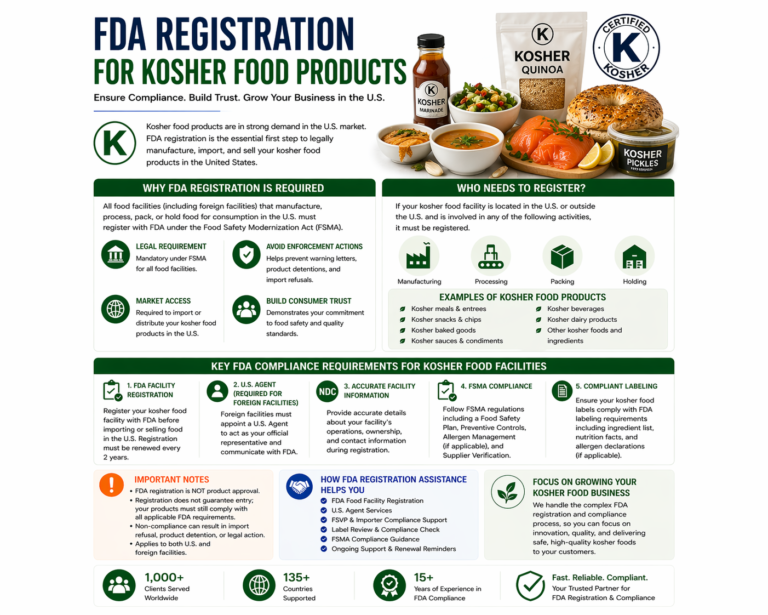
FDA Registration for Kosher Food Products
This guide explains exactly where kosher certification and FDA compliance diverge, which kosher food categories are regulated by FDA vs. USDA, the allergen labeling gaps specific to kosher food, and what foreign kosher food manufacturers (particularly from Israel) need to know about FDA compliance.
Kosher Certification vs. FDA Compliance — Two Completely Separate Systems
Which U.S. Agency Regulates Which Kosher Food Category
| Kosher Food Category | Regulating Agency | Key Requirement |
|---|---|---|
| Kosher packaged foods, snacks, baked goods, beverages, condiments | FDA | FDA Food Facility Registration + FSMA Preventive Controls + FDA food labeling including allergen declarations |
| Kosher dairy — cheese, yogurt, butter, cream | FDA | FDA Food Facility Registration + FDA labeling including milk allergen declaration (not satisfied by kosher D symbol) + FDA standards of identity for cheese (21 CFR Part 133) |
| Kosher fish (fins and scales) — salmon, tuna, cod, halibut | FDA | FDA Food Facility Registration + mandatory seafood HACCP under 21 CFR Part 123 |
| Kosher beef, lamb, veal | USDA FSIS | USDA inspection under Federal Meat Inspection Act. Shechita does not exempt from USDA inspection. FDA does not regulate fresh or processed red meat. |
| Kosher poultry — chicken, turkey, duck | USDA FSIS | USDA inspection under Poultry Products Inspection Act. Shechita (slaughter) does not exempt from USDA inspection requirements. |
| Kosher grape juice (non-alcoholic) | FDA | FDA Food Facility Registration + Juice HACCP under 21 CFR Part 120 + FDA food labeling |
| Kosher wine (alcoholic) | FDA + TTB | FDA food safety jurisdiction; TTB for alcohol labeling and permits. Both agencies’ requirements must be satisfied. |
| Kosher dietary supplements | FDA | DSHEA compliance + 21 CFR Part 111 (supplement cGMPs) + Supplement Facts panel + DSHEA disclaimer. Same as non-kosher supplements. |
Where Kosher Labeling Falls Short of FDA Allergen Requirements
Kosher D Symbol ≠ FDA Milk Allergen Declaration
The kosher “D” or “Dairy” designation communicates dairy content to kosher-observant consumers. It has no legal standing under FDA labeling regulations. Under FALCPA, any food containing milk or dairy-derived ingredients must carry a separate FDA allergen declaration:
Required: “Contains: Milk” statement below the ingredient list — OR — bold “milk” parenthetical in the ingredient list (e.g., “whey (milk)”)
NOT sufficient: Kosher “D” symbol alone, “Chalav Yisrael” designation alone, or any other kosher-side dairy indicator
Sesame in Kosher Foods — FASTER Act January 2023
Sesame is the 9th major U.S. allergen since January 1, 2023 (FASTER Act). Sesame is widely used in kosher cuisine:
• Tahini (sesame paste) — in hummus, dips, dressings
• Halva (sesame confectionery)
• Sesame-coated snacks and crackers — common in Israeli and Middle Eastern kosher products
• Sesame oil in sauces and marinades
• Baked goods with sesame seeds
Any kosher product containing sesame must declare sesame as an allergen — “Contains: Sesame” or bold “sesame” in the ingredient list. The pareve designation does not communicate sesame allergen content.
Why Israeli Kosher Food Manufacturers Need FDA Compliance Specifically
Hebrew-Only Labels
Under 21 CFR Part 101.15, all required FDA label information must appear in English. Israeli kosher food labels typically carry all required content in Hebrew — ingredient lists, allergen declarations, Nutrition Facts, manufacturer name. All of these must appear in English for U.S. import. A label in Hebrew only (even with a kosher symbol) is non-compliant for the U.S. market.
FDA Registration Often Incomplete
Israeli manufacturers typically have kosher certification well managed. FDA registration is frequently not in place. A well-certified OU product from an FDA-unregistered Israeli facility will be detained at U.S. ports. Kosher certification does not substitute for or signal FDA registration in OASIS’s screening.
Sesame Allergen Non-Compliance
Israel is one of the heaviest users of sesame in food — tahini, halva, sesame crackers, sesame-coated snacks, and sesame-based spreads are category staples. The January 2023 FASTER Act sesame requirement catches many Israeli kosher food importers who have not yet updated their U.S. labels.
How to Register a Kosher Food Manufacturing Facility with FDA
Label Review Included
FDA Registration Assistance reviews kosher food labels for: milk allergen declaration (not satisfied by kosher D symbol); sesame allergen declaration (FASTER Act, January 2023); English language requirements for Hebrew labels; 2020 Nutrition Facts format; RACC serving sizes; and full ingredient list compliance. Identifies the specific compliance gaps most common for kosher food imports.
FSVP for Kosher Food Importers
U.S. importers of kosher food must maintain FSVP for each foreign kosher food supplier under 21 CFR Part 1 Subpart L. The FSVP hazard analysis addresses food safety hazards specific to the kosher product category — not kosher compliance. Kosher certification documentation does not satisfy FSVP supplier verification requirements.
Ready to Get Your Kosher Food Business FDA-Compliant?
FDA Registration Assistance provides complete FDA compliance for kosher food manufacturers and importers — Food Facility Registration with correct activity codes, U.S. Agent services for foreign manufacturers, label compliance review (milk allergen, sesame allergen, English language requirements), FSVP programs, and Biennial Renewal management. Complete service: $858. FDA charges $0. DUNS fees separate. 1,000+ clients. 135+ countries. 15+ years of FDA regulatory experience.
Contact us at info@fdaregistrationassistance.com or call +1 (928) 275-8333.
Frequently Asked Questions — FDA Registration for Kosher Food Products
1. Do kosher food manufacturers need FDA registration?
Yes. Kosher certification does not replace FDA registration. Any facility that manufactures, processes, packs, or holds kosher food products for U.S. consumption must register under 21 U.S.C. § 350d and 21 CFR Part 1 Subpart H. Foreign manufacturers must also designate a U.S. Agent. Complete service: $858. FDA charges $0. DUNS fees separate.
2. Does kosher certification replace FDA compliance?
No. Kosher certification (OU, OK, Star-K, Kof-K, etc.) is a private religious certification with no U.S. government legal authority. FDA is a U.S. government agency enforcing the FD&C Act. A product can be fully kosher-certified and simultaneously non-compliant with FDA — an unregistered facility, a missing allergen declaration, a Hebrew-only label. Both systems must be satisfied independently.
3. Does the kosher “D” or dairy symbol satisfy FDA’s milk allergen declaration requirement?
No. The kosher D symbol has no standing under FDA labeling law. Under FALCPA, any food containing milk must carry an FDA allergen declaration: “Contains: Milk” or bold “milk” parenthetical in the ingredient list. The kosher D symbol alone is insufficient. This is the most common FDA compliance failure for imported kosher food products.
4. Which agency regulates kosher meat and poultry — FDA or USDA?
USDA FSIS, not FDA. Kosher beef, lamb, chicken, turkey, and duck are regulated under the Federal Meat Inspection Act and Poultry Products Inspection Act. Kosher slaughter (shechita) does not exempt facilities from USDA inspection. Kosher meat and poultry processors importing to the U.S. must comply with USDA FSIS requirements — not FDA food facility registration.
5. Which agency regulates kosher fish — FDA or USDA?
FDA, not USDA. Kosher fish (species with fins and scales — salmon, tuna, cod, halibut, tilapia) are regulated by FDA under seafood HACCP regulations in 21 CFR Part 123. Kosher fish processors must comply with FDA food facility registration, seafood HACCP, and FSVP.
6. Do kosher food labels with Hebrew text need to comply with FDA English language requirements?
Yes. Under 21 CFR Part 101.15, all required FDA label information must appear in English. A kosher food label presenting the ingredient list, allergen declarations, Nutrition Facts, and manufacturer name only in Hebrew is non-compliant for the U.S. market. This is a common compliance gap for Israeli kosher food exporters.
7. What FDA requirements apply to kosher dairy products imported into the United States?
FDA Food Facility Registration; U.S. Agent designation; FSVP for the U.S. importer; FDA food labeling including English-language ingredient list, milk allergen declaration (not satisfied by kosher D symbol), and 2020 Nutrition Facts panel; FDA standards of identity for cheese (21 CFR Part 133). Fluid milk additionally regulated at state level for pasteurization.
8. What FDA labeling requirements apply to kosher food products?
Same as any food under 21 CFR Part 101: statement of identity in English; net quantity in both U.S. and metric units; 2020 Nutrition Facts panel; ingredient list in English in descending order; allergen declarations for all nine allergens (milk — not satisfied by kosher D; sesame since January 2023); manufacturer/distributor name and U.S. address. The kosher symbol and D/M/Pareve designations are not FDA requirements but must not be deceptive.
9. Does FDA regulate the kosher certification symbol on food labels?
No. FDA has not established a regulatory definition of “kosher” and does not regulate kosher certification symbols or agencies. The use of “kosher” on a food label is a manufacturer’s claim regulated by FTC truth-in-advertising principles — not FDA labeling regulations. For FDA, the presence or absence of a kosher symbol has no regulatory significance.
10. What FSVP requirements apply to U.S. importers of kosher food?
Same as any imported food: FSVP under 21 CFR Part 1 Subpart L for each foreign supplier. The FSVP hazard analysis addresses food safety hazards specific to the product category — not kosher compliance. Kosher certification does not satisfy FSVP supplier verification requirements. Supplier verification activities, corrective actions, and 2-year recordkeeping required.
11. What are the most common FDA compliance failures for kosher food imports?
FDA registration not completed (facility registered with kosher agency but not FDA); missing milk allergen declaration (relying on kosher D symbol); missing sesame allergen declaration (FASTER Act, January 2023 — critical for tahini, halva, sesame products); Hebrew-only labeling; pre-2020 Nutrition Facts format; wrong serving size on Nutrition Facts; no FSVP for the U.S. importer.
12. Do Israeli kosher food manufacturers need FDA registration?
Yes. Israeli kosher food manufacturers exporting to the United States must register with FDA and designate a U.S. Agent. Israeli manufacturers typically have kosher certification well managed but FDA registration frequently incomplete. Israeli labels printed primarily in Hebrew must include English for all FDA-required label elements. FDA Registration Assistance serves a significant number of Israeli kosher food manufacturers.
13. Is sesame a required allergen declaration for kosher food products?
Yes. Sesame is the 9th major U.S. allergen since January 1, 2023 (FASTER Act). Widely used in kosher cuisine: tahini, halva, sesame-coated snacks, Israeli and Middle Eastern kosher foods. Must declare: “Contains: Sesame” or bold “sesame” in the ingredient list. Pareve designation does not communicate sesame allergen content.
14. What FDA requirements apply to kosher wine and grape juice imports?
Kosher grape juice (non-alcoholic): FDA Food Facility Registration + Juice HACCP (21 CFR Part 120) + FDA food labeling. Kosher wine (alcoholic): FDA food safety jurisdiction + TTB for alcohol labeling and permits. Both agencies’ requirements must be satisfied for kosher wine.
15. What FDA requirements apply to kosher dietary supplements?
Same as any dietary supplement: DSHEA compliance + 21 CFR Part 111 supplement cGMPs + Supplement Facts panel + DSHEA disclaimer + 30-day notification for structure/function claims. Kosher certification of a dietary supplement does not exempt the product from any FDA supplement requirement.
16. Can a kosher food product be imported without the manufacturer being FDA-registered?
No. Every imported food product must come from an FDA-registered facility. OASIS screens every Prior Notice against the FDA facility registration database. A kosher food shipment from an unregistered manufacturer will be detained. The kosher certification has no relevance to OASIS screening.
17. What is the $858 complete service for kosher food manufacturer registration?
FDA Registration Assistance charges $858 — U.S. Agent designation for foreign manufacturers, activity code selection, food product category selection, registration submission through FURLS, and Biennial Renewal management. FDA charges $0. DUNS fees are separate.
18. What activity codes should a kosher food manufacturer select?
Manufacture (producing kosher food products — baking, cooking, blending, fermenting); Pack (packaging into retail or food service containers); Hold (if the facility warehouses finished kosher food). Food product categories should reflect the specific types of kosher food manufactured.
19. Do kosher food products need Prior Notice before entering the United States?
Yes. Prior Notice under 21 CFR Part 1 Subpart I is required before every kosher food shipment: 8 hours (ocean), 4 hours (air), 2 hours (road). Must include the foreign manufacturer’s correct FDA registration number. Screened by OASIS the same as any other food import.
20. What Biennial Renewal requirements apply to kosher food registrations?
FDA Food Facility Registration renews every two years — October 1 through December 31 of even-numbered years. A lapsed kosher food manufacturer registration triggers OASIS detention of every subsequent shipment. FDA Registration Assistance manages Biennial Renewal.
21. What FSMA Preventive Controls requirements apply to kosher food manufacturers?
Same as all food manufacturers: full FSMA Preventive Controls under 21 CFR Part 117. Written food safety plan, hazard analysis, allergen controls (required type), sanitation controls, PCQI, monitoring, and corrective actions. Kosher supervision does not exempt facilities from FSMA. The strict dairy/meat separation common in kosher operations may support allergen cross-contact prevention — but FDA documentation must address FDA’s Preventive Controls allergen hazard analysis specifically.
22. What labeling requirements apply to kosher pareve products that contain sesame?
A kosher pareve product containing sesame must declare sesame as an allergen (FASTER Act, January 2023). The pareve designation communicates no dairy or meat content — it says nothing about sesame allergen status. Pareve halva, tahini, and sesame-based snacks must declare: “Contains: Sesame.” A common and specific compliance gap for kosher Middle Eastern foods.
23. What countries export the most kosher food to the United States and what FDA requirements apply?
Major kosher food exporters to the U.S.: Israel (processed foods, snacks, wine, dairy, meat alternatives), Mexico, European countries (Belgium, France, Argentina). All foreign kosher food manufacturers exporting to the U.S. must comply: FDA Food Facility Registration, U.S. Agent designation, FSVP through U.S. importer, FDA food labeling in English, and Prior Notice before each shipment.
24. How does FDA Registration Assistance help kosher food manufacturers and importers?
Complete FDA compliance: Food Facility Registration with correct activity codes; U.S. Agent for foreign manufacturers; label compliance review (milk allergen, sesame allergen, English language requirements); FSVP programs; Biennial Renewal. $858 service. FDA charges $0. 1,000+ clients. 135+ countries.
25. How do I get started with FDA registration for my kosher food manufacturing facility?
Contact FDA Registration Assistance at info@fdaregistrationassistance.com or call +1 (928) 275-8333. Provide your facility name and address, kosher food product types, whether domestic or foreign, and any existing FDA registration information. Complete service: $858. FDA charges $0. DUNS fees separate.