
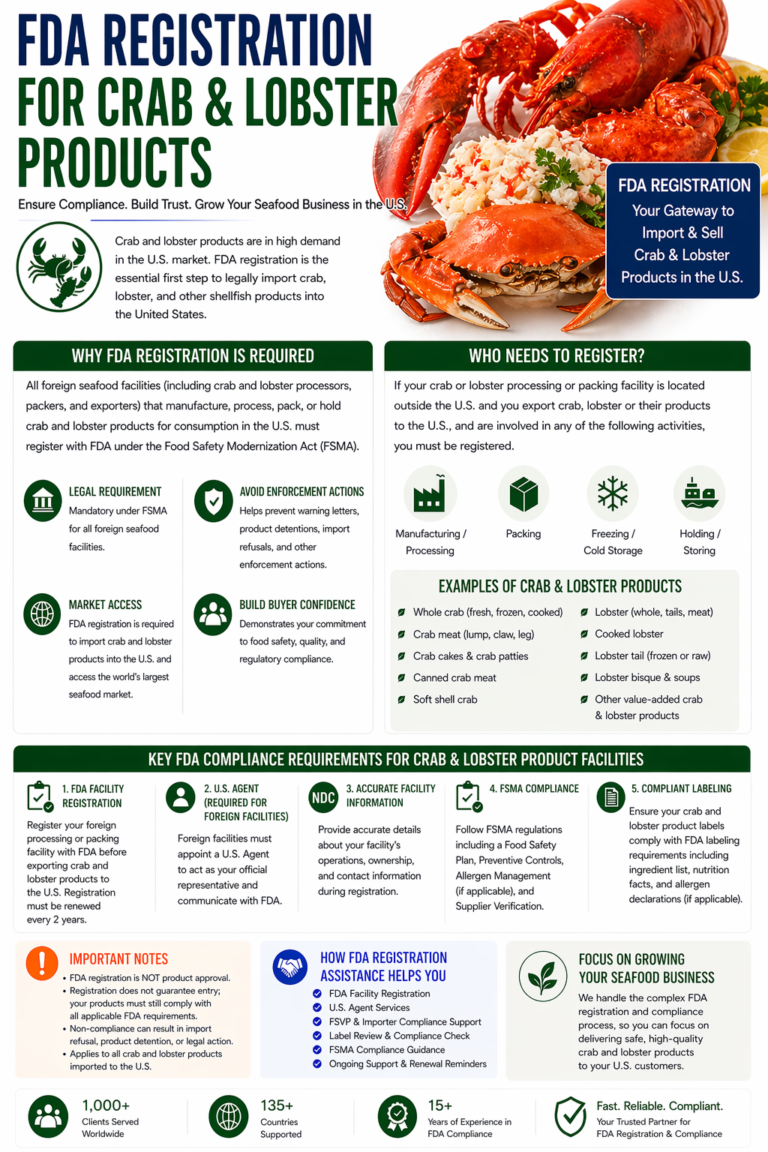
FDA Registration for Crab & Lobster Products
This guide covers FDA registration for all crab and lobster product forms, seafood HACCP requirements, the crustacean shellfish allergen obligation, the LACF distinction for canned crab, species identity labeling, FSVP for importers, and the most common reasons crab and lobster shipments are detained.
FDA Requirements Vary by Crab & Lobster Product Form — What Applies to Each
| Product Form | FDA Registration | Seafood HACCP | FCE & SID (LACF) | Key Hazard |
|---|---|---|---|---|
| Live crab or lobster | Required | Required | Not required (not thermally processed) | Vibrio, time-temperature control during transport |
| Fresh/frozen raw crab or lobster meat | Required | Required | Not required | Vibrio, time-temperature abuse, decomposition |
| Cooked crab meat — refrigerated, pasteurized (not shelf-stable) | Required | Required | Not required (not commercially sterile) | Listeria monocytogenes — primary hazard for RTE cooked crab meat |
| Shelf-stable canned crab (commercially sterile, pH > 4.6) | Required | Required | FCE + SID Required (LACF) | C. botulinum (LACF); Import Alert 36-07 if FCE/SID missing |
| Frozen cooked whole crab or lobster | Required | Required | Not required | Time-temperature control, post-cook contamination |
| Imitation crab / surimi | Required | Required | Not required (typically) | Fish allergen (not crustacean shellfish); species ID accuracy |
Listeria in Cooked Crab Meat & Vibrio in Raw and Live Shellfish
Listeria monocytogenes — Cooked Ready-to-Eat Crab Meat
Listeria monocytogenes is the primary food safety hazard for cooked, ready-to-eat crab meat — including refrigerated pasteurized crab meat in sealed containers. L. monocytogenes survives and grows in the cold, wet processing environments typical of crab processing facilities, even under continuous refrigeration. The CCP for cooked crab meat under seafood HACCP is typically post-cooking time-temperature control — preventing recontamination after the cook step and maintaining refrigeration through distribution. Cooked crab meat is one of FDA’s highest-scrutiny imported seafood categories for Listeria. Positive environmental or product Listeria findings can place a facility on Import Alert.
Vibrio — Raw and Live Crustacean Shellfish
Vibrio parahaemolyticus and Vibrio vulnificus are the primary pathogen hazards for raw and live crab and lobster. Vibrio species are naturally present in warm coastal waters and multiply rapidly in shellfish not properly chilled after harvest. For imported raw crab and live lobster, the FSVP hazard analysis must address the harvest environment, post-harvest chilling practices, and time-temperature controls through transport. Geographic origin matters — warm-water harvest origins have elevated Vibrio risk compared to cold North Atlantic lobster fisheries.
Heavy Metals — Chemical FSVP Hazard for Crab
Cadmium and lead contamination in crab are documented chemical hazards from certain geographic origins — particularly some Asian crab species. The FSVP hazard analysis for crab importers must address heavy metal risk based on the specific origin of the supplier’s harvest area. Periodic product testing for heavy metals may be required as a supplier verification activity for importers sourcing crab from higher-risk origins. FDA samples imported crab for heavy metals as part of its routine import monitoring program.
Shell Fragments — Physical Hazard in Processed Crab Meat
Shell fragments are a documented physical hazard in picked and processed crab meat. Fragments of crab shell that survive the picking process can cause dental injury if consumed. Seafood HACCP plans for crab processing operations must address shell fragment control — typically through visual inspection at the picking CCP, sorting procedures, and verification testing. Shell fragment detection and rejection is a standard HACCP control for crab meat processors.
Crab and Lobster Species Names Must Match the FDA Seafood List
King Crab
Paralithodes camtschaticus and related species. Premium species — most commonly counterfeited. Must be the correct Paralithodes species. Snow or queen crab substitution is fraud.
Snow Crab
Chionoecetes opilio. Acceptable market name on the FDA Seafood List. Distinct from king crab and queen crab — must be labeled correctly.
Dungeness Crab
Metacarcinus magister (formerly Cancer magister). West Coast U.S. species. Label must use the FDA Acceptable Market Name — “Dungeness Crab”.
Blue Crab
Callinectes sapidus. U.S. Atlantic and Gulf species. “Blue Crab” or “Blue Swimming Crab” are acceptable market names. Widely imported from Asia.
American Lobster
Homarus americanus. The classic New England/Canadian lobster. Entirely different from spiny/rock lobster. Labels must not use “lobster” interchangeably for both.
Spiny / Rock Lobster
Panulirus species. Clawless warm-water lobster — entirely different genus from American Lobster. Must be labeled “Spiny Lobster” or “Rock Lobster” — not just “Lobster.”
Imitation crab note: Surimi-based imitation crab is NOT crustacean shellfish — it is typically made from Alaska pollock (a fish). The label must identify it as “Imitation Crab,” “Surimi Seafood,” or similar. The allergen declaration is fish (not crustacean shellfish).
How to Register a Crab or Lobster Processing Facility with FDA
Activity Codes
Manufacture — cooking, picking, pasteurizing, canning, or further processing crab and lobster. Pack — packaging into retail or food service containers. Hold — if the facility warehouses finished product. Under 21 CFR 1.234, update within 60 days when new product categories are added.
Canned Crab — Also Needs FCE and SID
If your facility produces shelf-stable canned crab (pH above 4.6), your facility must also register as a Food Canning Establishment (FCE) and file a Scheduled Process (SID) for each product–container–process combination under 21 CFR Part 108. See the LACF Import Guide. FDA Registration Assistance coordinates FCE and SID filings alongside food facility registration.
FSVP for Crab and Lobster Importers
U.S. importers must maintain FSVP for each foreign supplier. The FSVP hazard analysis for crab and lobster must address Listeria (cooked products), Vibrio (raw/live), heavy metals, and species identity verification. FDA Registration Assistance develops FSVP programs specific to crab and lobster supply chains.
Biennial Renewal
Registration renews October–December of even years. For perishable seafood, a registration lapse causing port detention can result in spoilage and total product loss. FDA Registration Assistance manages all renewals automatically.
Ready to Get Your Crab or Lobster Products FDA-Compliant?
FDA Registration Assistance provides complete FDA compliance for crab and lobster processors and importers — Food Facility Registration with correct activity codes, U.S. Agent services, label compliance review including species identity and crustacean shellfish allergen declaration, FSVP programs, LACF FCE and SID coordination for canned crab, and Biennial Renewal management. Complete service: $858. FDA charges $0. DUNS fees separate. 1,000+ clients. 135+ countries. 15+ years of FDA regulatory experience.
Contact us at info@fdaregistrationassistance.com or call +1 (928) 275-8333.
Frequently Asked Questions — FDA Registration for Crab & Lobster Products
1. Do crab and lobster processors need FDA registration?
Yes. Facilities that process, pack, store, or hold crab and lobster products must register under 21 U.S.C. § 350d and 21 CFR Part 1 Subpart H. Foreign processors must also designate a U.S. Agent. Complete service: $858. FDA charges $0. DUNS fees separate.
2. What seafood HACCP requirements apply to crab and lobster processors?
Mandatory HACCP plans under 21 CFR Part 123 for all commercial crab and lobster processors. Covers: hazard analysis; CCPs; critical limits; monitoring; corrective actions; verification; and recordkeeping. Foreign processors must have HACCP programs. U.S. importers must verify foreign supplier HACCP compliance through FSVP supplier verification activities.
3. Is crustacean shellfish a major food allergen requiring declaration?
Yes. Crustacean shellfish is one of the nine major U.S. food allergens under FALCPA. Crab and lobster product labels must declare the crustacean shellfish allergen — “Contains: Crab” or “Contains: Lobster” — or through bold species identification in the ingredient list. The species name must be accurate and on the FDA Seafood List.
4. What are the primary food safety hazards for cooked crab meat?
Listeria monocytogenes is the primary hazard for cooked, ready-to-eat crab meat including refrigerated pasteurized crab. L. monocytogenes survives in cold, wet processing environments and can grow under refrigeration. The CCP under seafood HACCP is typically post-cooking time-temperature control and sanitation to prevent recontamination. Cooked crab meat is one of FDA’s highest-scrutiny imported seafood categories for Listeria.
5. What are the primary food safety hazards for raw and live crab and lobster?
Vibrio parahaemolyticus and Vibrio vulnificus are the primary pathogen hazards. Vibrio species are naturally present in warm coastal waters and multiply rapidly without proper post-harvest chilling. The FSVP hazard analysis must address harvest environment, post-harvest chilling, and time-temperature control through transport. Geographic origin matters — warm-water origins have elevated Vibrio risk.
6. Does canned shelf-stable crab require FCE and SID filings?
Yes — if the canned crab is shelf-stable (not refrigerated) with pH above 4.6. This makes it a Low-Acid Canned Food (LACF) under 21 CFR Part 113, requiring FCE registration and SID filing under 21 CFR Part 108.25. Missing FCE or SID triggers Import Alert 36-07. Refrigerated pasteurized crab meat (not commercially sterile) is NOT LACF and does not require FCE/SID. See the LACF Import Guide.
7. What is the difference between pasteurized refrigerated crab meat and shelf-stable canned crab?
Pasteurized refrigerated crab: heat-treated to destroy pathogens (L. monocytogenes) but not commercially sterile — requires continuous refrigeration. Not LACF. No FCE/SID needed. Subject to seafood HACCP. Shelf-stable canned crab: retorted to commercial sterility (C. botulinum destroyed) — shelf-stable at room temperature. IS LACF. Requires FCE and SID filings in addition to seafood HACCP.
8. What is the FDA Seafood List and why does species naming matter?
The FDA Seafood List provides Acceptable Market Names for seafood. Crab and lobster labels must use the correct species name: King Crab (Paralithodes camtschaticus), Snow Crab (Chionoecetes opilio), Dungeness Crab (Metacarcinus magister), Blue Crab (Callinectes sapidus), American Lobster (Homarus americanus), Spiny Lobster (Panulirus species). Species mislabeling is an active FDA enforcement area — FDA uses DNA testing to detect seafood fraud.
9. What is seafood economic fraud for crab and lobster?
Common fraud: selling snow or queen crab as king crab; selling spiny lobster as American lobster; mislabeling imitation crab as real crab; and origin misrepresentation. FDA uses DNA testing and species identification to detect fraud at U.S. ports. Mislabeled crab and lobster are subject to import refusal, recall, and Import Alert placement.
10. What FSVP requirements apply to U.S. importers of crab and lobster?
U.S. importers must maintain FSVP under 21 CFR Part 1 Subpart L for each foreign supplier. Hazard analysis must address: L. monocytogenes (cooked crab); Vibrio (raw/live); heavy metals — cadmium and lead (crab from some Asian origins); PCBs from contaminated harvest areas; shell fragments in processed crab meat; and species identity verification.
11. What labeling is required on crab and lobster products for the U.S. market?
Under 21 CFR Part 101: species-accurate statement of identity using FDA Seafood List name; net quantity; Nutrition Facts in 2020 FDA format with the 85g RACC; crustacean shellfish allergen declaration; manufacturer/distributor name and U.S. address; and any required process disclosures (“pasteurized,” “previously frozen”). All required text in English.
12. What is the FDA serving size (RACC) for crab and lobster?
The FDA RACC for shellfish and crustaceans (cooked) is 85g (approximately 3 oz) under 21 CFR Part 101.12. Using home country formats (100g comparison, 150g portion) is misbranding under 21 U.S.C. § 343.
13. Do foreign crab and lobster processors need a U.S. Agent?
Yes. Foreign processors must register and designate a U.S. Agent with a physical U.S. address. FDA Registration Assistance provides U.S. Agent services for foreign seafood processors.
14. What Prior Notice requirements apply to crab and lobster importers?
Prior Notice under 21 CFR Part 1 Subpart I must be filed before every shipment: 8 hours (ocean), 4 hours (air), 2 hours (road). Must include the foreign manufacturer’s correct FDA registration number and correct FDA product codes. For perishable seafood, Prior Notice errors causing port holds can result in spoilage.
15. What is the $858 complete service?
FDA Registration Assistance charges $858 — U.S. Agent designation for foreign processors, activity code selection, food product category selection, registration submission through FURLS, and Biennial Renewal management. FDA charges $0. DUNS fees are separate.
16. Why do crab and lobster shipments get detained at U.S. ports?
Most common causes: facility registration expired or not filed; missing crustacean shellfish allergen declaration; species mislabeling (wrong species name); for canned shelf-stable crab: missing FCE or SID (Import Alert 36-07); heavy metal contamination in crab from certain origins; Listeria contamination detected in cooked crab meat (places facility on Import Alert); Prior Notice errors.
17. What activity codes should a crab or lobster processor select?
Manufacture (cooking, picking, pasteurizing, canning, further processing); Pack (packaging into retail or food service containers); Hold (if the facility warehouses finished product). Under 21 CFR 1.234, update within 60 days when new product categories are added.
18. Is imitation crab (surimi) subject to the same requirements as real crab?
The processor must register with FDA and comply with seafood HACCP. But surimi-based imitation crab is NOT crustacean shellfish — typically made from Alaska pollock (a fish). Must be labeled as “Imitation Crab,” “Surimi Seafood,” etc. The allergen declaration is fish (not crustacean shellfish). Mislabeling surimi as real crab is misbranding.
19. What are the most common HACCP hazards for crab and lobster processors?
L. monocytogenes (cooked RTE crab — CCP: post-cook time-temperature control); Vibrio (raw/live — CCP: time-temperature after harvest); heavy metals including cadmium and lead (chemical hazard from some origins); decomposition/biogenic amines (chemical hazard from inadequate chilling); shell fragments in picked crab meat (physical hazard — CCP: inspection and sorting).
20. What Biennial Renewal requirements apply to crab and lobster registrations?
Registration renews every two years — October 1 through December 31 of even-numbered years. For perishable seafood, a registration lapse causing port detention can result in spoilage and total product loss. FDA Registration Assistance manages Biennial Renewal automatically.
21. Do lobster tanks and live seafood holding facilities need FDA registration?
Yes — if the live seafood holding facility holds live lobster or crab with intent to distribute in U.S. commerce, the facility may need to register as a food holding facility under 21 CFR Part 1 Subpart H. Fishing vessels engaged only in harvesting and transportation of live shellfish may qualify for the fishing vessel exemption under 21 CFR 1.226(c)(2) — but shore-based or vessel processing operations must register.
22. What FSMA Preventive Controls apply to crab and lobster manufacturers?
Seafood HACCP under 21 CFR Part 123 is the applicable food safety standard for crab and lobster processors and exempts them from the separate FSMA Preventive Controls requirements under 21 CFR Part 117 for those same seafood processing activities. However, seafood processors must still comply with the cGMP requirements in 21 CFR Part 117 Subpart B.
23. Can a crab or lobster processing facility get a fishing vessel exemption from FDA registration?
Fishing vessels engaged only in harvesting and transporting live shellfish (without cooking, picking, or further processing) may qualify for the fishing vessel exemption under 21 CFR 1.226(c)(2). Any vessel or shore-based facility that cooks, picks, pasteurizes, packs, or processes crab or lobster must register with FDA. The exemption is narrow and applies only to harvest and transport activities.
24. How does FDA Registration Assistance help crab and lobster processors and importers?
Complete FDA compliance: Food Facility Registration with correct activity codes; U.S. Agent for foreign processors; label compliance review including species identity and crustacean shellfish allergen declaration; FSVP programs; LACF FCE and SID coordination for canned crab; Prior Notice accuracy review; Biennial Renewal management. $858 service. FDA charges $0. 1,000+ clients. 135+ countries.
25. How do I get started with FDA registration for my crab or lobster processing facility?
Contact FDA Registration Assistance at info@fdaregistrationassistance.com or call +1 (928) 275-8333. Provide your facility name and address, crab and lobster product types (live, fresh, frozen, cooked, canned), whether domestic or foreign, and any existing FDA registration information. Complete service: $858. FDA charges $0. DUNS fees separate.