
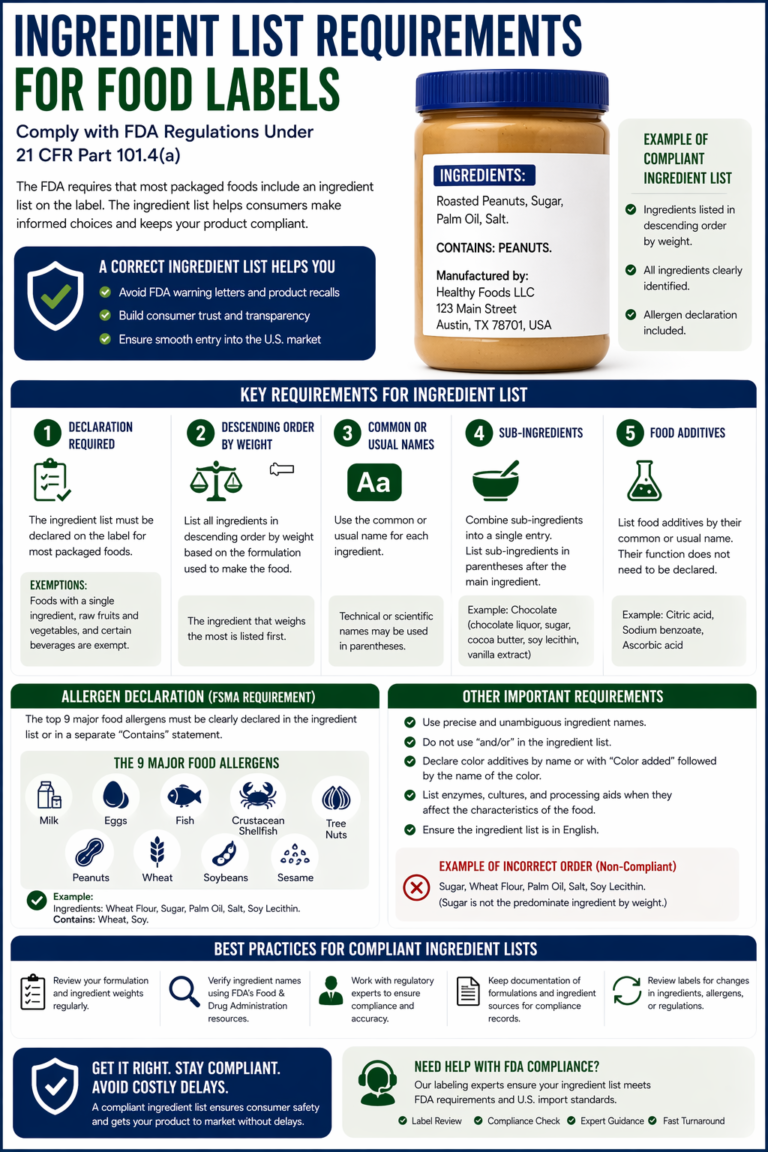
Ingredient List Requirements for Food Labels
The ingredient list is one of the most critical components of any food label in the United States. Regulated by the U.S. Food and Drug Administration, it ensures consumers know exactly what is in the product they are purchasing and consuming.
If your ingredient list is incomplete, incorrectly ordered, or improperly formatted, your product can be delayed, detained, or refused at the port of entry. For importers and food businesses, understanding FDA ingredient list requirements is essential for compliance and successful entry into the U.S. market.
Why Ingredient Lists Matter
Ingredient lists are not just informational—they are a legal requirement. The FDA uses them to verify that products are accurately represented and that consumers are protected from hidden ingredients or allergens.
Even small errors, such as missing sub-ingredients or incorrect ordering, can result in non-compliance and enforcement action.
Basic FDA Ingredient List Requirements
All ingredients in a food product must be declared on the label using their common or usual names.
Ingredients must be listed in descending order by weight, meaning the ingredient present in the greatest amount appears first, followed by others in decreasing quantities.
This rule applies to all ingredients, regardless of how minor they may seem.
Sub-Ingredients Must Also Be Declared
If an ingredient itself contains multiple components, those sub-ingredients must also be listed.
For example, if your product contains chocolate chips, the label must include the components of the chocolate chips such as sugar, cocoa, and other ingredients.
Failing to declare sub-ingredients is one of the most common reasons labels are rejected.
Allergen Labeling Requirements
The FDA requires that major food allergens be clearly declared on the label.
These include milk, eggs, fish, shellfish, tree nuts, peanuts, wheat, soy, and sesame.
Allergens can be declared within the ingredient list or in a separate “Contains” statement, but they must be clearly identifiable.
Improper allergen labeling is considered a serious violation and can lead to immediate enforcement action.
Use of Proper Ingredient Names
Ingredients must be listed using their common or usual names, not brand names or technical terms that consumers would not understand.
For example, “sugar” should be used instead of chemical names that may confuse consumers.
Using incorrect or misleading names can result in non-compliance.
Additives, Colors, and Preservatives
All additives, including colors, flavors, and preservatives, must be declared in the ingredient list.
Some additives require specific labeling, such as certified color additives or chemical preservatives.
Failure to properly declare these substances is a common compliance issue.
Formatting and Placement Requirements
The ingredient list must be clearly visible and placed on the information panel of the product packaging.
Font size must meet FDA minimum requirements to ensure readability.
The list must be presented in a single, continuous statement without unnecessary breaks.
Even formatting errors can result in non-compliance.
Common Ingredient Labeling Mistakes
Many food labels fail FDA compliance due to avoidable ingredient list errors.
Ingredients not listed in the correct order is a frequent issue.
Sub-ingredients are often omitted or incomplete.
Allergens may not be clearly declared.
Additives and preservatives may be missing from the list.
Incorrect naming or misleading terminology is another common problem.
These issues can delay shipments and require relabeling.
Imported Products and Ingredient Lists
Imported food products must meet the same FDA ingredient labeling requirements as domestic products.
Labels must be in English or include accurate translations.
Ingredient names must follow FDA conventions.
All required elements must be present and correctly formatted.
Many international labels do not meet these standards and must be updated before import.
How to Ensure Your Ingredient List Is Compliant
The best way to ensure compliance is to review your label before production and shipment.
This includes verifying ingredient order, confirming sub-ingredient declarations, and ensuring proper allergen labeling.
Professional label review services can identify issues early and help you correct them before they become costly problems.
Our Process for Ingredient List Compliance
FDA Registration Assistance provides expert label review services to ensure your ingredient list meets all FDA requirements.
We review your ingredient list against FDA regulations.
We identify missing or incorrect elements.
We ensure proper ordering and naming of ingredients.
We verify allergen and additive declarations.
We guide corrections to achieve full compliance.
Why Work with FDA Registration Assistance
Ingredient labeling compliance requires attention to detail and regulatory expertise.
FDA Registration Assistance has supported over 1,000 clients across 135+ countries, with more than 15 years of combined experience.
We ensure your labels meet FDA requirements so your products enter the U.S. market without delays or disruptions.
Frequently Asked Questions (FAQs)
What is an ingredient list on a food label?
An ingredient list shows all components used in a food product, listed in descending order by weight. It is required by the FDA for most packaged foods.
Do I need to list all ingredients?
Yes, all ingredients must be listed, including minor components and additives.
What does “descending order by weight” mean?
It means the ingredient present in the largest quantity appears first, followed by others in decreasing amounts.
Do I need to list sub-ingredients?
Yes, if an ingredient contains multiple components, those must also be declared.
How do I declare allergens?
Major allergens must be clearly identified in the ingredient list or in a separate “Contains” statement.
Can I use brand names in my ingredient list?
No, ingredients must be listed using their common or usual names.
Do I need to declare preservatives?
Yes, all preservatives and additives must be listed.
Is formatting important for ingredient lists?
Yes, font size, placement, and readability must meet FDA requirements.
Do imported products need to follow the same rules?
Yes, all imported food products must meet FDA labeling requirements.
What happens if my ingredient list is incorrect?
Your shipment may be delayed, detained, or refused, and you may need to relabel your product.
Do I need to declare flavors and colors?
Yes, all flavors and color additives must be declared.
Can I group ingredients together?
Ingredients must be listed individually unless specific grouping rules apply.
How long does a label review take?
Typically 2–3 business days depending on complexity.
Do I need professional help?
It is strongly recommended to ensure compliance and avoid costly mistakes.
Can one small mistake cause issues?
Yes, even minor errors can result in non-compliance.
Ensure Your Ingredient List Meets FDA Requirements
If you are preparing to import or sell food products in the United States, ensuring your ingredient list is fully compliant is essential.
FDA Registration Assistance provides professional label review services to verify your ingredient list meets all FDA requirements, helping you avoid delays, refusals, and costly relabeling.
Contact FDA Registration Assistance today at info@fdaregistrationassistance.com or call +1-928-275-8333 to ensure your label is fully compliant.