
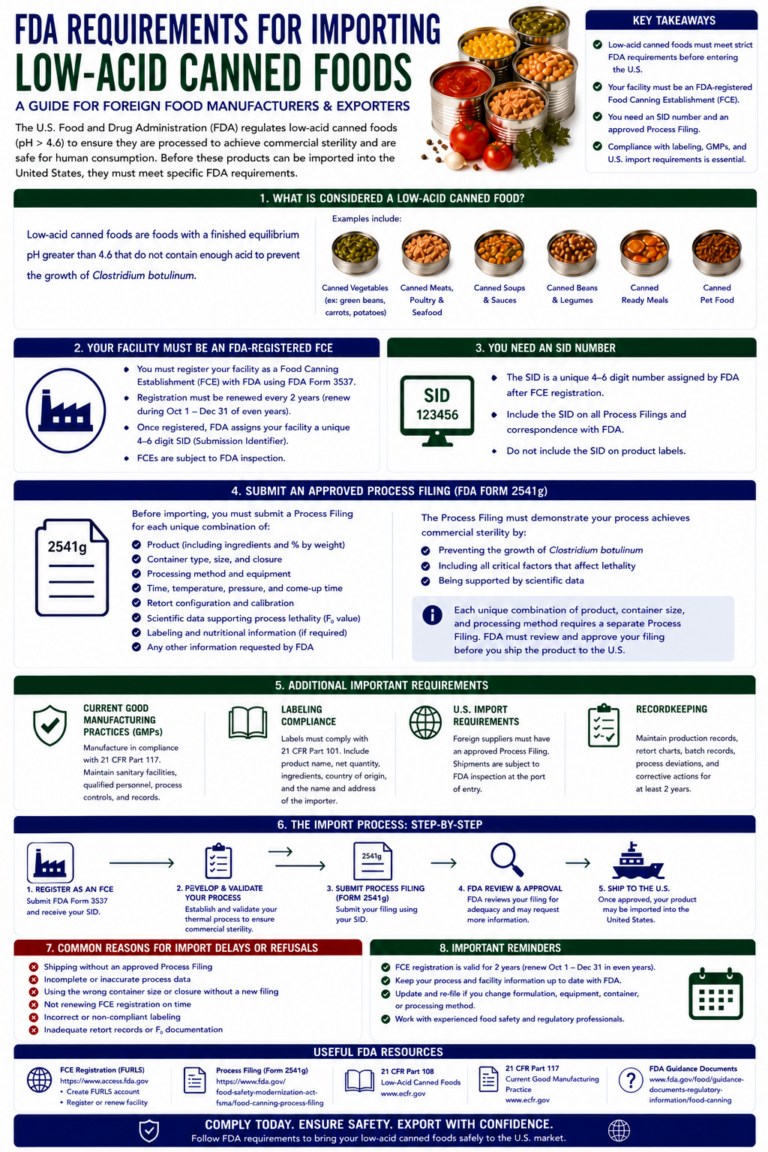
FDA Requirements for Importing Low-Acid Canned Foods (LACF)
This guide covers the LACF definition, FCE and SID filing requirements, hermetically sealed container types, Import Alert 36-07, OASIS screening, the Process Authority’s role, FSVP for LACF importers, and the pre-export deadline for SID filings.
What Is a Low-Acid Canned Food Under 21 CFR 113.3?
All three conditions must be met simultaneously. A product at pH 4.2 is not LACF (too acidic — acidified food instead). A product at pH 5.0 with water activity of 0.80 is not LACF (too dry). A product at pH 5.0 and aw 0.90 in an unsealed flexible bag is not LACF (not hermetically sealed). Common LACF products: canned vegetables, canned meats, canned seafood, canned soups and stews, canned beans, retort-pouch meals, certain canned dairy products.
FCE and SID Apply to All Hermetically Sealed Containers — Not Only Metal Cans
This is one of the most common LACF compliance misunderstandings. A hermetically sealed container under 21 CFR 113.3 means any container designed to prevent microorganism entry and maintain commercial sterility — the material does not matter. All of the following are hermetically sealed containers subject to FCE and SID requirements when filled with LACF-definition products:
Every Requirement That Must Be Completed Before the First LACF Shipment
Import Alert 36-07 — What Happens When FCE or SID Is Missing
Common Triggers for Import Alert 36-07
✗ Shipping LACF to the U.S. without any FCE registration
✗ FCE registered but SID not filed for the specific product–container combination
✗ Container size changed but no new SID filed for the new size
✗ Product shipped before SID filing was confirmed — no post-arrival cure
✗ Retort pouch or glass jar product — importer did not realize FCE/SID required
✗ FCE expired or inactivated and shipments continued
OASIS — How the Automatic Screening Works
OASIS (Operational and Administrative System for Import Support) is FDA’s electronic import screening system. At the time of Prior Notice filing, OASIS automatically cross-checks: FDA facility registration database (facility registered and current); Import Alert list (DWPE active for facility or product?); FCE/SID database (valid FCE and SID on file for this facility and LACF product category?). Most LACF detentions are triggered automatically by OASIS — no FDA inspector needs to review the shipment. The screening is instantaneous and unavoidable.
Clostridium botulinum — The Pathogen Driving the Entire LACF Framework
Why C. botulinum Makes LACF Different from Every Other Food
C. botulinum is an anaerobic (oxygen-hating) spore-forming bacterium that thrives in the exact conditions created inside a hermetically sealed container — low oxygen, low acid (pH above 4.6), adequate moisture. If not destroyed by adequate thermal processing, C. botulinum produces botulinum toxin, one of the most lethal biological substances known. As few as a few nanograms can be fatal. Botulism from inadequately processed canned food is rare but remains one of FDA’s highest-enforcement food safety priorities because the consequences are catastrophic and irreversible.
Commercial Sterility — What It Means
Commercial sterility under 21 CFR 113.3 means the condition achieved by heat application that renders the LACF product free from microorganisms capable of growing in the food under normal non-refrigerated conditions of storage and distribution. Commercial sterility does not mean the product is completely sterile — it means all pathogens including C. botulinum and all spoilage organisms capable of growing at room temperature have been eliminated. The Scheduled Process (SID) must be designed to achieve commercial sterility for the specific LACF product and container. The Process Authority validates that the Scheduled Process parameters accomplish this goal.
Need Help Getting Your LACF Products Cleared for U.S. Import?
FDA Registration Assistance provides complete LACF import compliance: Food Facility Registration and U.S. Agent services for foreign LACF processors; FCE registration coordination; Process Authority coordination and SID filing submission; FSVP programs for U.S. LACF importers; Prior Notice accuracy review; and Import Alert 36-07 removal support. If your LACF shipment is currently detained, contact us immediately for emergency response. 1,000+ clients. 135+ countries. 15+ years of FDA regulatory experience.
Contact us at info@fdaregistrationassistance.com or call +1 (928) 275-8333.
Frequently Asked Questions — FDA Requirements for Importing LACF
1. What are the FDA requirements for importing low-acid canned foods (LACF)?
All of the following must be completed before the first shipment: (1) FDA Food Facility Registration + U.S. Agent for foreign facilities; (2) FCE registration under 21 CFR Part 108.25; (3) Process Authority engagement and Scheduled Process validation; (4) SID filing for each product–container–process combination; (5) FSVP for the U.S. importer; (6) Prior Notice before each shipment. Missing any requirement before shipment causes detention.
2. What is a low-acid canned food (LACF) under FDA definitions?
Under 21 CFR 113.3: finished equilibrium pH greater than 4.6 AND water activity greater than 0.85 AND thermally processed in a hermetically sealed container. All three conditions must be met. The pH threshold is 4.6 — the point below which C. botulinum cannot grow.
3. What types of containers qualify as “hermetically sealed” for LACF?
Any container designed to prevent microorganism entry and maintain commercial sterility after processing: metal cans (two-piece and three-piece); glass jars with vacuum lids; retort pouches (flexible laminated pouches processed in a retort); and plastic cans/semi-rigid containers. FCE/SID requirements apply to all these formats — not only metal cans.
4. What is an FCE number and what is an SID number for LACF?
FCE (Food Canning Establishment): identifies the specific physical facility — one FCE per facility. SID (Submission Identifier): identifies a specific Scheduled Process for one product–container type–container size–process combination. One FCE can have many SIDs — one for each unique product/container/process. Both are required. See the SID Number Guide for full detail.
5. What is the SID filing deadline relative to shipment?
The SID filing must be completed and confirmed with FDA before the product ships. There is no post-arrival cure for a missing SID — a product that ships before its SID is on file is subject to automatic Import Alert 36-07 detention. OASIS checks the FCE/SID database at the time of Prior Notice filing, before the shipment arrives.
6. What is Import Alert 36-07 and how does it affect LACF importers?
Import Alert 36-07 subjects LACF products from foreign processors without valid FCE and SID filings to automatic Detention Without Physical Examination (DWPE) at U.S. ports. Every subsequent LACF shipment from the non-compliant facility is detained automatically. Removal requires completing FCE registration and SID filings and petitioning FDA.
7. How does FDA’s OASIS system screen LACF import shipments?
OASIS automatically checks Prior Notice filings against three databases: FDA facility registration (facility registered and current); Import Alert list (DWPE active?); and the FCE/SID database (valid FCE and SID on file?). Most LACF detentions are triggered automatically by OASIS — no FDA inspector needs to review the shipment individually.
8. What is a Process Authority and why is one required for LACF?
A Process Authority is a qualified food scientist with specialized thermal processing expertise who establishes the Scheduled Process parameters, validates that the process achieves commercial sterility for the specific LACF product, and provides signed documentation required for the SID filing. Without Process Authority documentation, the SID filing cannot be properly completed.
9. What is commercial sterility for LACF?
Under 21 CFR 113.3, commercial sterility means the condition achieved by heat that renders LACF free from microorganisms capable of growing under normal non-refrigerated storage conditions — principally C. botulinum. Not complete sterility — specifically freedom from pathogens and spoilage organisms that could grow at room temperature. The Scheduled Process (SID) must be designed to achieve commercial sterility.
10. What FSVP requirements apply to U.S. importers of LACF?
U.S. LACF importers must maintain FSVP under 21 CFR Part 1 Subpart L for each foreign supplier. The FSVP hazard analysis must address: C. botulinum (primary biological hazard); inadequate thermal processing (process control hazard); and container integrity failure. Supplier verification must include verification of valid FCE and SID filing.
11. What are the most common LACF import compliance failures?
No FCE registration; no SID filed for the specific product and container; wrong SID (container size changed, no new SID filed); SID filed after shipment (no post-arrival cure); no Process Authority documentation; and assuming FCE/SID only applies to metal cans (retort pouches and glass jars are also covered).
12. Does the FCE/SID requirement apply to retort pouches?
Yes. Retort pouches are hermetically sealed containers processed in a retort. If the food meets LACF criteria (pH above 4.6, aw above 0.85), FCE registration and SID filing are required — same as metal cans. Many importers of retort-pouched products (ready-to-eat meals, fish in sauce, soups in pouches) are unaware of this requirement.
13. Do glass jars of LACF require FCE/SID?
Yes — if the glass-jarred product meets the LACF definition. Common examples: pasta sauces not sufficiently acidified, stews and soups in glass jars, preserved vegetables in glass. FCE/SID requirements apply based on the food’s pH and water activity — not the container material. Each jar size typically requires its own SID.
14. What regulatory basis governs LACF import requirements?
21 CFR Part 108 (Emergency Permit Control) — the authority requiring FCE registration and Scheduled Process filing; 21 CFR Part 113 (Thermally Processed Low-Acid Foods) — the full LACF regulation covering definitions, production controls, coding, recordkeeping, and Scheduled Process filing; 21 CFR Part 1.94 — administrative detention at import.
15. What is the container coding requirement for LACF?
Under 21 CFR 113.60, each individual LACF container must bear a permanent code identifying the establishment where packed, the product, and the year, day, and period during which packed. Enables lot tracing in recalls. Containers without required coding may be detained as non-compliant.
16. How does FDA LACF registration differ from standard food facility registration?
Standard FDA Food Facility Registration (21 CFR Part 1 Subpart H) is required for all food facilities. FCE registration (21 CFR Part 108) is an additional, product-specific registration required specifically for LACF and acidified food processors. A foreign LACF facility needs both — a standard food facility registration AND an FCE with SID filings. Completing one does not satisfy the other.
17. What triggers a new SID filing for an existing LACF product?
A new SID is required for: changes to product formulation (different pH-affecting ingredients); changes in container type; changes in container size; changes in retort or processing equipment; changes in processing parameters (retort temperature, process time, come-up time); or changes to initial temperature range. Shipping a product with an unregistered process change is a violation.
18. Can LACF products be released from detention by providing missing FCE/SID documentation?
Possibly — but it is not guaranteed and takes time. For products on Import Alert 36-07 with active DWPE, individual shipment release and Import Alert removal are separate processes. The far better approach is completing all FCE and SID filings before the first export.
19. How many SIDs does a foreign LACF processor typically need?
One SID per unique combination of product formulation, container type, container size, and thermal process. A facility packing five products in three can sizes with one retort process needs 15 SIDs. Adding retort pouch versions adds more. Adding new container sizes adds more. Many foreign LACF facilities are surprised by the total number of SIDs required for their full product portfolio.
20. Why is C. botulinum the primary hazard driving LACF regulations?
C. botulinum is an anaerobic spore-former that thrives in the oxygen-free, low-acid interior of hermetically sealed containers. It produces botulinum toxin — one of the most lethal substances known, fatal in nanogram quantities. The entire LACF framework (the pH 4.6 threshold, commercial sterility requirements, Process Authority validation, Scheduled Process filings) exists to ensure C. botulinum and its toxin cannot survive in processed canned food.
21. What is the difference between LACF and acidified foods for FDA import?
LACF: thermally processed (retorted) to achieve commercial sterility — heat kills C. botulinum. Governed by 21 CFR Part 113. SID filed under 21 CFR 108.25. Import Alert 36-07. Acidified foods: low-acid foods acidified to pH at or below 4.6 — acid prevents C. botulinum growth. Governed by 21 CFR Part 114. SID filed under 21 CFR 108.35. Import Alert 36-08. Both categories require FCE/SID filings.
22. Does FCE/SID requirement apply to domestic U.S. LACF manufacturers?
Yes. FCE/SID requirements under 21 CFR Parts 108 and 113 apply equally to domestic and foreign LACF processors. FDA does not distinguish between the two. OASIS makes the import non-compliance immediately visible, but the underlying obligation is identical for domestic U.S. processors.
23. What record retention requirements apply to LACF processors?
Under 21 CFR 113.100: minimum 3 years from date of manufacture for shelf-stable LACF; minimum 2 years for refrigerated or frozen LACF. Required records: Scheduled Process documentation; production and process control records; container integrity examination records; incubation test records; and corrective action records for any Scheduled Process deviations. Records must be available to FDA inspectors on request.
24. What does FDA Registration Assistance do for LACF import compliance?
Complete LACF import compliance: Food Facility Registration and U.S. Agent services; FCE registration coordination; Process Authority coordination and SID filing; FSVP programs for U.S. LACF importers; Prior Notice accuracy review; and Import Alert 36-07 removal support. 1,000+ clients. 135+ countries. 15+ years of FDA regulatory experience.
25. How do I get started with LACF import compliance?
Contact FDA Registration Assistance at info@fdaregistrationassistance.com or call +1 (928) 275-8333. Provide your facility name and address, specific LACF products and container types, current FDA facility registration number if applicable, and any existing FCE information. If your LACF shipment is currently detained under Import Alert 36-07, contact us immediately for emergency response.