What You Need Before Your First Canned Food Shipment to the U.S.
A readiness verdict — are you actually ready to ship, or is something still blocking you?
Key Takeaways
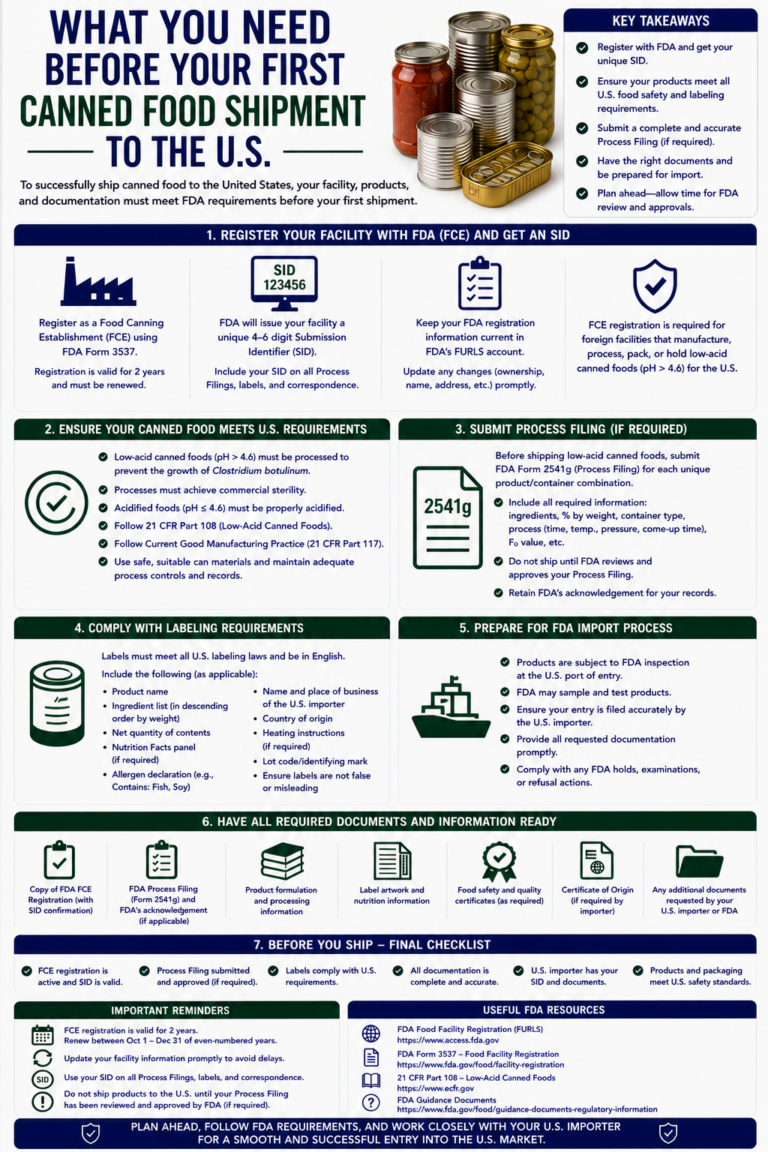
- Ready means complete, not started — every item finished and consistent.
- Six things must be in place — registration, FCE/SID, label, FSVP, prior notice.
- The first shipment gets no benefit of the doubt — no compliance history yet.
- Validation is usually the blocker — the process authority is the long pole.
- Nothing is fixable at the border — readiness is a before-you-ship question.
- Classification decides your path — confirm it first.
The First Shipment Has No Margin
On a first canned shipment, everything is being established for the first time — the FCE, the scheduled process, the validation, all new — and there's no track record behind your facility. That combination is why first shipments carry the most risk: if a filing is missing or a document doesn't match, it surfaces at entry, not before, and there's no history to smooth it over. Getting the first one right also shapes how your future shipments are reviewed, so "ready" has to mean genuinely ready.
Ready When… / Not Ready If…
Walk each requirement across both columns. You're ready to ship only when every row lands on the left.
What's Most Often Not Ready
If one row is holding you up, it's almost always row 3. Process-authority validation is the long pole — a technical evaluation of your process for each product that takes the most time of any step, and the one first-timers most often leave too late. Because your scheduled process filing depends on it, unfinished validation is the single most common reason a first canned shipment isn't actually ready.
Where to Go From Here
Make Sure You're Actually Ready
FDA Registration Assistance gets every readiness item in place and verifies it before you ship: Food Facility Registration and U.S. Agent, classification, FCE and scheduled process (SID) filings with process-authority coordination, label review, and a final consistency check — so your first shipment isn't a gamble.
Contact us at info@fdaregistrationassistance.com or call +1 (928) 275-8333. Food Facility Registration is available starting at $858. Trusted by companies across 135+ countries, with 15+ years of experience.
Frequently Asked Questions
1. What do I need before my first canned food shipment to the U.S.?
Six things must be verifiably in place: confirmed product classification with Food Facility Registration and a U.S. Agent, FCE registration and a validated scheduled process (SID) if your product is low-acid or acidified, a compliant label that matches your filing, FSVP assigned to your U.S. importer, and prior notice arranged. If any one of these isn't complete, you're not ready to ship — none of it can be finished at the border.
2. How do I know if I'm actually ready to ship?
You're ready only when every required item is complete and consistent — not merely started. Registration active, FCE and the scheduled process filed and validated, the label matching your formulation and filing, FSVP confirmed with your importer, and prior notice arranged. If you're waiting on any of them, especially process-authority validation, you're not ready yet.
3. Why does the first shipment carry the most risk?
Because everything is being established for the first time and there's no compliance history behind you. A first shipment gets no benefit of the doubt — if a filing is missing or a document is inconsistent, it's caught at entry. Getting the first one right also sets the tone for how future shipments are reviewed.
4. What's most often not ready in time?
Process-authority validation. It's a technical evaluation of your process for each product, it takes the longest of any step, and first-timers routinely leave it too late. Because the scheduled process filing depends on it, unfinished validation is the single most common reason a first canned shipment isn't actually ready.
5. What's the first thing to confirm?
Your product's classification — whether it's a low-acid canned food, an acidified food, or neither. It decides whether you're on the full FCE-and-scheduled-process track, and getting it wrong sends every later step in the wrong direction. A process authority should confirm it before you build your plan.
6. Do all canned foods require FCE and SID?
No, but many do — especially low-acid canned foods and acidified foods, which rely on validated thermal processing or acidification for safety. Naturally acidic foods and several excluded categories generally don't. Your classification determines whether these readiness items apply to your first shipment at all.
7. Can I ship before completing all FDA requirements?
No. Missing any required step — FCE, the scheduled process, a compliant label, FSVP, or prior notice — can lead to a hold or refusal, and it can't be resolved once the shipment is at the port. Shipping before everything is complete is the single most common first-timer mistake.
8. Who is responsible for FSVP?
The U.S. importer — the owner or consignee at entry — legally holds FSVP obligations. As a first-time exporter you don't hold it yourself, but part of being ready is confirming your importer has it assigned and documented, since it's commonly checked during clearance.
9. Who submits prior notice?
Usually the customs broker or importer, filed through FDA's system before the shipment arrives. It must include details that match your other filings. Being ready means confirming it's been arranged correctly rather than assuming it's handled by someone else.
10. Can labeling issues cause problems even if filings are correct?
Yes. A label that isn't compliant, or that doesn't match your formulation and the process on file, can hold a shipment on its own — even when every filing is correct. So a compliant, consistent label is one of the six readiness items, not an afterthought.
11. Can I fix issues after shipping?
In most cases, no. FDA checks compliance at entry, and missing filings or inconsistent documents generally can't be corrected once the goods are at the port. That's exactly why readiness is a before-you-ship question — the border isn't where problems get solved.
12. How long does it take to get ready?
There's no single fixed number — it depends on your product and how ready your information is. Registration is relatively quick; the process-authority validation behind your scheduled process is the part that takes longest. The practical advice is to start early, especially anything involving validation, rather than aim for a fixed date.
13. Does registration mean FDA approved my product?
No. Registration and the scheduled process filing are compliance steps, not an FDA approval or endorsement. FDA doesn't pre-approve foods or labels; being ready means your facility and validated process are on record and your documents are consistent — the product still has to meet all applicable requirements at entry.
14. How does FDA Registration Assistance help with a first shipment?
We get every readiness item in place and verify it before you ship: Food Facility Registration and U.S. Agent, classification, FCE and scheduled process (SID) filings, process-authority coordination, label review, and a final check that everything is complete and consistent. Starting at $858 for registration, for companies across 135+ countries. Contact info@fdaregistrationassistance.com or +1 (928) 275-8333.