
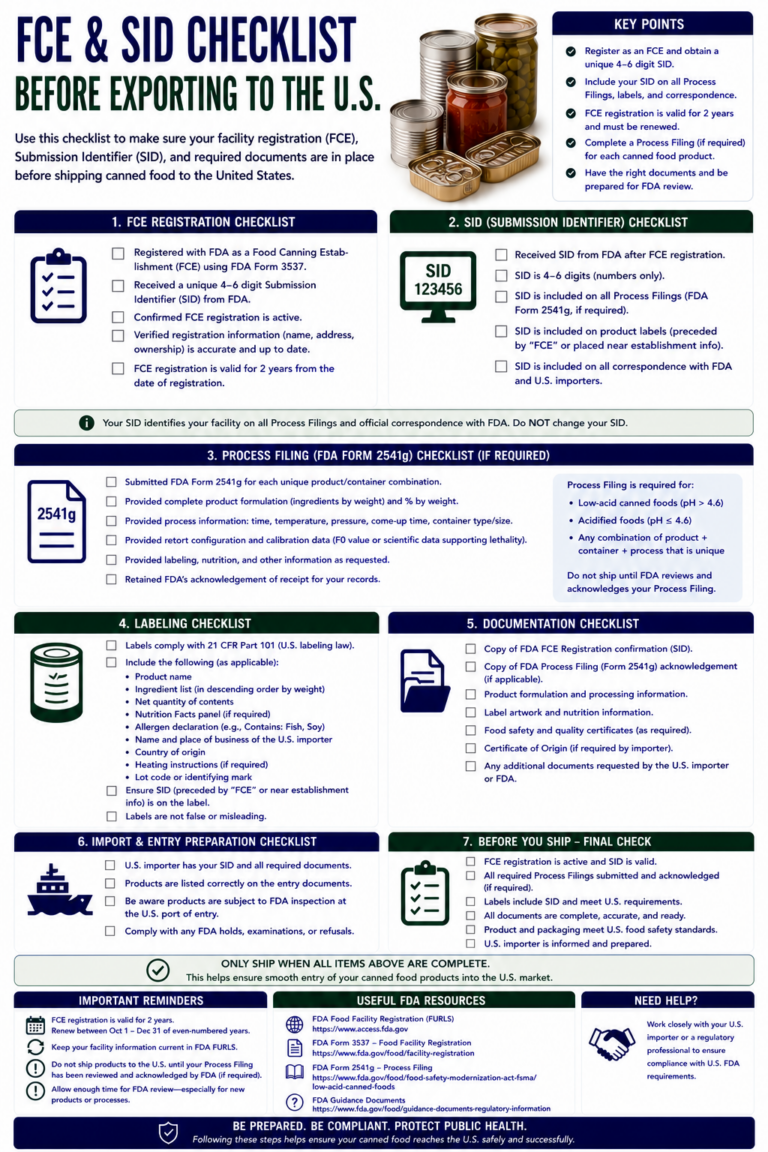
FCE & SID Checklist Before Exporting to the U.S.
This is the readiness tool — tick what you've done and it tallies your score, flags the gaps, and tells you what still needs to happen before you ship.
Key Takeaways
- Applies to low-acid canned foods (LACF) and acidified foods in hermetically sealed, shelf-stable containers.
- Classification first — it decides whether FCE and SID are even required.
- FCE ≠ Food Facility Registration — you need both, and FCE is the one most exporters miss.
- Every SID needs Process Authority validation, and real production must match the filing.
- Only the processor can file FCE/SID — never an importer or broker.
- Do it before you ship — corrections after a port hold can take weeks.
Your FCE & SID Pre-Export Checklist
Tick each item you've completed. Anything left unchecked is a gap to close before your shipment leaves the facility.
Check Your Readiness — 16 Points
For self-assessment. Not a substitute for a formal FDA compliance review.
The Failures That Cause FDA Holds
If the checklist surfaced unchecked items, these are the ones that most often stop shipments:
FCE done, SID missing
The establishment is registered but the scheduled processes were never filed.
SID not validated
A filing exists but isn't backed by Process Authority validation.
Label ≠ process
The label describes the product differently than the formulation or SID.
Misclassification
The acidified-vs-low-acid call, or pH/aw, was wrong.
FSVP not assigned
No importer FSVP confirmed for the product.
Prior Notice errors
Missing or inaccurate Prior Notice — a fast route to refusal.
Want the reasoning behind each item — what LACF and acidified foods are, how FCE and SID actually work? That's all in the FDA compliance for international food exporters guide.
Not 16 out of 16? Close the Gaps First.
Every unchecked item is a potential FDA hold. FDA Registration Assistance completes the whole list — registration and U.S. Agent, FCE and SID filings, Process Authority coordination, label review, and FSVP and Prior Notice guidance — so your shipment clears without surprises.
Contact us at info@fdaregistrationassistance.com or call +1 (928) 275-8333. Trusted by 1,000+ clients across 135+ countries, with 15+ years of FDA experience.
Frequently Asked Questions — FCE & SID Pre-Export Checklist
1. What is the FCE & SID checklist for exporting to the U.S.?
A pre-export readiness list for exporters of low-acid canned and acidified foods: classification, Food Facility Registration and U.S. Agent, FCE registration, Process Authority validation, SID filings for each product/variation, compliant labeling matching the filing, importer FSVP, and Prior Notice. The interactive tool above walks through each.
2. Do all products require FCE and SID?
No — only LACF (pH > 4.6, aw > 0.85, sealed, shelf-stable) and acidified foods (acidified to pH ≤ 4.6). Refrigerated, frozen, and naturally high-acid products generally don't, though they still need registration, labeling, FSVP where applicable, and Prior Notice.
3. Which step is most important?
Correct classification and validated SID. Classification decides whether FCE/SID apply, and a SID that's filed but not validated — or that doesn't match production — is a common failure.
4. Do I complete this checklist for every shipment?
Most steps are once per product and facility. Prior Notice is per shipment, and FSVP is maintained on an ongoing basis by the importer. Any product, container, or process change means re-checking the affected steps.
5. Can I file SID without a Process Authority?
No. A scheduled process must be established and validated by a qualified Process Authority, and the SID reflects that. An unvalidated SID isn't fully supported.
6. Can my importer or broker file FCE and SID?
No. Only the commercial processor can file. Importers, wholesalers, distributors, brokers, and repackagers cannot. As the processor, it's your responsibility before export.
7. Is FCE the same as Food Facility Registration?
No. Registration is the baseline; FCE is an extra step for canned/acidified foods, and FDA's FCE system only opens once your registration flags you as an acidified/low-acid processor. Doing registration but skipping FCE/SID is a common gap.
8. Does my real production have to match my SID?
Yes. Equipment, method, time, temperature, pressure, and pH must match the validated scheduled process. FDA checks for consistency, and a deviation is a problem even if both would be safe.
9. Does labeling have to match the SID?
Yes — the label must meet 21 CFR 101 and match the formulation and scheduled process. A mismatch can trigger a hold, so check them together.
10. How many SID filings do I need?
Generally one per product and container variation. Different products, sizes, or methods each need their own validated process and SID.
11. Who is responsible for FSVP?
The U.S. importer — but you must ensure it's properly assigned and that they have your documentation, including scheduled processes. A missing FSVP is a high risk of delay.
12. What is Prior Notice and when is it filed?
An electronic notice to FDA before each shipment arrives, with accurate details, usually coordinated with the broker. Errors can cause immediate refusal, so it's prepared for every shipment.
13. What documentation should I have ready?
FCE and SID records, Process Authority validation, finalized label files, and importer/FSVP documentation — all accessible, since FDA may request any of them.
14. What happens if I miss one step?
The shipment can be delayed, held, or refused. Because the steps interlock, one gap can stop it even when everything else is in order.
15. What are the most common failures?
FCE done but SID missing; SID not validated; label not matching the process; misclassification; FSVP not assigned; and Prior Notice errors.
16. Can I fix issues after shipping?
Usually no. Registration, FCE, SID, labeling, and Prior Notice must be complete before export. Corrections after a flag can take weeks and may end in refusal.
17. How long does it take to get FCE and SID ready?
The longest step is the Process Authority validating each scheduled process, plus registering and filing. Start well before your first shipment — it can't be rushed at the port.
18. Where can I learn what each item means in detail?
Our FDA compliance for international food exporters guide explains classification and the FCE/SID process in depth. This checklist is the hands-on companion to it.
19. Should I use professional assistance?
Most exporters do — classification, Process Authority coordination, FCE, and multiple SID filings are technical, and a hold or refusal costs far more than getting the checklist right up front.
20. How does FDA Registration Assistance help?
It handles registration and U.S. Agent, completes FCE and SID, coordinates Process Authorities, reviews labels for compliance and consistency with the filing, and supports FSVP and Prior Notice — so the whole checklist is done before your shipment is at risk.
21. How do I get started?
Contact FDA Registration Assistance at info@fdaregistrationassistance.com or call +1 (928) 275-8333. Share your product details — pH, water activity, packaging, processing method — and facility information for a readiness review before you ship.
