FDA Registration for Salt Products
The mandatory iodine statement most sellers miss — plus why salt skips process filing, and the additive and claim rules.
Key Takeaways
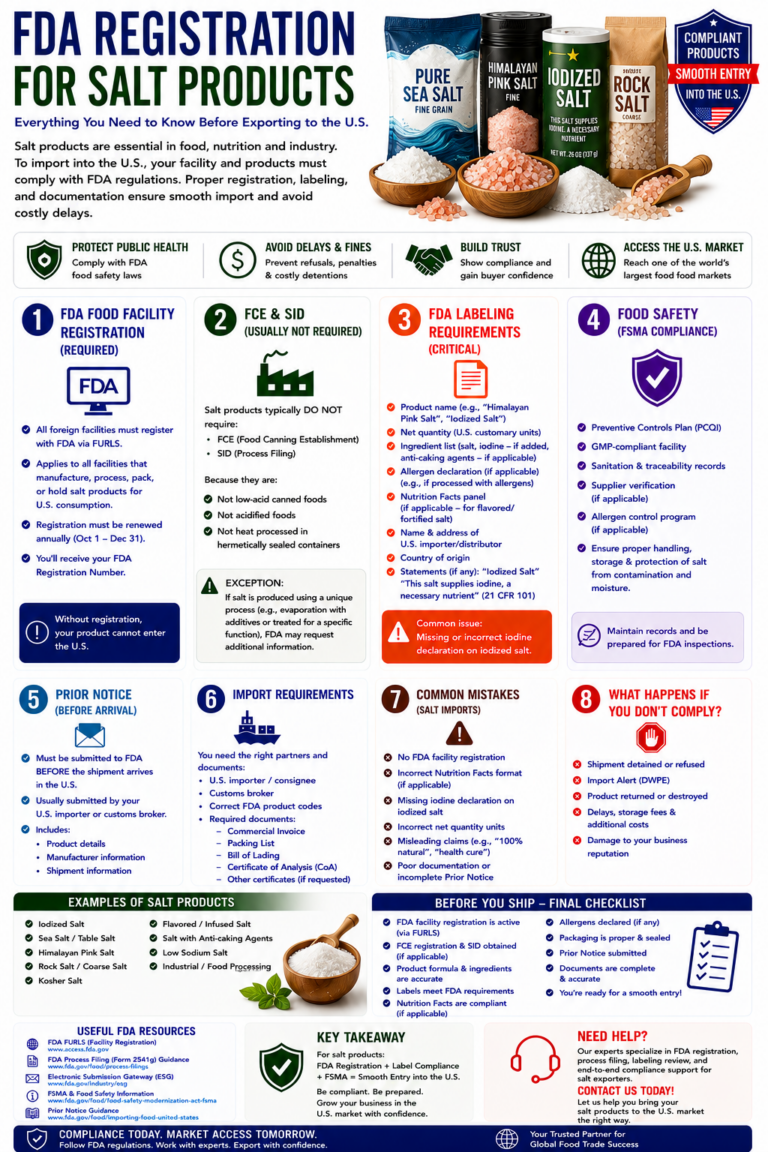
- Salt registers as a conventional food — facility registration + U.S. Agent if foreign.
- No FCE or SID — salt isn't low-acid canned or acidified.
- An iodine statement is mandatory — whether or not you iodize (21 CFR 100.155).
- Iodizing itself is voluntary — but the label statement isn't.
- Additives must be lawful & declared — anticaking agents, iodine source, stabilizer.
- Bath & de-icing salt aren't food salt — intended use decides.
The Iodine Labeling Statement
This is the single most common salt-labeling error, and it's specific to salt. Under 21 CFR 100.155, every retail salt package must carry an iodine statement — a set wording that depends on whether iodide was added:
| Your salt | Required statement (21 CFR 100.155) |
|---|---|
| Iodized (iodide added) | "This salt supplies iodide, a necessary nutrient" |
| Not iodized | "This salt does not supply iodide, a necessary nutrient" |
Salt Skips Process Filing
Good news that's worth stating plainly: salt does not require FCE registration or a scheduled process (SID). It's neither a low-acid canned food nor an acidified food, so the process-filing burden that applies to canned goods, sauces, and pickles simply doesn't apply here.
Additives & Ingredient Labeling
Even "plain" salt often isn't a single ingredient. Whatever's added must be a lawful additive or GRAS for the use, and declared:
- Anticaking agents — added to keep salt free-flowing; must be approved for the use and listed in the ingredients
- Iodine source — cuprous iodide or potassium iodide (the permitted forms), declared in the ingredient list
- Stabilizer — a small amount of dextrose is commonly used to stabilize the iodine in iodized salt, and is declared
- Blended & flavored salts — every added ingredient (herbs, spices, flavorings) must be listed, with any allergens declared
Claims & the Food-vs-Non-Food Line
Get Your Salt Products U.S.-Ready
FDA Registration Assistance handles facility registration and U.S. Agent, reviews your labeling against the salt-specific rules — the required iodine statement, additive declarations, sodium and mineral claims, and the Nutrition Facts panel — and sets up FSVP and import documentation for imported salt.
Contact us at info@fdaregistrationassistance.com or call +1 (928) 275-8333. Food Facility Registration is available starting at $858. Trusted by companies across 135+ countries, with 15+ years of experience.
Frequently Asked Questions
1. Do salt products need FDA registration?
Yes. Salt is a conventional food, so any facility that manufactures, processes, packs, or holds salt for the U.S. market must be registered with FDA, and foreign facilities need a U.S. Agent. Salt is low-risk, but registration, labeling, and (for imports) FSVP are still mandatory before it can be sold.
2. Do salt products need FCE registration or a scheduled process?
No. Salt is neither a low-acid canned food nor an acidified food, so it doesn't require Food Canning Establishment (FCE) registration or a scheduled process (SID) filing. That makes salt simpler than many food categories — the compliance effort is on facility registration, labeling (especially the iodine statement), and import verification rather than process filing.
3. What is the iodine labeling requirement for salt?
This is the salt-specific rule most sellers miss. Under 21 CFR 100.155, iodized salt must be labeled "iodized salt" or "iodized table salt" and carry the statement "This salt supplies iodide, a necessary nutrient." Salt without added iodide must carry the statement "This salt does not supply iodide, a necessary nutrient." Either way, a set iodine statement is required — and it must appear right after the product name, in letters at least as tall as the net-quantity declaration.
4. Do I have to iodize my salt?
No — adding iodine is voluntary in the U.S.; fortification isn't mandatory. But the labeling statement is not optional: if you don't iodize, your retail package must still state "This salt does not supply iodide, a necessary nutrient." So whether or not you add iodine, one of the two set statements has to be on the label. Leaving the statement off entirely is the common error.
5. How is iodine added to salt, and how is it declared?
Iodine is added as cuprous iodide or potassium iodide (the forms FDA permits for this use), often with a small amount of dextrose as a stabilizer. The iodine source appears in the ingredient list, the name must be "iodized salt," the "supplies iodide" statement must appear, and because a nutrient has been added, the percent Daily Value for iodine has to be listed in the Nutrition Facts. All of these move together for an iodized product.
6. What additives can salt contain, and how are they labeled?
Salt commonly contains anticaking agents (to keep it free-flowing) and, if iodized, an iodine source and stabilizer. Each additive must be an approved additive or GRAS for the use and declared in the ingredient list. A salt with anticaking agents may also carry a descriptive statement like "free flowing," but it can't be more prominent than the required iodine statement. Blended or flavored salts must list every ingredient.
7. What claims can I make on salt — like "sea salt" or mineral claims?
Descriptive names like "sea salt," "Himalayan pink salt," or "kosher salt" are fine if accurate, but sodium and health claims are regulated. Nutrient content claims like "low sodium" or "no salt added" have specific FDA definitions the product must meet, and mineral-content or health claims on specialty salts must be truthful and not misleading — you can't imply a specialty salt has meaningful nutritional benefits it doesn't. "Natural" claims also have to be accurate.
8. Is bath salt or de-icing salt regulated the same as food salt?
No. Only salt intended for human food use is regulated as food. Bath salts, cosmetic salts, de-icing salt, and industrial salt aren't food (bath and cosmetic salts fall under cosmetic rules; de-icing and industrial salt aren't FDA-regulated as food at all). The intended use determines the framework — so it's important that food-grade salt is produced, labeled, and marketed as food, and kept distinct from non-food salt.
9. What does the Nutrition Facts panel show for salt?
For plain salt, the Nutrition Facts panel is dominated by sodium, shown per serving with its percent Daily Value. If the salt is iodized, iodine's percent Daily Value must also appear because a nutrient was added. Flavored or blended salts show the nutrients contributed by their other ingredients too. The panel has to follow FDA's required format unless a small-package exemption applies.
10. Do imported salt products need FSVP?
Yes. If salt is imported, the U.S. importer holds FSVP and must verify the foreign supplier meets U.S. standards, with records available to FDA, plus prior notice before each shipment. Salt is low-risk, so the verification is usually straightforward — but the importer still needs the FSVP program in place, and the foreign facility must be registered.
11. What are the most common compliance mistakes for salt?
By far the most common is the iodine statement — either omitting it, or using the wrong one for the product. Others include undeclared anticaking agents, misleading mineral or health claims on specialty salts, missing facility registration or FSVP, and incorrect sodium claims. Most are simple to avoid once you know the salt-specific rules, especially 21 CFR 100.155.
12. Does FDA approve salt products before sale?
No. FDA doesn't pre-approve food or facilities — registration just puts the facility on record. Your salt product still has to meet all applicable requirements, and FDA enforces compliance at import and in the marketplace. There's no "FDA approved" salt; there's compliant salt, produced in a registered facility with correct labeling.
13. Can I sell salt on Amazon or in retail without compliance?
No. Retailers and marketplaces like Amazon expect FDA-compliant labeling and may request documentation or review products before listing, and a non-compliant label (a missing iodine statement, for instance) can get a listing removed. Compliance is required both to import and to sell, so it's best sorted before shipping or listing rather than after a hold or takedown.
14. How does FDA Registration Assistance help with salt products?
We handle facility registration and U.S. Agent, review your labeling against the salt-specific rules — the required iodine statement, additive declarations, sodium and mineral claims, and the Nutrition Facts panel — and set up FSVP and import documentation for imported salt. Starting at $858 for registration, for companies across 135+ countries. Contact info@fdaregistrationassistance.com or +1 (928) 275-8333.