
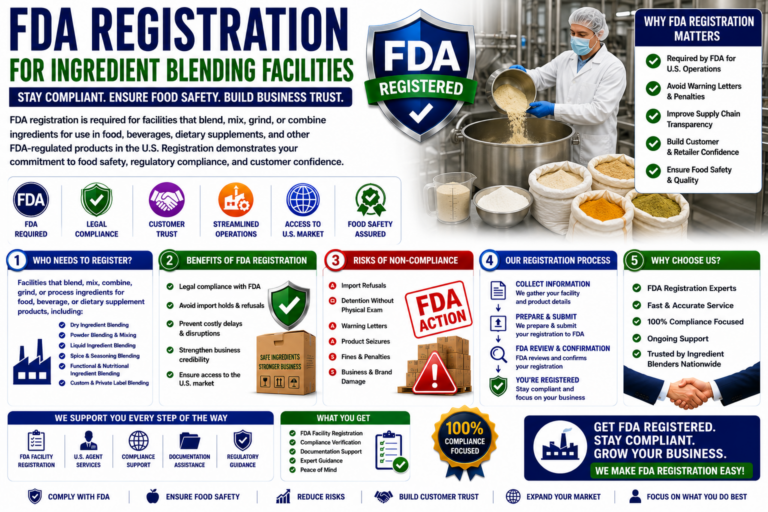
FDA Registration for Ingredient Blending Facilities
This guide covers FDA registration for all types of ingredient blending facilities — spice and seasoning blenders, flavor compound manufacturers, herb and botanical blenders, protein powder blenders, bakery premix blenders, and dietary supplement ingredient blenders — with the specific compliance requirements for each.
FDA Requirements for Each Type of Ingredient Blending Facility
| Blending Facility Type | FDA Registration | Applicable cGMP | Key Compliance Notes |
|---|---|---|---|
| Spice and seasoning blenders | Food Facility Registration — biennial | 21 CFR Part 117 | Allergen controls critical. Sesame as major allergen since January 2023 (FASTER Act) is high-priority for spice blenders. Multiple allergen cross-contact risk between production runs. |
| Flavor compound manufacturers | Food Facility Registration — biennial | 21 CFR Part 117 | Flavor ingredients must be GRAS or approved food additives. FEMA GRAS program applies. Activity codes: Manufacture and Pack. |
| Herb and botanical ingredient blenders | Food Facility Registration — biennial | 21 CFR Part 117 (food) or 21 CFR Part 111 (supplement) | Pesticide residue FSVP hazard for imported botanicals. GRAS status required for food applications. Identity testing required for supplement applications (Part 111). |
| Protein powder and supplement ingredient blenders | Food Facility Registration — biennial | 21 CFR Part 111 for supplement products; 21 CFR Part 117 for food products | Identity testing of incoming dietary ingredients; blend uniformity testing; finished product specifications under Part 111. Dual cGMP obligations if serving both food and supplement customers. |
| Bakery premix blenders | Food Facility Registration — biennial | 21 CFR Part 117 | High allergen cross-contact risk — wheat, milk, eggs, tree nuts common in bakery premixes. Written allergen segregation, cleaning protocols, and allergen testing procedures required. |
| Beverage premix and powder blenders | Food Facility Registration — biennial | 21 CFR Part 117 or 21 CFR Part 111 | Caffeine content must be within FDA guidance limits. Botanical ingredients must have appropriate regulatory status. Classification as food or supplement depends on claims and label. |
| Foreign ingredient blending facilities | Food Facility Registration + U.S. Agent — biennial | Same as domestic | Must designate U.S. Agent with physical U.S. address. FDA registration number in every Prior Notice for shipments to United States. Biennial renewal required same as domestic. |
Activity Codes and the Food vs. Supplement cGMP Decision
Activity Codes for Ingredient Blending Facilities
The Critical cGMP Decision — Part 117 vs. Part 111
21 CFR Part 117 — Conventional Food Ingredient Blenders
If the blending facility produces conventional food ingredient blends — spice blends, seasoning mixes, flavor compounds used as food ingredients, herb powder blends — the applicable cGMP is 21 CFR Part 117 (FSMA Preventive Controls for Human Food). Requires: written food safety plan; hazard analysis; allergen controls; sanitation controls; monitoring; corrective actions; and a PCQI.
21 CFR Part 111 — Dietary Supplement Ingredient Blenders
If the blending facility produces dietary supplement ingredient blends or finished supplements, the applicable cGMP is 21 CFR Part 111 (Dietary Supplement cGMPs). Part 111 requires: identity testing of incoming dietary ingredients; batch records; blend uniformity testing; finished product specifications; and independent laboratory verification. Many blending facilities serve both food and supplement customers — both cGMPs must be applied to the respective products.
Why Allergen Cross-Contact Is the Highest Priority for Multi-Product Blending Facilities
The Cross-Contact Risk in Ingredient Blending
Ingredient blending facilities that blend multiple products — some containing allergens, some allergen-free — face significant cross-contact risk between production runs. A spice blending facility producing both tree nut seasonings and allergen-free herb blends on the same equipment, without adequate cleaning between runs, risks allergen cross-contact in the allergen-free product. Under FSMA, allergen controls are a required type of preventive control for any facility where allergen cross-contact is a significant hazard.
The consequences cascade: if an ingredient blend contains undeclared allergens due to cross-contact, the blending facility’s customer — a food manufacturer using that blend — may have an allergen recall on their finished product. FDA may trace the source of the undeclared allergen back to the blending facility.
Sesame — The New Allergen Alert for Spice Blenders
Sesame became the 9th major U.S. food allergen under the FASTER Act effective January 1, 2023. Sesame seeds, sesame oil, and sesame paste are common in spice and seasoning blends — particularly in Middle Eastern, Asian, and Mediterranean seasoning profiles. A spice blending facility that processes sesame-containing blends alongside sesame-free blends must:
✓ Include sesame cross-contact as a significant hazard in the allergen hazard analysis
✓ Implement written allergen segregation and cleaning procedures addressing sesame
✓ Validate cleaning procedures to confirm sesame removal
✓ Declare sesame on all products containing sesame or at risk of sesame cross-contact
The Nine Allergens That Require Management in Blending Facilities
MilkCommon in bakery premixes, beverage powder blends, protein blends
EggsCommon in bakery premixes, pasta premixes, mayonnaise base blends
FishCommon in seasoning blends, umami flavor compounds (anchovy, fish sauce-derived)
ShellfishSeafood seasoning blends, coastal cuisine spice mixes
Tree NutsSpecific nut name required. Common in baking spice blends, trail mix seasoning
PeanutsSatay and Asian seasoning blends, snack seasoning blends
WheatBakery premixes, sauce base blends, soy sauce-containing seasoning blends
SoybeansAsian seasoning blends, protein blends, flavor compounds containing soy derivatives
⚠ Sesame — Since January 2023Middle Eastern, Asian, and Mediterranean spice blends. High priority for spice blenders. FASTER Act.
FSVP Obligations for Ingredient Blending Facilities That Import Raw Materials
Ingredient blending facilities that import raw botanical ingredients, spices, herbs, or other raw materials from foreign suppliers may have Foreign Supplier Verification Program (FSVP) obligations under 21 CFR Part 1 Subpart L if they are the U.S. owner or consignee of those ingredients at time of U.S. entry:
Pesticide Residues — Primary FSVP Hazard
FDA actively monitors imported spices and botanical ingredients for pesticide residues. Several Import Alerts are active for pesticide residue violations in imported herbs and spices. An ingredient blending facility importing raw spice or botanical materials must include pesticide residue as a chemical hazard in its FSVP hazard analysis and implement supplier verification activities — typically third-party pesticide residue testing certificates or laboratory test results.
Heavy Metals and Pathogen Contamination
Heavy metals (lead, arsenic, cadmium) are documented concerns for certain botanical ingredients, particularly herbs and spice ingredients from specific origins. Salmonella contamination in spices is a documented food safety issue that has caused multiple product recalls. The FSVP hazard analysis for imported spice and botanical ingredients must address all relevant hazards — not just pesticides.
How to Register an Ingredient Blending Facility with FDA
Step 1 — Confirm Registration and Applicable cGMP
FDA Registration Assistance reviews the blending facility’s products — conventional food ingredient blends or dietary supplement ingredient blends — to confirm the registration obligation and determine whether 21 CFR Part 117 (food), 21 CFR Part 111 (supplement), or both apply to the facility’s production.
Step 2 — Select Activity Codes and Categories
All applicable activity codes (Manufacture, Pack, Hold) and food product categories are selected. Under 21 CFR 1.234, the registration must be updated within 60 days when new food product categories are added to the facility’s production mix.
Step 3 — Submit Registration
FDA Food Facility Registration submitted through FURLS. U.S. Agent designation completed simultaneously for foreign blending facilities. FDA registration number provided upon confirmation.
Step 4 — Manage Biennial Renewal
FDA Registration Assistance tracks the Biennial Renewal window (October–December of even years) and submits renewals automatically. A missed renewal cancels the registration and can disrupt ingredient supply to the blending facility’s food manufacturer customers.
Ready to Register Your Ingredient Blending Facility with FDA?
FDA Registration Assistance provides complete FDA compliance for ingredient blending facilities — spice blenders, flavor compound manufacturers, herb and botanical blenders, protein powder blenders, bakery premix blenders, and dietary supplement ingredient blenders. Complete service: $858. FDA charges $0. DUNS fees separate. 1,000+ clients. 135+ countries. 15+ years of FDA regulatory experience.
Contact us at info@fdaregistrationassistance.com or call +1 (928) 275-8333.
Frequently Asked Questions — FDA Registration for Ingredient Blending Facilities
1. Do ingredient blending facilities need FDA registration?
Yes. Combining food ingredients into a blend is manufacturing food under 21 CFR 1.227. Any facility that manufactures food for U.S. consumption must register under 21 U.S.C. § 350d and 21 CFR Part 1 Subpart H. This applies whether the blended product is sold B2B to other food manufacturers or directly to consumers. Complete service: $858. FDA charges $0. DUNS fees separate.
2. Why does ingredient blending constitute manufacturing under FDA rules?
Under 21 CFR 1.227, manufacturing means making food — which includes combining, mixing, or blending ingredients to create a food product. The fact that the blended ingredient product is sold B2B to other food manufacturers rather than to consumers does not change the classification. Blending spice mixes, seasoning blends, flavor compounds, or herb powders is manufacturing food under FDA’s definition.
3. What activity codes should an ingredient blending facility select?
Manufacture — combining, mixing, or blending ingredients; primary activity code for all ingredient blending facilities. Pack — placing blended product into packaging for distribution. Hold — if the facility also stores finished blended product. Most blending facilities select Manufacture and Pack at minimum.
4. What FSMA Preventive Controls requirements apply to ingredient blending facilities?
Full FSMA Preventive Controls under 21 CFR Part 117: written food safety plan; hazard analysis; allergen controls (highest priority for multi-product blending); sanitation controls; process controls; monitoring; corrective actions; verification; and a PCQI. For dietary supplement ingredient blenders, 21 CFR Part 111 applies instead of Part 117.
5. Why are allergen controls the most critical FSMA requirement for ingredient blenders?
Ingredient blending facilities that blend products with different allergen profiles on shared equipment face significant allergen cross-contact risk between production runs. An allergen cross-contact event at the blending facility can trigger recalls at the customer food manufacturer’s level. Sesame as a major allergen (FASTER Act, January 2023) is particularly impactful for spice and seasoning blenders.
6. What is the difference between 21 CFR Part 117 and 21 CFR Part 111 for blending facilities?
21 CFR Part 117 (FSMA Preventive Controls for Human Food) applies to conventional food ingredient blenders. 21 CFR Part 111 (Dietary Supplement cGMPs) applies to dietary supplement ingredient blenders — requiring identity testing of incoming dietary ingredients, batch records, blend uniformity testing, and finished product specifications. Blending facilities serving both food and supplement customers must apply both regulations to their respective products.
7. Do dietary supplement ingredient blending facilities need a different FDA registration?
No — same FDA Food Facility Registration form and FURLS portal. However, the applicable cGMP for supplement products is 21 CFR Part 111, not Part 117. Blending facilities that produce both food and supplement ingredients must comply with Part 117 for food products and Part 111 for supplement products simultaneously.
8. What is the FSVP requirement for ingredient blending facilities that import raw botanical ingredients?
Blending facilities that import raw botanical ingredients and are the U.S. owner or consignee at time of U.S. entry must maintain an FSVP under 21 CFR Part 1 Subpart L for each foreign supplier. The FSVP hazard analysis must address pesticide residues (primary hazard for imported botanicals), heavy metals, pathogen contamination, and foreign material.
9. Do spice and seasoning blending facilities need FDA registration?
Yes. Blending individual spice ingredients into seasoning blends is manufacturing food. 21 CFR Part 117 applies. Allergen controls are the highest-priority preventive control — sesame specifically has been a major allergen concern for spice blenders since January 2023 (FASTER Act). Complete service: $858.
10. Do herb and botanical ingredient blending facilities need FDA registration?
Yes. Herb and botanical ingredient blending facilities must register. FSVP obligations may apply for imported raw botanicals. Pesticide residue monitoring is a critical supplier verification activity. Botanical ingredients must have GRAS status for food applications or approved dietary ingredient status for supplement applications.
11. Do protein powder and supplement ingredient blending facilities need FDA registration?
Yes. Protein powder blending facilities must register with FDA. If producing dietary supplement products or ingredients, 21 CFR Part 111 cGMPs apply — including identity testing of incoming protein ingredients, blend uniformity verification, and finished product specifications.
12. Do flavor compound manufacturers need FDA registration?
Yes. Flavor compound manufacturers producing flavoring ingredients for food manufacturers are manufacturing food ingredients and must register. Flavor ingredients must be GRAS or approved food additives. The FEMA GRAS program is the primary basis for flavor ingredient safety determinations in the United States.
13. Do foreign ingredient blending facilities exporting to the U.S. need FDA registration?
Yes. Foreign ingredient blending facilities must register with FDA and designate a U.S. Agent with a physical U.S. address. The foreign blending facility’s FDA registration number must appear in every Prior Notice for ingredient shipments to the United States.
14. What allergens must ingredient blending facilities manage?
All nine major U.S. food allergens: milk, eggs, fish (species name required), shellfish (species name required), tree nuts (specific nut name required), peanuts, wheat, soybeans, and sesame (FASTER Act, effective January 1, 2023). Each must be declared on blended product labels and managed to prevent cross-contact between allergen-containing and allergen-free blends.
15. What is the $858 complete service for ingredient blending facility registration?
FDA Registration Assistance charges $858 — U.S. Agent designation for foreign blending facilities, activity code selection, food product category selection, registration submission through FURLS, and Biennial Renewal management. FDA charges $0. DUNS fees are separate.
16. What is the Biennial Renewal for ingredient blending facility registrations?
FDA Food Facility Registration renews every two years — October 1 through December 31 of every even-numbered year. Missing the window causes automatic cancellation and can disrupt ingredient supply to the blending facility’s food manufacturer customers.
17. What food product categories should an ingredient blending facility select?
Select all FDA food product categories corresponding to the blended products manufactured: spices, flavors, and salting agents (for spice and seasoning blenders); dietary supplements (for supplement blenders); bakery products (for bakery premix blenders); and other applicable categories. Under 21 CFR 1.234, update within 60 days when new food product categories are added.
18. Does an ingredient blending facility need to update its registration when it adds new products?
Yes. Under 21 CFR 1.234, update within 60 days when food product categories change. A spice blender adding dietary supplement blending must update registration and apply 21 CFR Part 111 cGMPs to the new supplement products within 60 days.
19. Can FDA inspect an ingredient blending facility?
Yes. FDA has authority to inspect registered ingredient blending facilities. During an inspection, FDA may review allergen control procedures, cleaning and sanitizing records, FSMA Preventive Controls documentation, cGMP compliance, FSVP records for imported raw ingredients, and product labeling for blended ingredient products.
20. Does FDA registration mean FDA has approved the ingredient blending facility?
No. FDA Food Facility Registration means the facility is in FDA’s regulatory system as required by law — not that the facility or its blended products are FDA-approved. FDA does not pre-approve food ingredient blends. Registration enables traceability and inspection authority.
21. What are the most common FDA compliance mistakes by ingredient blending facilities?
Most common: not registering because the facility sells B2B (mistakenly believing the customer’s registration covers the blending facility); wrong activity codes; inadequate allergen controls for multi-allergen blending operations; not applying 21 CFR Part 111 when blending dietary supplement products; missing Biennial Renewal; and no FSVP for imported raw botanical ingredients.
22. Do bakery premix blending facilities need FDA registration?
Yes. Bakery premix blending facilities combining flour, leavening agents, dried eggs, dried milk, and other ingredients into premix blends are manufacturing food and must register. Allergen controls are critical — bakery premixes typically contain wheat, milk, and eggs, with significant cross-contact risk between different premix formulations sharing equipment.
23. What is the PCQI requirement for ingredient blending facilities?
Ingredient blending facilities subject to full FSMA Preventive Controls under 21 CFR Part 117 must have a PCQI who developed or oversaw the food safety plan. The PCQI must have training equivalent to the FSPCA Preventive Controls for Human Food curriculum. Very small blending facilities (under $1M annual food sales) may qualify for the Qualified Facility Exemption from full documentation requirements but still must register and comply with cGMPs.
24. How does FDA Registration Assistance help ingredient blending facilities?
Complete FDA compliance: Food Facility Registration with correct activity codes; U.S. Agent for foreign blending facilities; Biennial Renewal management; food vs. supplement cGMP determination; FSVP for imported botanical ingredients; allergen control compliance guidance. $858 service. FDA charges $0. DUNS fees separate. 1,000+ clients. 135+ countries.
25. How do I get started with FDA registration for my ingredient blending facility?
Contact FDA Registration Assistance at info@fdaregistrationassistance.com or call +1 (928) 275-8333. Provide your blending facility name and address, the types of ingredient blends you manufacture, whether you produce food or dietary supplement ingredients (or both), whether you import any raw ingredients, and any existing FDA registration information. Complete service: $858. FDA charges $0. DUNS fees separate.