
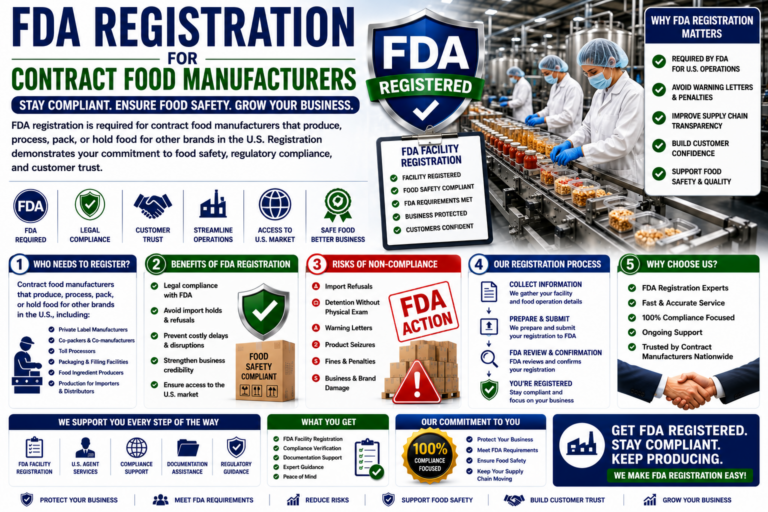
FDA Registration for Contract Food Manufacturers
This guide explains exactly who registers, how compliance responsibilities divide between the contract manufacturer and the brand, what happens when the brand imports from a foreign co-packer, and what both parties must have in place to stay compliant.
Contract Manufacturer vs. Private Label Brand — Complete Responsibility Split
Which Activity Codes Apply to Contract Food Manufacturing Facilities
Under 21 CFR 1.234, the registration must be updated within 60 days when new food product categories are added to the facility’s production. A new brand client that introduces a food category not previously manufactured at the facility triggers this update obligation.
When the Co-Packer Is Overseas — What Both Parties Must Have
This is the highest-risk compliance structure in private label food — and the most common source of import detentions. Three independent compliance requirements must be satisfied simultaneously:
FSMA Preventive Controls and Allergen Management at Contract Manufacturing Facilities
The Contract Manufacturer’s FSMA Obligations
A contract food manufacturing facility subject to FSMA must maintain a full Preventive Controls program under 21 CFR Part 117: written food safety plan; hazard analysis for each product category manufactured; allergen controls, sanitation controls, and process controls; monitoring procedures; corrective actions; verification activities; and a PCQI who developed or oversaw the food safety plan. These obligations belong to the contract manufacturer — not the brand. The brand cannot substitute its own food safety systems for the co-packer’s.
Allergen Controls — Critical for Multi-Brand Co-Packers
Contract manufacturers that run multiple brand products on shared production lines face the highest allergen cross-contact risk in the food industry. A co-packer running a peanut-containing product immediately before a peanut-free product without adequate cleaning and verification creates a cross-contact hazard. Under FSMA, allergen controls are a required preventive control type. The nine U.S. major allergens — including sesame since January 2023 (FASTER Act) — must all be managed with written procedures, cleaning validation, and verification testing.
How to Register a Contract Food Manufacturing Facility with FDA
Step 1 — Confirm Who Registers
The contract manufacturer registers the physical facility. The brand confirms which co-packer facility will be named in Prior Notice and verifies that facility’s registration is current. If importing from a foreign co-packer, the brand confirms its FSVP obligations.
Step 2 — Select Activity Codes and Categories
All applicable activity codes (Manufacture, Pack, Hold) and food product categories are selected for the co-packer’s facility. Correct category selection matters — incorrect or missing categories can cause Prior Notice mismatches. Update required within 60 days when new categories are added.
Step 3 — Submit Registration and Designate U.S. Agent
FDA Food Facility Registration submitted through FURLS. For foreign contract manufacturers: U.S. Agent designation completed simultaneously. FDA registration number provided for use in Prior Notice filings.
Step 4 — Manage Biennial Renewal
FDA Registration Assistance tracks the Biennial Renewal window (October–December of even years) and submits renewals. If the co-packer’s registration lapses, the brand’s products come from an unregistered facility — triggering import detention and potential prohibited act violations.
Ready to Register Your Contract Food Manufacturing Facility with FDA?
FDA Registration Assistance provides complete FDA compliance for contract food manufacturers and the brands that work with them — Food Facility Registration with correct activity codes, U.S. Agent designation for foreign co-packers, FSVP programs for brands importing from foreign contract manufacturers, Biennial Renewal management, and ongoing compliance support. Complete service: $858. FDA charges $0. DUNS fees separate. 1,000+ clients. 135+ countries. 15+ years of FDA regulatory experience.
Contact us at info@fdaregistrationassistance.com or call +1 (928) 275-8333.
Frequently Asked Questions — FDA Registration for Contract Food Manufacturers
1. Does a contract food manufacturer need FDA registration?
Yes. A contract food manufacturer (co-packer) that manufactures, processes, packs, or holds food for U.S. consumption at its physical facility must register that facility with FDA under 21 U.S.C. § 350d and 21 CFR Part 1 Subpart H. Complete service: $858. FDA charges $0. DUNS fees separate.
2. Does the private label brand or the contract manufacturer need to register with FDA?
The contract manufacturer registers the physical facility. The brand does not register its corporate headquarters — unless it also physically manufactures food there. This is the most common compliance gap: brands think they should register; contract manufacturers think the brand handles it. The contract manufacturer registers; the brand has separate but different compliance obligations (labeling, FSVP if importing).
3. What is the private label brand’s FDA obligation if it does not manufacture the food itself?
As the responsible firm under 21 CFR Part 101.5: (1) full food labeling compliance under 21 CFR Part 101; (2) verify the contract manufacturer’s registration is current; (3) if importing from a foreign co-packer, maintain FSVP for the foreign contract manufacturer under 21 CFR Part 1 Subpart L.
4. What activity codes should a contract food manufacturer select?
Manufacture — making food from ingredients (primary code for all co-packers). Pack — filling and packaging product for brands. Hold — if the co-packer also stores finished product before shipment. Most contract manufacturers select Manufacture and Pack at minimum.
5. What FSMA Preventive Controls requirements apply to contract food manufacturers?
Full FSMA Preventive Controls under 21 CFR Part 117: written food safety plan; hazard analysis; allergen controls; sanitation controls; process controls; PCQI; monitoring; corrective actions; verification. These obligations belong to the contract manufacturer — not the brand. Dietary supplement co-packers must also comply with 21 CFR Part 111.
6. Do foreign contract manufacturers need FDA registration?
Yes. Foreign co-packers that produce food for U.S. distribution must register under 21 CFR Part 1 Subpart H and designate a U.S. Agent. The foreign co-packer’s FDA registration number must appear in every Prior Notice for food shipments to the United States. There is no foreign company exemption.
7. Does the brand need FSVP if it imports food from a foreign contract manufacturer?
Yes — if the brand is the U.S. importer of record (the brand’s name is on the CBP entry as importer of record), the brand is the FSVP importer under 21 CFR Part 1 Subpart L. The brand must maintain a written FSVP for the foreign co-packer including hazard analysis, supplier verification activities, corrective actions, and 2-year records.
8. What is the $858 service for contract food manufacturer registration?
FDA Registration Assistance charges $858 — U.S. Agent designation for foreign co-packers, activity code selection, food product category selection, registration submission through FURLS, and Biennial Renewal management. FDA charges $0. DUNS fees are separate.
9. What is the Biennial Renewal for contract food manufacturer registrations?
FDA Food Facility Registration renews every two years — October 1 through December 31 of every even-numbered year. If the co-packer’s registration lapses, the brand’s products come from an unregistered facility — triggering import detention for imported food and a prohibited act violation for domestic food.
10. Does a contract manufacturer need to update its registration when it takes on new brand customers?
Adding new brand customers producing the same food product categories does not require an update. However, under 21 CFR 1.234, update within 60 days when new food product categories are added. A new brand client bringing a new food category triggers the update obligation.
11. Who is the responsible firm on the food label — the brand or the contract manufacturer?
The responsible firm is the entity whose name appears on the label under 21 CFR Part 101.5. In private label arrangements, the brand’s name is typically on the label — making the brand the responsible firm. The brand bears labeling compliance responsibility even though it did not physically manufacture the product.
12. Can a contract manufacturer’s registration be used by multiple brand clients?
Yes. The contract manufacturer’s FDA Food Facility Registration covers the physical facility — not specific brands or products. Multiple brand customers can source from the same registered facility. Each brand product imported must reference the contract manufacturer’s FDA registration number in Prior Notice.
13. What happens if the contract manufacturer’s FDA registration expires when the brand’s product ships?
For imported food: Prior Notice from that facility will trigger automatic detention at the U.S. port because OASIS flags the expired registration. For domestic food: shipping from an unregistered facility is a prohibited act under 21 U.S.C. § 331. Brands should verify their co-packer’s registration status before each shipment — especially around Biennial Renewal windows.
14. Does the contract manufacturer or the brand file Prior Notice for imported food?
Prior Notice is the U.S. importer’s (brand’s) obligation — not the contract manufacturer’s. Filed by the customs broker on the brand’s behalf. The Prior Notice must include the foreign contract manufacturer’s correct and current FDA registration number. Brands must verify their customs broker is using the correct number.
15. What allergen controls does a contract food manufacturer need?
Allergen controls are required for co-packers running multiple brand products with different allergen profiles on shared equipment. Written procedures must cover: production scheduling to minimize cross-contact; equipment cleaning between allergen-containing and allergen-free runs; label control to apply the correct label to each product; and verification testing. All nine U.S. major allergens — including sesame since January 2023 — must be managed.
16. Can the brand also serve as the FDA-registered facility operator?
Yes — if the brand physically owns or operates the manufacturing facility, the brand registers that manufacturing location. If the brand uses a contract manufacturer for production but operates its own warehouse for holding finished product, the brand must register its own warehouse as a separate facility.
17. Does FDA registration mean the contract manufacturer’s products are FDA-approved?
No. FDA Food Facility Registration means the facility is in FDA’s regulatory system as required by law — not that the facility or its products are FDA-approved. Registration enables traceability and inspection authority. It is a legal compliance requirement, not a quality certification or endorsement.
18. What are the most common FDA compliance mistakes in contract food manufacturing?
Most common: brand assumes co-packer’s registration covers the brand’s obligations; co-packer assumes brand handles registration; neither registers; brand imports from foreign co-packer without FSVP; non-compliant label (wrong RACC, missing sesame, pre-2020 Nutrition Facts); co-packer registration lapses at Biennial Renewal unnoticed; brand label shows co-packer address instead of brand address.
19. Does a contract manufacturer need separate registration for each brand it serves?
No. The contract manufacturer registers its physical facility once — not once per brand client. The same FDA registration covers all brands whose food is manufactured at the facility, provided all applicable food product categories are included. A new brand client bringing a new food product category requires a registration update within 60 days.
20. What should a brand look for when verifying a contract manufacturer’s FDA registration?
Confirm: registration is active (not expired or cancelled); the facility address matches where the brand’s food is manufactured; food product categories include the brand’s products; and registration will not expire before the next shipment. FDA’s public FURLS database allows registration status verification.
21. What labeling obligations does the brand have for products made by a contract manufacturer?
The brand as responsible firm must ensure the label complies with 21 CFR Part 101: statement of identity; net quantity; Nutrition Facts in 2020 FDA format with correct RACC; ingredient list; allergen declarations including sesame (January 2023); and the brand’s name and U.S. address with appropriate qualification (“Manufactured for,” “Distributed by,” or “Manufactured by [co-packer]” if co-packer name is disclosed).
22. Can a contract food manufacturer help a brand with FDA compliance?
A co-packer can and should provide: current FDA facility registration number; confirmation of active registration status; food safety plan documentation to support the brand’s FSVP supplier verification; allergen management protocols; certificates of analysis. However, each party’s FDA compliance obligations are independent — co-packer registration does not satisfy the brand’s labeling compliance, and the brand’s FSVP does not satisfy the co-packer’s Preventive Controls obligation.
23. Do dietary supplement contract manufacturers have additional FDA requirements?
Yes. Contract manufacturers producing dietary supplement products must comply with 21 CFR Part 111 (Dietary Supplement cGMPs) in addition to food facility registration — including identity testing of incoming dietary ingredients, batch production records, laboratory testing of finished products, and written product specifications. Co-packers serving both food and supplement brands must apply Part 117 to food products and Part 111 to supplement products simultaneously.
24. How does FDA Registration Assistance help contract food manufacturers?
Complete FDA Food Facility Registration for co-packers: U.S. Agent designation for foreign contract manufacturers, activity code and food product category selection, registration submission, Biennial Renewal management. For brands importing from foreign co-packers: FSVP programs. $858 service. FDA charges $0. DUNS fees separate. 1,000+ clients. 135+ countries.
25. How do I get started with FDA registration for my contract food manufacturing facility?
Contact FDA Registration Assistance at info@fdaregistrationassistance.com or call +1 (928) 275-8333. Provide your facility name and address, the food product categories you manufacture, whether you are domestic or foreign, and any existing FDA registration information. Complete service: $858. FDA charges $0. DUNS fees separate.