
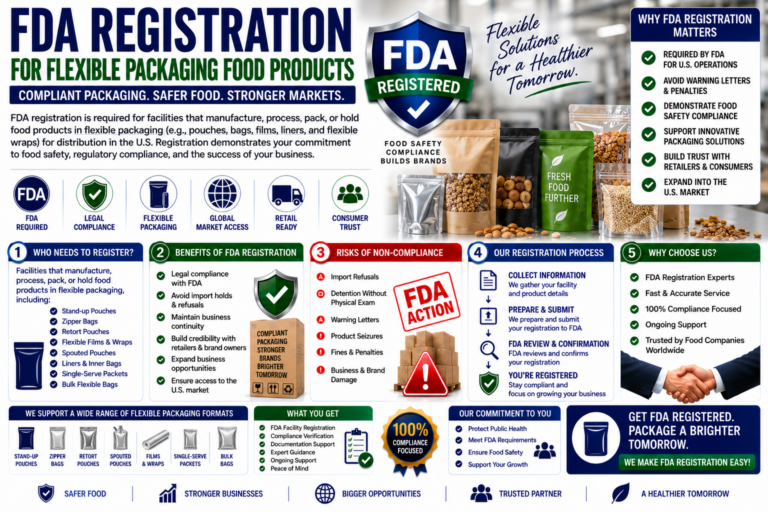
FDA Registration for Flexible Packaging Food Products
Multi-layer laminates, the functional-barrier concept, inks and adhesives, and why conditions of use decide everything.
Key Takeaways
- It's food-contact compliance, not registration — for a pure material maker.
- Every migrating component counts — layers, adhesives, coatings, inks.
- A functional barrier changes things — no migration means no clearance needed.
- Inks aren't for direct food contact — kept behind a barrier, with no set-off.
- Conditions of use decide clearance — retort ≠ room-temperature storage.
- Retort pouches carry two jobs — packaging clearance and LACF process filing.
Flexible Packaging Is a Food Contact Substance
Like all food packaging, flexible materials are regulated as food contact substances — so a company that only makes the film or pouch generally isn't a "food facility," and food facility registration doesn't apply. The material itself has to be cleared for its use through an existing indirect food additive regulation (21 CFR 174–179), a GRAS basis, a Threshold of Regulation exemption, or a Food Contact Notification.
The Multi-Layer Problem
Flexible packaging is rarely a single material — it's a laminate of several layers, each with a job, and each a potential source of migration. A typical structure, from the outside in:
The Functional Barrier
This is the idea that unlocks most multi-layer analysis. FDA's rules say a substance that doesn't migrate to food isn't a food additive — so a component sitting behind a layer that prevents its migration isn't subject to premarket clearance.
Conditions of Use: Retort ≠ Room Temperature
Migration depends heavily on temperature, time, and food type — so a material's clearance is tied to specific conditions of use. The same film can be fine for one and non-compliant for another:
| Condition of use | Migration demand |
|---|---|
| Room-temperature dry-food storage | Lowest — the baseline many films are cleared for |
| Refrigerated / frozen | Low |
| Hot-fill / pasteurization | Higher — elevated temperature drives more migration |
| Microwave / boil-in-bag | High |
| Retort (high-temp sterilization) | Highest — the most demanding condition |
| Fatty & acidic foods | Higher — draw out more migrants than aqueous foods |
Retort Pouches: Two Requirements at Once
Retort pouches — flexible laminates that withstand high-temperature sterilization, a shelf-stable alternative to cans — carry two separate compliance jobs:
- The packaging side — the laminate must be cleared specifically for the retort condition of use, with its tighter extractable limits
- The food side — the shelf-stable food inside a retort pouch is usually a low-acid canned food, so it needs FCE registration and a scheduled process, just like a can
Get Documentation That Matches Your Use
If you buy flexible packaging rather than make it, you're responsible for using compliant packaging for your product — and your evidence is the supplier's documentation:
- A food-contact compliance statement for the full structure — not just one layer
- Citing the basis — the FCN, regulation, GRAS, or TOR behind it
- Stating the conditions of use and food types — and matching your actual product, temperature, and process
- Covering imports too — a laminate legal abroad isn't automatically cleared in the U.S.
Get Your Flexible Packaging Cleared for Its Use
FDA Registration Assistance identifies whether you need food-contact-substance compliance (material maker) or food facility registration (if you also fill food), then reviews the full laminate — each layer, adhesive, coating, and ink — against your intended conditions of use, using the functional-barrier and migration framework. For retort products, we also handle the low-acid canned food side.
Contact us at info@fdaregistrationassistance.com or call +1 (928) 275-8333. Food Facility Registration is available starting at $858. Trusted by companies across 135+ countries, with 15+ years of experience.
Frequently Asked Questions
1. Do flexible packaging companies need FDA registration?
It depends on what you do. A company that makes flexible packaging materials — films, pouches, laminates, wraps — generally isn't a food facility, so food facility registration usually doesn't apply. What applies is that the material must be a cleared food contact substance for its intended use. If you also fill or pack food into the packaging, then you're a food facility and do register. Be wary of paying for a registration a pure material maker may not need.
2. How is flexible packaging regulated by FDA?
As food contact substances — the same framework as any food packaging. Any component that migrates, or may be expected to migrate, into food has to be authorized: through an existing indirect food additive regulation (21 CFR Parts 174–179), a GRAS basis, a Threshold of Regulation exemption, or a Food Contact Notification. What makes flexible packaging different is that it's usually built from multiple layers, each of which has to be considered.
3. Does every layer of a laminate need FDA clearance?
Every layer that could migrate to food has to be addressed — but not every layer necessarily needs its own clearance. The critical layer is the food-contact (sealant) layer. Layers separated from the food by a functional barrier that prevents migration are generally not food additives, so they may not require clearance. So the analysis is structure-by-structure: which components can actually reach the food under the intended conditions.
4. What is a "functional barrier"?
A functional barrier is a layer that separates a substance from the food and prevents it from migrating into the food. FDA's rules say a substance that doesn't migrate to food isn't a food additive — so a component sitting behind a functional barrier isn't subject to premarket clearance. But the barrier has to actually work: its effectiveness is established by migration testing or structural analysis under the anticipated conditions of use, not just assumed.
5. Are printing inks on flexible packaging regulated?
FDA doesn't regulate printing inks as a distinct category, and most inks aren't approved for direct food contact. Inks are typically kept off the food-contact surface — printed on the outside, or reverse-printed behind a barrier. If an ink is separated from food by a functional barrier, and is fully dry with no "set-off" (transfer onto the food-contact side during stacking or winding), it's treated as having no direct food contact. If migration is possible, a migration study is needed.
6. How are adhesives and coatings handled?
Adhesives used in food packaging are covered by 21 CFR 175.105, and FDA has cleared adhesives for use in multilayer laminates; an adhesive separated from food by a functional barrier, or present only in trace amounts at seams and edges, is treated as very low migration. Coatings are assessed the same way: if a coating migrates to food at detectable levels under the conditions of use, it's subject to food-contact rules; if it doesn't, it may be exempt.
7. Why do "conditions of use" matter so much for flexible packaging?
Because migration depends heavily on temperature, time, and food type. A film cleared for room-temperature dry-food storage is not automatically cleared for hot-fill, microwave, boil-in-bag, retort, or fatty and acidic foods — those conditions drive far more migration. FDA defines specific "conditions of use," and a material's clearance is tied to them. Using packaging outside the conditions it was cleared for is a common and serious error.
8. What's special about retort pouches?
Retort pouches are flexible laminates designed to withstand high-temperature sterilization — a demanding condition of use, so the materials must be cleared specifically for it (with tighter extractable limits). And there's a second layer: the food inside a shelf-stable retort pouch is usually a low-acid canned food, which means the food side needs FCE registration and a scheduled process, just like a can. So a retort pouch involves both packaging clearance and process filing.
9. Does an FCN cover any use of my film?
No — an FCN and other clearances are tied to specific conditions of use and food types. A clearance for one temperature range or food type doesn't automatically extend to more demanding ones. If you plan to sell the same film for both ambient storage and retort, both conditions need to be supported. Matching the clearance to how the film will actually be used is the essential step.
10. If I buy flexible packaging, how do I confirm it's compliant?
Ask your supplier for a food-contact compliance statement that identifies the basis (FCN, regulation, GRAS, or TOR) for the full structure — and, crucially, states the conditions of use and food types it covers. As the food company, you're responsible for using compliant packaging for your actual product, temperature, and process, so the statement has to match your use. A generic "FDA compliant" claim without conditions of use isn't enough.
11. Do imported flexible packaging materials need clearance?
Yes. Imported films, pouches, and laminates must meet the same U.S. food-contact requirements as domestic ones — a structure legal in another market isn't automatically cleared here, and other regions test migration differently. If you import packaging or import food already in flexible packaging, the packaging still has to be compliant for its use. Confirming this is part of import due diligence.
12. Does registration or an FCN mean FDA "approved" my packaging?
No. FDA doesn't "approve" packaging companies, and an effective FCN authorizes a specific substance and use rather than approving your business or structure as a whole. The responsibility to use a properly cleared material — for the actual food, temperature, and conditions — stays with you. Clearance of a component isn't a blanket sign-off on the finished laminate.
13. What are the common compliance gaps for flexible packaging?
Assuming a material cleared for one condition of use covers all of them; relying on a functional barrier without testing that it actually works; ink set-off onto the food-contact side; adhesives or coatings not properly cleared for the structure; and treating a component clearance as clearance of the whole laminate. Most trace back to not analyzing the full structure against the real conditions of use.
14. How does FDA Registration Assistance help with flexible packaging?
We identify whether you need food-contact-substance compliance (material maker) or food facility registration (if you also fill food), then review the full laminate structure — each layer, adhesive, coating, and ink — against the intended conditions of use, using the functional-barrier and migration framework, and help with the documentation your customers need. For retort products, we also address the low-acid canned food side. Starting at $858 for registration, for companies across 135+ countries. Contact info@fdaregistrationassistance.com or +1 (928) 275-8333.