
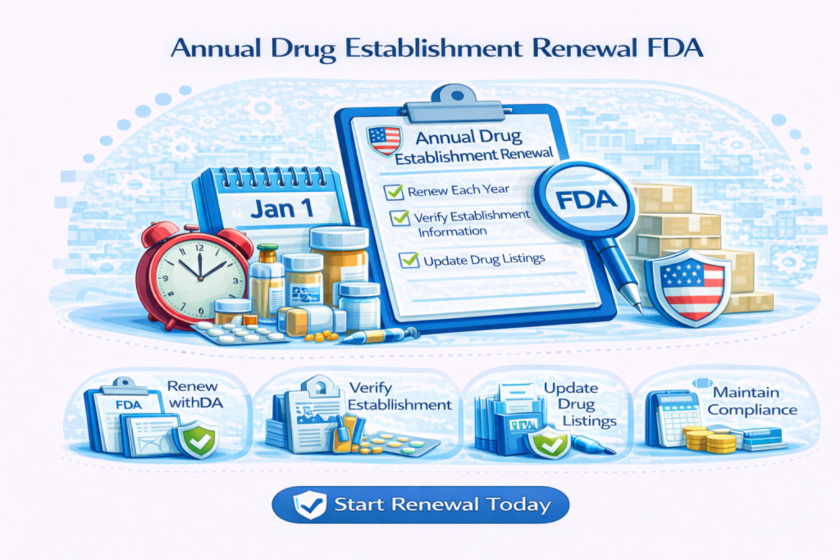
Annual Drug Establishment Renewal (FDA)
The Oct 1–Dec 31 window, registration vs listing, who must renew, and exactly what a lapse costs you.
Key Takeaways
- Annual, October 1 – December 31 — every year (21 CFR 207.29).
- Drugs are annual, food is biennial — don't apply the food cycle to drugs.
- Two obligations — registration renewal and drug listing updates.
- A lapse = misbranding — under FD&C §502(o), with real border consequences.
- Every registered establishment renews — domestic and foreign, all activity types.
- Renewal ≠ approval — it keeps registration active; it doesn't approve the drug.
Annual — Every October to December
Under 21 CFR 207.29, a registered drug establishment must renew its registration each year, between October 1 and December 31, submitted electronically in SPL format. This is one of the most common points of confusion for companies that also handle food: food facility registration is biennial (every even year), but drug establishment registration is annual. Applying the food cycle to a drug facility is a reliable way to let a registration lapse.
Registration Renewal vs Drug Listing
"Renewal" is really two maintenance duties that people often merge — but they run on different schedules:
| Establishment registration | Drug listing (NDC) | |
|---|---|---|
| What it is | Your facility's active registration | The record of each product you make (NDC) |
| When | Renewed annually, Oct 1 – Dec 31 | Reviewed/updated June and December (if changes) |
| Basis | 21 CFR 207.29 | 21 CFR 207.41 / section 510(j) |
| If nothing changed | Still must actively renew | Certify "no changes" (can bundle into the annual update) |
Every Registered Establishment
- Finished-drug manufacturers — prescription and OTC
- Active pharmaceutical ingredient (API) manufacturers
- Contract manufacturers — producing for other labelers
- Repackers & relabelers
- Private-label distributors with their own registration
- Foreign establishments — same annual cycle, plus a maintained U.S. Agent and importer list
What a Lapse Actually Costs
Missing the renewal isn't a paperwork slip — it changes your product's legal status. Drugs from an establishment that isn't currently registered are misbranded under section 502(o) of the FD&C Act (and failing to register is a prohibited act under §301(p)). That opens the door to:
- Import refusal & detention — including Detention Without Physical Examination under an Import Alert
- FDA warning letters — and seizure or injunction under §304 in serious cases
- Marketplace removal — platforms like Amazon, Walmart, and Shopify delist products tied to a lapsed registration
- Listing inactivation — your NDCs drop out of FDA's directory, and reactivation takes time you may not have
Renewal Is Not Approval
Keeping your registration renewed means FDA knows your facility exists and what it makes — nothing more. It is not FDA approval, and claiming a product is "FDA-approved" merely because the establishment is registered or has an NDC is itself misbranding (21 CFR 207.77). Approval is a separate, product-level status (NDA/ANDA, or OTC monograph compliance). Renewal keeps the door open; the approval pathway is what makes the drug marketable.
Keep Your Drug Registration Active
FDA Registration Assistance provides fully managed annual drug establishment renewal: we track your window, verify and update your facility, registrant, DUNS/FEI, and U.S. Agent details, file the SPL renewal, confirm alignment with your listings, and carry the record forward — year after year, so your registration never lapses and your products keep clearing.
Contact us at info@fdaregistrationassistance.com or call +1 (928) 275-8333 for a quote. Domestic and foreign establishments across 135+ countries, with 15+ years of experience.
Frequently Asked Questions — Annual Drug Renewal
1. What is the FDA annual drug establishment renewal?
It's the mandatory yearly renewal that keeps a drug establishment's FDA registration active. Under 21 CFR 207.29, every registered drug establishment must renew its registration each year between October 1 and December 31, submitted electronically in SPL format. Unlike food facility registration (which is biennial), drug registration is annual — so this comes around every single year.
2. When is the drug renewal window?
October 1 through December 31 of every year. The renewal must be completed within that window to keep the registration active into the next year. There's no grace period built into the requirement, so the practical approach is to renew early in the window rather than waiting until the December 31 deadline.
3. What happens if I miss the renewal deadline?
Your registration lapses — and that has real consequences. Drugs from an establishment that isn't currently registered are considered misbranded under section 502(o) of the FD&C Act. That exposes them to import refusal and detention at U.S. ports (potentially Detention Without Physical Examination under an Import Alert), FDA warning letters, seizure or injunction, and removal from marketplaces like Amazon, Walmart, and Shopify. Reactivating a lapsed registration also takes time you may not have.
4. Is renewal the same as updating my drug listing?
No — they're two related but separate obligations. Registration renewal happens annually (October–December, 21 CFR 207.29). Drug listing information (your NDCs) must be reviewed and updated twice a year, in June and December, whenever anything changes — and if nothing has changed you must certify "no changes." After the initial listing, that "no changes" certification can be made during the annual registration update. Both the registration and the listings have to stay current.
5. Who must complete the annual renewal?
Every registered drug establishment: finished-drug manufacturers, active pharmaceutical ingredient (API) manufacturers, contract manufacturers, repackers, relabelers, and private-label distributors, whether domestic or foreign. If your facility holds an active FDA drug establishment registration, annual renewal is mandatory — and foreign establishments must keep their U.S. Agent designation current as part of it.
6. Do foreign drug establishments have to renew too?
Yes. Foreign drug establishments follow the same annual October–December renewal, and they must also maintain their U.S. Agent designation and their list of known U.S. importers. A lapsed foreign registration means the establishment can't lawfully export drugs to the U.S., and its shipments will be refused — so keeping the renewal and the U.S. Agent current is essential to uninterrupted market access.
7. What exactly does the renewal involve?
An electronic SPL submission that confirms and updates the establishment's information — facility name and address, registrant and contact details, DUNS/FEI, operational activities, and (for foreign facilities) the U.S. Agent — and that stays consistent with your active drug listings. It's not just clicking "renew": outdated contact information or DUNS validation errors can hold up the submission or cause you to miss FDA communications.
8. Why does the renewal need to align with my drug listings?
Because your listings are only valid if the establishment behind them is actively registered. If the registration lapses, the associated drug listings can be inactivated (FDA periodically "cleans up" listings tied to unregistered establishments or missing annual certifications), which removes your NDCs from FDA's directory. Keeping registration and listings aligned each cycle prevents your products from silently dropping out of the system.
9. Does renewing my registration mean my drug is FDA-approved?
No. Registration — and renewing it — only means FDA knows your facility exists and what it makes; it is not approval. In fact, claiming a product is "FDA-approved" merely because the establishment is registered or has an NDC is itself misbranding (21 CFR 207.77). Approval is a separate, product-level status (NDA/ANDA, or OTC monograph compliance). Renewal keeps registration active; it doesn't confer approval.
10. How long does a lapse take to fix?
Reactivating a lapsed registration isn't instantaneous — you have to correct whatever caused the lapse, resubmit, and wait for the record to update, and in the meantime your drugs are misbranded and can be held at the border. That gap is exactly the costly disruption the annual renewal is meant to prevent, which is why tracking the deadline and renewing early in the window matters.
11. Can one lapse affect future shipments?
Yes. Beyond the immediate misbranding exposure, a compliance history of lapses or errors can increase scrutiny on future entries and, in serious cases, contribute to Import Alert placement (Detention Without Physical Examination), where every subsequent shipment is held until the issue is resolved. Continuous, on-time renewal keeps your compliance record clean.
12. What if my company or facility details changed during the year?
The renewal is the point to capture those changes — updated ownership, address, contacts, activities, or U.S. Agent. Some changes (like material changes to listing information or discontinuations) should be reported when they occur rather than waiting, but the annual renewal is a backstop to confirm everything on file is accurate. Accurate records also ensure you actually receive FDA's communications.
13. Do I need to do anything if nothing changed?
Yes — renewal is still required even if nothing changed. You confirm the existing information and, for listings, can make a "no changes" certification. "Nothing changed" is not the same as "nothing to do": without the affirmative annual renewal, the registration lapses regardless of whether your operations changed.
14. How does managed renewal work?
We track your renewal window, contact you before it opens, review and update your facility, registrant, DUNS/FEI, and U.S. Agent details, prepare and file the SPL renewal, confirm alignment with your listings, and provide confirmation once it's complete — then carry the record forward for the next cycle. The goal is a renewal handled proactively, not a scramble at year-end.
15. Can you manage renewals for multiple establishments?
Yes. We manage annual renewals for single facilities and for companies with multiple drug establishments and many listed products, keeping every registration and listing aligned each October–December cycle. Consolidating renewals under one compliance partner reduces the risk of any single facility slipping through.
16. How does FDA Registration Assistance help with annual drug renewal?
We provide fully managed annual drug establishment renewal: deadline tracking, verification and update of facility/registrant/DUNS/U.S. Agent information, the SPL renewal submission, listing alignment, and confirmation — year after year, so your registration never lapses and your products keep clearing. We support domestic and foreign establishments across 135+ countries with 15+ years of experience. Contact info@fdaregistrationassistance.com or +1 (928) 275-8333 for a quote.
