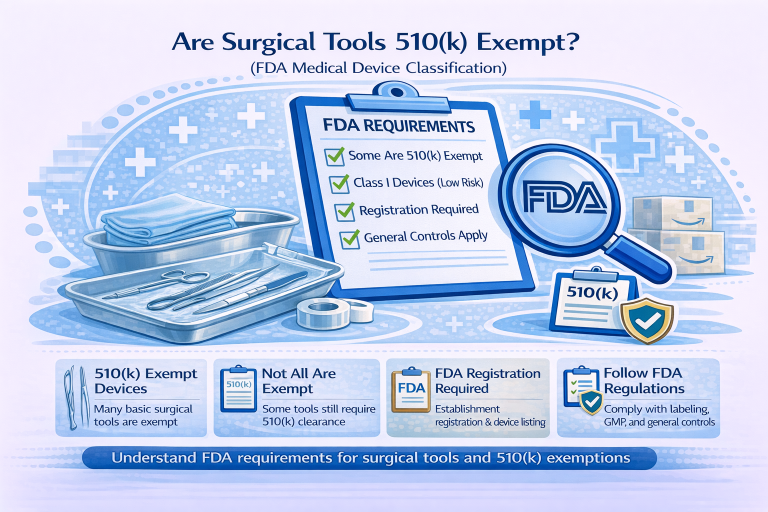
Are Surgical Tools 510(k) Exempt?
This guide explains the three FDA device classes, which surgical instruments are 510(k) exempt under 21 CFR 878.4800, the limitations of exemption that can void it, the difference between manual and powered instruments, and the FDA requirements that apply even to exempt devices.
Device Class Determines Whether a 510(k) Is Required
“510(k)-Exempt” Does NOT Mean “FDA-Exempt”
510(k)-exempt = exempt from all FDA requirements
510(k) exemption means the device does not need the premarket notification that demonstrates substantial equivalence to a predicate device. An exempt surgical instrument is still subject to all of these requirements:
A manufacturer that assumes a 510(k)-exempt surgical instrument requires nothing further from FDA will be non-compliant on establishment registration, device listing, and Quality System requirements — all of which apply regardless of 510(k) exemption.
When a Surgical Instrument Loses Its 510(k) Exemption
Exemption Retained — Still 510(k)-Exempt
A standard manual stainless steel scalpel used for cutting tissue in general surgery. Same intended use and same fundamental technology as legally marketed manual scalpels. Remains Class I and 510(k)-exempt under 21 CFR 878.4800 — subject to establishment registration, listing, labeling, and UDI.
Exemption Voided — 510(k) Now Required
A scalpel with a novel antimicrobial coating claiming to reduce surgical site infections has a new intended use (a therapeutic claim) beyond cutting. A surgical instrument incorporating a sensor or a fundamentally new material technology has a different fundamental scientific technology. Either change voids the exemption and triggers a 510(k) requirement.
Manual Instruments Are Usually Exempt; Powered Instruments Usually Require a 510(k)
- Manual scalpels and scalpel handles
- Surgical scissors
- Forceps (tissue, dressing, hemostatic)
- Handheld retractors
- Clamps
- Needle holders
- Surgical hooks, probes, directors
- Curettes and elevators
Classified under 21 CFR 878.4800 — manual surgical instrument for general use. No energy source. Standard intended use.
- Powered surgical drills and saws
- Powered surgical staplers
- Electrosurgical cutting/coagulation devices (21 CFR 878.4400)
- Surgical lasers
- Ultrasonic surgical instruments
- Robotic surgical systems
- Surgical instrument motors (21 CFR 878.4820)
- Any manual instrument with a new intended use or novel technology
The introduction of an energy source, automation, or specialized function generally moves the device into Class II requiring 510(k) clearance.
Need to Confirm Whether Your Surgical Tool Is 510(k) Exempt?
FDA Registration Assistance provides device classification assessment, 510(k) exemption determination including evaluation of the limitations of exemption, FDA device establishment registration and device listing, U.S. Agent services for foreign manufacturers, medical device labeling review, UDI compliance, and QMSR compliance guidance. We help you confirm your device’s regulatory status before marketing — so you avoid the costly mistake of assuming exemption where a 510(k) is actually required. 1,000+ clients. 135+ countries. 15+ years of FDA regulatory experience.
Contact us at info@fdaregistrationassistance.com or call +1 (928) 275-8333.
Frequently Asked Questions — Surgical Tool 510(k) Exemption
1. Are surgical tools 510(k) exempt?
Some are, not all. Most basic manual surgical instruments — scalpels, forceps, scissors, retractors, clamps, needle holders — are Class I devices under 21 CFR 878.4800 and exempt from 510(k). Powered instruments, electrosurgical devices, and surgical lasers are typically Class II and require a 510(k). Exemption status depends on the device, its FDA product code and classification, and intended use. Even exempt devices require establishment registration, listing, Quality System compliance, labeling, UDI, and MDR.
2. What are the three FDA medical device classes?
Class I (low risk): general controls; most are 510(k)-exempt; manual surgical instruments, bandages. Class II (moderate risk): general + special controls; most require 510(k); powered instruments, infusion pumps, surgical lasers. Class III (high risk): general controls + PMA; the highest-risk devices; implantable pacemakers, heart valves. The class determines whether a 510(k), a PMA, or no premarket submission is required.
3. What does 510(k) exemption actually mean?
It means the device does not require premarket notification (the 510(k) demonstrating substantial equivalence to a predicate). It does NOT mean the device is exempt from all FDA requirements. An exempt device still requires: establishment registration (21 CFR Part 807); device listing; Quality System/QMSR (21 CFR Part 820); labeling (21 CFR Part 801); UDI (21 CFR Part 830); and MDR (21 CFR Part 803). “510(k)-exempt” is not the same as “FDA-exempt.”
4. Under what regulation are manual surgical instruments classified?
21 CFR 878.4800 — manual surgical instrument for general use, part of the general and plastic surgery device regulations in 21 CFR Part 878. Covers nonpowered handheld instruments: scalpels, scissors, forceps, retractors, clamps, needle holders, surgical hooks, probes. Class I, generally exempt from 510(k), subject to the limitations of exemption in 21 CFR 878.9.
5. What are the limitations of 510(k) exemption?
Under 21 CFR 878.9, a device within an exempt generic type loses its exemption if: (1) it has a new intended use different from legally marketed devices in that type; or (2) it operates using a different fundamental scientific technology. A standard manual scalpel is exempt; a scalpel with a novel antimicrobial coating making a therapeutic claim may have a new intended use that voids the exemption and requires a 510(k).
6. What is the difference between manual and powered surgical instruments for 510(k)?
Manual instruments (no energy source) — scalpels, scissors, forceps — are generally Class I and exempt under 21 CFR 878.4800. Powered instruments (electric, pneumatic, battery) — drills, saws, powered staplers — are generally Class II requiring 510(k); surgical instrument motors are under 21 CFR 878.4820. Electrosurgical devices (21 CFR 878.4400) and surgical lasers are Class II. Introducing an energy source generally moves an instrument from Class I exempt to Class II.
7. Does a 510(k)-exempt manufacturer still need FDA establishment registration?
Yes. All device establishments — including makers of exempt devices — must register under 21 CFR Part 807. Annual registration with the annual establishment registration user fee (set by FDA each fiscal year). Each device must be listed. Foreign establishments must designate a U.S. Agent. Exemption from premarket notification does not exempt the establishment from registration.
8. Does the Quality System Regulation (QMSR) apply to 510(k)-exempt devices?
Yes, with limited exceptions for certain Class I exempt devices. The QSR (21 CFR Part 820) — replaced by the QMSR incorporating ISO 13485:2016, effective February 2026 — applies to device manufacturers including makers of exempt devices. Certain Class I exempt devices are exempt from most QSR requirements except general requirements for records and complaint files. Whether a specific exempt surgical instrument qualifies must be confirmed for each device.
9. What labeling requirements apply to surgical instruments?
Under 21 CFR Part 801: manufacturer/packer/distributor name and place of business; adequate directions for use (or the prescription device exemption statement); required warnings and precautions. Reusable instruments need validated reprocessing instructions. Sterile devices need sterilization information. UDI (21 CFR Part 830) must appear on the label and packaging. These apply even to exempt instruments. See our medical device labeling review service for a full compliance check.
10. What is UDI and does it apply to exempt surgical instruments?
Unique Device Identification (21 CFR Part 830) assigns a unique identifier consisting of a Device Identifier (DI) and possibly a Production Identifier (PI). The UDI must appear on the label and package in plain text and barcode form, and device data must be submitted to FDA’s GUDID. UDI applies to exempt surgical instruments based on device class and FDA’s compliance dates. Reusable instruments may require direct part marking of the UDI on the device itself.
11. What are examples of 510(k)-exempt surgical instruments?
Under 21 CFR 878.4800: manual scalpels and handles; surgical scissors; forceps (tissue, dressing, hemostatic); handheld retractors; clamps; needle holders; surgical hooks; probes and directors; curettes; elevators. Class I instruments used in standard procedures without energy or automation. Exemption must be confirmed for each specific device.
12. What are examples of surgical instruments that require a 510(k)?
Powered surgical instruments (drills, saws, powered staplers); electrosurgical devices (21 CFR 878.4400); surgical lasers; ultrasonic surgical instruments; robotic surgical systems; and any manual instrument modified to have a new intended use or novel technology. Energy source, automation, or specialized function generally moves the device into Class II requiring 510(k) clearance.
13. Do reusable surgical instruments have special FDA requirements?
Yes. Reusable instruments must include validated reprocessing instructions (cleaning, disinfection, sterilization) in their labeling. FDA guidance on reprocessing reusable devices establishes validation and labeling criteria. The reprocessing instructions must be validated to demonstrate effective cleaning and sterilization. Applies even to exempt instruments. Reusable instruments may require direct part marking of the UDI.
14. What requirements apply to sterile surgical instruments?
Sterile instruments must have a validated sterilization process achieving the required sterility assurance level (SAL). The sterilization method (steam, EtO, radiation) must be appropriate and validated. Labeling must indicate the device is sterile, the method, and conditions affecting sterility. Sterility validation is part of regulatory compliance even for exempt devices. Single-use sterile devices must be clearly labeled as single-use.
15. Do foreign manufacturers of surgical instruments need a U.S. Agent?
Yes. Foreign device manufacturers — including makers of exempt instruments — must register under 21 CFR Part 807 and designate a U.S. Agent with a physical U.S. address. The U.S. Agent serves as FDA’s contact for the foreign establishment. FDA Registration Assistance provides U.S. Agent services for foreign device manufacturers.
16. How do I determine the FDA product code and classification for my surgical instrument?
Determined by intended use and technological characteristics, matched against FDA’s classification database and the relevant regulation (for surgical instruments, typically 21 CFR Part 878). Identify the generic device type matching the intended use; find the classification regulation and product code; confirm the class; determine 510(k)-exempt status and whether it meets the limitations of exemption. Misclassification is a common error — FDA Registration Assistance provides device classification assessment.
17. What happens if a device is incorrectly assumed to be 510(k)-exempt?
Marketing a device that requires a 510(k) without clearance is a serious violation — the device is adulterated and misbranded, and marketing it is a prohibited act under the FD&C Act. Consequences: Warning Letters; import detention and refusal; recall; seizure; injunction. A manufacturer that incorrectly assumed exemption — when a new intended use or novel technology voided it — faces enforcement. Confirming exemption status before marketing is essential.
18. Is establishment registration the same as 510(k) clearance?
No. Establishment registration (21 CFR Part 807) is the annual registration of the facility — required for all device establishments. 510(k) clearance is FDA’s review of a premarket notification demonstrating substantial equivalence — required for Class II and some Class I/III devices that are not exempt. An exempt device requires establishment registration but not 510(k) clearance.
19. What is the annual FDA establishment registration fee for device manufacturers?
FDA charges an annual establishment registration user fee for all registered device establishments, including makers of exempt surgical instruments. The amount is set each fiscal year under MDUFA and changes annually — manufacturers should confirm the current fiscal year fee. The fee must be paid before registration is completed or renewed. Unlike food facility registration (no FDA fee), device registration requires this annual fee.
20. Are surgical instrument kits and trays 510(k) exempt?
Kits containing multiple individually exempt instruments may be exempt, but it depends on the contents and intended use. A convenience kit of individually exempt Class I instruments is often exempt, but FDA’s convenience kit and combination product policies apply. If a kit contains a device requiring 510(k), or is assembled/labeled to create a new intended use, it may require its own submission. The kit assembler may be a device manufacturer required to register and list. Each kit configuration should be evaluated individually.
21. What is the QMSR transition and how does it affect surgical instrument manufacturers?
FDA replaced the QSR in 21 CFR Part 820 with the Quality Management System Regulation (QMSR), incorporating ISO 13485:2016, effective February 2, 2026. Surgical instrument manufacturers subject to Quality System requirements must align their QMS with ISO 13485. Makers of certain Class I exempt devices that were exempt from most QSR requirements retain limited obligations under the QMSR.
22. What is Medical Device Reporting (MDR) and does it apply to exempt instruments?
MDR under 21 CFR Part 803 requires manufacturers and importers to report to FDA when a device may have caused or contributed to a death or serious injury, or malfunctioned in a way likely to cause death/serious injury if it recurred. Applies to all device manufacturers and importers, including makers of exempt surgical instruments. Exemption from premarket notification does not exempt a device from postmarket adverse event reporting.
23. How does FDA Registration Assistance help surgical instrument manufacturers determine 510(k) exemption?
Device classification assessment to identify the correct FDA product code and classification; 510(k) exemption determination including evaluation of the limitations of exemption; device establishment registration (21 CFR Part 807); device listing; U.S. Agent for foreign manufacturers; labeling review; UDI compliance; and QMSR guidance. 1,000+ clients. 135+ countries.
24. Why do imported surgical instruments get detained at U.S. ports?
Common causes: establishment not registered or registration lapsed (annual renewal/fee not paid); device requiring 510(k) marketed as exempt; missing or non-compliant labeling under 21 CFR Part 801; UDI not implemented; reusable instrument without validated reprocessing instructions; sterile device without sterility validation; and no U.S. Agent designated. Confirming the full compliance picture — not just exemption status — before import prevents detention.
25. How do I confirm whether my surgical tool is 510(k) exempt?
Contact FDA Registration Assistance at info@fdaregistrationassistance.com or call +1 (928) 275-8333. Provide a detailed description: intended use; manual or powered; any energy source; materials and coatings; single-use or reusable; sold sterile or not; and any therapeutic claims. FDA Registration Assistance will assess the device classification, confirm 510(k)-exempt or 510(k)-required status, evaluate the limitations of exemption, and complete establishment registration, device listing, and other required compliance steps.