
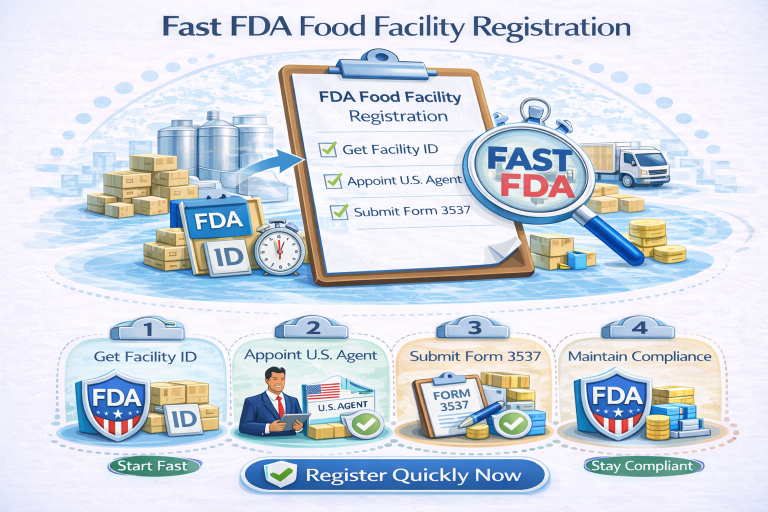
Fast FDA Food Facility Registration
Trusted by 1,000+ companies across 135+ countries, with 15+ years of FDA regulatory experience. This page explains what's included, who needs expedited registration, why filings get delayed, and how our process keeps yours moving.
One Flat Fee, Fully Managed
No per-step surprises: intake, preparation, U.S. Agent designation, submission, and confirmation are handled as a single streamlined process, and we keep the record on file for your renewals.
The Three Things That Slow a Registration Down
A delay in FDA registration can mean shipment holds at the port, missed launch dates, fulfillment-center receiving delays, and customs complications. Almost all delays trace to three causes:
Who Needs Expedited Registration
Time-sensitive importers
First-time exporters to the U.S., suppliers with goods already in transit, and importers facing shipment deadlines.
Amazon FBA & e-commerce
Food sellers with inventory scheduled into fulfillment centers that verify FDA registration before receiving.
Launches & new operations
New product launches, new warehouse operations, co-packer onboarding, and retail/distribution requirements.
Provider switches
Facilities changing compliance providers or U.S. Agents who need the transfer handled without a lapse.
How It Differs by Facility Location
Foreign facilities
Must designate a U.S. Agent (21 CFR 1.227) before registration completes — the most common delay when handled separately. We accept the U.S. Agent role at the same time we file, so it's one process, not two.
U.S. facilities
Often need expedited registration for new warehouses, product launches, retail or distribution requirements, or co-packer onboarding. No U.S. Agent is required, but the activity and category data still must be accurate.
Our Expedited Registration Process
Registration Is Where Import Compliance Starts
Registration gets your facility on the FDA's radar, but importing food has more moving parts. Depending on your role you may also need:
Prior Notice
Advance electronic notice to the FDA before every shipment arrives — see Prior Notice.
FSVP
The U.S. importer's supplier-verification program — see FSVP.
Registration is also not FDA approval — it notifies the FDA of your facility; the agency does not approve most foods before marketing. Background on the requirement is in 21 CFR Part 1, Subpart H on eCFR.
Start Your Fast FDA Registration Today
Send us your facility details and timeline and we'll begin intake immediately, start the DUNS step if needed, designate your U.S. Agent, and submit your registration — usually the same day once your information is complete. Email info@fdaregistrationassistance.com or call +1 (928) 275-8333.
Frequently Asked Questions — Fast FDA Food Facility Registration
How fast can FDA food facility registration be completed?
We can typically prepare and submit your registration the same day we receive complete facility information, and the FDA confirmation often comes within 24 to 48 hours when a valid DUNS Number is already on file. Our $858 service includes the registration, U.S. Agent designation, and biennial renewal management.
What does the $858 registration service include?
FDA food facility registration, U.S. Agent service for foreign facilities, and biennial renewal management. The FDA itself charges $0 to register a facility; the DUNS Number request is handled separately and its fees are separate.
Does the FDA charge a fee to register a food facility?
No. The FDA charges $0 for food facility registration. Be cautious of sites implying a government registration fee. Our $858 is a professional service fee covering preparation, U.S. Agent service, and renewal management.
Can I register my food facility the same day?
In many cases the submission goes out the same day. Same-day submission depends on having your facility details and a valid DUNS Number ready; we flag anything missing immediately so it does not stall the filing.
What is a DUNS Number and do I need one?
A DUNS Number is the Unique Facility Identifier (UFI) the FDA requires for food facility registration. You need one before the registration can be completed, and obtaining it is a separate step — see DUNS request assistance. We start it early to avoid delays.
Do foreign facilities need a U.S. Agent?
Yes. Every foreign food facility must designate a U.S. Agent under 21 CFR 1.227 as its U.S. point of contact with the FDA before the registration is complete. We provide the U.S. Agent designation as part of the same streamlined process.
Why is a missing U.S. Agent the most common delay?
Because a foreign registration cannot be completed without one, and arranging an agent separately creates back-and-forth. We accept the U.S. Agent role at the same time we file, which removes that bottleneck.
Who must register a food facility?
Any facility that manufactures, processes, packs, or holds food for human or animal consumption in the U.S., whether domestic or foreign, unless specifically exempt under 21 CFR 1.226. This includes manufacturers, warehouses, seafood processors, pet food facilities, supplement companies, and many e-commerce brands.
What information do you need to register quickly?
The legal facility name and address, owner/operator and parent-company details, facility and emergency contacts, the food product categories handled, and — for foreign facilities — U.S. Agent acceptance. Accurate, consistent details are what keep the filing fast.
Is fast registration still compliant?
Yes. The speed comes from preparation and priority handling, not shortcuts. We verify the activity types and food categories so the record reflects your real operations and stays accurate.
Does registration mean my product is FDA-approved?
No. Registration notifies the FDA of your facility; it is not product approval. The FDA does not approve most foods before marketing, and anyone claiming a product is “FDA-approved” merely because the facility is registered is mistaken.
How do I get confirmation of my registration?
Once the registration is filed and accepted, the FDA issues an 11-digit registration number. We provide your confirmation and keep the record on file for future renewals and updates.
When do food facility registrations renew?
Registrations renew every two years, during the renewal window from October 1 to December 31 of each even-numbered year — see food facility registration renewal. We manage your biennial renewal so it does not lapse.
What happens if my registration lapses?
A lapsed or inactive registration can stop imports and disrupt distribution. The FDA can also suspend a registration in certain food-safety situations. Keeping it active and accurate is essential to uninterrupted U.S. market access.
Can you help if my shipment is already in transit?
Yes. Time-sensitive situations are common, and we prioritize them. We move quickly on the registration and U.S. Agent so your shipment is not held for a missing or inactive registration.
Do Amazon and e-commerce food sellers need this?
Often yes, especially when inventory is heading to fulfillment centers. Marketplaces and FBA increasingly verify FDA registration before receiving food products — see FDA compliance for Amazon food sellers.
Can you transfer my registration from another provider quickly?
Yes. We handle U.S. Agent changes and registration updates, so you can move providers without losing your registration or your renewal tracking.
Do warehouses and holding facilities need to register?
Often yes. “Holding” food (storage) is a covered activity, so warehouses that store food for the U.S. market generally must register, even if they do not manufacture anything.
Can you register multiple facilities at once?
Yes. We support multi-location and multi-entity companies, keeping each facility's registration, U.S. Agent, and renewal organized.
Do imports need anything beyond registration?
Yes. Importing food also requires Prior Notice for each shipment and, for the U.S. importer, an FSVP. Registration is the first checkpoint, not the only one — see Prior Notice.
What are the food product categories on the registration?
The FDA requires you to identify the types of food handled at the facility. Correct category selection matters: mismatches can cause import confusion or compliance follow-ups, so we confirm them with you before filing.
Is registration different for dietary supplements or pet food?
They register through the same food facility system, with their own product categories. Supplements and animal food each carry additional labeling and compliance rules beyond the registration itself.
What's the difference between this and foreign food facility registration?
They are the same registration; “foreign food facility registration” simply refers to facilities located outside the U.S., which additionally require a U.S. Agent — see foreign food facility registration. We handle both.
Do you provide ongoing support after registration?
Yes. We manage your biennial renewal, handle updates when your information changes, and remain your U.S. Agent and compliance contact going forward.
How do I start a fast FDA registration?
Send us your facility details and timeline. Reach our team and we begin intake immediately, start the DUNS step if needed, designate your U.S. Agent, and submit your registration — usually the same day once your information is complete. Email info@fdaregistrationassistance.com or call +1 (928) 275-8333.
