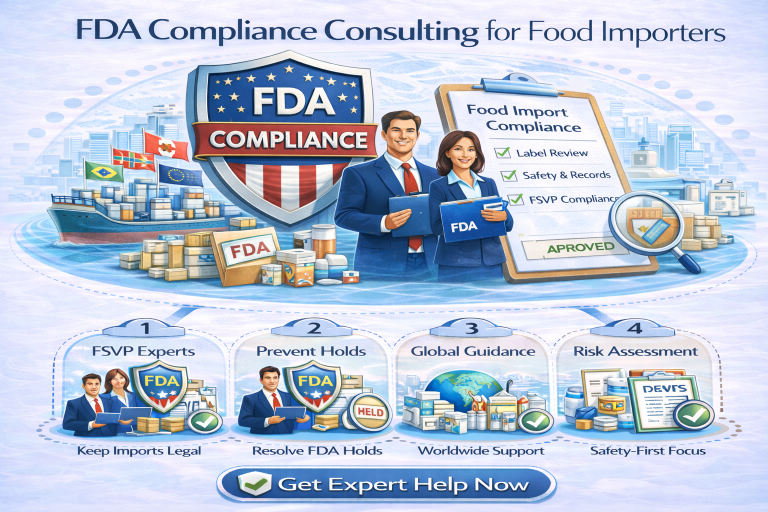
FDA Compliance Consulting for Food Importers
Importing food into the United States means navigating a set of overlapping FDA regulations that your customs broker does not handle. FDA Registration Assistance provides fully managed FDA compliance consulting for U.S. food importers — from supplier verification and labeling review to Prior Notice accuracy and import hold resolution — so you can import with confidence.
Trusted by 1,000+ companies in 135+ countries. 15+ years of FDA regulatory experience. All food import categories served.
What Your Customs Broker Doesn't Handle
Many food importers assume their customs broker is managing FDA compliance because the broker files the entry. They are not. Your broker handles CBP clearance and duty payment. Every FDA compliance obligation belongs to you as the U.S. importer of record:
Complete FDA Compliance Services for Food Importers
The Most Common FDA Compliance Failures for Food Importers
Labeling Errors
Undeclared allergens — particularly sesame, which became a major allergen in January 2023 under the FASTER Act — are the most common detention trigger. Other frequent issues: Nutrition Facts panels using non-U.S. serving sizes; ingredient lists not in descending order by weight; foreign-language-only labels; and missing manufacturer information.
Supplier Registration Issues
An expired foreign supplier registration makes every shipment from that facility non-compliant. FDA Food Facility Registration expires if not renewed during the biennial renewal window (October–December of even years). A single missed renewal can block an entire supply chain until the registration is re-activated.
No FSVP or Inadequate FSVP
Operating without an FSVP or with a generic, non-product-specific FSVP is a violation of 21 CFR Part 1 Subpart L. FDA inspects FSVP records. A missing or inadequate program results in Form 483 observations, Warning Letters, and — for repeated failures — Import Alert placement. A Warning Letter is public on FDA's website and affects retailer and eCommerce platform trust.
Prior Notice Inaccuracies
Filing Prior Notice with the wrong manufacturer, a registration number that doesn't match the actual producing facility, or the wrong FDA product code triggers an immediate hold. In a common error for re-import and trading company supply chains, importers list themselves or a trading company as the manufacturer when the actual producing facility is different.
Built for Every Type of U.S. Food Importer
FDA Registration Assistance serves food importers at every scale — from first-time importers building their initial FSVP to established multi-supplier importers needing a compliance partner to take over an existing program:
Amazon & eCommerce Sellers
Importing food for Amazon FBA or direct-to-consumer eCommerce requires the same FDA compliance as traditional retail importation. FDA Registration Assistance specializes in FSVP compliance, label review, and supplier registration verification for eCommerce food sellers.
Seafood Importers
Seafood importers face the full range of importer compliance obligations plus seafood-specific requirements — FSVP hazard analyses addressing mercury, histamine, marine biotoxins, and pathogens; seafood HACCP verification for suppliers under 21 CFR Part 123; and monitoring of active seafood Import Alerts.
Multi-Supplier Importers
Importers with large supplier networks need a tiered, risk-prioritized compliance program — individual hazard analyses per supplier, scheduled verification activities based on risk profile, and centralized FSVP documentation for all suppliers. FDA Registration Assistance builds and manages programs for importers with 50+ suppliers.
Ready to Import with Confidence?
FDA Registration Assistance provides fully managed FDA compliance consulting for U.S. food importers — FSVP development and Agent services, supplier FDA registration, label review, Prior Notice guidance, and import hold resolution. 1,000+ clients. 135+ countries. 15+ years of FDA regulatory experience.
Contact us at info@fdaregistrationassistance.com or call +1 (928) 275-8333.
Frequently Asked Questions — FDA Compliance Consulting for Food Importers
1. What does FDA compliance consulting for food importers cover?
Every area of U.S. FDA regulatory responsibility for the importer of record: FSVP development and management; supplier FDA registration verification; food label compliance review; Prior Notice accuracy; import detention resolution; Import Alert response; and ongoing compliance maintenance.
2. Who is legally responsible for FDA compliance when importing food?
The U.S. importer of record — the U.S. owner or consignee identified on the CBP entry documentation. The customs broker handles CBP clearance and duties only. All FDA obligations under FSMA and the FSVP rule remain with the importer of record.
3. Does my customs broker handle FDA compliance?
No. Your customs broker files your CBP entry, pays duties, and handles CBP clearance. They do not maintain your FSVP, verify supplier FDA registration, review food labels for FDA compliance, or manage your Prior Notice accuracy. All FDA compliance obligations remain with you.
4. What FDA compliance issues most commonly cause food shipment detentions?
Most common: undeclared allergens (especially sesame since January 2023 under the FASTER Act); expired or missing foreign supplier FDA registration; inaccurate Prior Notice (wrong manufacturer or registration number); Nutrition Facts with wrong U.S. serving size; foreign-language-only labels; and missing manufacturer/distributor information.
5. What is FSVP and is it required for food importers?
The Foreign Supplier Verification Program under 21 CFR Part 1 Subpart L is required for most U.S. food importers. It consists of a written hazard analysis per food and supplier, supplier verification activities commensurate with the risk, corrective action procedures, and 2-year recordkeeping. FDA inspects FSVP records — importers without a compliant FSVP face Form 483 observations, Warning Letters, and potential import restrictions.
6. What labeling issues cause food import problems?
Most common: missing allergen declarations — all nine FALCPA and FASTER Act allergens including sesame; Nutrition Facts with non-U.S. serving sizes; ingredient list not in descending order by weight; foreign-language-only labels; and non-compliant Nutrition Facts format. FDA Registration Assistance reviews all labels before shipment departs origin.
7. What is Prior Notice and why does accuracy matter?
FDA Prior Notice is a mandatory pre-arrival notification for every food shipment — 8 hours for ocean, 4 hours for air, 2 hours for road. The manufacturer must be the FDA-registered facility that produced the food. Wrong manufacturer, wrong registration number, or wrong product code triggers an immediate hold.
8. What is the difference between a shipment detention and an Import Alert?
A detention holds one shipment and can be resolved through corrective documentation. An Import Alert places a facility on DWPE — Detention Without Physical Examination — where every future shipment is automatically detained at every U.S. port. Import Alerts require a formal corrective action plan, demonstrated sustained compliance, and sometimes a paid FDA inspection to remove. Prevention through proactive compliance is far less costly.
9. What is a Form 483 and what should I do when I receive one?
Form 483 is a list of inspectional observations issued at the end of an FDA inspection, citing potential violations — typically FSVP deficiencies. It requires a prompt, substantive written response demonstrating each observation has been or will be corrected. Inadequate responses escalate to Warning Letters. FDA Registration Assistance prepares Form 483 responses for food importers.
10. What is supplier verification and why does it matter?
Supplier verification means confirming through documented activities that your foreign food supplier controls the hazards in their product at a level equivalent to FDA requirements. Recognized activities include on-site auditing, product testing, food safety records review, or a combination. The activity must match the risk level — higher-risk products require more rigorous verification.
11. Do Amazon FBA food sellers need FDA compliance consulting?
Yes. If you import food for Amazon FBA or any eCommerce channel, you are the U.S. importer of record with full FDA compliance obligations — FSVP, supplier verification, label review, and Prior Notice. Amazon's own compliance programs also request FDA documentation. FDA Registration Assistance specializes in compliance for Amazon food sellers.
12. Do dietary supplement importers need FDA compliance consulting?
Yes. Dietary supplements are regulated as food for FSVP purposes. FSVP hazard analyses for supplements must address heavy metals, pesticide residues in botanical ingredients, and adulteration risk. Labels must comply with FDA's Supplement Facts panel requirements.
13. Do seafood importers need FDA compliance consulting?
Yes. Seafood importers face the full importer compliance requirements plus seafood-specific hazards — mercury, histamine, marine biotoxins, pathogens — and must verify that foreign seafood suppliers comply with mandatory seafood HACCP under 21 CFR Part 123. Active seafood Import Alerts must also be monitored.
14. How does FDA Registration Assistance resolve import detentions?
FDA Registration Assistance reviews the Notice of FDA Action to identify the compliance issue, prepares the corrective response — labeling corrections, registration updates, Prior Notice amendments, or documentation submissions — and coordinates with the importer's customs broker. Speed is critical: detention fees accumulate and unresolved detentions lead to refused entry.
15. What types of food importers does FDA Registration Assistance serve?
Amazon FBA food sellers; private label food brands; specialty food importers; seafood importers; dietary supplement importers; food distributors; grocery brokers; and high-volume global importers with complex multi-supplier supply chains. Services scale from single-supplier to 50+ supplier programs.
16. What ongoing compliance maintenance does FDA Registration Assistance provide?
FSVP updates when suppliers or products change; periodic supplier re-verification on a risk-based schedule; monitoring of supplier FDA registration and biennial renewal status; label review for new products or reformulations; Prior Notice accuracy review for new suppliers; and regulatory monitoring for changes in FDA requirements affecting existing programs.
17. What happens if a food importer has no FSVP?
Operating without an FSVP violates 21 CFR Part 1 Subpart L. FDA inspects FSVP records. A missing or inadequate FSVP results in Form 483 observations, Warning Letters (public on FDA's website), and — for repeated failures — Import Alert placement. The cost of non-compliance typically far exceeds the cost of proactive compliance consulting.
18. How does FDA Registration Assistance verify supplier FDA registration?
Through FDA's public FURLS database — confirming active status, current biennial renewal, active U.S. Agent designation, and that the registration covers the supplier's actual processing activities. For suppliers with expired or missing registrations, FDA Registration Assistance completes new registrations as part of supplier qualification.
19. Can FDA Registration Assistance help with an existing Import Alert on my supplier?
Yes. FDA Registration Assistance reviews the alert, identifies the underlying violation, prepares the corrective action plan, and manages the FDA submission process for Import Alert removal. If the supplier cannot be remediated quickly, FDA Registration Assistance can also qualify an alternative supplier through a new FSVP program.
20. Is FDA compliance consulting a one-time engagement?
No. FDA compliance for food importers is ongoing. FSVP programs must be updated when suppliers or products change. Supplier verification must be performed on schedule. Labels need review when products are reformulated. Supplier registrations must be monitored against biennial renewal cycles. FDA Registration Assistance provides both initial program builds and continuous ongoing compliance management.
21. What is the full range of FDA compliance obligations for a food importer?
A U.S. food importer's full FDA obligations: (1) FSVP under 21 CFR Part 1 Subpart L — written hazard analysis, supplier verification, corrective actions, 2-year recordkeeping; (2) verification that each foreign supplier's facility is FDA-registered and current; (3) FDA-compliant labels on all imported food — Nutrition Facts, ingredient list, allergen declarations, English text; (4) accurate Prior Notice before every food shipment; and (5) all records available for FDA inspection.
22. How quickly can FDA Registration Assistance start compliance consulting?
Immediately. For urgent situations — an active shipment detention, an upcoming FDA inspection, or a new import program launching — FDA Registration Assistance prioritizes onboarding and can begin hazard analysis, supplier verification, and label review within the first business day of engagement.
23. What is the cost of non-compliance for food importers?
Shipment detention fees accumulate daily. Refused entry means lost product plus return or destruction costs. An Import Alert on a key supplier disrupts an entire supply chain. A public FDA Warning Letter affects retailer and eCommerce platform relationships. Form 483 inspection failures require corrective responses more time-consuming than simply having a compliant FSVP in place from the start.
24. What services does FDA Registration Assistance provide for food importers?
Complete FDA compliance consulting: FSVP development and Agent services; supplier FDA registration verification; food label compliance review; Prior Notice accuracy review; import detention resolution; Import Alert response; Form 483 response preparation; and ongoing compliance maintenance. 1,000+ clients. 135+ countries. 15+ years of regulatory experience.
25. How do I get started with FDA compliance consulting for food importing?
Contact FDA Registration Assistance at info@fdaregistrationassistance.com or call +1 (928) 275-8333. Provide your importer of record information, the food products you import, your foreign suppliers, countries of origin, and any existing FDA correspondence. FDA Registration Assistance will assess your compliance posture and begin building or taking over your program.