
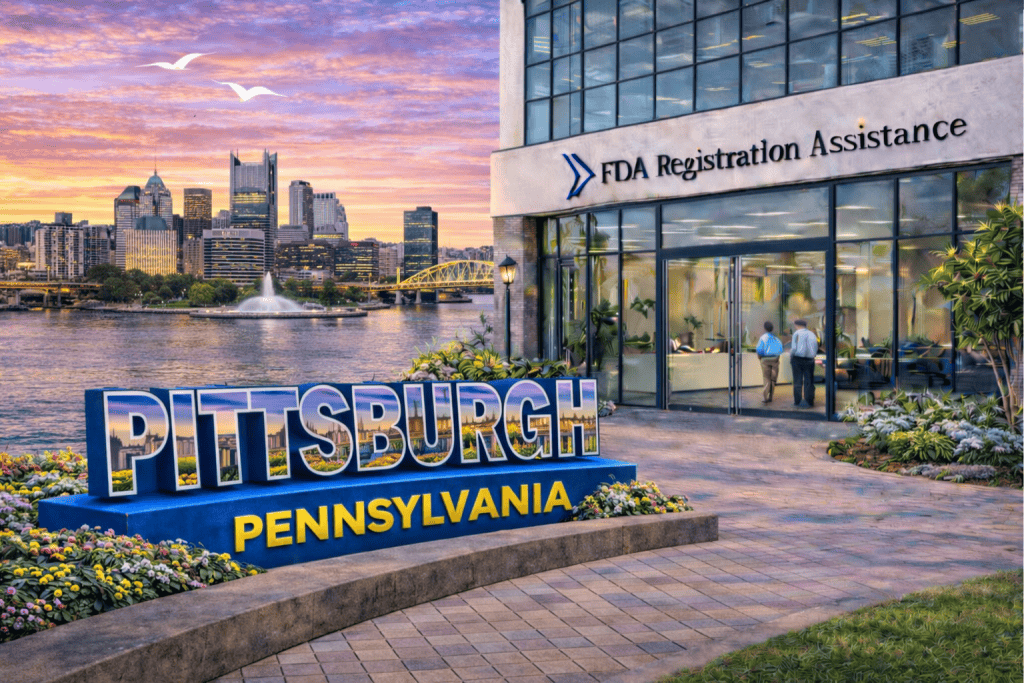
FDA Consulting Services in Pittsburgh, Pennsylvania
Trusted by 1,000+ companies across 135+ countries, with 15+ years of FDA regulatory experience. We help Pittsburgh device and diagnostics makers, drug and biologic companies, food and supplement producers, and brand owners register correctly across every FDA-regulated category.
FDA Services for Pittsburgh Businesses
Medical Devices
Robotic, AI-enabled, and diagnostic devices. Medical device and IVD registration, listing, the QMSR, U.S. Agent, and 510(k), De Novo, or PMA.
Drugs & Pharma
Pharma, vaccine, and biomanufacturing research. FDA drug establishment registration, NDC listing, and cGMP, separate from approvals.
Food & Beverage
Pittsburgh food, condiment, and specialty-food makers. FDA food facility registration, FSMA preventive controls, and labeling.
Cosmetics & Wellness
Pittsburgh-area beauty, personal-care, and wellness brands. MoCRA cosmetic registration, product listing, a Responsible Person, and safety substantiation.
Is Your Software or Robot a Medical Device?
In a city built on robotics and AI, the first question is often whether the technology is a regulated medical device at all. When software, an algorithm, or a robot is intended to diagnose, treat, or guide care, the FDA generally regulates it like any other device — with the same registration, listing, and premarket duties.
| If it's a… | It's regulated as | Key requirements |
|---|---|---|
| Robotic or surgical device | Medical device | Registration, listing, QMSR, 510(k) or PMA |
| AI/ML diagnostic software | Software as a Medical Device | Registration, listing, QMSR, premarket clearance |
| General wellness tool | Often outside device rules | Depends on claims — we help you confirm |
Where robotics meets medicine, the claims decide the pathway. An AI model or a robot built to inform a clinical decision is a medical device and follows the device framework; a general-wellness tool may sit outside it. We help Pittsburgh's engineers and founders classify the technology first, then register, list, and prepare the right premarket submission.
Where Robotics Meets Medicine
Once the Steel City, Pittsburgh is now a center where robotics and artificial intelligence, pioneered at Carnegie Mellon, meet world-class medicine at the University of Pittsburgh and UPMC, one of the nation's largest health systems. That rare combination has produced dozens of medical-device manufacturers and a steady flow of AI-enabled and robotic devices — which is why establishment registration, listing, the QMSR, and premarket pathways are everyday work here.
The region's research runs deep — this is where Jonas Salk developed the polio vaccine — and today its universities and health system feed a pipeline of device, diagnostic, drug, and vaccine companies, plus new biomanufacturing. Each carries its own FDA registration and listing obligations. We're a U.S.-based firm serving Pittsburgh and western Pennsylvania across every category.
A Cross-Category Checklist
FDA Registration for Every Product Type
Whatever you build in Pittsburgh — devices, diagnostics, drugs, or food — we handle the full FDA pathway by category: medical device registration, FDA drug establishment registration, FDA food facility registration, and MoCRA cosmetic registration. Tell us your category and role, and we'll map the exact steps.
FDA Compliance for Your Pittsburgh Business
Tell us your products and your role — device, diagnostics, or drug maker, food or supplement producer, importer, or brand owner — and we'll confirm exactly which FDA registrations, listings, and premarket steps apply, then handle the filings, quality-system setup, U.S. Agent or FSVP work, and label review. Email info@fdaregistrationassistance.com or call +1 (928) 275-8333.
Frequently Asked Questions — FDA Consulting in Pittsburgh, Pennsylvania
Do businesses in Pittsburgh need FDA registration?
Many do. If your Pittsburgh or western Pennsylvania business manufactures, processes, packs, holds, imports, or markets FDA-regulated devices, drugs, food, or cosmetics, registration is generally required. What you file depends on your role.
What makes Pittsburgh distinctive for FDA compliance?
Pittsburgh pairs two of the country's strongest sectors — robotics and AI from Carnegie Mellon, and medicine from the University of Pittsburgh and UPMC. So much of the FDA work here is medical devices, including AI-enabled and robotic devices, plus the pharma and vaccine research the region is known for.
Do medical device companies in Pittsburgh need to register?
Yes. Device and diagnostic makers complete FDA establishment registration and device listing, maintain the QMSR, and obtain a 510(k), De Novo, or PMA depending on class. The region's 60-plus device manufacturers make this the most common work here.
How does the FDA regulate AI- and software-driven medical devices?
Software as a Medical Device and AI/ML-enabled devices are still medical devices: the manufacturer registers and lists, maintains a quality system, and clears the right premarket pathway. We help Pittsburgh's robotics and AI innovators map device requirements onto their technology.
We're building a surgical or robotic device — what applies?
Robotic and computer-assisted surgical devices follow the device framework: establishment registration, listing, the QMSR, and usually a 510(k) or PMA given their risk class. We help translate an engineering project into an FDA-ready submission and registration.
Does a domestic Pittsburgh producer need a U.S. Agent?
No. A U.S. Agent is only required for foreign facilities. As a domestic Pittsburgh manufacturer you register your own establishment, but you don't need a U.S. Agent — that requirement falls on foreign suppliers if you import.
What is the QMSR?
The Quality Management System Regulation is the FDA's quality-system requirement for medical devices, now aligned with ISO 13485. Device makers must build and maintain a compliant quality system, and we help set yours up alongside registration and listing.
What is a 510(k), and is it the same as registration?
No. A 510(k) is a premarket clearance showing your device is substantially equivalent to one already on the market. Establishment registration and device listing are separate, mandatory steps. Most Class II devices need both — registration plus clearance.
Do university spinouts and startups need to register?
Once you manufacture or commercially distribute an FDA-regulated product, yes. Pittsburgh's universities and health system produce many device and diagnostic spinouts, and we help them register and list at the right stage as they move from lab to market.
Do diagnostics companies in Pittsburgh register?
Yes. In-vitro diagnostic makers face device requirements — establishment registration, listing, and often a 510(k) or PMA. Pittsburgh's data- and AI-driven diagnostics community includes many such companies, and we map the right pathway.
Do drug and vaccine companies in Pittsburgh register?
Yes. Drug and biologic establishments register and list with the FDA, with NDC labeler codes and cGMP, separate from the approval and licensure pathways new products follow. The region's research and biomanufacturing base falls under these rules.
Does Pittsburgh's vaccine and research heritage change the rules?
No. A storied research history — Pittsburgh is where the polio vaccine was developed — doesn't change registration requirements. Each manufacturing establishment still registers, lists, and follows cGMP. It does mean a dense pipeline of products moving from research toward market.
We're a contract manufacturer in Pittsburgh — do we register?
Yes. A facility that manufactures FDA-regulated products registers in its own right, whether it makes devices, drugs, food, or cosmetics. Contract manufacturers and their brand-owner clients each have obligations, and we sort out who files what.
Do food and beverage makers in Pittsburgh register?
Yes. Facilities that make, process, or hold food or beverages register as FDA food facilities, follow FSMA preventive controls, and label correctly. Pittsburgh's food, condiment, and specialty-food makers are within scope.
Do dietary supplement companies in Pittsburgh register?
Yes. Supplements are regulated as foods, so facilities register and follow cGMP under Part 111 with a Supplement Facts label. The area's supplement and natural-products makers fall under these rules.
Do cosmetics and personal-care brands register?
Under MoCRA, cosmetic manufacturers register their facility, list products, name a Responsible Person, and substantiate safety. Pittsburgh-area beauty and personal-care brands are within scope.
We import devices or components into Pittsburgh — what do we need?
Imported devices need the foreign establishment registered with a U.S. Agent and proper listing; imported food adds FSVP and Prior Notice. Pittsburgh's manufacturers often source components abroad, and we set up the right import requirements for each product type.
Can FDA Registration Assistance act as our U.S. Agent or FSVP Agent?
Yes. We serve as the U.S. Agent for foreign facilities and the FSVP Agent for imported food, and we manage device, drug, food, and cosmetic registrations and listings for Pittsburgh businesses.
Are you local to Pittsburgh?
We are a U.S.-based firm serving Pittsburgh and western Pennsylvania, alongside clients across the country and 135+ countries, with the same structured process whether you're local or elsewhere.
Does FDA registration mean FDA approval?
No. Registration and listing are mandatory regulatory steps; they are not FDA approval or endorsement. A device may still need a 510(k) or PMA, and a drug its own approval, to be marketed.
What's the difference between a 510(k), De Novo, and PMA?
They are device premarket pathways by risk. A 510(k) shows substantial equivalence, De Novo creates a new low-to-moderate-risk classification, and PMA is the most rigorous, for high-risk devices. Registration and listing apply regardless of which one you use.
We import devices or ingredients and also manufacture — can you handle both?
Yes. Many Pittsburgh companies both make products here and source components or ingredients abroad. We register your domestic establishment and listings while setting up U.S. Agent, FSVP, and Prior Notice for the imported side, under one engagement.
Is a DUNS Number required?
Yes, for food facility registration the DUNS Number is the required Unique Facility Identifier. We help you or your foreign supplier obtain one if it isn't already in place; device and drug registrations use their own FDA identifiers.
Does registration need to be renewed?
Yes. Drug and device establishment registrations renew annually, while food and cosmetic facility registrations renew biennially. We track and manage the renewals so nothing lapses.
How do I get started?
Send us your products and your role — device, diagnostics, or drug maker, food or supplement producer, importer, or brand owner. Contact our team and we'll confirm which FDA requirements apply to your Pittsburgh business and handle the registrations and filings. Email info@fdaregistrationassistance.com or call +1 (928) 275-8333.