
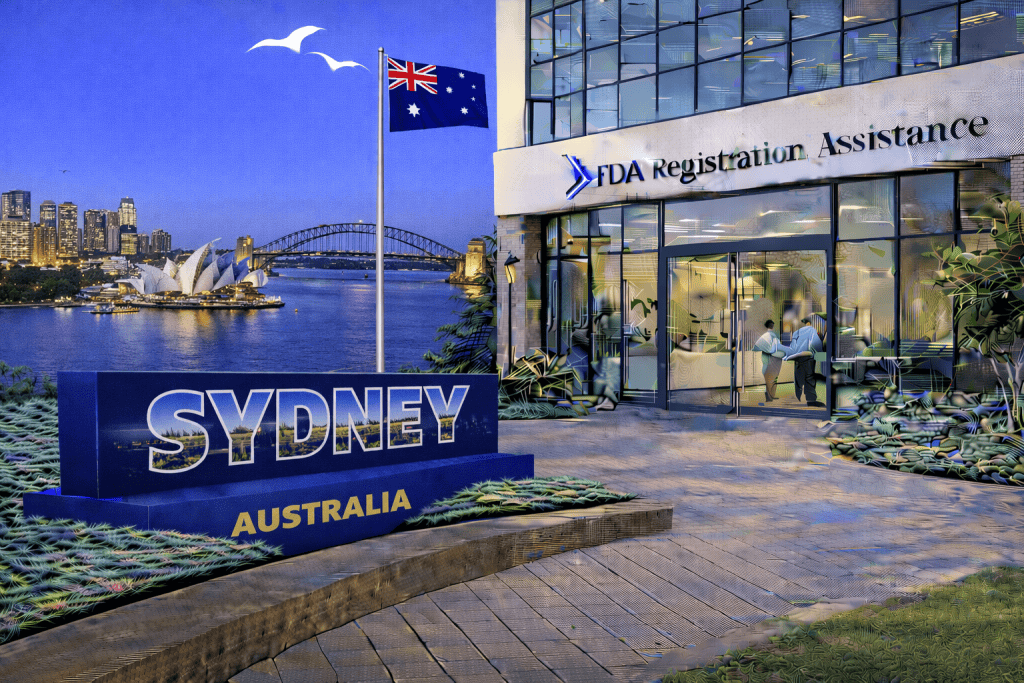
FDA Consulting Services in Sydney, Australia
Trusted by 1,000+ companies across 135+ countries, with 15+ years of FDA regulatory experience. As a U.S.-based firm, we help Sydney device makers, biotech, pharma, supplement, and food exporters register with the FDA and reach the U.S. market — and we can serve as your U.S. Agent.
FDA Services for Sydney Exporters
Medical Devices & Software
Devices, diagnostics & SaMD. Foreign device establishment registration, listing, 510(k)/PMA, QMSR, UDI & U.S. Agent.
Drugs & Biotech
Pharmaceutical and biotech exporters. Drug establishment registration, listing, NDC labeler codes, DMF, and a U.S. Agent.
Supplements & Cosmetics
Complementary medicines & skincare. MoCRA cosmetic registration and Part 111 supplement registration, with a U.S. Agent.
Food & Agriculture
Macadamias, honey & seafood. Foreign food facility registration, allergen & Seafood HACCP review, U.S. Agent & FSVP.
Register, Clear, or Approve?
For a medical device, registering is not the same as being allowed to sell. Registration and listing identify you to the FDA; a separate premarket pathway, set by the device's risk, decides market access.
| Device | Risk | FDA pathway |
|---|---|---|
| Most Class I | Low | Register & list; many are exempt from review |
| Class II with a predicate | Moderate | 510(k) clearance (substantial equivalence) |
| Novel, no predicate | Low / moderate | De Novo (new classification) |
| Class III | High | PMA (premarket approval) |
Calling a device “FDA approved” when it is only registered, or only cleared, is a violation. We confirm your establishment registration and listing, appoint your U.S. Agent, identify the correct pathway, and align your quality system, UDI, and Medical Device Reporting — so your device reaches the U.S. the right way.
A Medtech Heartland, Cleared for the U.S.
Sydney is a leading center of Australia's medical technology and life sciences industry — the heritage home of innovations like the cochlear hearing implant and the CPAP breathing device, and a strong base for diagnostics, digital health, and software as a medical device. It also exports pharmaceuticals, complementary medicines, natural skincare, and foods such as macadamias and honey.
For the U.S. market, each category has its own track. Devices register and list, appoint a U.S. Agent, and clear a 510(k), De Novo, or PMA pathway, with QMSR, UDI, and reporting. Drugs register and list with NDC codes; supplements follow Part 111; cosmetics follow MoCRA; and food needs foreign facility registration, FSVP, and Prior Notice. Meat is generally a USDA matter, and wine falls under the Alcohol and Tobacco Tax and Trade Bureau — not the FDA. We're a U.S.-based firm guiding Sydney exporters across every FDA-regulated category.

A Step-by-Step Checklist
FDA Registration for Every Product Type
Whatever you export from Sydney, we handle the full FDA pathway by category: medical device registration, FDA drug establishment registration, MoCRA cosmetic registration, and FDA food facility registration — with U.S. Agent services for each. Tell us your category and risk class, and we'll map the exact steps.
FDA Compliance for Your Sydney Exports
Tell us your product and company — medical devices, software, pharma, supplements, cosmetics, or food — and we'll confirm exactly which FDA registrations, listings, and premarket pathways apply, review your labeling, appoint your U.S. Agent, and coordinate FSVP and Prior Notice for any food. Email info@fdaregistrationassistance.com or call +1 (928) 275-8333.
Frequently Asked Questions — FDA Consulting in Sydney, Australia
Do companies in Sydney need FDA registration to sell in the U.S.?
Many do. If your Sydney business makes FDA-regulated medical devices, drugs, foods, supplements, or cosmetics intended for the U.S. market, the foreign establishment generally must register with the FDA. Devices and drugs register and list, and what you file depends on the product.
What makes Sydney distinctive for FDA compliance?
Sydney is one of Australia's main hubs for medical technology, health innovation, and life sciences. So the FDA work here often centers on medical devices — establishment registration, the right premarket pathway, and a U.S. Agent — alongside pharma, supplements, and food.
Do Australian medical device makers have to register with the FDA?
Yes. A foreign device establishment that makes devices for the U.S. registers with the FDA, lists its devices, and appoints a U.S. Agent. Device registration renews annually. We handle the registration, listing, and agent appointment.
Is registration the same as FDA clearance or approval?
No, and this matters most for devices. Registration and listing simply tell the FDA you exist and what you make. Market access comes separately through a premarket pathway — 510(k) clearance, De Novo, or PMA approval — depending on the device's risk. We map both.
What is a 510(k)?
A 510(k) is a premarket submission showing your device is substantially equivalent to a legally marketed predicate device. Most moderate-risk Class II devices use it. We help identify a predicate and prepare the submission.
What is the De Novo pathway?
De Novo is for novel low- to moderate-risk devices that have no predicate to compare against. It creates a new classification. If your Sydney device is genuinely new, we assess whether De Novo is the right route.
When is a PMA required?
Premarket Approval is the most rigorous pathway, required for high-risk Class III devices such as many implants. It involves clinical evidence and FDA approval before marketing. We map the evidence and process for Class III devices.
What is the QMSR, and do we need ISO 13485?
The FDA's Quality Management System Regulation now aligns with ISO 13485, the international quality standard many Australian manufacturers already follow. We help you confirm your quality system meets the FDA's expectations.
What is UDI, and does it apply to us?
Unique Device Identification requires most devices to carry a standardized identifier and be entered in the FDA's database. We help you assign UDIs and meet the labeling and database requirements.
What is Medical Device Reporting?
Once on the U.S. market, manufacturers must report certain device-related deaths, serious injuries, and malfunctions to the FDA. We help you set up the reporting procedures so you stay compliant after launch.
We build software or AI as a medical device — does the FDA regulate that?
Often, yes. Software as a medical device and many AI- and machine-learning-driven tools are regulated as devices, with their own considerations. Sydney's strong digital-health scene puts this front and center, and we map the pathway.
Is a U.S. Agent required for an Australian company?
Yes. Every foreign establishment that registers with the FDA must appoint a U.S. Agent located in the United States to serve as the FDA's contact. FDA Registration Assistance can act as your U.S. Agent.
Do pharmaceutical and biotech exporters register?
Yes. Foreign drug establishments register and list with the FDA, appoint a U.S. Agent, follow cGMP, use NDC labeler codes, and file a Drug Master File (DMF) for active ingredients. We map the requirements for Sydney pharma and biotech.
Australia has a big vitamins and supplements industry — how are those handled?
Australian complementary medicines are usually treated as dietary supplements in the U.S., regulated as foods under Part 111, with a Supplement Facts label and carefully worded claims. The facility registers and appoints a U.S. Agent. We set it up.
Do natural skincare and cosmetic exporters register?
Under MoCRA, the foreign cosmetic manufacturer registers its facility, lists products, names a Responsible Person, and substantiates safety. Australia's natural skincare brands are within scope, and we handle the registration.
Do food exporters — macadamias, honey, seafood — register?
Yes. Foreign food facilities register, appoint a U.S. Agent, and the U.S. importer runs FSVP and files Prior Notice. Macadamias carry tree-nut allergen labeling, and seafood adds Seafood HACCP. We map each product's requirements.
Is our beef or meat FDA-regulated?
Usually not by the FDA. Most meat and poultry are regulated by the USDA, not the FDA, though some products are split between the two. We confirm which agency governs your product and handle the FDA-regulated portion.
Is Australian wine FDA-regulated?
Generally no. Wine and other alcohol are mainly regulated by the U.S. Alcohol and Tobacco Tax and Trade Bureau, not the FDA. We focus on your FDA-regulated products and can point you to the right path for wine.
What is FSVP, and who is responsible for it?
For food, the Foreign Supplier Verification Program is the U.S. importer's responsibility — they verify the foreign supplier meets U.S. safety standards. It doesn't apply to devices or drugs. We support your food registration and the importer's FSVP.
Do labels need to change for the U.S. market?
Usually, yes. U.S. labels follow product-specific rules — device labeling and UDI, drug labeling and NDC, Supplement Facts, cosmetic labeling, or Nutrition Facts and allergens for food. We review and correct labels so products aren't refused for misbranding.
What happens if a shipment or submission doesn't comply?
The FDA can refuse admission, detain shipments, issue warning letters, or place products on import alert. For devices, marketing without the right clearance or approval is a serious problem. A review before you ship or submit is essential.
Does FDA registration mean our product is FDA approved?
No. Registration and listing are mandatory steps, not approval or endorsement, and for most devices “FDA cleared” is the accurate term rather than “approved.” Claiming “FDA approved” when you are only registered or cleared is a violation.
Is FDA registration the same as meeting customs and trade rules?
No. FDA registration is separate from, and in addition to, U.S. customs, import, and other applicable trade laws. We handle the FDA side; your importer and customs broker handle entry and any other requirements.
How often do registrations renew?
Device and drug establishment registrations renew annually, while foreign food and cosmetic facility registrations renew biennially. A DUNS Number is required as the facility identifier for food. We track and manage every renewal so nothing lapses.
How do I get started?
Send us your product and company details — medical devices, software, pharma, supplements, cosmetics, or food. Contact our team and we'll confirm which FDA registrations, listings, and premarket pathways apply to your Sydney business, review your labeling, and handle the registration, U.S. Agent appointment, and filings. Email info@fdaregistrationassistance.com or call +1 (928) 275-8333.