
FDA Consulting Services in Yerevan, Armenia
Trusted by 1,000+ companies across 135+ countries, with 15+ years of FDA regulatory experience. As a U.S.-based firm, we help Yerevan fruit, dried-fruit, bottled-water, and food exporters register with the FDA and reach the U.S. market — and we can serve as your U.S. Agent.

FDA Services for Yerevan Exporters
Food & Beverage
Apricots, dried fruit, preserves & mineral water. Foreign food facility registration, sulfite & water labeling, U.S. Agent & FSVP.
Cosmetics & Wellness
Apricot-kernel oil and botanical skincare. MoCRA cosmetic registration, product listing, the Responsible Person role, and safety.
Drugs & Pharma
Pharmaceutical and OTC exporters. Drug establishment registration, listing, NDC labeler codes, and a U.S. Agent.
Medical Devices
Device and software exporters. Foreign device registration, listing, the QMSR, U.S. Agent, and 510(k) context.
Dried, Preserved, or Bottled?
Armenia's apricot leaves Yerevan in many forms, and so does its water — and each one meets the FDA with its own labeling rule. Getting the declaration right is what keeps the shipment moving.
| Product | What it is | Key U.S. requirement |
|---|---|---|
| Dried apricots & fruit | Sulfur-dioxide treated | Declare sulfites on the label |
| Jams, preserves & compotes | Processed fruit | Facility registration & labeling |
| Pastille, leather & confections | Fruit + sugar | Ingredient, color & allergen review |
| Mineral / spring water | Bottled water | Type & source identity labeling |
Undeclared sulfites are a classic reason dried fruit gets held. Sulfured apricots almost always carry enough sulfur dioxide to require a declaration, and bottled water must be labeled by its correct type and source. We confirm your facility registration, get the sulfite statement right, and make sure “mineral” or “spring” water is labeled the way the FDA defines it — so every form clears.
The Apricot Capital, Cleared for the U.S.
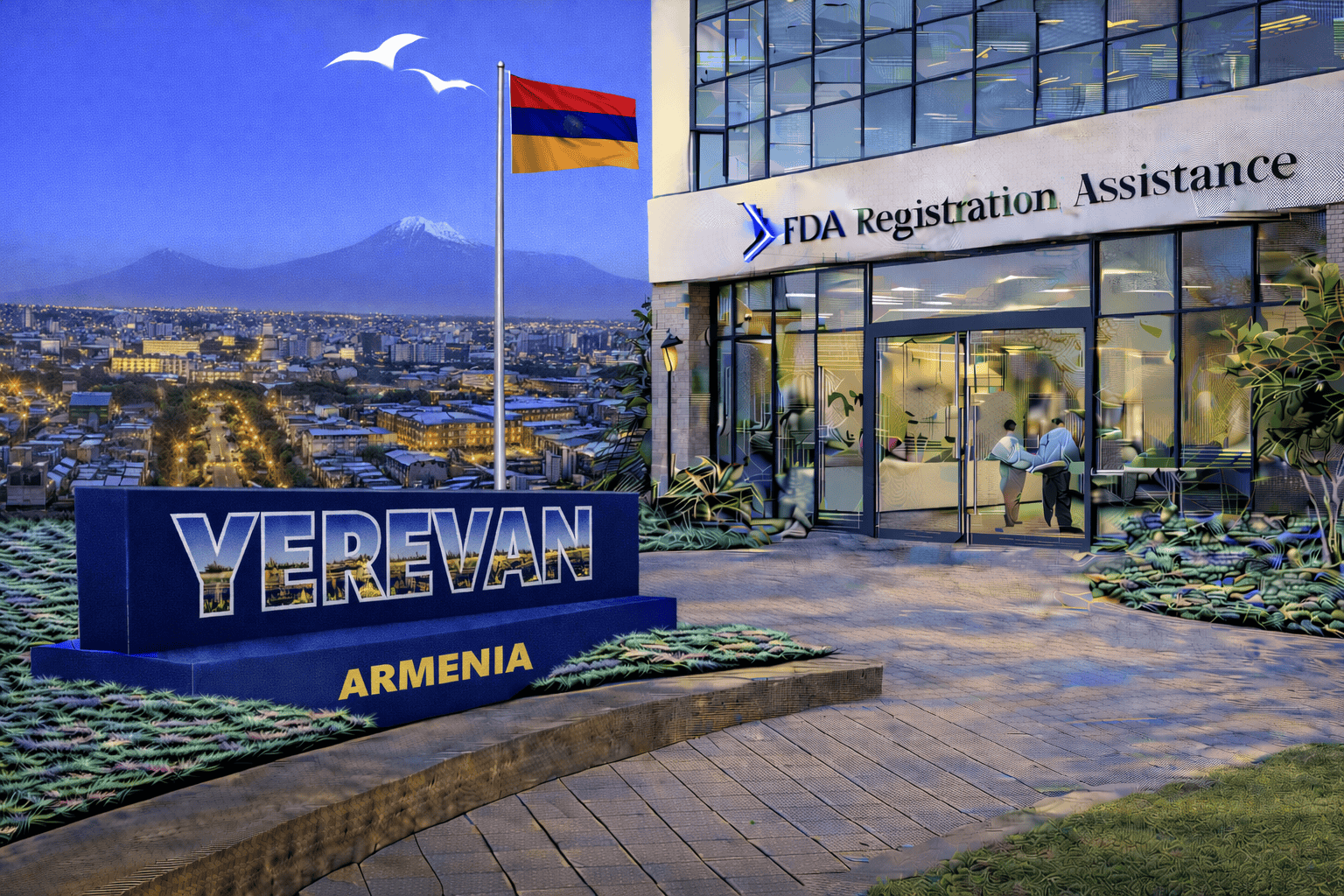
Yerevan, capital of Armenia and one of the world's oldest cities, anchors a food and beverage trade built on the country's emblem — the apricot, whose Latin name Prunus armeniaca means “Armenian plum” and whose color sits on the national flag. From the Ararat Valley come dried apricots, jams and preserves, fruit pastille, and juice, while the highlands yield prized mineral and spring water.
Reaching the U.S. market means the producing facility registers with the FDA, appoints a U.S. Agent, and clears the details that matter for these products: sulfite declarations on dried fruit, bottled-water identity and source labeling, and MoCRA registration for apricot-kernel oil cosmetics — while the U.S. importer handles FSVP and Prior Notice. Brandy and wine, Armenia's famous exports, fall under the U.S. Alcohol and Tobacco Tax and Trade Bureau rather than the FDA. We're a U.S.-based firm serving Yerevan exporters across every FDA-regulated category.
A Step-by-Step Checklist
FDA Registration for Every Product Type
Whatever you export from Yerevan, we handle the full FDA pathway by category: FDA food facility registration, FDA drug establishment registration, medical device registration, and MoCRA cosmetic registration — with U.S. Agent services for each. Tell us your category and role, and we'll map the exact steps.
FDA Compliance for Your Yerevan Exports
Tell us your facility and products — dried apricots, preserves, mineral water, supplements, cosmetics, or other goods — and we'll confirm exactly which FDA registrations and listings apply, review your sulfite and water labeling, appoint your U.S. Agent, and coordinate FSVP and Prior Notice with your importer. Email info@fdaregistrationassistance.com or call +1 (928) 275-8333.
Frequently Asked Questions — FDA Consulting in Yerevan, Armenia
Do companies in Yerevan need FDA registration to sell in the U.S.?
Many do. If your Armenian business produces, processes, packs, or holds FDA-regulated fruit, water, foods, supplements, cosmetics, drugs, or devices intended for the U.S. market, the foreign facility generally must register with the FDA. What you file depends on the product.
What makes Yerevan distinctive for FDA compliance?
Armenia's emblem is the apricot, and its highlands are known for mineral and spring water. So the FDA work here centers on fruit — where sulfites on dried apricots get declared — and on bottled water, which has its own identity and labeling rules.
Is a U.S. Agent required for an Armenian exporter?
Yes. Every foreign facility that registers with the FDA must appoint a U.S. Agent located in the United States to serve as the FDA's contact. FDA Registration Assistance can act as your U.S. Agent.
How does a foreign food facility register with the FDA?
The facility submits a foreign food facility registration through the FDA's system, obtains a DUNS Number as its Unique Facility Identifier, and appoints a U.S. Agent. We prepare and submit the registration and maintain it through each renewal.
We export dried apricots — what does the FDA require?
Dried apricots and other dried fruit register as a foreign food facility and label correctly. The key detail is that dried fruit is often treated with sulfur dioxide to preserve color, and sulfites must be declared. We make sure that declaration is right.
Why do sulfites have to be declared?
Sulfites can trigger reactions in sensitive people, so the FDA requires them to be declared when present at or above ten parts per million. Sulfured dried apricots almost always cross that line, so the label must say so, and we confirm yours does.
Can dried fruit have other issues?
Yes. Dried fruit can develop mold or carry foreign material if dried or stored poorly, so good drying, storage, and sorting matter. We help you document those controls alongside the sulfite declaration so the shipment clears.
We bottle mineral or spring water — is that FDA-regulated?
Yes. Bottled water is a food with its own FDA quality standards, and the terms “mineral water” and “spring water” have defined meanings. The facility registers, meets the bottled-water standards, and labels the type and source correctly. We map all of it.
What does bottled-water labeling require?
The label must use the correct water type, identify the source, and meet general food-labeling rules, and the water has to meet FDA quality standards. Claims about minerals or origin must be accurate. We review the label and the standard your water is held to.
Do jams, preserves, and compotes need registration?
Yes. Fruit preserves, jams, and compotes register as foreign food facilities, label to U.S. rules, and meet safety standards; some are acidified foods with added requirements. We confirm which rules apply to each of your products.
What about fruit leather, pastille, and fruit confections?
Those are processed foods that register like other foods, with attention to ingredients, any added sulfites or colors, and allergen declarations. We review the recipe and label so they clear U.S. review.
Is apricot kernel oil a food or a cosmetic?
It depends on use. Apricot kernel oil used in skincare is a cosmetic under MoCRA, while culinary oil is a food. We confirm the category and set up the right registration — cosmetic facility and Responsible Person, or food facility.
Are our brandy and wine FDA-regulated?
Generally no. Wine, brandy, and other alcohol are mainly regulated by the U.S. Alcohol and Tobacco Tax and Trade Bureau, not the FDA. We focus on your FDA-regulated foods, water, and cosmetics and can point you to the right path for alcohol.
What is FSVP, and who is responsible for it?
The Foreign Supplier Verification Program is the U.S. importer's responsibility — they verify that you, the foreign supplier, meet U.S. safety standards. We support both sides: your registration and documentation, and the importer's FSVP, so shipments clear.
What is Prior Notice?
Prior Notice is an electronic notice filed with the FDA before each food shipment arrives in the U.S. It's usually handled on the U.S. side, and we coordinate it with your importer so fruit and water shipments aren't held at the port of entry.
What happens if a shipment doesn't comply at the U.S. border?
The FDA can refuse admission, detain the shipment, or place it on an import alert, and goods may be re-exported or destroyed. Undeclared sulfites and labeling problems are common triggers, so a label and records review before shipment is essential.
Do labels need to change for the U.S. market?
Usually, yes. U.S. labels must be in English, with a Nutrition Facts panel, an ingredient list, sulfite and allergen declarations, net quantity, and accurate claims. We review and correct labels so products aren't refused for misbranding.
Do herbal tea or honey exporters register?
Yes. Highland herbal teas, honey, and similar products register as foreign food facilities and label to U.S. rules. We handle whatever mix of products your facility exports alongside fruit and water.
Do dietary supplement exporters register?
Yes. Supplements, including botanical or herbal products, are regulated as foods, so the facility registers and follows U.S. cGMP under Part 111 with a Supplement Facts label and carefully worded claims. We handle the registration and U.S. Agent.
Do cosmetics and personal-care exporters register?
Under MoCRA, the foreign cosmetic manufacturer registers its facility, lists products, names a Responsible Person, and substantiates safety. Armenian botanical and apricot-oil cosmetics are within scope.
Yerevan has a strong tech and pharma scene — do drug and device makers register?
Yes. Foreign drug and device establishments register and list with the FDA, appoint a U.S. Agent, follow cGMP or the QMSR, and use the right pathway. Software as a medical device is also in scope, and we map the requirements.
Does FDA registration mean our product is FDA approved?
No. Registration and listing are mandatory steps that let you enter the U.S. market; they are not FDA approval or endorsement. Claiming “FDA approved” when you are only registered is itself a violation.
Is FDA registration the same as meeting customs and trade rules?
No. FDA registration is separate from, and in addition to, U.S. customs, import, and other applicable trade laws. We handle the FDA side; your importer and customs broker handle entry and any other requirements.
Does our registration renew, and is a DUNS Number required?
Yes to both. Foreign food and cosmetic facility registrations renew biennially, while drug and device registrations renew annually, and food facility registration requires a DUNS Number as the Unique Facility Identifier. We obtain the DUNS and manage your renewals so your market access doesn't lapse.
How do I get started?
Send us your facility and product details — dried apricots, preserves, mineral water, supplements, cosmetics, or other products. Contact our team and we'll confirm which FDA requirements apply to your Yerevan business, review your sulfite, water, and label records, and handle the registration, U.S. Agent appointment, and filings. Email info@fdaregistrationassistance.com or call +1 (928) 275-8333.