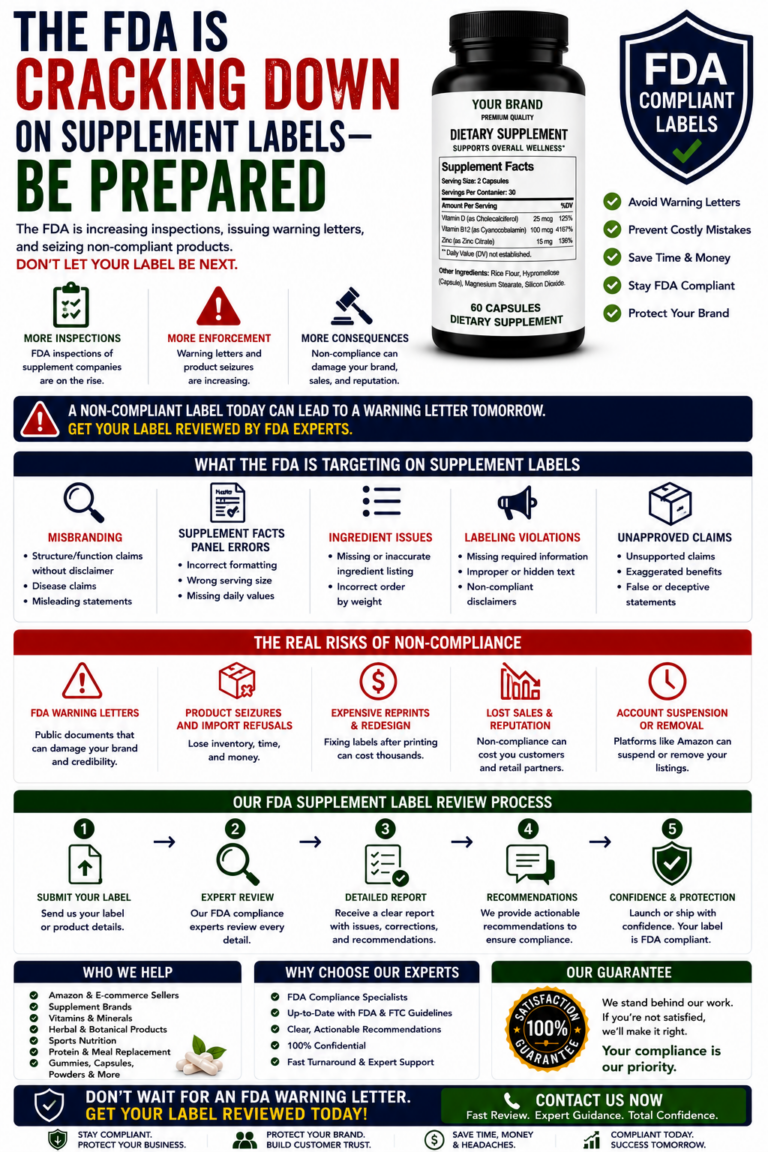
The FDA Is Cracking Down on Supplement Labels — Be Prepared
A product that's already selling can be flagged for a label or claim — even when the formula is safe. Here's the real landscape in 2026, and how to get ahead of it.
Key Takeaways
- Two agencies, not one: FDA (labeling, misbranding, tainted products) and FTC (advertising, claim substantiation) coordinate on supplement enforcement.
- Tainted products are a top target: FDA has flagged 1,000+ supplements with hidden drug ingredients — often weight-loss, sexual-enhancement, and bodybuilding products.
- Marketing everywhere counts: websites, social media, influencer posts, and marketplace listings are all treated as labeling or advertising.
- Claim categories under fire: weight loss, cognitive/performance, disease claims, and broad "natural / purity" positioning.
- The system itself is changing: a push for mandatory product listing, a re-examination of what qualifies as a supplement ingredient, and modernized labeling rules.
- FDA says it wants compliance, not just punishment — transparent, compliant brands are far less likely to be targets.
What's Actually Driving the Crackdown
A market that exploded
By FDA officials' estimates, the supplement market has grown from about 4,000 products when DSHEA passed in 1994 to roughly 100,000 today — far outpacing the oversight tools built for a smaller industry.
A 1994 law with gaps
DSHEA never required companies to register their products with FDA, so the agency has limited visibility into what's actually on the market — a gap now driving calls for change.
Tainted products & safety
A steady stream of products found to contain hidden drug ingredients has pushed FDA to act more publicly and more often, coordinating with law-enforcement partners.
E-commerce & influencers
The explosion of online selling and influencer marketing multiplied where non-compliant claims appear — and regulators have followed the claims onto those channels.
What FDA & FTC Are Targeting Right Now
| Target | What it looks like | Who acts |
|---|---|---|
| Tainted products | Hidden drug ingredients in weight-loss, sexual-enhancement, bodybuilding, joint-pain, diabetes, and sleep products | FDA (+ law enforcement) |
| Opaque "proprietary blends" | Blends that hide an undeclared active — several 2026 cases found synthetic stimulants in an "herbal blend" | FDA |
| Disease claims | Language that treats/cures/prevents disease — turns a supplement into an unapproved drug | FDA (+ FTC) |
| Unsubstantiated claims | Weight-loss, cognitive/performance, and "natural/purity" claims without competent, reliable evidence | FTC |
| Influencer marketing | Undisclosed material connections; implied health claims in lifestyle content | FTC |
| Marketplace listings | Non-compliant claims in Amazon/Walmart third-party listings | FTC + marketplaces |
The Structural Shifts to Watch in 2026
Mandatory Product Listing
A proposed requirement (backed by FDA, discussed in Congress) that supplement products — not just facilities — be listed with FDA. Not yet law, but the biggest structural change on the table.
Scope of ingredients
FDA is examining what can even qualify as a supplement ingredient — including whether substances with no traditional dietary history can. Tied to NDI rules, this could reshape what's sellable as a supplement.
Modernized labeling rules
The December 2025 DSHEA disclaimer enforcement-discretion letter signaled FDA's willingness to simplify outdated rules — though the disclaimer itself, linked to each claim, is still required.
How to Get Ahead of the Crackdown
Audit claims across every channel
Not just the label — your website, social media, influencer content, and marketplace listings are all in scope.
Confirm your product isn't "tainted"
Verify it contains only what the label declares — no undeclared actives hidden in a proprietary blend.
Substantiate every claim
Each structure/function claim needs competent, reliable evidence you can produce — the core of FTC enforcement.
Fix the label fundamentals
The disease-claim line, DSHEA disclaimer, Supplement Facts, allergens, and identity — see the warning-letter guide.
Manage influencer & marketplace risk
Ensure influencer disclosures meet FTC rules and marketplace listings match your compliant claims.
Review before selling
Have the label and full marketing reviewed against current FDA and FTC expectations before market.
Get Enforcement-Ready Before You're a Target
In a coordinated FDA-FTC environment, your label and your marketing both have to hold up. FDA Registration Assistance reviews both against current expectations — the claim rules and DSHEA disclaimer, Supplement Facts, allergen declarations, and claim substantiation — and returns clear corrections before your product is on the market.
Contact us at info@fdaregistrationassistance.com or call +1 (928) 275-8333. Trusted by 1,000+ clients across 135+ countries, with 15+ years of FDA experience.
Frequently Asked Questions — The FDA Supplement Crackdown
1. Is the FDA really cracking down on supplement labels?
Yes — and it's coordinated with the FTC. More products draw warning letters, safety alerts, and import scrutiny for labeling and claim problems rather than only safety issues, and FDA is also pursuing structural changes to how the industry is overseen.
2. Why is enforcement increasing now?
The market grew from around 4,000 products in 1994 to roughly 100,000 today (by FDA estimates), while DSHEA never required product registration — leaving FDA limited visibility. Add e-commerce, influencer marketing, and a wave of tainted products, and pressure to enforce and modernize has grown.
3. Is it just FDA, or the FTC too?
Both. FDA covers labeling, misbranding, adulteration, and tainted products; FTC covers advertising and requires claims be backed by competent, reliable evidence. They coordinate on public warnings, so your label and marketing are both in scope.
4. What are "tainted" supplements?
Products marketed as supplements that actually contain hidden drug ingredients. FDA has identified 1,000+, most often weight-loss, sexual-enhancement, bodybuilding, joint-pain, diabetes, or sleep products laced with prescription drugs, banned drugs, controlled substances, or untested actives. Sellers can face liability even without formulating them.
5. Why are "proprietary blends" a red flag?
A blend listing only a total can hide an undeclared active. In several 2026 cases, a "proprietary herbal blend" was found on testing to contain undeclared synthetic stimulants. Opaque blends draw extra scrutiny; transparency lowers risk.
6. Which claim categories draw the most scrutiny?
Weight loss/body composition, performance/cognitive, and disease-related claims, plus broad "natural," purity, and sustainability positioning — the areas where FTC substantiation enforcement and FDA disease-claim actions concentrate.
7. Do my website and social media claims count?
Yes. FDA treats them as labeling and FTC as advertising subject to substantiation. A compliant bottle with disease claims or unsupported promises online can still trigger enforcement.
8. Is influencer marketing being targeted?
Yes. FTC Endorsement Guides require influencers disclose material connections (payment, free product, affiliate), and wellness/supplement content is a flagged risk area. Brands are responsible for their influencers' claims.
9. Are marketplaces like Amazon affected?
Yes. Regulators have signaled enforcement extends to third-party listings, and marketplaces tighten reviews and remove risky products — sometimes before FDA acts. A non-compliant listing can get you delisted independent of FDA.
10. What is mandatory product listing?
Because DSHEA never required product registration, FDA has limited market visibility. Mandatory product listing (MPL) is a proposed requirement — backed by FDA, discussed in Congress — that supplement products be listed with FDA. Not yet law, but a major potential change.
11. What is the "scope of ingredients" question?
In 2026 FDA is examining what can legally be a supplement ingredient — including whether substances with no traditional dietary history qualify. Tied to NDI rules, it could reshape what's sellable as a supplement.
12. Did FDA change the DSHEA disclaimer rules?
In December 2025 FDA said it would exercise enforcement discretion on the "each panel" disclaimer requirement and may propose removing it — but the disclaimer, linked to each claim, is still required. It signals a broader willingness to modernize outdated rules.
13. Is FDA's approach purely punitive?
FDA's Office of Dietary Supplement Programs has framed 2026 as encouraging compliance — communicating priorities so responsible firms stay compliant — while reserving enforcement for those who don't. Compliant, transparent brands are less likely to be targets.
14. Does this affect imported supplements more?
Imported supplements often face extra scrutiny at entry, where labeling and claim problems can cause detention or refusal. Combined with the tainted-product focus, opaque or non-compliant imports are at elevated risk.
15. Can small labeling mistakes still cause problems?
Yes. Even as some rules modernize, the fundamentals still apply — a disease claim, a missing disclaimer, an undeclared allergen, or an inaccurate Supplement Facts panel can each trigger enforcement.
16. What happens if my product is flagged?
From a public warning letter or safety alert, to import detention or refusal, to marketplace delisting, and for serious cases like tainted products, seizure, injunction, or criminal liability. Public actions carry reputational damage too.
17. How is this different from the warning-letter guide?
The label rules — structure/function vs. disease claims, the DSHEA disclaimer, Supplement Facts, allergens — are in our warning-letter guide. This page covers the current enforcement landscape: what's driving it and what's changing. Use both together.
18. How should my brand get ahead of it?
Audit claims across every channel including influencers and marketplaces; confirm the product contains only what the label declares; substantiate every claim; fix the label fundamentals; and get a professional review before selling.
19. When should I review my label and marketing?
Before production, before shipping, and before listing on any marketplace — and again whenever you change the formulation, add a claim, or launch a new campaign.
20. Does the tainted-product focus affect honest brands?
Indirectly — it raises scrutiny industry-wide, so transparent formulations and clear ingredient disclosure help honest brands stand apart from the products FDA is targeting.
21. How does FDA Registration Assistance help?
It reviews supplement labels and marketing against current FDA and FTC expectations — the claim rules, DSHEA disclaimer, Supplement Facts, allergens, and substantiation — and helps brands correct issues before they become enforcement targets.
22. How do I get my supplement reviewed?
Contact FDA Registration Assistance at info@fdaregistrationassistance.com or call +1 (928) 275-8333. Send your label, formulation, and the claims across your label, website, and marketing for review before market.