FDA eDRLS Compliance for Drug Companies
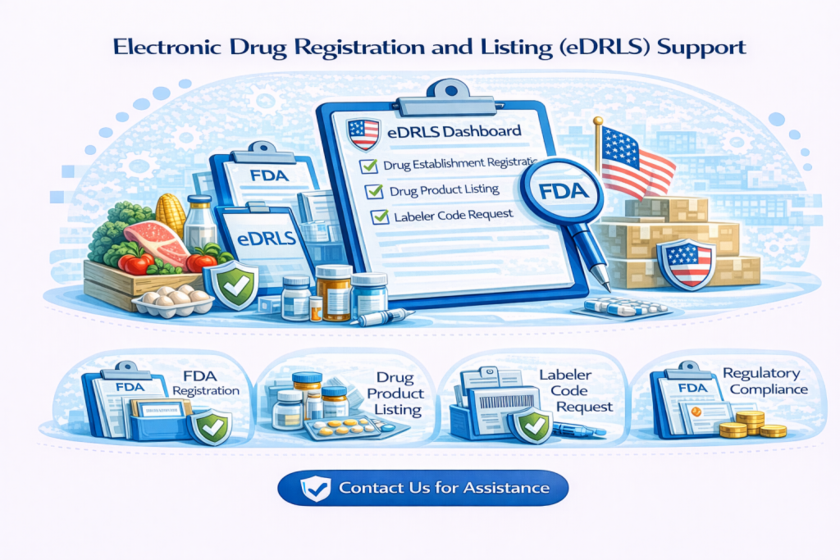
This guide explains the eDRLS system, who must register, the SPL drug listing format, NDC codes, annual renewal requirements, the U.S. Agent obligation for foreign drug establishments, and what FDA Registration Assistance does to manage the entire eDRLS compliance lifecycle.
Drug Establishment Types That Must Register Through eDRLS
| Establishment Type | eDRLS Registration Required? | Drug Product Listing Required? | Notes |
|---|---|---|---|
| Finished drug product manufacturer (prescription or OTC) | Yes — 21 CFR Part 207 | Yes — SPL format | Annual renewal October–December. NDC labeler code assigned at registration. |
| API (Active Pharmaceutical Ingredient) manufacturer | Yes — 21 CFR Part 207 | Yes — API listing | Foreign API manufacturers increasingly scrutinized. U.S. Agent required for foreign API facilities. |
| Contract manufacturer (manufactures drugs for other companies) | Yes — as the manufacturing facility | Yes — as the contract manufacturer of record | Both the contract manufacturer and the finished drug product labeler typically have eDRLS obligations. |
| Repacker (repackages drug products into different containers) | Yes | Yes — for repackaged products | Must list repackaged products separately. Repacker name may appear on the label. |
| Relabeler (changes or adds labeling without opening immediate container) | Yes | Yes | Must register as a relabeler. New listing required for relabeled products. |
| Private label distributor (distributes under own label, does not manufacture) | Yes — commonly missed | Yes — under own labeler code | Own FDA labeler code and drug listing required even though drug is manufactured by a contract manufacturer. |
| Foreign drug establishment (any of the above, outside the U.S.) | Yes + U.S. Agent required | Yes — SPL format | Import Alert 89-06 for missing or non-compliant registration. U.S. Agent must facilitate inspections under 21 CFR 207.69. |
How FDA Drug Establishment Registration and Listing Works Step by Step
National Drug Code (NDC) Structure and SPL Drug Listing Requirements
The NDC must appear on the drug product label and in the eDRLS drug product listing. The labeler code is assigned by FDA upon eDRLS establishment registration.
NDC — National Drug Code
The NDC is the unique 10-digit identifier for each drug product. Three segments: the labeler code (FDA-assigned based on the registrant’s DUNS and establishment registration); the product code (assigned by the labeler to identify the specific formulation); and the package code (identifies the specific package size and type). The NDC must appear on every drug product label and in the eDRLS drug listing. Foreign manufacturers must obtain their own FDA labeler code — they cannot use a U.S. importer’s labeler code.
SPL — Structured Product Labeling
SPL is the HL7 XML-based standard required for all drug product listings submitted through eDRLS. Each SPL file must include: drug product name; active ingredient(s) with strength per dosage unit; inactive ingredients; dosage form; route of administration; product labeling content in structured XML format; NDC number(s) for each package configuration; marketing category (Prescription/OTC/homeopathic); and marketing start date. Incorrectly structured SPL files are rejected by FDA’s submission processing system. SPL preparation is a technical discipline that FDA Registration Assistance manages on behalf of drug companies.
What Happens When Foreign Drug Establishments Miss eDRLS Compliance
Common Triggers for Import Alert 89-06
✗ Initial failure to register through eDRLS before first drug shipment to the U.S.
✗ Missing the annual October–December renewal — lapsed registration
✗ Inconsistencies in the eDRLS registration data (company name, address, establishment type)
✗ Missing or inactive U.S. Agent designation in the eDRLS registration
✗ Drug product listing not filed or incorrectly filed in eDRLS
How to Get Removed from Import Alert 89-06
Removal from Import Alert 89-06 requires demonstrating to FDA that the underlying eDRLS compliance issue has been corrected. For missing registration: submit and complete the eDRLS registration correctly with accurate establishment information and active U.S. Agent designation. For lapsed renewal: renew through eDRLS for the current registration period. For listing issues: correct and resubmit SPL files. FDA Registration Assistance manages Import Alert 89-06 removal by completing the corrective eDRLS filings.
FDA Registration Assistance Manages Your Entire eDRLS Compliance Lifecycle
FDA Registration Assistance provides complete, done-for-you eDRLS compliance: drug establishment registration including DUNS coordination and labeler code application; U.S. Agent services for foreign drug establishments; SPL drug product listing preparation and submission; annual renewal management (October–December every year); listing updates for formulation, labeling, or facility changes; and Import Alert 89-06 removal support. 1,000+ clients. 135+ countries. 15+ years of FDA regulatory experience.
Contact us at info@fdaregistrationassistance.com or call +1 (928) 275-8333.
Frequently Asked Questions — FDA eDRLS Compliance for Drug Companies
1. What is FDA eDRLS?
FDA eDRLS is the Electronic Drug Registration and Listing System — the mandatory electronic platform for drug establishment registrations and drug product listings under Section 510 of the FD&C Act and 21 CFR Part 207. All drug establishment registrations and drug product listings must be submitted and maintained electronically through eDRLS in SPL format via FDA’s Electronic Submissions Gateway (ESG).
2. Who must register through FDA eDRLS?
Under 21 CFR Part 207: finished drug product manufacturers (Rx and OTC); API manufacturers; contract manufacturers; repackers; relabelers; private label distributors (commonly missed); and salvagers. All foreign establishments meeting any of these descriptions that manufacture drugs imported into the United States must also register and designate a U.S. Agent.
3. What is SPL and why is it required for drug product listings?
SPL (Structured Product Labeling) is the HL7 XML-based standard required by FDA for all drug product listings submitted through eDRLS. Drug listings must include: drug product name; active ingredients with strength; inactive ingredients; dosage form; route of administration; product labeling in XML format; NDC number(s); marketing category; and marketing start date. Incorrectly structured SPL files are rejected.
4. What is an NDC number and how is it obtained?
The NDC (National Drug Code) is a unique 10-digit identifier structured in three segments: labeler code (FDA-assigned upon eDRLS registration, based on DUNS), product code (labeler-assigned), and package code (labeler-assigned for each package size/type). The NDC must appear on the drug product label and in the eDRLS drug listing. Foreign manufacturers must obtain their own FDA labeler code — they cannot use a U.S. importer’s labeler code.
5. What is the annual renewal requirement for FDA drug establishment registration?
Drug establishment registration must be renewed annually — October 1 through December 31 of every year. Unlike FDA Food Facility Registration (biennial, every 2 years), drug establishment registration renews every year without exception. Missing the window results in lapsed registration and Import Alert 89-06 for foreign establishments.
6. What is Import Alert 89-06 and how does it affect drug companies?
Import Alert 89-06 subjects drug shipments from foreign establishments with registration violations to automatic Detention Without Physical Examination (DWPE) at U.S. ports. Every subsequent drug shipment from a non-compliant foreign establishment is detained automatically. Resolution requires completing or correcting the eDRLS registration. FDA Registration Assistance manages Import Alert 89-06 removal.
7. What is the U.S. Agent requirement for foreign drug establishments?
Under 21 CFR 207.69, foreign drug establishments must designate a U.S. Agent with a physical U.S. address. The drug U.S. Agent must actively assist FDA in scheduling and facilitating inspections of the foreign facility — a more demanding role than the food U.S. Agent. The U.S. Agent’s information is included in the eDRLS registration submission. FDA Registration Assistance provides U.S. Agent services.
8. What triggers a new drug listing or listing update in eDRLS?
A new or updated drug listing is required when: a new drug product is introduced to the U.S. market; a product is discontinued; the formulation changes (active or inactive ingredients); the labeling changes; the NDC changes; the labeler name or address changes; or the product’s marketing status changes.
9. What is FDA’s Electronic Submissions Gateway (ESG)?
The FDA ESG is the secure electronic platform through which eDRLS submissions — drug establishment registration, annual renewal, drug product listings, and updates — are transmitted to FDA. ESG requires specific account credentials and technical submission requirements. FDA Registration Assistance manages all ESG submissions on behalf of drug establishment clients.
10. How does drug establishment registration differ from food facility registration?
Key differences: drug establishments use eDRLS (21 CFR Part 207); food facilities use FURLS (21 CFR Part 1 Subpart H). Drug registration renews annually (October 1–December 31 every year); food renews biennially. Drug establishments must submit SPL drug product listings; food facilities have no equivalent product listing requirement. Drug U.S. Agents have active inspection facilitation obligations under 21 CFR 207.69.
11. What are the most common eDRLS filing errors?
Most common: incorrect or missing DUNS Number; SPL file structure errors (wrong XML formatting, missing required elements); NDC format errors; missing or incorrect U.S. Agent information; incomplete ingredient data in the drug product listing; failing to update listings when formulations or labeling change; and missing the annual October–December renewal window.
12. Does FDA Registration Assistance handle both initial eDRLS filing and ongoing maintenance?
Yes. FDA Registration Assistance provides complete eDRLS lifecycle management: initial drug establishment registration (DUNS coordination, labeler code, U.S. Agent designation, ESG account setup); SPL drug product listing preparation and submission; annual renewal management; listing updates; and ongoing compliance consultation.
13. Do private label drug distributors need eDRLS registration?
Yes. Private label distributors — companies that distribute drug products under their own label without manufacturing — must register as drug establishments and submit drug product listings in eDRLS. Their name appears on the drug label as the labeler, requiring their own FDA labeler code. This is a commonly missed registration for companies sourcing finished drug products from contract manufacturers.
14. What is the FEI number?
The FEI (Facility Establishment Identifier) is the unique identifier FDA assigns to a drug establishment upon eDRLS registration. The FEI is the primary identifier FDA uses to track the establishment across registration, listing, inspection, and enforcement records. The FEI must be referenced in drug product listings and is associated with the U.S. Agent designation for foreign establishments.
15. What happens if my drug establishment’s annual renewal is missed?
Missing the October–December annual renewal results in lapsed registration. For foreign establishments: every subsequent drug shipment is automatically detained under Import Alert 89-06. For domestic establishments: lapsed registration is a prohibited act under 21 U.S.C. § 331 exposing the company to FDA enforcement. FDA Registration Assistance tracks and manages annual renewal for all drug establishment clients.
16. Do API manufacturers need eDRLS registration separately?
Yes. API (Active Pharmaceutical Ingredient) manufacturers must register their establishments through eDRLS under 21 CFR Part 207 separately from any finished drug manufacturer using their APIs. Foreign API manufacturers are subject to the same eDRLS requirements and must designate a U.S. Agent.
17. What SPL data elements are required for a drug product listing?
Required SPL elements: product name and labeler name; marketing category (Rx/ANDA, Rx/NDA, OTC monograph, homeopathic OTC, biologic, etc.); active ingredient(s) with strength per dosage unit; inactive ingredients; dosage form; route of administration; labeling content in SPL XML format; NDC number(s) for each package; marketing start date; and the FEI number of the registering establishment.
18. How does the eDRLS process work for a foreign drug manufacturer new to the U.S. market?
Step sequence for foreign drug manufacturers: (1) Obtain DUNS Number; (2) Designate U.S. Agent under 21 CFR 207.69; (3) Create FDA ESG account and submit drug establishment registration to obtain FEI and labeler code; (4) Prepare drug product listings in SPL format; (5) Submit drug product listings through eDRLS; (6) Renew annually October–December. FDA Registration Assistance manages all steps.
19. Can a drug company manage eDRLS internally?
Technically yes — eDRLS is directly accessible. However, SPL file preparation, ESG technical submission requirements, and ongoing maintenance are complex and error-prone for first-time filers. SPL submission rejections are common without specialized expertise. FDA Registration Assistance provides done-for-you management that removes the internal resource burden and submission risk.
20. What is the difference between eDRLS and FURLS?
eDRLS (Electronic Drug Registration and Listing System) is for drug establishment registrations and drug product listings under 21 CFR Part 207. FURLS (FDA Unified Registration and Listing System) is for food facility registrations under 21 CFR Part 1 Subpart H, dietary supplement facilities, MoCRA cosmetics, and other categories. Drug companies use eDRLS; food manufacturers use FURLS. A company manufacturing both food and drug products must comply with both systems independently.
21. How does FDA Registration Assistance help foreign drug companies with eDRLS?
U.S. Agent designation and ongoing services (21 CFR 207.69); DUNS Number coordination; eDRLS drug establishment registration submission; SPL drug product listing preparation; annual renewal management; listing updates; and FDA inspection coordination through the U.S. Agent. 1,000+ clients. 135+ countries. 15+ years of FDA regulatory experience.
22. What are the consequences of eDRLS non-compliance?
Import Alert 89-06 for foreign establishments — every drug shipment automatically detained; FDA Warning Letters citing 21 U.S.C. § 331 and 21 CFR Part 207; import refusal of drug shipments; seizure of drug products; and injunctive action. eDRLS non-compliance can halt U.S. market access indefinitely.
23. What is eDRLS used for beyond initial registration?
eDRLS is used throughout the drug product lifecycle: initial establishment registration; drug product listing at market introduction; annual renewal of the establishment registration; listing updates for formulation, labeling, or marketing status changes; and product discontinuation filings. It is an ongoing compliance platform, not a one-time filing.
24. Is eDRLS the same for OTC and prescription drug companies?
The eDRLS registration and SPL listing process is the same platform for both OTC and prescription drug establishments. The difference lies in the marketing category selected in the SPL listing (OTC monograph, OTC NDA, Rx NDA, Rx ANDA, etc.) and the applicable FDA approval or monograph compliance requirements for the drug itself. eDRLS registration and listing obligations are the same regardless of whether the drug requires a prescription.
25. How do I get started with FDA eDRLS compliance support?
Contact FDA Registration Assistance at info@fdaregistrationassistance.com or call +1 (928) 275-8333. Provide your drug establishment name and address, establishment type, whether domestic or foreign, drug product information, and any existing FDA registration information. FDA Registration Assistance will assess your eDRLS obligations and begin the registration and listing process. See also: food facility registration for food companies and medical device services if your company also manufactures devices.