FDA Food Facility Registration Cost — What You Actually Pay
This guide explains every cost component of FDA Food Facility Registration — what FDA charges (nothing), what compliance firms charge, and why each cost element exists — so you understand exactly what you're paying for.
Complete Cost Breakdown: FDA Food Facility Registration
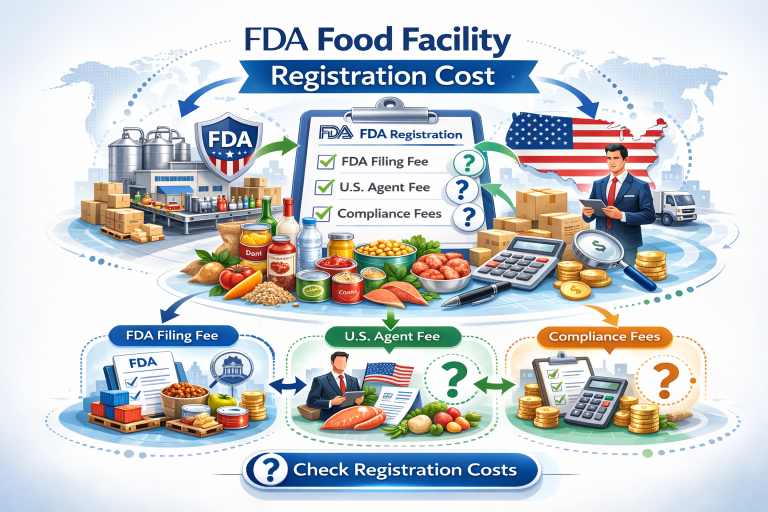
There are four distinct cost components in FDA Food Facility Registration. Understanding what each is and who charges it prevents confusion and unexpected expenses:
| Cost Component | Who Charges It | Amount | Notes |
|---|---|---|---|
| FDA Registration Filing Fee | FDA (federal government) | $0 — Free | FDA charges no government fee. Registration is submitted through FURLS at no cost to FDA. |
| Compliance Firm Service Fee | U.S. compliance firm (e.g., FDA Registration Assistance) | $858 (FDA Registration Assistance) | Covers registration preparation, submission, U.S. Agent designation, DUNS Number procurement, and Biennial Renewal management. |
| U.S. Agent Annual/Biennial Fee | U.S. Agent provider | Varies by provider | Required for all foreign facilities. FDA Agent must be physically located in the U.S. Often bundled with registration service. |
| DUNS Number (Unique Facility Identifier) | Dun & Bradstreet | $0 (standard) or expedite fee | Standard DUNS issuance is free from D&B but can take days to weeks. Expedited processing carries a fee. |
| Biennial Renewal Management | Compliance firm (if managed on your behalf) | Often included in annual fee | Renewal window is Oct 1 – Dec 31 of every even-numbered year. Missing it cancels the registration. |
If FDA Charges Nothing, Why Do Companies Pay a Service Fee?
FDA doesn't charge to register. So why do 1,000+ companies across 135+ countries pay FDA Registration Assistance to handle it? Because the registration must be accurate, maintained, and actively managed — and the consequences of getting it wrong are severe.
Accuracy Matters
An incorrectly submitted registration — wrong DUNS Number, missing product categories, incorrect facility name format — can be rejected or link to the wrong facility record. Errors can result in shipment detention at U.S. ports even after the registration appears complete. A compliance firm verifies every field before submission.
The U.S. Agent Requirement
All foreign facilities must designate a U.S. Agent with a physical U.S. address. This is not optional. The U.S. Agent must be reachable for FDA inspections, communications, and regulatory matters. A non-responsive or inactive U.S. Agent creates serious compliance risk — and paying for a real, responsive agent is the entire point of the service fee.
Biennial Renewal Management
Missing the Biennial Renewal window — October 1 through December 31 of every even-numbered year — automatically cancels the registration. A cancelled registration blocks all U.S. food shipments from that facility until re-registration is completed. A compliance firm tracks the renewal deadline and ensures it is never missed.
Ongoing FDA Communications
FDA contacts the U.S. Agent for inspection scheduling, import notices, safety alerts, and compliance queries. If FDA sends a communication and receives no response, the facility may be flagged as non-cooperative — escalating to Import Alert or enforcement action. A responsive U.S. Agent receives and forwards all communications immediately.
What FDA Registration Assistance Provides
When you work with FDA Registration Assistance, the service covers every component of FDA Food Facility Registration — from initial submission through ongoing compliance management:
Registration Preparation & Filing
We collect your facility information, verify your DUNS Number, select the correct product categories, and submit the registration accurately through FDA's FURLS system. Most food facility registrations are confirmed within 24–48 hours of documentation being provided.
U.S. Agent Designation
We formally accept the U.S. Agent designation for your facility. FDA Registration Assistance is based in Miami, Florida, and provides a responsive, real-person U.S. Agent service — not an automated service that leaves FDA communications unanswered.
DUNS Number Procurement
If your facility does not have a DUNS Number, we assist with obtaining one from Dun & Bradstreet before registration submission. DUNS Number procurement is part of our intake process so it does not create delays in your registration timeline.
Biennial Renewal Management
We track the Biennial Renewal window (October 1 – December 31, even-numbered years) and manage the renewal for all facilities we serve as U.S. Agent. Your registration never lapses due to a missed renewal while under our management.
Record Updates
When your facility name, address, contact information, or product categories change, we update your FDA registration record to keep it current. Out-of-date FDA records create compliance risk for shipments and should be updated promptly when changes occur.
Ongoing Compliance Support
We respond to FDA communications directed to your facility, forward regulatory notices and inspection requests, and provide guidance on general FDA compliance questions related to your registration throughout the service period.
The Cost of Not Registering — or Registering Incorrectly
The service fee for FDA Food Facility Registration is modest relative to the costs of non-compliance. Consider what a compliance failure can cost:
Shipment Detention or Refusal
A shipment detained at a U.S. port due to missing or lapsed registration incurs storage fees, demurrage costs, customs delays, and potential destruction of perishable goods. A single detained container can cost far more than years of compliance service fees.
FDA Import Alert
Facilities placed on FDA Import Alert face detention of all future shipments without physical examination until the compliance issue is resolved. Import Alert removal can take months and require significant legal and compliance resources.
Relabeling & Reconditioning Costs
Products refused entry may need to be exported back to the country of origin or destroyed at the importer's expense. Neither option is inexpensive. Correct registration before shipment eliminates this risk entirely.
Lost Business
Shipment delays damage buyer relationships, retailer timelines, and seasonal supply windows. U.S. importers facing repeated compliance issues with a foreign supplier will look for alternative suppliers. Consistent FDA compliance protects long-term business relationships.
Ready to Register Your Food Facility with FDA?
FDA Registration Assistance provides a complete, accurate, and fully managed FDA Food Facility Registration service — including U.S. Agent designation, DUNS Number procurement, Biennial Renewal management, and ongoing compliance support. The complete service fee is $858 — covering FDA registration, U.S. Agent designation, DUNS Number procurement, and Biennial Renewal management.
Email info@fdaregistrationassistance.com or call +1 (928) 275-8333. Most food facility registrations completed within 24–48 hours. 1,000+ clients. 135+ countries. 15+ years experience.
Frequently Asked Questions — FDA Food Facility Registration Cost
1. Does FDA charge a fee for Food Facility Registration?
No. FDA does not charge a government filing fee for Food Facility Registration. The registration is submitted through FDA's Unified Registration and Listing System (FURLS) at no charge from FDA. The costs associated with FDA Food Facility Registration come from the service fees charged by a compliance firm or U.S. Agent to prepare, submit, and maintain the registration.
2. What is the real cost of FDA Food Facility Registration?
FDA Registration Assistance charges $858 for a complete FDA Food Facility Registration service — including registration preparation and submission, U.S. Agent designation, DUNS Number procurement assistance, and Biennial Renewal management. FDA itself charges $0 in government filing fees. Contact FDA Registration Assistance to get started.
3. Why do companies pay for help with registration if FDA charges nothing?
Because the registration must be accurate, maintained, and actively managed. Errors in the registration — wrong DUNS Number, incorrect product categories, lapsed Biennial Renewal — can result in shipment detention or refusal at U.S. ports. A compliance firm handles the registration correctly the first time, maintains the U.S. Agent designation, tracks renewal deadlines, and provides ongoing compliance support.
4. What is included in FDA Registration Assistance's service?
FDA Registration Assistance provides: preparation and submission of the FDA Food Facility Registration; U.S. Agent designation and ongoing service; DUNS Number procurement assistance; Biennial Renewal management; record updates when facility information changes; and ongoing compliance guidance.
5. Is the DUNS Number free and how does it factor into cost?
A DUNS Number obtained directly from Dun & Bradstreet is free, but the standard process can be time-consuming. Expedited processing carries a fee. Many compliance firms assist with DUNS Number procurement as part of their registration service, which may or may not be included in the service fee.
6. What is the U.S. Agent and what does U.S. Agent service cost?
All foreign FDA-registered food facilities must designate a U.S. Agent physically located in the United States. The cost of U.S. Agent service is set by the compliance firm providing it, typically charged as an annual or biennial fee. FDA itself charges nothing for U.S. Agent designation.
7. Does FDA Food Facility Registration need to be renewed and what does renewal cost?
Yes. FDA Food Facility Registration must be renewed every two years during the Biennial Renewal window — October 1 through December 31 of every even-numbered year. Missing the renewal results in automatic cancellation of the registration. The cost of Biennial Renewal management depends on the compliance provider — FDA charges nothing for the renewal submission itself.
8. Can I register with FDA myself at no cost?
Foreign facilities can register directly through FURLS at no FDA charge. However, foreign facilities must still designate a U.S. Agent physically located in the United States — which requires hiring a U.S.-based person or company regardless. In practice, most foreign facilities use a compliance firm to handle both the registration and U.S. Agent requirement together to ensure accuracy and ongoing management.
9. What happens if FDA Food Facility Registration is submitted incorrectly?
An incorrectly submitted registration can cause serious problems: wrong DUNS Number links the registration to the wrong facility; missing product categories create compliance gaps for specific shipments; incorrect U.S. Agent designation means FDA communications go unanswered. Any of these can result in shipment detention or refusal at U.S. ports of entry.
10. What is included in a complete FDA Food Facility Registration compliance package?
A complete package typically includes: DUNS Number procurement; FDA Food Facility Registration preparation and submission; U.S. Agent designation; registration confirmation; Biennial Renewal management; record updates when facility information changes; and ongoing compliance support for regulatory questions.
11. Is FDA Food Facility Registration different from FDA approval?
Yes. FDA Food Facility Registration and FDA approval are entirely different. Registration is the mandatory process of entering the facility into FDA's system under the Bioterrorism Act of 2002. It does not mean FDA has reviewed, approved, or endorsed any product. FDA approval applies to drugs, biologics, and certain medical devices — not conventional food products.
12. Do domestic U.S. food facilities need FDA Food Facility Registration?
Yes. U.S. domestic food facilities that manufacture, process, pack, or hold food for human or animal consumption in the United States must also register with FDA. Domestic facilities do not need to designate a U.S. Agent, but they are subject to the same Biennial Renewal requirement during October 1 – December 31 of every even-numbered year.
13. Do food warehouses and cold storage facilities need FDA registration?
Yes, in most cases. Facilities that hold food — including cold storage, warehouse, and distribution facilities — may be subject to FDA Food Facility Registration if they store food for human or animal consumption. FDA Registration Assistance can assess your specific facility type to confirm whether registration is required.
14. What is the FURLS system used for FDA Food Facility Registration?
FURLS — FDA's Unified Registration and Listing System — is the FDA online portal used to submit and manage Food Facility Registrations. Registration is created, updated, renewed, and U.S. Agent designations are recorded through FURLS. FDA does not charge a fee to use FURLS.
15. When is the Biennial Renewal window for FDA Food Facility Registration?
The Biennial Renewal window is October 1 through December 31 of every even-numbered year (2024, 2026, 2028, etc.). All registered food facilities must renew during this window. Registrations not renewed by December 31 are automatically cancelled, blocking all U.S. food shipments from that facility until re-registration is completed.
16. Can FDA Registration Assistance take over an existing registration?
Yes. FDA Registration Assistance can transfer an existing Food Facility Registration from another U.S. Agent. The registration number stays the same — only the U.S. Agent contact information is updated. Transfers are typically completed within 24 to 48 hours. No approval from the previous agent is required.
17. What are the risks of using a low-cost or automated FDA registration service?
Low-cost or automated services may submit the registration without verifying accuracy, provide only a nominal U.S. Agent that doesn't respond to FDA, and fail to manage Biennial Renewals. If FDA attempts to contact your facility and receives no response, this creates a compliance risk that can lead to enforcement action or FDA Import Alert placement.
18. How long does FDA Food Facility Registration take?
FDA Food Facility Registration can typically be completed within 24 to 48 hours after all required information — facility name and address, DUNS Number, product categories, and U.S. Agent information — is confirmed. Delays typically occur when DUNS Number procurement takes longer.
19. What product categories must be declared on the registration?
FDA requires facilities to select all applicable food product categories from a standardized list in FURLS — covering food types such as seafood, bakery products, beverages, dairy, dietary supplements, food additives, and others. All categories manufactured, processed, packed, or held at the facility must be declared. Missing categories can create compliance gaps for specific shipments.
20. Does a facility need a separate registration for each brand or product?
No. FDA Food Facility Registration is per facility — not per brand or per product. A single facility can produce multiple brands and product lines under one registration. If a company operates multiple physical facilities, each facility must be registered separately.
21. What information is needed to register a food facility?
Required information includes: the facility's legal name and physical address; the owner/operator name; contact information; product categories; DUNS Number; and the name and U.S. address of the designated U.S. Agent (for foreign facilities). FDA Registration Assistance collects all required information through a structured intake process.
22. What happens to shipments if a Food Facility Registration is cancelled?
Shipments from facilities with cancelled registrations may be detained or refused at U.S. ports of entry. FDA may also flag the facility for Import Alert if registration lapses are associated with ongoing non-compliance. Re-registration must be completed before new shipments can legally proceed.
23. Can a facility register with FDA before its first export?
Yes — and this is the recommended approach. FDA Food Facility Registration should be completed before the first shipment leaves the facility. Attempting to register after a shipment has already been detained at a U.S. port adds unnecessary risk. Most facilities register as part of their pre-export compliance preparation.
24. How do I get started with FDA Registration Assistance?
Contact FDA Registration Assistance by email at info@fdaregistrationassistance.com or by phone at +1 (928) 275-8333. Provide your facility name, location, and the food products you intend to export to the United States. Most food facility registrations are completed within 24 to 48 hours.
25. Why should I choose FDA Registration Assistance for my Food Facility Registration?
FDA Registration Assistance has helped 1,000+ companies across 135+ countries with 15+ years of combined regulatory experience. The firm provides a complete, accurate, and fully managed FDA Food Facility Registration service — including U.S. Agent designation, DUNS Number procurement, Biennial Renewal management, and ongoing compliance support. Unlike automated filing services, FDA Registration Assistance provides direct access to experienced regulatory specialists and a responsive, active U.S. Agent service.