FDA Food Labeling Requirements
This guide breaks down every mandatory FDA food label element, the nine major allergens and how to declare them, the current Nutrition Facts format, nutrient content and health claims, the updated "healthy" rule and the proposed front-of-package label, and the mistakes that most often get imported food detained.
Key Takeaways
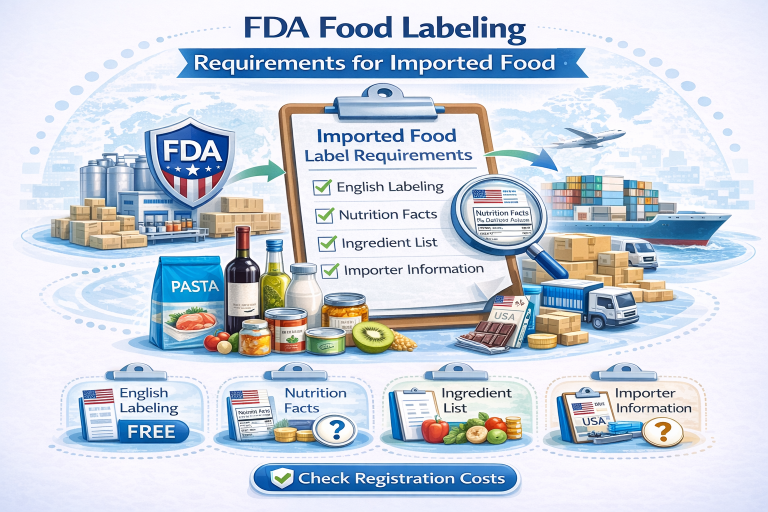
- Six mandatory elements: statement of identity, net quantity, Nutrition Facts, ingredient list, allergen declaration, and responsible-firm name & address — governed by 21 CFR Part 101.
- There are now 9 major allergens: milk, eggs, fish, Crustacean shellfish, tree nuts, peanuts, wheat, soybeans, and sesame (added January 1, 2023).
- The Nutrition Facts panel must use the current format (added sugars, updated Daily Values) — the pre-2020 format is a top detention trigger on imported goods.
- Net quantity must show both U.S. customary and metric units, and all mandatory text must be in English.
- Claims are regulated: "low," "good source," and "high" have exact thresholds (21 CFR 101.13), and the definition of "healthy" changed in 2025.
- A front-of-package "Nutrition Info box" is proposed (2025) but not yet required — one to watch.
- A non-compliant label is misbranded and can be detained, refused, or placed on Import Alert.
Required Elements on an FDA Food Label
A food label has two zones: the Principal Display Panel (PDP) — the part the shopper sees first — and the information panel, usually to its right. Each mandatory element has a defined home and defined rules under 21 CFR Part 101:
| Element | CFR | Requirement |
|---|---|---|
| Statement of Identity | 101.3 | The common or usual name of the food, on the PDP, in bold, prominent type. Must use the FDA standard-of-identity name where one exists. |
| Net Quantity of Contents | 101.7 | The amount of food, on the PDP, in both U.S. customary and metric units. Metric-only is a common error. |
| Nutrition Facts | 101.9 | Current FDA format — bold calories, "Added Sugars," updated Daily Values, and serving size based on the RACC (101.12). |
| Ingredient List | 101.4 | All ingredients by common name, in descending order by weight, including sub-ingredients of compound ingredients. |
| Allergen Declaration | FALCPA / FASTER | The 9 major allergens declared via a "Contains" statement or in parentheses in the ingredient list. Undeclared allergens = misbranding. |
| Name & Address | 101.5 | Name and place of business of the manufacturer, packer, or distributor. Qualify if not the maker (e.g., "Imported by"). |
| English Language | 101.15 | All mandatory information in English. If any foreign language appears, all required info must appear in it too. |
The 9 Major Allergens — and How to Declare Them
Allergen errors are among the most serious and most common labeling violations. FDA requires nine major food allergens to be clearly declared; sesame is the newest, mandatory since January 1, 2023 under the FASTER Act.
Two Accepted Methods
Either name the source in parentheses in the ingredient list — "flour (wheat)" — or use a separate "Contains" statement after it — "Contains: Wheat, Milk, Sesame." If you use both, they must match exactly.
Check Sub-Ingredients & Flavorings
Every sub-ingredient and flavoring must be traced for allergens. An allergen hidden in a seasoning or flavor system that isn't declared is a misbranding violation under 21 U.S.C. § 343(w) — a frequent cause of recalls.
Nutrition Facts: Use the Current Format
FDA overhauled the Nutrition Facts panel in 2016, with compliance dates in 2020–2021. Imported labels that still use the old format are routinely flagged. The current panel requires:
Serving Size = RACC
The serving size must reflect the Reference Amount Customarily Consumed for the food category (101.12) — not a foreign or arbitrary serving.
Added Sugars & Daily Values
A mandatory "Added Sugars" line, updated Daily Values, and updated mandatory nutrients (including vitamin D and potassium).
Format & Emphasis
Larger, bolder calories and serving size, in the current FDA layout. Limited exemptions exist (e.g., some very small businesses), but they're lost if a claim is made.
Claims Are Regulated — and Two Things Are Changing
Marketing words on a label are not free text. Nutrient content claims have exact thresholds, health claims need FDA authorization, and two high-profile rules are in motion right now:
Nutrient Content Claims
Defined in 21 CFR 101.13: "low sodium" = ≤140 mg per reference amount; "good source" = 10–19% Daily Value; "high" or "excellent source" = ≥20% DV. Using these terms without meeting the threshold is misbranding.
Health Claims
Claims linking a food to reduced disease risk require FDA authorization and specific wording (101.14). An unauthorized disease claim can make the product an unapproved drug.
"Healthy" — New Rule (2025)
FDA's updated definition of "healthy" took effect February 25, 2025, replacing the 1994 fat-focused rule with food-group requirements and limits on added sugars, sodium, and saturated fat. Some products may no longer qualify; others (nuts, salmon, avocados) now can.
Front-of-Package Box — Proposed
FDA's proposed "Nutrition Info box" (2025) would flag saturated fat, sodium, and added sugars as Low/Med/High on the front. As of 2026 it's proposed, not required — monitor it, but don't add it yet.
How to Build an FDA-Compliant Food Label
Whether you're designing a new label or fixing an imported one, the sequence is the same:
Place the PDP elements
Put the statement of identity and the net quantity (U.S. + metric) on the Principal Display Panel.
Build the ingredient list
List every ingredient by its common name in descending order by weight, including sub-ingredients.
Declare allergens
Add a "Contains" statement or parenthetical declarations for any of the 9 allergens — check flavorings and sub-ingredients.
Format the Nutrition Facts panel
Use the current FDA format with a RACC-based serving size, added sugars, and updated Daily Values.
Add the responsible firm & verify claims
Declare the manufacturer/packer/distributor (and U.S. importer), confirm every claim meets FDA criteria, and keep mandatory text in English.
Review before printing
Check the whole label against 21 CFR Part 101 before you print or ship — fixing it afterward means relabeling or re-export.
Don't Let a Label Detain Your Shipment
FDA Registration Assistance reviews and corrects food labels against 21 CFR Part 101 — statement of identity, net quantity, Nutrition Facts formatting, ingredient statement, allergen declaration, responsible-firm declaration, and claims — and returns a U.S.-ready label. We support foreign manufacturers and U.S. importers and also handle Food Facility Registration and FSVP.
Contact us at info@fdaregistrationassistance.com or call +1 (928) 275-8333. Trusted by companies in 75+ countries. 15+ years of FDA regulatory experience.
Frequently Asked Questions — FDA Food Labeling
1. Do imported foods need FDA-compliant labels?
Yes. Every food sold in the U.S., domestic or imported, must meet 21 CFR Part 101. A non-compliant label makes the product misbranded under 21 U.S.C. § 343, and imported food can be detained or refused at the port even when the product is safe. Labeling is one of the top reasons shipments are held.
2. What are the mandatory elements on an FDA food label?
A statement of identity and net quantity on the Principal Display Panel; and on the information panel, a Nutrition Facts panel, an ingredient list by weight, an allergen declaration for the 9 major allergens, and the responsible firm's name and address — all in English.
3. What is a statement of identity?
The common or usual name of the food, required on the PDP in bold, prominent type under 101.3. If the food has an FDA standard of identity, the label must use that established name.
4. Does net quantity need both U.S. and metric units?
Yes. Under 101.7, net quantity must appear on the PDP in both U.S. customary units and metric. Metric-only declarations — common on imports — are a frequent error.
5. Is a Nutrition Facts panel required?
Most packaged foods require one under 101.9. Limited exemptions exist (some very small businesses, very low-volume products, foods with no significant nutrients), but they're lost if a nutrient content or health claim is made.
6. What is the current Nutrition Facts format?
The 2016 update (compliance 2020–2021): larger, bolder calories, updated serving sizes, a mandatory "Added Sugars" line, updated Daily Values, and updated nutrients like vitamin D and potassium. The pre-2020 format is non-compliant and frequently flagged.
7. How is serving size determined?
By the Reference Amount Customarily Consumed (RACC) for the food category in 101.12 — not by the manufacturer. Nutrient values are declared per that serving. A foreign or arbitrary serving size is a common mistake.
8. What are the 9 major food allergens?
Milk, eggs, fish, Crustacean shellfish, tree nuts, peanuts, wheat, soybeans, and sesame. Sesame became the ninth under the FASTER Act, mandatory since January 1, 2023. FDA guidance also narrows "tree nut" to specific varieties.
9. When did sesame become a major allergen?
January 1, 2023, under the FASTER Act of 2021. Labels last updated before then that don't declare sesame are non-compliant, and undeclared sesame — including in flavorings — is a common misbranding and recall issue.
10. How must allergens be declared?
Two ways: name the source in parentheses in the ingredient list — "flour (wheat)" — or a separate "Contains" statement after it — "Contains: Wheat, Milk, Sesame." If both are used, they must agree. The specific food source name must be used.
11. Do I declare allergens in sub-ingredients?
Yes. Every ingredient, sub-ingredient, and flavoring must be checked for the 9 allergens. An undeclared allergen inside a compound ingredient is misbranding under 21 U.S.C. § 343(w) — a leading cause of recalls.
12. Does the label have to be in English?
Yes. Under 101.15, all mandatory information must be in English. If any foreign language appears on the label, all required information must also appear in that language.
13. Can I use my home-country ingredient names?
Not always. Ingredients must use FDA-accepted common or usual names, and additives and colors must use their U.S.-recognized names. Ingredients must also be permitted in food in the U.S. Foreign names FDA doesn't recognize are a frequent problem.
14. What order must ingredients be listed in?
Descending order by weight under 101.4 — the ingredient present in the greatest amount first. Each is listed by its common name, and colors and certain additives have specific declaration rules.
15. Do I need a U.S. address on my label?
The label must show the name and place of business of the manufacturer, packer, or distributor (101.5). For imports, the responsible firm — often the U.S. importer — must be identified, qualified appropriately (e.g., "Imported by") if not the maker.
16. Who is responsible — importer or manufacturer?
Both. The manufacturer produces the labeled product; the U.S. importer is responsible for ensuring imported food complies, including labeling. Aligning the label before production protects both from detention, refusal, or Import Alert.
17. What are the rules for nutrient content claims?
Under 101.13, terms have exact thresholds: "low sodium" = ≤140 mg per reference amount; "good source" = 10–19% DV; "high"/"excellent source" = ≥20% DV. Using them without meeting the threshold is misbranding.
18. What changed with the "healthy" claim?
FDA's updated definition took effect February 25, 2025, with a multi-year compliance runway. It replaces the 1994 fat-focused rule with food-group requirements and limits on added sugars, sodium, and saturated fat. Some long-labeled products may no longer qualify; nuts, salmon, and avocados now may.
19. What is the front-of-package "Nutrition Info box"?
A proposed rule (January 2025) that would require a front-of-package box showing Low/Med/High for saturated fat, sodium, and added sugars. As of 2026 it's proposed, not final — FDA is reviewing comments. Monitor it, but it isn't required yet.
20. What are health claims?
Claims linking a food to reduced disease risk (e.g., calcium and osteoporosis). Authorized health claims require FDA authorization and specific wording under 101.14. An unauthorized disease claim can make the product an unapproved drug.
21. Is country of origin required on the label?
Country-of-origin marking is required by U.S. Customs (the Tariff Act), not by FDA's food-label rules. It's still needed for import and retail, so imported food generally must be marked — separate from, and in addition to, 21 CFR Part 101.
22. What happens if my label isn't compliant at the port?
The product is misbranded and can be detained or refused. You may have to relabel under FDA supervision or re-export, and repeat issues can lead to an Import Alert — detention without physical exam on future shipments. A pre-shipment review avoids this.
23. What are the most common labeling mistakes?
Old Nutrition Facts format; undeclared sesame or other allergens (including in sub-ingredients); wrong serving size; metric-only net quantity; missing or incorrect responsible-firm address; unauthorized claims; non-English or translation-only labels; and FDA-unrecognized ingredient names.
24. Do small food businesses need compliant labels?
Yes — requirements apply regardless of size. Some small businesses qualify for a Nutrition Facts exemption based on volume or employee count, but identity, net quantity, ingredients, allergens, and responsible-firm rules still apply, and any exemption is lost if a claim is made.
25. Can my label be reviewed before printing?
Yes — it's the best way to avoid costly relabeling. Reviewing against 21 CFR Part 101 before production catches format, allergen, ingredient, and claims issues while they're cheap to fix, instead of after a shipment is detained.
26. How does FDA Registration Assistance help with labeling?
FDA Registration Assistance reviews and corrects your label against every mandatory element of 21 CFR Part 101 — identity, net quantity, ingredients, allergens, Nutrition Facts format, responsible firm, and claims — and returns a U.S.-ready label, supporting both foreign manufacturers and U.S. importers.
27. How do I get my label reviewed?
Contact FDA Registration Assistance at info@fdaregistrationassistance.com or call +1 (928) 275-8333. Send your current label artwork, ingredients, and product details, and receive a corrected, U.S.-compliant label before you print or ship.