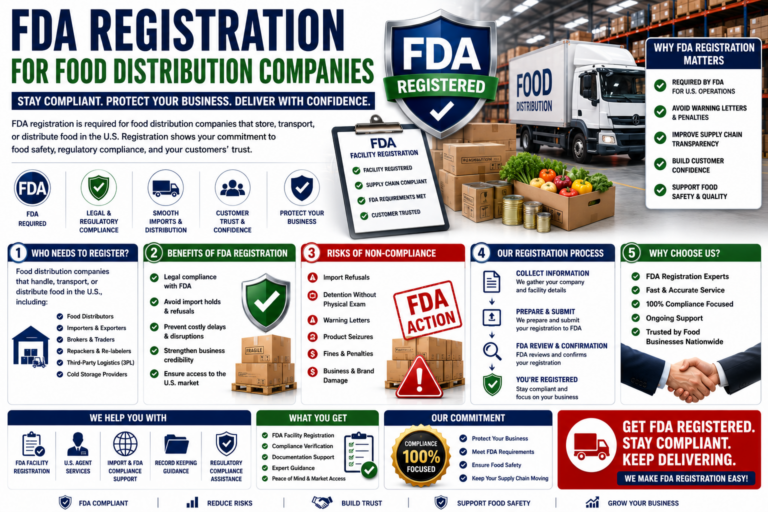
FDA Registration for Food Distribution Companies
This guide covers which food distribution companies must register, the broker vs. distributor distinction, the correct activity codes, labeling responsibility, when a distributor also has FSVP obligations, and what happens when a distribution facility is not registered.
Food Broker vs. Food Distributor — Which Needs FDA Registration?
The single most important question in food distribution FDA compliance is whether the company physically holds food. The answer determines everything:
Food Broker — No Registration Required
A food broker arranges purchases and sales on behalf of buyers and sellers but never takes physical possession of the food. Because the broker’s facility never holds food, it is not a food facility under 21 CFR 1.227 and does not require FDA Food Facility Registration. The broker’s role is transactional — title and payment flow through the broker, but the food flows directly between manufacturer and buyer.
Food Distributor — Registration Required
A food distributor takes physical possession of food — receives it at its facility, stores it, and ships it forward to retailers, food service operators, or other distributors. Because the distributor’s facility holds food for U.S. consumption, it must register with FDA. If a company does both brokerage and physical distribution from the same facility, the holding activity triggers registration for that facility.
The legal test is physical possession at the facility — not title, invoicing, or whether the company is named on the label. A distributor who briefly holds food in transit storage is holding food and must register. A broker who directs manufacturers to ship directly to end customers without the broker’s facility ever receiving the food is not holding food and does not need to register.
Which Food Distribution Operations Need FDA Registration
| Distribution Operation | Registration Required? | Key Notes |
|---|---|---|
| Regional food distributor (holds and ships to retailers) | Required | Holds food at distribution facility. Activity code: Hold. Biennial renewal required. $858 complete service. |
| National food distributor (multi-facility) | Required — each facility | Each physical distribution facility requires its own separate FDA registration. A single registration does not cover multiple locations. |
| Food importer / distributor (also imports) | Required + FSVP | Facility registration for holding activity plus FSVP obligation as U.S. importer of record. Two separate compliance obligations. |
| Food distributor that repackages or relabels | Required | Activity codes: Hold AND Pack. Relabeled products must carry fully compliant FDA labels with distributor name and address. |
| Specialty / natural / organic food distributor | Required | Food specialty or niche does not create an exemption. All held food for U.S. consumption requires the holding facility to register. |
| Foreign food distributor supplying the U.S. | Required + U.S. Agent | Foreign distribution facilities must register and designate a U.S. Agent with a physical U.S. address. |
| eCommerce / online food seller holding inventory | Required | Sales channel is irrelevant. If food is held at a facility before shipping to customers, that facility must register. |
| Pure food broker (no physical possession) | Not Required | Arranges sales but never holds food. Food ships directly from manufacturer to buyer. No holding activity = no food facility registration required. |
| Distributor using 3PL only (no own inventory) | Confirm Case-by-Case | If the distributor never holds food at its own facility, the 3PL registers its own location. Distributor may have FSVP obligations if it is the importer of record, separate from facility registration. |
Activity Codes and Additional FDA Obligations for Food Distributors
Activity Codes
During FDA FURLS registration, every facility selects activity codes reflecting what it does with food. For food distributors:
Hold
Storage of food. Primary activity code for all food distribution facilities. Must be selected by any distributor whose facility receives and stores food before shipping it forward.
Pack
Placing food into packages or new containers. Must be selected if the distributor repackages food — splitting cases, repackaging bulk into consumer sizes, or applying new packaging to existing products.
Manufacture / Process
Making food or changing its properties. Must be selected if the distributor also cuts, blends, cooks, or otherwise processes food. Triggers full FSMA Preventive Controls requirements including a written food safety plan and PCQI.
When Distributors Also Have FSVP Obligations
Distributor as Importer of Record
When a food distributor imports food — and its name appears as the U.S. owner or consignee on the CBP entry documentation — it is the importer of record and must maintain an FSVP program for each foreign food supplier under 21 CFR Part 1 Subpart L. This is a separate obligation from FDA Food Facility Registration. Both are required simultaneously.
Prior Notice for Imported Shipments
When a distributor is the importer of record, it is also responsible for FDA Prior Notice accuracy — ensuring the correct manufacturing facility registration number and FDA product code are filed before each shipment. Prior Notice must be filed before arrival: 8 hours for ocean, 4 hours for air, 2 hours for road.
FDA Labeling Responsibility for Food Distributors
A food distributor’s labeling responsibility depends on what role it plays in the supply chain:
Distributor Named on Label
If the distributor’s name appears on the food label as the responsible firm — “Distributed by [Company Name]” — that company bears labeling compliance responsibility under 21 CFR Part 101. All required label elements must be present and compliant, including allergen declarations covering all nine FALCPA and FASTER Act allergens.
Distributor Who Repackages
A distributor who repackages food takes on full manufacturer labeling responsibility. The repacked product must carry a compliant FDA label with correct U.S. RACC serving size, current Nutrition Facts format, complete ingredient list in descending order, and allergen declarations — including sesame (FASTER Act, effective January 2023).
Sesame Allergen Alert
Sesame became the 9th major U.S. food allergen under the FASTER Act effective January 1, 2023. Any food distributed or relabeled by a distributor that contains sesame seeds, sesame oil, sesame paste, or tahini must include a sesame allergen declaration. Missing sesame declarations are a high-priority FDA detention trigger and a common labeling compliance gap for food distributors.
How to Register a Food Distribution Facility with FDA
Step 1 — Confirm Registration Obligation
FDA Registration Assistance reviews your distribution operation — whether your facility physically holds food, whether you also import, and whether any of your facilities may qualify for an exemption. Pure brokers who never hold food at any facility are confirmed exempt before any registration is initiated.
Step 2 — Select Activity Codes and Categories
The correct activity codes (Hold, Pack, and/or others) and food product categories for your distribution operation are selected. Multi-category distributors handling diverse food inventories select all applicable categories. Under 21 CFR 1.234, the registration must be updated within 60 days when new food categories are added.
Step 3 — Submit Registration
Registration is submitted through FDA’s FURLS system. For foreign distribution facilities, U.S. Agent designation is completed simultaneously. FDA Registration Assistance handles the complete submission and provides the 10-digit FDA registration number upon confirmation.
Step 4 — Manage Biennial Renewal
FDA Registration Assistance tracks the Biennial Renewal window (October–December of even-numbered years) and submits renewals automatically. Unmanaged renewals are the most common compliance failure for food distribution companies — a missed renewal cancels the registration and can disrupt supplier relationships.
Ready to Register Your Food Distribution Company with FDA?
FDA Registration Assistance provides complete FDA Food Facility Registration for food distribution companies — activity code selection, Biennial Renewal management, U.S. Agent designation for foreign distributors, FSVP for distributor importers of record, and label compliance review. Complete service: $858. FDA charges $0. DUNS Number fees are separate. 1,000+ clients. 135+ countries. 15+ years of FDA regulatory experience.
Contact us at info@fdaregistrationassistance.com or call +1 (928) 275-8333.
Frequently Asked Questions — FDA Registration for Food Distribution Companies
1. Do food distribution companies need FDA registration?
Yes — if the distribution company physically holds food. Under 21 U.S.C. § 350d and 21 CFR 1.227, any facility that holds (stores) food for U.S. consumption must register. A distribution facility that receives and stores food before shipping it forward is holding food and must register. Complete service: $858. FDA charges $0. DUNS Number fees are separate.
2. What is the difference between a food broker and a food distributor for FDA purposes?
A food broker arranges sales but never takes physical possession of food — no registration required. A food distributor receives, stores, and ships food from its own facility — registration required. The legal test is physical possession at the facility, not title, invoicing, or whether the company’s name appears on the label.
3. What activity codes should a food distributor select?
Hold is the primary activity code for food distribution facilities. If the distributor also repackages food, Pack should be added. If the distributor cuts, blends, cooks, or otherwise processes food, Manufacture or Process must also be selected. Incorrect activity code selection is a common distributor registration error.
4. What is the legal basis for food distributor FDA registration?
Required under 21 U.S.C. § 350d and implemented at 21 CFR Part 1 Subpart H. The holding definition at 21 CFR 1.227 — storage of food — is the operative term. All domestic and foreign facilities holding food for U.S. consumption must register.
5. Does a food distributor who never touches the food need FDA registration?
No — if the facility never physically holds food. A pure drop-ship arranger who directs manufacturers to ship directly to customers without the distributor’s facility ever receiving or storing food is not a food facility. However, if the distributor maintains any inventory at its own facility, even temporarily, that facility must register.
6. What labeling responsibility does a food distributor have?
If the distributor’s name appears on the label as the responsible firm, it bears full labeling compliance responsibility under 21 CFR Part 101. A distributor who repackages or relabels food takes on manufacturer labeling responsibility — including correct Nutrition Facts format, allergen declarations (covering sesame since January 2023), ingredient list, and manufacturer name and address.
7. Does a foreign food distributor supplying the U.S. need FDA registration?
Yes. A foreign distribution facility holding food destined for U.S. export must register and designate a U.S. Agent with a physical U.S. address under 21 CFR Part 1.
8. When is a food distributor also the FSVP importer of record?
When the distributor is the U.S. owner or consignee of imported food at time of U.S. entry — i.e., its name appears on the CBP entry as importer. In this case the distributor must maintain an FSVP program under 21 CFR Part 1 Subpart L for each foreign food supplier in addition to its facility registration.
9. What is the $858 complete service?
FDA Registration Assistance charges $858 for the complete FDA Food Facility Registration service — U.S. Agent designation (foreign distributors), activity code selection, food product category selection, registration submission through FURLS, and Biennial Renewal management. FDA charges $0. DUNS Number procurement fees are separate.
10. What food product categories should a food distributor select?
Select all categories the facility routinely holds. Multi-category distributors handling diverse inventories should select all applicable categories. Under 21 CFR 1.234, the registration must be updated within 60 days whenever a new food product category is added to the distribution operation.
11. Does a food distributor need to update its registration when it adds new product lines?
Yes. Under 21 CFR 1.234, changes to registered food product categories must be reported to FDA within 60 calendar days. A distributor that begins handling dietary supplements, refrigerated products, or any new food category must update its registration promptly.
12. Do food distributors need to comply with FSMA Preventive Controls?
Yes, with modified requirements. Distributors holding only packaged food not exposed to the environment have modified Preventive Controls requirements — no PCQI required for process controls. But distributors storing food requiring temperature control for safety must implement temperature monitoring as a preventive control under 21 CFR Part 117. Distributors who repack or process food have full preventive control obligations.
13. What is the Biennial Renewal requirement?
FDA Food Facility Registration renews every two years — October 1 through December 31 of every even-numbered year. Missing the Biennial Renewal results in automatic cancellation. An unregistered distributor cannot legally distribute food in U.S. commerce, and supplier clients who listed the distributor in FSVP supply chain documentation may face compliance issues.
14. Do specialty food distributors need FDA registration?
Yes. Specialty food distributors — ethnic foods, gourmet foods, organic foods, dietary supplements, natural foods — that physically hold food must register. The food specialty or niche creates no exemption from the holding facility registration requirement.
15. Does a food distributor who only uses 3PLs need its own registration?
It depends. If the distributor never holds food at its own facility, the 3PL registers its own location — the distributor may not need a separate facility registration. However, if the distributor is the U.S. importer of record for imported food, FSVP obligations apply regardless of where the food is stored.
16. Does a distributor that repackages or relabels food have additional requirements?
Yes. A distributor that repacks food must select Hold and Pack as activity codes; ensure repacked products carry fully compliant FDA labels under 21 CFR Part 101 with the distributor’s name and address; declare all allergens including sesame; use the correct U.S. RACC serving size; and list ingredients in descending order by weight.
17. Do food distributors need Prior Notice for imported food shipments?
When the distributor is the importer of record, it is responsible for Prior Notice accuracy — correct manufacturing facility registration number, FDA product code, and importer information — filed before each shipment. 8 hours for ocean, 4 hours for air, 2 hours for road.
18. What happens if a food distributor operates without FDA registration?
Violates 21 U.S.C. § 331 and 21 U.S.C. § 350d. Consequences: FDA Warning Letters; product seizure; import detention for products associated with the unregistered facility; and supplier relationship risk — manufacturers and food brands routinely verify distributor FDA registration status as part of their FSVP supplier qualification.
19. Does an online food distributor or eCommerce food seller need FDA registration?
Yes — if the company holds food at a facility before shipping to customers. The sales channel is irrelevant. An online food seller who maintains inventory at a warehouse or fulfillment center before shipping is operating a food-holding facility that must register with FDA.
20. Does a food distributor that only operates in one state need FDA registration?
Yes. FDA Food Facility Registration is a federal requirement with no state-only exemption. Any facility holding food for U.S. consumption — whether distributed in one state or fifty — must register with FDA.
21. How does distributor registration relate to the manufacturer’s registration?
They are separate and independent registrations. The manufacturer registers its production facility. The distributor registers its distribution or holding facility. If the manufacturer ships directly to the distributor’s warehouse, the distributor’s warehouse needs its own registration. Each physical location that holds food requires its own separate FDA registration.
22. Can FDA inspect a food distributor’s facility?
Yes. FDA has authority to inspect registered food distribution facilities. During an inspection, FDA may review food storage practices, temperature monitoring records, allergen segregation procedures, FSMA Preventive Controls documentation, and labeling compliance for any products being repacked or relabeled at the facility.
23. What are the most common FDA compliance mistakes by food distribution companies?
Most common: failing to register the distribution facility at all; selecting incorrect activity codes; missing the Biennial Renewal; failing to update registration when new food product categories are added; distributor-importers not maintaining FSVP programs; and relabeled products without compliant FDA labels including sesame allergen declarations.
24. What services does FDA Registration Assistance provide for food distribution companies?
Complete FDA compliance: Food Facility Registration with activity code and category selection, Biennial Renewal management, U.S. Agent for foreign distributors, FSVP for distributor importers, label compliance review, and Prior Notice guidance. Complete service: $858. FDA charges $0. DUNS fees separate. 1,000+ clients. 135+ countries.
25. How do I get started with FDA registration for my food distribution company?
Contact FDA Registration Assistance at info@fdaregistrationassistance.com or call +1 (928) 275-8333. Provide your distribution facility name and address, the food product categories you handle, whether you import food, and any existing FDA registration information. FDA Registration Assistance will confirm your registration obligation, select correct activity codes, submit the registration, and manage Biennial Renewal. Complete service: $858. FDA charges $0. DUNS fees separate.