
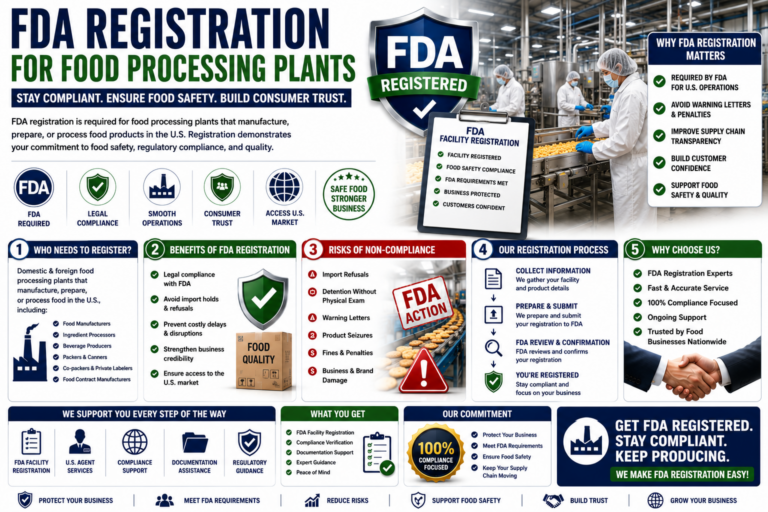
FDA Registration for Food Processing Plants
This guide covers exactly who must register, which activity codes to select, what FSMA Preventive Controls require from food processing plants, the PCQI requirement, cGMPs, and the specialized regulatory requirements for seafood, juice, low-acid canned food, acidified food, and dietary supplement processors.
What "Manufacture" and "Process" Mean — and Which Activity Codes to Select
Under 21 CFR 1.227, manufacturing and processing means making food or applying a treatment that alters food’s physical or chemical properties. All four activity codes may apply to a food processing plant — select every code that reflects actual operations:
Selecting the correct activity codes matters. FDA uses activity codes to determine inspection frequency and scope. An incorrectly coded registration may also cause FDA to misclassify the facility’s risk profile, potentially triggering unexpected inspection requirements.
FDA Registration and Additional Requirements by Processing Category
| Processing Category | FDA Registration | Additional Requirements Beyond Registration |
|---|---|---|
| General food manufacturers (bakeries, snack foods, beverages, prepared meals, candy, condiments) | Food Facility Registration (biennial) | Full FSMA Preventive Controls under 21 CFR Part 117; written food safety plan; PCQI; cGMPs |
| Dairy processors (pasteurization, cheese making, yogurt, butter) | Food Facility Registration (biennial) | FSMA Preventive Controls; pasteurization standards under 21 CFR Part 1240.61; FDA standards of identity under 21 CFR Part 131 |
| Seafood processors (finfish, shellfish, smoked fish, aquaculture products) | Food Facility Registration (biennial) | Mandatory seafood HACCP under 21 CFR Part 123; written HACCP plan; CCPs; 2-year recordkeeping. Additional HACCP Required |
| Juice processors (fruit juices, vegetable juices, juice blends) | Food Facility Registration (biennial) | Mandatory juice HACCP under 21 CFR Part 120; 5-log pathogen reduction process; written HACCP plan. Additional HACCP Required |
| Low-acid canned food (LACF) processors (canned vegetables, soups, meats, fish in sealed containers, pH > 4.6) | Food Facility Registration + FCE Registration | Separate Food Canning Establishment (FCE) registration under 21 CFR Part 113 + Scheduled Process (SP) filing. Failure to have FCE and SP = automatic import refusal. FCE + SP Required |
| Acidified food processors (pickles, salsa, hot sauce, vinegar-based products, pH ≤ 4.6) | Food Facility Registration + FCE Registration | Separate FCE registration under 21 CFR Part 114 + Scheduled Process (SP) from a Process Authority. FCE + SP Required |
| Dietary supplement manufacturers | Food Facility Registration (biennial) | Dietary supplement cGMPs under 21 CFR Part 111 (separate from food cGMP Part 117); Supplement Facts labeling; DSHEA safety requirements |
| Infant formula manufacturers | Food Facility Registration (biennial) | Additional infant formula requirements under 21 CFR Part 106 and Part 107; mandatory nutrient requirements; notification to FDA before production |
| Co-packers / contract manufacturers | Food Facility Registration (biennial) | Co-packer registers its own facility. Full FSMA Preventive Controls apply. Co-packer’s FDA registration number appears in Prior Notice for all products manufactured at the facility. |
What FSMA Requires from Food Processing Plants
Unlike food warehouses (which have modified Preventive Controls requirements), food processing plants are subject to the full FSMA Preventive Controls for Human Food requirements under 21 CFR Part 117. These are not optional best practices — they are federal regulatory requirements that FDA verifies during inspections:
Written Food Safety Plan
Every food processing plant subject to Preventive Controls must have a written food safety plan covering: the facility and each food manufactured or processed; hazard analysis for each food; identified preventive controls; monitoring procedures; corrective action procedures; verification activities; and a supply chain program for hazards controlled by the supplier. The written food safety plan must be prepared or verified by the facility’s PCQI.
Hazard Analysis
A written, product-specific hazard analysis must identify all potential biological hazards (pathogens, toxins, parasites), chemical hazards (allergens, environmental contaminants, pesticide residues, heavy metals), physical hazards (foreign material such as glass, metal, hard plastic), and radiological hazards. The hazard analysis must evaluate the severity and likelihood of each hazard and determine which hazards require a preventive control.
Preventive Controls
Preventive controls are measures that significantly minimize or prevent identified hazards. Four types: process controls (time, temperature, pH, water activity — typically CCPs); allergen controls (preventing allergen cross-contact and ensuring correct labeling); sanitation controls (food-contact surface cleaning and sanitizing, employee hygiene); and supply chain controls (verifying that suppliers control hazards they are responsible for).
PCQI — Preventive Controls Qualified Individual
A PCQI must develop or oversee the food safety plan. The PCQI must have training equivalent to the FDA-recognized FSPCA (Food Safety Preventive Controls Alliance) Preventive Controls for Human Food curriculum, or equivalent job experience. The PCQI does not need to be a full-time employee — a qualified consultant or external PCQI may serve this role. FDA Registration Assistance can connect processing plants with PCQI resources.
Current Good Manufacturing Practices (cGMPs) — 21 CFR Part 117 Subpart B
cGMPs are baseline operational requirements that apply to all registered food processing plants regardless of size or Preventive Controls exemption status. FDA inspectors routinely cite cGMP violations during food processing plant inspections. Key cGMP areas:
Personnel Hygiene
Employees with illness, open lesions, or communicable disease excluded from food contact. Handwashing requirements. Protective clothing, hair restraints, and jewelry restrictions for food contact areas.
Plant and Grounds
Pest control programs. Drainage and waste removal. Building construction that prevents contamination. Adequate lighting, ventilation, and temperature control for food production areas.
Equipment and Utensils
Food-contact surfaces smooth, non-porous, non-toxic, corrosion-resistant, and cleanable. Adequate cleaning and sanitizing. Adequate physical separation of raw and ready-to-eat food zones.
Production Controls
Time and temperature controls for food requiring temperature control for safety. Allergen segregation to prevent cross-contact. Foreign material prevention (metal detection, sifters, magnets).
Sanitary Operations
Cleaning and sanitizing schedules for food-contact equipment and utensils. Potable water from approved sources. Adequate floor drains and waste management to prevent contamination.
Warehousing and Distribution
Finished product stored and distributed under conditions that protect against contamination and deterioration. Adequate temperature control for products requiring refrigeration or freezing.
How to Register a Food Processing Plant with FDA
Step 1 — Confirm Registration and Special Requirements
FDA Registration Assistance reviews the processing plant’s products and operations to confirm registration is required and to identify any specialized requirements — seafood HACCP, juice HACCP, FCE registration for LACF or acidified foods, or dietary supplement cGMP applicability — before any filings are made.
Step 2 — Select Activity Codes and Food Categories
All applicable activity codes (Manufacture, Process, Pack, Hold) and food product categories are selected based on the plant’s actual operations. Under 21 CFR 1.234, the registration must be updated within 60 days when new food categories are added or when processing activities change.
Step 3 — Submit Registration
Registration submitted through FDA’s FURLS system. For foreign processing plants, U.S. Agent designation is completed simultaneously. FDA Registration Assistance provides the 10-digit FDA registration number upon confirmation, typically within 24–48 hours.
Step 4 — Manage Biennial Renewal
FDA Registration Assistance tracks the Biennial Renewal window (October–December of even years) and submits renewals automatically. A missed renewal cancels the registration and can block all product distribution — one of the most operationally disruptive compliance failures for food processing plants.
Ready to Register Your Food Processing Plant with FDA?
FDA Registration Assistance provides complete FDA Food Facility Registration for food processing plants of all types — general food manufacturers, dairy processors, seafood processors, juice facilities, LACF and acidified food processors, dietary supplement manufacturers, co-packers, and foreign processing plants. Complete service: $858. FDA charges $0. DUNS Number fees are separate. 1,000+ clients. 135+ countries. 15+ years of FDA regulatory experience.
Contact us at info@fdaregistrationassistance.com or call +1 (928) 275-8333.
Frequently Asked Questions — FDA Registration for Food Processing Plants
1. Do food processing plants need FDA registration?
Yes. Under 21 U.S.C. § 350d and 21 CFR Part 1 Subpart H, any facility that manufactures or processes food for U.S. consumption must register with FDA. Manufacturing and processing under 21 CFR 1.227 means making food from ingredients or applying a treatment — cooking, canning, pasteurizing, freezing, drying, mixing, grinding, slaughtering, cutting. Complete service: $858. FDA charges $0. DUNS fees are separate.
2. What is the legal definition of manufacture and process for FDA registration?
Under 21 CFR 1.227, manufacturing means making food from raw ingredients. Processing means applying a treatment that alters food’s physical or chemical properties — pasteurizing, canning, freezing, drying, smoking, fermenting, grinding, cutting. Both activities trigger FDA Food Facility Registration.
3. What activity codes should a food processing plant select?
Select all applicable codes: Manufacture (making food from ingredients); Process (applying a treatment to food); Pack (placing food into packages); Hold (if the plant also stores finished product). All codes that reflect actual operations must be selected. Incorrect codes affect FDA’s inspection frequency and risk classification of the facility.
4. What FSMA Preventive Controls requirements apply to food processing plants?
Food processing plants are subject to the full FSMA Preventive Controls requirements under 21 CFR Part 117: written food safety plan; hazard analysis for each food; process controls, allergen controls, sanitation controls, and supply chain controls; monitoring procedures; corrective actions; verification activities; recall plan; and a PCQI. Unlike warehouses, processing plants do not qualify for modified Preventive Controls requirements.
5. What is a PCQI and does every food processing plant need one?
A Preventive Controls Qualified Individual (PCQI) must develop or oversee the food safety plan for any processing plant subject to full Preventive Controls under 21 CFR Part 117. The PCQI must have training equivalent to the FSPCA Preventive Controls for Human Food curriculum or equivalent experience. Very small businesses (under $1M in annual food sales) may qualify for the Qualified Facility Exemption from full Preventive Controls but still must register with FDA.
6. What are current Good Manufacturing Practices (cGMPs) for food processing plants?
cGMPs under 21 CFR Part 117 Subpart B are mandatory baseline requirements for all registered food processing plants: personnel hygiene; plant and grounds maintenance; pest control; equipment cleanliness and design; production and process controls; sanitary operations; and warehousing and distribution. cGMP violations are the most commonly cited deficiencies during FDA food processing plant inspections.
7. Do seafood processing plants need additional FDA requirements?
Yes. Seafood processing plants must comply with mandatory seafood HACCP under 21 CFR Part 123: a written HACCP plan; Critical Control Points (CCPs) for each significant hazard; critical limits; monitoring procedures; corrective actions; verification; and 2-year recordkeeping. Common seafood hazards: C. botulinum in vacuum-packaged fish; histamine in scombroid fish; Listeria in smoked fish; pathogen contamination.
8. Do juice processing plants need additional requirements?
Yes. Juice processors must comply with mandatory juice HACCP under 21 CFR Part 120 — including a 5-log pathogen reduction process (reducing the most resistant pathogen by 100,000-fold). For most juices, this means pasteurization or an equivalent validated treatment. The specific target pathogen varies by juice type (E. coli O157:H7 for apple juice; Salmonella for citrus).
9. Do low-acid canned food processors need special registration?
Yes. LACF processors (pH above 4.6, water activity above 0.85 — most canned vegetables, soups, meats, fish) must complete a separate Food Canning Establishment (FCE) registration under 21 CFR Part 113 and file a Scheduled Process (SP) for each product. FCE + SP is separate from and in addition to the standard FDA Food Facility Registration. Missing FCE and SP is an automatic import refusal trigger.
10. Do acidified food processors need special registration?
Yes. Acidified food processors (pickles, salsa, hot sauce, vinegar-based products with final equilibrium pH ≤ 4.6) must complete an FCE registration under 21 CFR Part 114 and file a Scheduled Process from an FDA-recognized Process Authority. The Scheduled Process must document and validate that the acidification process consistently achieves pH ≤ 4.6 throughout the product.
11. Do dietary supplement manufacturing facilities need a different registration?
Dietary supplement manufacturers use the same FDA Food Facility Registration form and FURLS portal as conventional food processors. However, they are subject to separate dietary supplement cGMPs under 21 CFR Part 111 — covering specifications, component testing, manufacturing controls, and finished product testing — rather than food cGMP under Part 117.
12. What is the co-packer registration situation?
The co-packer registers its own food processing facility — the brand hiring the co-packer does not register the co-packer’s facility. The co-packer’s FDA registration number appears in Prior Notice for all products made there. If the brand imports finished product from a foreign co-packer, the brand may have FSVP obligations as the U.S. importer of record.
13. Do foreign food processing plants need FDA registration?
Yes. Foreign food processing plants exporting to the United States must register with FDA and designate a U.S. Agent with a physical U.S. address. The foreign plant’s FDA registration number must appear in every Prior Notice filing for U.S.-bound food shipments.
14. What is the farm exemption for food processing plants?
Farms that only grow and pack raw agricultural commodities without manufacturing, processing, or packing food from non-farm sources qualify for the farm exemption under 21 CFR 1.226. A facility that also cans, juices, or processes farm products beyond harvesting and packing is not simply a farm and must evaluate registration obligations — the farm definition under FSMA is complex.
15. What is the Qualified Facility Exemption for small food processing plants?
Very small businesses with average annual food sales under $1 million may qualify for the Qualified Facility Exemption under 21 CFR Part 117 Subpart F. The exemption covers full Preventive Controls documentation requirements — not FDA registration itself. Qualified facilities must still register and comply with cGMPs and must disclose their qualified facility status on product labels.
16. What is the $858 complete service for food processing plant registration?
FDA Registration Assistance charges $858 for the complete service — U.S. Agent designation for foreign processing plants, activity code selection, food product category selection, registration submission through FURLS, and Biennial Renewal management. FDA charges $0. DUNS Number procurement fees are separate.
17. What is the Biennial Renewal requirement?
FDA Food Facility Registration renews every two years — October 1 through December 31 of every even-numbered year. Missing the window results in automatic registration cancellation and blocks all product distribution from the facility in U.S. commerce — one of the most operationally disruptive compliance failures for food processing plants.
18. What types of food processing plants must register with FDA?
Bakeries; beverage producers; dairy processors; meat and seafood processors; juice facilities; canning operations; frozen food manufacturers; snack food producers; candy and confection manufacturers; prepared meal manufacturers; dietary supplement manufacturers; infant formula manufacturers; condiment and sauce producers; co-packers and contract manufacturers of any food category.
19. Do commercial kitchens need FDA registration?
It depends. Commercial kitchens serving food directly to consumers (restaurants, caterers, food service) are retail establishments exempt from FDA registration — regulated by state and local health departments. Commercial kitchens manufacturing food for wholesale distribution to retailers or other non-consumer purchasers are food processing plants subject to FDA Food Facility Registration.
20. What FDA inspection authority applies to registered food processing plants?
FDA inspects registered domestic food processing plants on a risk-based schedule under FSMA — high-risk facilities at least every 3 years, lower-risk facilities every 5 years. FDA may also conduct unannounced for-cause inspections in response to foodborne illness outbreaks, consumer complaints, or recalls. Foreign food processing plants are also subject to FDA inspection authority.
21. Does FDA registration mean FDA has approved the food processing plant?
No. FDA Food Facility Registration means the facility is in FDA’s regulatory system as required by law — not that any product or facility is FDA-approved. FDA does not pre-approve food processing plants or their products. Registration enables FDA traceability, oversight, and inspection — it is a compliance requirement, not a quality seal or certification.
22. What are the most common FDA compliance mistakes by food processing plants?
Most common: failing to register before beginning production; incorrect activity codes (omitting Hold when the plant stores finished product); missing Biennial Renewal; no written food safety plan or PCQI; cGMP violations; LACF and acidified food processors operating without FCE and Scheduled Process; and foreign processing plants without a U.S. Agent.
23. Can a food processing plant register online with FDA?
Yes. FDA Food Facility Registration is submitted electronically through FDA’s FURLS system at furls.fda.gov. It requires a DUNS Number, facility information, owner/operator information, U.S. Agent designation for foreign facilities, activity codes, and food product categories. FDA Registration Assistance handles the complete FURLS submission ensuring correct codes and categories from the initial registration.
24. What produce safety requirements apply to produce packing facilities?
Produce packing facilities are subject to FDA’s Produce Safety Rule under 21 CFR Part 112 — covering agricultural water quality, biological soil amendments, worker health and hygiene, and equipment sanitation. Produce packing facilities that also process produce (cutting, mixing, treating) are subject to both the Produce Safety Rule and FSMA Preventive Controls.
25. How do I get started with FDA registration for my food processing plant?
Contact FDA Registration Assistance at info@fdaregistrationassistance.com or call +1 (928) 275-8333. Provide your plant name, address, food products manufactured or processed, processing activities, and any existing FDA registration or FCE information. Complete service: $858. FDA charges $0. DUNS fees are separate.