FDA Registration for Baby Food
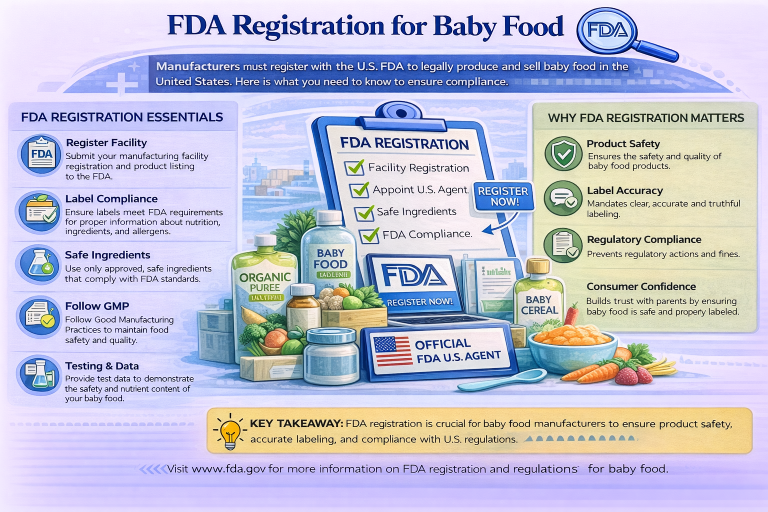
This guide covers every FDA requirement for baby food manufacturers and importers — facility registration, the heavy-metal action levels under Closer to Zero, the infant Nutrition Facts label, allergens, FSVP, California's testing law, and the critical line between baby food and infant formula.
Key Takeaways
- Baby food facilities must complete FDA Food Facility Registration (biennial renewal; foreign facilities need a U.S. Agent) — but the category faces higher scrutiny than general food.
- Under Closer to Zero, FDA finalized lead action levels in 2025: 10 ppb for most baby foods and 20 ppb for root vegetables and dry infant cereals.
- Inorganic arsenic in infant rice cereal has a 100 ppb action level; cadmium and mercury levels are still being developed.
- These action levels are non-binding guidance, but FDA weighs them when deciding whether a product is adulterated.
- Foods for children under 4 use a modified Nutrition Facts format (21 CFR 101.9(j)(5)).
- Infant formula is not baby food — it requires a premarket notification under Section 412 and 21 CFR 106/107.
- FDA charges $0 to register; complete service is $858.
Heavy-Metal Action Levels for Baby Food
FDA's Closer to Zero initiative sets action levels for toxic elements in food for babies and young children (under two). They are non-binding, but FDA considers them in adulteration decisions under FD&C Act § 402(a)(1), so manufacturers are expected to meet them through sourcing controls and testing.
| Contaminant | Food Category | Action Level & Status |
|---|---|---|
| Lead | Fruits, non-root vegetables, mixtures, yogurts, custards/puddings, single-ingredient meats | 10 ppb — final guidance, January 2025 |
| Lead | Single-ingredient root vegetables | 20 ppb — final guidance, January 2025 |
| Lead | Dry infant cereals | 20 ppb — final guidance, January 2025 |
| Inorganic Arsenic | Infant rice cereal | 100 ppb — final guidance, 2020 |
| Cadmium & Mercury | Baby foods (various) | Action levels in progress under Closer to Zero |
What Every Baby Food Importer Must Have in Place
Beyond the heavy-metal expectations, baby food must satisfy the full set of food-import requirements — with a few baby-specific twists:
Facility Registration + U.S. Agent
The manufacturing facility must be registered with FDA and renewed biennially. Foreign facilities must designate a U.S. Agent as FDA's domestic point of contact.
Infant Nutrition Facts Format
Foods for children under 4 use a modified Nutrition Facts panel under 21 CFR 101.9(j)(5) — because adult Daily Values don't apply. Using an adult panel is a common error.
Allergen Declarations
The 9 major allergens must be declared via a "Contains" statement or in the ingredient list, including allergens in sub-ingredients — especially important for this population.
FSVP & Prior Notice
Importers need an FSVP addressing heavy metals, pathogens, and nutrient adequacy, and must file Prior Notice before each shipment arrives.
How to Register & Import Baby Food
The path is the same core registration flow as any food facility, with baby-specific checkpoints along the way:
Confirm the product category
Determine whether your product is baby food (purees, cereals, snacks) or infant formula — formula needs a separate premarket notification.
Register the manufacturing facility
Complete Food Facility Registration through FURLS, obtain a DUNS Number, and designate a U.S. Agent for foreign facilities.
Meet heavy-metal expectations
Confirm the product meets Closer to Zero action levels for lead (and arsenic for infant rice cereal) through sourcing controls and finished-product testing.
Prepare a compliant label
Use the correct statement of identity, net quantity, ingredients, allergen declaration, and the modified infant Nutrition Facts format.
Establish FSVP & Prior Notice
Build an FSVP addressing heavy-metal and other hazards, and file Prior Notice before each shipment arrives at the port.
Manage biennial renewal
Renew the registration every even-numbered year (Oct 1–Dec 31) so it never lapses.
Bringing Baby Food into the U.S. Market?
FDA Registration Assistance provides Food Facility Registration for baby food facilities, U.S. Agent designation, baby food label review (including the infant Nutrition Facts format and allergens), FSVP support addressing heavy-metal hazards, Prior Notice guidance, and Biennial Renewal management.
Contact us at info@fdaregistrationassistance.com or call +1 (928) 275-8333. 1,000+ clients across 135+ countries. 15+ years of FDA regulatory experience.
Frequently Asked Questions — FDA Registration for Baby Food
1. Does baby food require FDA registration?
Yes. The manufacturing facility must complete FDA Food Facility Registration under 21 CFR Part 1 before products enter the U.S. Foreign facilities also need a U.S. Agent, and registration renews every two years. Baby food is regulated as food but held to higher scrutiny.
2. Is baby food regulated differently than other food?
It follows the same core food rules but receives heightened FDA scrutiny. Under Closer to Zero, FDA has set action levels for toxic elements like lead and arsenic in baby food, and expects stronger sourcing controls, testing, and documentation than for general food.
3. Is baby food the same as infant formula?
No — a critical distinction. Baby food (purees, cereals, snacks) is regulated as food. Infant formula falls under a separate, stricter regime: Section 412 of the FD&C Act and 21 CFR Parts 106/107 require specific nutrients, quality controls, and a mandatory premarket notification. For formula, facility registration alone is not enough.
4. What are FDA's lead limits for baby food?
In January 2025, FDA finalized lead action levels for processed food for children under two: 10 ppb for fruits, non-root vegetables, mixtures, yogurts, custards/puddings, and single-ingredient meats; and 20 ppb for single-ingredient root vegetables and dry infant cereals. They're non-binding but inform adulteration decisions.
5. What is FDA's Closer to Zero initiative?
Launched in 2021, it's FDA's iterative plan to reduce babies' and young children's exposure to lead, arsenic, cadmium, and mercury to the lowest achievable levels while keeping nutritious foods available. Lead levels were finalized in 2025; arsenic, cadmium, and mercury are on an ongoing timeline.
6. Are the lead action levels legally enforceable?
They're non-binding recommendations, not binding limits. But FDA says it will consider them when deciding whether to take enforcement action against a product as adulterated under § 402(a)(1). Manufacturers are expected to stay at or below the levels through good manufacturing practices.
7. Which foods do the lead action levels cover and exclude?
They cover processed foods for children under two — fruits, vegetables, mixtures, yogurts, and infant cereals. They exclude infant formula, beverages (including toddler drinks and juice), snacks (puffs, teething biscuits, grain-based/freeze-dried snacks), raw commodities, and homemade foods, some of which are addressed through other FDA actions.
8. What is the arsenic limit in infant rice cereal?
FDA set a 100 ppb action level for inorganic arsenic in infant rice cereal (final guidance, 2020). Manufacturers meet it through practices like selective sourcing and testing of rice and rice-derived ingredients.
9. What about cadmium and mercury?
Both are part of Closer to Zero, but FDA hasn't yet finalized action levels for them in baby food. Manufacturers should monitor updates and continue minimizing all toxic elements through sourcing and testing.
10. Does California require heavy-metal testing of baby food?
Yes. California's AB 899 requires baby food makers to test for lead, arsenic, cadmium, and mercury and share results — including a QR code on packaging linking to the data. Though a state law, it affects products sold nationally and is a real compliance consideration.
11. Do foreign baby food manufacturers need a U.S. Agent?
Yes. Every foreign facility that registers must designate a U.S. Agent physically present in the U.S. and reachable during business hours. Registration can't be completed without one.
12. Do baby food importers need FSVP?
Yes. Importers must maintain an FSVP under 21 CFR Part 1 Subpart L. The hazard analysis should specifically address toxic elements, pathogens, and nutrient adequacy, with verification commensurate with those hazards.
13. Is Prior Notice required for baby food imports?
Yes. Every shipment requires Prior Notice under 21 CFR Part 1 Subpart I before arrival, referencing the manufacturer's active registration number. Without a registered facility, Prior Notice can't be submitted and the shipment can be refused.
14. What labeling is required for baby food?
Standard 21 CFR Part 101 elements — statement of identity, net quantity (U.S. + metric), ingredient list, allergen declaration, responsible-firm name/address, and a Nutrition Facts panel — plus the modified infant format for foods for children under 4. All mandatory text must be in English.
15. Are there special Nutrition Facts rules for baby food?
Yes. Under 21 CFR 101.9(j)(5), foods for infants and children under 4 use a modified panel — some percent Daily Value and calories-from-fat information are handled differently because Daily Values are set for adults. An adult-format panel on baby food is a labeling error.
16. Do allergen rules apply to baby food?
Yes. Baby food must declare any of the 9 major allergens — milk, eggs, fish, Crustacean shellfish, tree nuts, peanuts, wheat, soybeans, sesame — via a "Contains" statement or in the ingredient list, including in sub-ingredients. Accuracy is especially important for this population.
17. How is infant formula regulated?
Under a distinct, stringent framework — Section 412 of the FD&C Act and 21 CFR Parts 106/107 — with specific nutrient content, GMP and quality control, required testing, and a mandatory premarket notification before a new formula is marketed. Far more involved than ordinary baby food.
18. Do I need to notify FDA before marketing a new infant formula?
Yes. Under Section 412, a manufacturer must submit a notification to FDA before marketing a new infant formula — generally at least 90 days in advance — with assurances it meets nutrient requirements and quality controls. This premarket step is unique to formula.
19. What happens if my baby food isn't compliant?
It can be detained or refused at the port, and a product exceeding contaminant action levels or with labeling violations may be deemed adulterated or misbranded. Consequences include holds, relabeling or re-export costs, and possible Import Alert. Baby food gets close attention at import review.
20. Can FDA stop my baby food shipment?
Yes. FDA can detain or refuse imported baby food for an unregistered facility, missing Prior Notice, a non-compliant label, or a contaminant concern. Baby food is frequently flagged, so confirm compliance before shipping.
21. What are common baby food compliance mistakes?
Assuming standard food rules are enough; using an adult Nutrition Facts panel instead of the infant format; missing allergen declarations; not addressing heavy-metal action levels through sourcing and testing; no FSVP; and confusing baby food with infant formula. Assuming foreign compliance satisfies U.S. rules is another frequent error.
22. Do pouches, snacks, and organic baby foods differ?
All are regulated as food and need registration and compliant labeling. Note the finalized lead action levels exclude snacks like puffs and teething biscuits and exclude beverages, though those remain subject to general adulteration standards. "Organic" claims are governed by the USDA National Organic Program, separate from FDA.
23. How often must baby food registration be renewed?
Every two years, during the biennial window from October 1 to December 31 of each even-numbered year. If a facility doesn't renew, the registration is considered expired and products can be refused at U.S. ports.
24. How much does registration cost?
FDA charges $0 in government fees. FDA Registration Assistance charges $858 for the complete service — registration, DUNS Number, U.S. Agent designation for foreign facilities, and Biennial Renewal management. Label and FSVP support are provided alongside.
25. How long does registration take?
With the required information and a valid DUNS Number ready, registration can often be completed through FURLS within a few business days. Full compliance — label formatting, heavy-metal controls, and FSVP — can take longer and should be planned before shipping.
26. How does FDA Registration Assistance help baby food companies?
FDA Registration Assistance provides complete compliance — Food Facility Registration ($858 complete service), U.S. Agent designation, baby food label review (infant Nutrition Facts and allergens), FSVP support addressing heavy-metal hazards, Prior Notice guidance, and Biennial Renewal management — for companies in 135+ countries.
27. How do I get started with FDA compliance for my baby food?
Contact FDA Registration Assistance at info@fdaregistrationassistance.com or call +1 (928) 275-8333. Share your facility location, your products (and whether any are infant formula), and your current label. Your registration, U.S. Agent, label, and FSVP are handled end to end. Complete service: $858.