FDA Registration for Candy & Confectionery
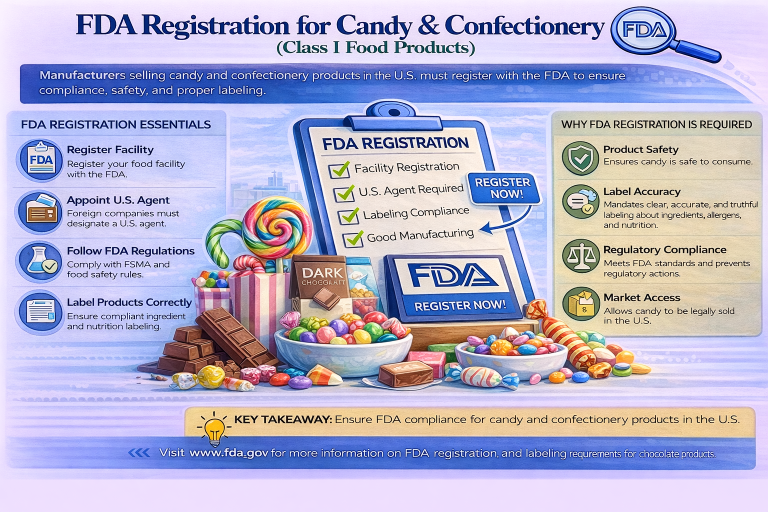
This guide covers FDA registration requirements for candy and confectionery manufacturers and importers, with specific detail on RACC serving sizes, allergen declarations, color additive naming, aspartame warnings, sugar alcohol labeling, and prohibited candy ingredients.
FDA Serving Sizes for Candy — The Most Common Labeling Violation
The FDA Reference Amount Customarily Consumed (RACC) under 21 CFR Part 101.12 is specific to each candy type. Using home country serving sizes instead of FDA RACCs is the most common Nutrition Facts labeling violation for imported candy and constitutes misbranding under 21 U.S.C. § 343:
| Candy Type | FDA RACC | Common Home Country Error |
|---|---|---|
| Soft candy — gummies, gummy bears/worms, chews, caramels, nougat | 40g | 25g, 30g, 50g, or “1 piece” |
| Hard candy and breath mints | 2 pieces | 1 piece, 5g, 10g |
| Chocolate and milk chocolate — bars, blocks, pieces | 40g | 25g, 30g, or per-100g comparison format |
| Candy-coated products — M&M-style, dragées, chocolate-covered | 15g | 30g, 40g, or “1 handful” |
| Candy corn | 30g | 15g or per-bag serving |
| Licorice and licorice-type candy | 40g | 30g, 50g, or 1 piece |
| Lollipops — with stick | 1 piece | 30g weight-based |
The Most Common Candy Labeling Violations That Cause Port Detentions
Aspartame Warning — Mandatory for Sugar-Free Candy
Any candy containing aspartame must carry the statement:
PHENYLKETONURICS: CONTAINS PHENYLALANINE
Required under 21 CFR Part 101.9(d)(3). Individuals with phenylketonuria (PKU) cannot metabolize phenylalanine. This warning must appear on the label and is frequently missing on imported sugar-free candy containing aspartame.
Sugar Alcohol Labeling for Sugar-Free Candy
Sugar alcohols (xylitol, sorbitol, maltitol, mannitol, erythritol, isomalt) must be listed by name in the ingredient list and declared on a separate “Sugar Alcohols” line in the Nutrition Facts panel. If the candy is labeled “sugar-free” and contains sugar alcohols at levels likely to cause a laxative effect, the label should include:
Excess consumption may have a laxative effect.
FDA Certified Color Names vs. EU E-Numbers — What Must Appear on U.S. Candy Labels
| Color | FDA Required Name | EU E-Number (NOT valid on U.S. labels) | Common in Candy |
|---|---|---|---|
| Red 40 (FD&C Red No. 40) | E129 (Allura Red AC) | Red and orange candy, licorice, gummies | |
| Yellow 5 (FD&C Yellow No. 5) | E102 (Tartrazine) | Yellow candy, butterscotch, lemon-flavored candy | |
| Yellow 6 (FD&C Yellow No. 6) | E110 (Sunset Yellow) | Orange candy, peach-flavored candy, caramel coloring | |
| Blue 1 (FD&C Blue No. 1) | E133 (Brilliant Blue) | Blue candy, blue raspberry-flavored products | |
| Red 3 (FD&C Red No. 3) | E127 (Erythrosine) | Cherry-flavored candy, maraschino cherry coating | |
| Blue 2 (FD&C Blue No. 2) | E132 (Indigo Carmine) | Blue and purple candy blends | |
| Green 3 (FD&C Green No. 3) | E143 (Fast Green) | Green candy, mint-flavored products |
Color additives used in non-U.S. markets that are NOT approved by FDA — including some EU-permitted colors like Red 2G (E128) — cannot be used in candy sold in the United States regardless of their legal status in the country of manufacture.
Candy Ingredients That Will Cause U.S. Port Detention
CBD in Candy — Not Legally Permitted
FDA has taken the position that CBD (cannabidiol) cannot be legally added to food — including candy — sold in U.S. interstate commerce. CBD was first approved as a drug ingredient (Epidiolex), triggering 21 U.S.C. § 331(ll) which prohibits adding a drug substance that was first approved as a drug to food. CBD candy is frequently detained at U.S. ports and is subject to FDA Warning Letters. Importers and retailers selling CBD candy face refusal of admission and potential Import Alert placement.
Candy Toys / Non-Food Objects Embedded in Candy
Candy products incorporating non-food objects — toys inside chocolate eggs, prize-containing candy — are subject to additional FDA and CPSC scrutiny. Under 21 U.S.C. § 342(d), a food can be adulterated if it bears or contains a deleterious, non-food substance. FDA and CPSC have historically detained Kinder Surprise-style products because the embedded non-food toy is considered to render the candy adulterated or present a choking hazard.
How to Register a Candy Manufacturing Facility with FDA
Activity Codes for Candy Manufacturers
Manufacture — making candy from ingredients (cooking, molding, enrobing, panning, depositing). Pack — packaging candy into retail units, bags, boxes. Hold — if the facility warehouses finished candy before distribution. Under 21 CFR 1.234, update within 60 days when new candy categories are added.
Label Review Included
FDA Registration Assistance reviews candy labels for RACC serving size compliance, 2020 Nutrition Facts format, allergen declarations (soy lecithin, sesame, tree nuts, peanuts, milk), color additive naming (Red 40 vs. E129), aspartame phenylketonuria warning, sugar alcohol disclosure, and English language requirements.
U.S. Agent for Foreign Candy Manufacturers
Foreign candy and confectionery manufacturers must designate a U.S. Agent with a physical U.S. address as part of the FDA registration. FDA Registration Assistance provides U.S. Agent services for foreign candy manufacturers — receiving FDA communications and facilitating inspection coordination.
Biennial Renewal Management
FDA Food Facility Registration must be renewed every two years — October 1 through December 31 of even-numbered years. FDA Registration Assistance tracks the renewal window and submits renewals automatically. A lapsed candy manufacturer registration triggers OASIS detention of every subsequent candy shipment.
Ready to Get Your Candy Business FDA-Compliant?
FDA Registration Assistance provides complete FDA compliance for candy and confectionery manufacturers and importers — Food Facility Registration with correct activity codes, U.S. Agent services for foreign manufacturers, label compliance review, FSVP programs for importers, Prior Notice accuracy review, and Biennial Renewal management. Complete service: $858. FDA charges $0. DUNS fees separate. 1,000+ clients. 135+ countries. 15+ years of FDA regulatory experience.
Contact us at info@fdaregistrationassistance.com or call +1 (928) 275-8333.
Frequently Asked Questions — FDA Registration for Candy & Confectionery
1. Do candy and confectionery manufacturers need FDA registration?
Yes. All candy and confectionery manufacturers must register with FDA under 21 U.S.C. § 350d and 21 CFR Part 1 Subpart H. Applies to chocolate, gummies, hard candy, caramels, toffee, licorice, lollipops, candy bars, breath mints, and all other confectionery. Foreign manufacturers must also designate a U.S. Agent. Complete service: $858. FDA charges $0. DUNS fees separate.
2. What is the FDA serving size (RACC) for candy?
Under 21 CFR Part 101.12: Soft candy (gummies, chews, caramels): 40g. Hard candy and breath mints: 2 pieces. Chocolate bars/pieces: 40g. Candy-coated products: 15g. Candy corn: 30g. Licorice-type candy: 40g. Lollipops: 1 piece. Using home country serving sizes is misbranding under 21 U.S.C. § 343.
3. Does soy lecithin in candy require a soy allergen declaration?
Yes. Soy lecithin contains trace soy proteins and must be declared as a soy allergen — either “Contains: Soy” or bold parenthetical “Soy Lecithin (soy)” or other compliant method. The ingredient name “Soy Lecithin” alone does not satisfy the allergen declaration requirement. Missing soy declaration in chocolate is the most common candy allergen violation.
4. Does sesame in candy require an allergen declaration since 2023?
Yes. Sesame is the 9th major U.S. allergen under the FASTER Act (effective January 1, 2023). Sesame candy, sesame snaps, sesame brittle, halva, and any candy with sesame seeds, tahini, or sesame oil must declare sesame as an allergen. Missing sesame declaration = misbranding, import detention risk, recall exposure.
5. How must color additives be labeled on candy in the United States?
FDA-certified color additives must be declared by their exact certified FDA name — not EU E-numbers. Correct: “Red 40,” “Yellow 5,” “Yellow 6,” “Blue 1.” Incorrect: “E129,” “E102,” “E110,” “E133.” “Color added” or “Artificial color” without naming the specific color is also non-compliant.
6. Does candy with aspartame need a special warning?
Yes. Any candy containing aspartame must carry: “PHENYLKETONURICS: CONTAINS PHENYLALANINE” under 21 CFR Part 101.9(d)(3). Required because individuals with phenylketonuria cannot metabolize phenylalanine. Frequently missing on imported sugar-free candy with aspartame.
7. What labeling is required for sugar-free candy with sugar alcohols?
Sugar alcohols (xylitol, sorbitol, maltitol, mannitol, erythritol, isomalt) must be listed by name in the ingredient list and declared on a separate “Sugar Alcohols” line in the Nutrition Facts panel. If the candy is “sugar-free” and contains sugar alcohols at levels likely to cause laxation, the label should note: “Excess consumption may have a laxative effect.”
8. What allergens must be declared on candy labels?
All nine major U.S. allergens where applicable: Milk (chocolate, caramel, nougat); Eggs (cream-filled candy); Tree nuts (almonds, hazelnuts, cashews, pecans — each specific nut named); Peanuts; Wheat (wafer-containing candy bars); Soybeans/Soy Lecithin; Sesame (since January 2023). All must be declared in a “Contains” statement or through bold parenthetical declarations in the ingredient list.
9. Can CBD be added to candy sold in the United States?
No. FDA has taken the position that CBD cannot be legally added to food sold in U.S. interstate commerce under 21 U.S.C. § 331(ll). CBD candy is frequently detained at U.S. ports and is subject to FDA Warning Letters. Importers and retailers selling CBD candy face refusal of admission and potential Import Alert placement.
10. What color additives are approved for candy sold in the U.S.?
Only FDA-certified color additives: Red 40, Yellow 5, Yellow 6, Blue 1, Red 3, Blue 2, Green 3. Color additives common in non-U.S. markets but not FDA-approved cannot be used in candy imported for U.S. distribution regardless of their status in the country of manufacture.
11. What FDA requirements apply to chocolate candy specifically?
FDA has standards of identity for chocolate under 21 CFR Part 163. Milk chocolate must contain at least 10% chocolate liquor and 12% total milk solids. A product not meeting the standard cannot be labeled “milk chocolate” — must use “chocolate candy” or “chocolatey.” Chocolate RACC: 40g. Soy lecithin (common emulsifier) must declare soy allergen. Milk must declare milk allergen.
12. What are the FDA Nutrition Facts requirements for candy?
2020 FDA format required: correct RACC serving size for the specific candy type; Calories in large bold type; Added Sugars as a separate line (significant for candy with high Added Sugars); Sugar Alcohols if present; % Daily Values based on 2020 FDA reference daily intakes. Added Sugars is among the most important mandatory lines for candy products.
13. Do foreign candy manufacturers need a U.S. Agent?
Yes. Foreign candy manufacturers exporting to the United States must register and designate a U.S. Agent with a physical U.S. address. FDA Registration Assistance provides U.S. Agent services for foreign candy manufacturers.
14. What FSVP requirements apply to candy importers?
U.S. candy importers must maintain FSVP under 21 CFR Part 1 Subpart L for each foreign candy supplier. The FSVP hazard analysis must address: allergen cross-contact (multiple allergen-containing products on shared equipment); prohibited or unapproved color additives; Salmonella in chocolate; heavy metals in cocoa; and pesticide residues in cocoa and botanical candy ingredients.
15. What is the $858 complete service for candy manufacturer registration?
FDA Registration Assistance charges $858 — U.S. Agent designation for foreign candy manufacturers, activity code selection, food product category selection, registration submission through FURLS, and Biennial Renewal management. FDA charges $0. DUNS fees are separate.
16. Why do candy shipments get detained at U.S. ports?
Most common causes: facility registration expired or not filed; undeclared soy allergen for soy lecithin in chocolate; missing sesame allergen declaration since January 2023; color additives listed by EU E-numbers instead of FDA certified names; wrong RACC serving size on Nutrition Facts panel; CBD in candy; candy toys with embedded non-food objects; Prior Notice errors.
17. What activity codes should a candy manufacturer select?
Manufacture (making candy — cooking, molding, enrobing, panning, depositing); Pack (packaging into retail units, bags, boxes); Hold (if the facility warehouses finished candy). Under 21 CFR 1.234, update within 60 days when new candy categories are added.
18. Does the Biennial Renewal apply to candy manufacturer registrations?
Yes. FDA Food Facility Registration renews every two years — October 1 through December 31 of even-numbered years. A lapsed candy manufacturer registration triggers OASIS detention of every subsequent candy shipment.
19. Do gummy candy manufacturers have specific FDA labeling requirements?
Yes. RACC for gummies (gummy bears, gummy worms, soft chews): 40g. Gummies may contain gelatin (pork or beef) which must be declared in the ingredient list. Pectin-based gummies must declare pectin source. Color additives by FDA certified name (not E-numbers). Sesame-flavored gummies must declare sesame since January 2023.
20. Are there FDA requirements specific to novelty candy or candy toys?
Yes. Candy with non-food objects embedded inside — toys in chocolate eggs — may be considered adulterated under 21 U.S.C. § 342(d) because the non-food object can render the candy adulterated or present a choking hazard. FDA and CPSC have historically detained Kinder Surprise-style products at U.S. ports.
21. What FSMA Preventive Controls apply to candy manufacturers?
Full FSMA Preventive Controls under 21 CFR Part 117. Key hazards: allergen cross-contact (milk, nuts, peanuts, soy, sesame on shared equipment); Salmonella in chocolate and cocoa; heavy metals in cocoa; pesticide residues in cocoa and botanical candy ingredients. Written food safety plan and PCQI required.
22. How does the FDA chocolate standard of identity affect candy labeling?
Under 21 CFR Part 163, “milk chocolate” requires at least 10% chocolate liquor and 12% total milk solids. Products not meeting the standard must use alternative names: “chocolate candy,” “chocolatey coating,” etc. Mislabeling as chocolate when not meeting FDA’s standard of identity is misbranding.
23. What ingredient labeling issues are most common for imported candy?
Missing soy allergen declaration for soy lecithin in chocolate; missing sesame allergen declaration (FASTER Act, January 2023); color additives listed by EU E-numbers; aspartame candy without phenylketonuria warning; sugar alcohols in sugar-free candy not listed separately in Nutrition Facts; gelatin source claims; natural and artificial flavor declarations not complying with 21 CFR Part 101.22.
24. How does FDA Registration Assistance help candy manufacturers and importers?
Complete FDA compliance: Food Facility Registration with correct activity codes; U.S. Agent for foreign manufacturers; label compliance review (RACC, allergens, color names, aspartame warning, sugar alcohols); FSVP programs; Biennial Renewal management. $858 service. FDA charges $0. 1,000+ clients. 135+ countries.
25. How do I get started with FDA registration for my candy manufacturing facility?
Contact FDA Registration Assistance at info@fdaregistrationassistance.com or call +1 (928) 275-8333. Provide your facility name and address, candy types you manufacture, whether you are domestic or foreign, and any existing FDA registration information. Complete service: $858. FDA charges $0. DUNS fees separate.