FDA Registration for Co-Packed Foods
Co-packing (contract manufacturing) is one of the most common ways to bring food products to market in the United States. Whether you are outsourcing production to a third-party manufacturer or acting as a co-packer for multiple brands, FDA compliance is still required at every level of the supply chain.
The U.S. Food and Drug Administration regulates all facilities involved in manufacturing, processing, packing, or holding food products—including co-packers.
Many businesses assume that working with a co-packer shifts responsibility entirely to the manufacturer, but in reality, compliance is shared. Both the brand owner and the co-packer must ensure that all FDA requirements are met to avoid delays, detention, or enforcement actions.
What Are Co-Packed Food Products
Co-packed food products are items manufactured by a third-party facility on behalf of a brand owner.
The co-packer handles production, packaging, and sometimes labeling.
The brand owner markets and sells the product under their own name.
In many cases, multiple parties are involved in the supply chain.
Because of this structure, FDA compliance must be carefully managed to ensure all responsibilities are covered.
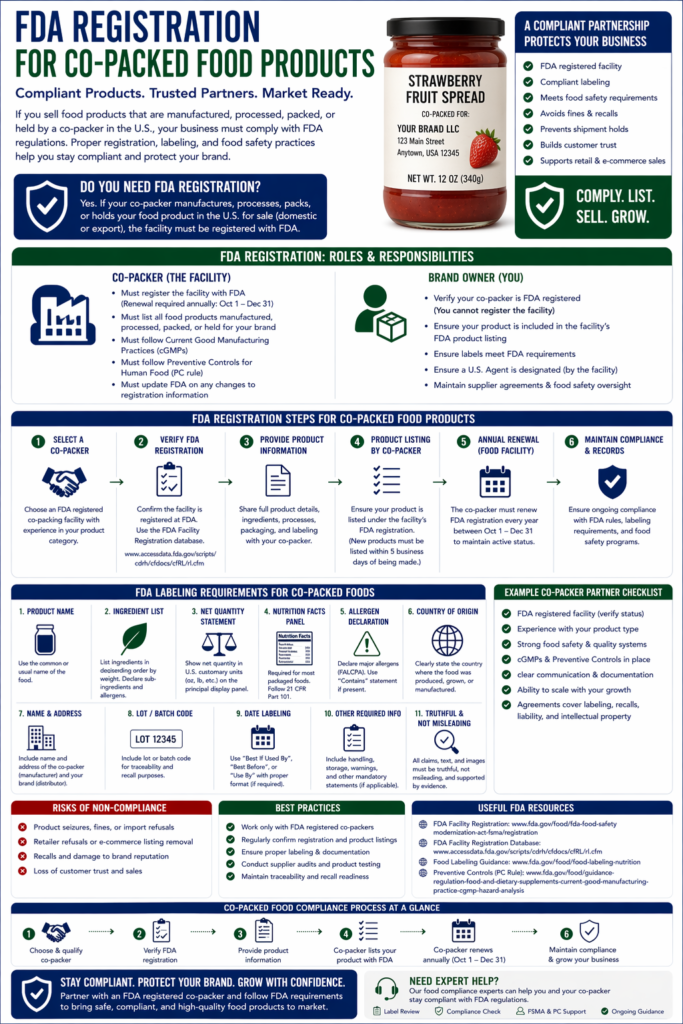
Who Is Responsible for FDA Compliance
One of the most common misunderstandings in co-packing is responsibility.
The co-packer is responsible for maintaining an active FDA Food Facility Registration and following food safety regulations.
The brand owner is responsible for ensuring the product label is compliant and accurately represents the product.
If the product is imported, the U.S. importer is responsible for FSVP compliance.
In practice, all parties must work together to ensure full compliance.
FDA Food Facility Registration Requirements
Any facility involved in manufacturing, processing, packing, or holding food products must be registered with the FDA.
This includes co-packers, contract manufacturers, and storage facilities.
Foreign co-packers must designate a U.S. Agent as part of their registration.
Registration must be maintained and updated as required.
Without a valid FDA registration, products cannot legally enter the U.S. market.
FSVP Requirements for Imported Co-Packed Products
If your co-packed product is manufactured outside the United States, the importer must comply with the Foreign Supplier Verification Program (FSVP).
FSVP requires verification that the co-packer follows FDA food safety standards.
This includes reviewing hazard analyses, supplier documentation, and production processes.
Importers must maintain records and be prepared for FDA inspection.
Even when using a reputable co-packer, FSVP remains a mandatory requirement.
Labeling Requirements for Co-Packed Products
Labeling is one of the most critical compliance areas for co-packed products.
The label must accurately reflect the product’s ingredients and formulation.
The name and address of the responsible party must be included.
A compliant Nutrition Facts panel must be present unless exempt.
Allergen declarations must be clearly stated.
Net quantity must be accurate and properly displayed.
In many cases, labeling responsibility falls on the brand owner, making careful review essential.
Brand Owner vs. Manufacturer Information
Co-packed products often raise questions about whose information should appear on the label.
The label must include the name and address of the responsible party, which can be the manufacturer, packer, or distributor.
If the brand owner is listed instead of the manufacturer, the label must include a qualifying phrase such as “Manufactured for” or “Distributed by.”
This ensures transparency and compliance with FDA requirements.
Incorrect labeling of responsible parties is a common issue.
Common Compliance Issues with Co-Packed Products
Co-packed products often face unique compliance challenges due to multiple parties being involved.
Unclear responsibility for labeling can lead to errors.
Ingredient lists may not match the actual formulation used by the co-packer.
Allergen declarations may be incomplete or inconsistent.
Imported co-packed products may not meet U.S. labeling standards.
These issues can result in delays, detention, or product recalls.
Why a Label Review Is Critical for Co-Packed Products
Because multiple parties are involved, co-packed products benefit greatly from a thorough label review.
It ensures the label accurately reflects the product.
It verifies compliance with FDA requirements.
It helps align responsibilities between the brand owner and co-packer.
It reduces the risk of costly corrections after production.
Many brands incorporate label review as a standard step when working with co-packers.
How FDA Registration Assistance Supports Co-Packed Products
FDA Registration Assistance works with both brand owners and co-packers to ensure compliance across the entire supply chain.
We assist with FDA Food Facility Registration and U.S. Agent services.
We support FSVP compliance for imported products.
We review labels to align with FDA requirements.
We help identify gaps and provide clear guidance for corrections.
This coordinated approach helps ensure all parties are aligned before products reach the market.
Why Businesses Choose FDA Registration Assistance
Co-packing adds efficiency, but it also adds complexity to compliance.
FDA Registration Assistance has supported over 1,000 clients across 135+ countries, helping businesses navigate FDA requirements across multi-party supply chains.
With more than 15 years of combined experience, the focus is on helping products move smoothly through registration, labeling, and import processes without unnecessary delays.
Frequently Asked Questions (FAQs)
Do co-packed food products require FDA registration?
Yes, the co-packing facility must be registered with the FDA if it is involved in manufacturing, processing, packing, or holding food products. If the facility is located outside the United States, it must also designate a U.S. Agent. Without proper registration, products cannot legally enter the U.S. market.
Who is responsible for compliance when using a co-packer?
Responsibility is shared. The co-packer is responsible for facility registration and food safety practices, while the brand owner is typically responsible for labeling accuracy. If the product is imported, the U.S. importer is responsible for FSVP compliance. All parties must coordinate to ensure full compliance.
Do I still need FSVP if my co-packer is reputable?
Yes, FSVP is required for all imported food products, regardless of the supplier’s reputation. The importer must verify that the co-packer meets FDA food safety standards and maintain documentation for inspection.
What name should appear on the label for co-packed products?
The label must include the name and address of the responsible party. If the brand owner is listed instead of the manufacturer, a qualifying phrase such as “Manufactured for” or “Distributed by” must be used.
Can labeling errors occur with co-packed products?
Yes, labeling errors are common because multiple parties are involved. Ingredient lists, allergen declarations, and product claims must be carefully reviewed to ensure accuracy.
Do imported co-packed products need to meet FDA labeling requirements?
Yes, imported products must meet the same FDA labeling standards as domestic products. There are no exceptions.
What happens if my co-packed product is not compliant?
Your product may be detained, delayed, or refused at the port of entry. You may also need to relabel the product or provide additional documentation.
Do I need a U.S. Agent for a foreign co-packer?
Yes, foreign facilities must designate a U.S. Agent as part of FDA registration.
How long does it take to become compliant?
Timelines vary depending on the requirements, but many steps such as registration and label review can be completed within a few business days once all information is provided.
Is a label review necessary for co-packed products?
While not mandatory, it is highly recommended due to the complexity of multi-party production. A review helps ensure accuracy and reduces the risk of compliance issues.
Ensure Your Co-Packed Products Are Fully Compliant
If you are working with a co-packer or planning to bring co-packed food products into the U.S. market, ensuring compliance from the start is essential.
FDA Registration Assistance provides support across FDA registration, U.S. Agent services, FSVP, and label review—helping you align all parties and move forward with confidence.
You can reach out at info@fdaregistrationassistance.com or call +1-928-275-8333 to get started.