FDA Registration for Fermented Foods
Fermented foods—such as kimchi, sauerkraut, kombucha, yogurt-based products, fermented sauces, and pickled vegetables—are rapidly growing in popularity across the United States. While these products are often rooted in traditional processes, they must still meet strict U.S. regulatory requirements before they can be legally sold.
The U.S. Food and Drug Administration regulates fermented foods as part of the broader food supply, with requirements covering facility registration, labeling, safety, and in some cases, process controls.
Because fermentation involves biological activity and pH changes, these products can fall into more complex regulatory categories. Ensuring compliance from the beginning is essential to avoid delays, detention, or refusal at the port of entry.
What Are Fermented Foods
Fermented foods are products that undergo controlled microbial processes to develop flavor, texture, or preservation.
Common examples include kimchi, sauerkraut, yogurt, kefir, kombucha, fermented sauces, and pickled vegetables.
These products may be refrigerated, shelf-stable, or require controlled storage conditions.
Fermentation can affect acidity, shelf life, and safety.
Because of these factors, regulatory classification depends on the specific product and process.
Do Fermented Foods Require FDA Registration
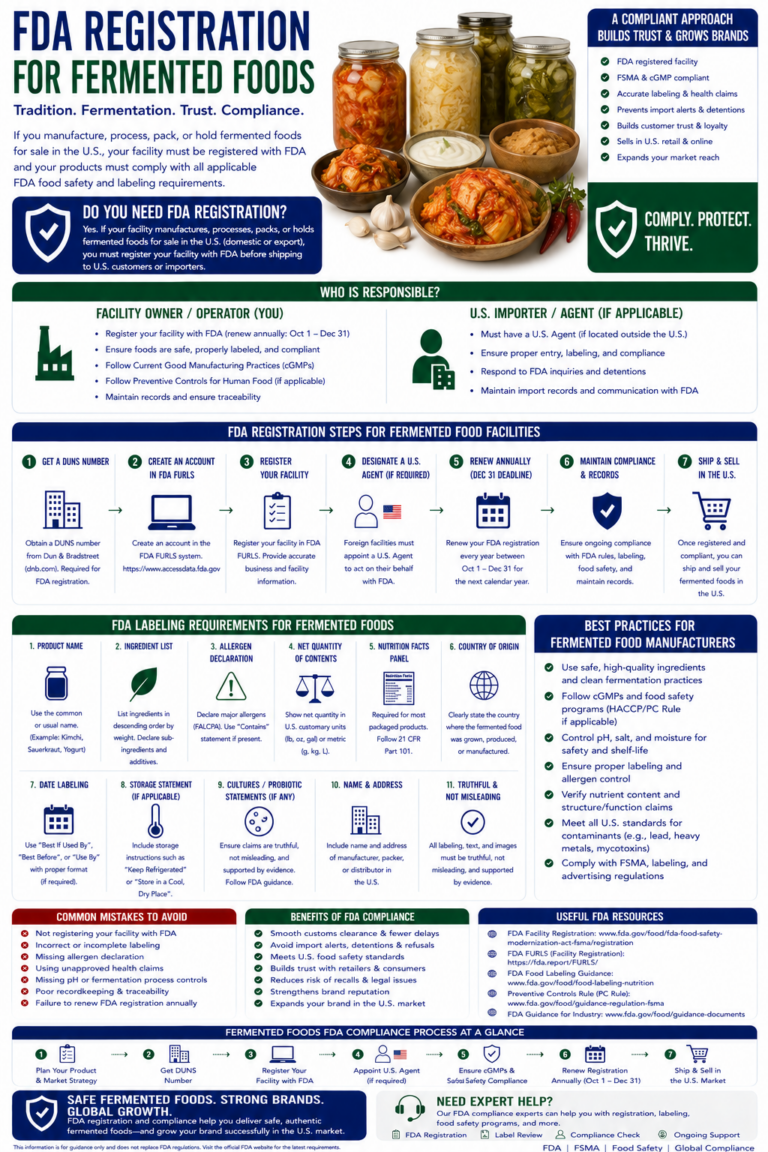
Yes, any facility involved in manufacturing, processing, packing, or holding fermented foods must be registered with the FDA.
This applies to both domestic and foreign facilities.
Foreign facilities must designate a U.S. Agent as part of their registration.
Registration must be active and properly maintained.
Without valid registration, fermented food products cannot legally enter the U.S. market.
When Process Filing May Be Required
Some fermented foods may require additional FDA process filings depending on their characteristics.
Acidified foods, such as certain pickled or fermented products, may require process filing.
Products that rely on controlled pH levels for safety may need validation.
Shelf-stable fermented products may fall under additional regulatory requirements.
If applicable, facilities may need to obtain a Food Canning Establishment (FCE) number and file Scheduled Processes (SIDs).
Role of pH and Safety Controls
pH plays a critical role in the safety of fermented foods.
Products must maintain safe pH levels to prevent microbial growth.
Fermentation processes must be controlled and consistent.
Testing and validation may be required to ensure safety.
Improper control of fermentation conditions can lead to compliance issues.
FSVP Requirements for Imported Fermented Foods
If fermented foods are manufactured outside the United States, the importer must comply with the Foreign Supplier Verification Program (FSVP).
The importer must verify that the foreign supplier meets FDA food safety standards.
This includes reviewing hazard analyses, fermentation controls, and documentation.
Records must be maintained for FDA inspection.
FSVP is required for all imported fermented food products.
Labeling Requirements for Fermented Foods
Labeling is one of the most critical compliance areas for fermented foods.
The label must clearly identify the product.
All ingredients must be listed in descending order by weight.
A compliant Nutrition Facts panel must be included unless exempt.
Allergen declarations must be clearly stated.
Net quantity and responsible party information must be included.
Fermented products often contain complex ingredient combinations, making accurate labeling essential.
Claims and Marketing Considerations
Fermented foods often include health-related claims that require careful attention.
Claims such as “probiotic,” “gut health,” or “natural fermentation” must be accurate and substantiated.
Claims must not be misleading or unsupported.
Product identity must clearly reflect the nature of the product.
Improper claims are a common reason fermented products are flagged.
Common Compliance Issues with Fermented Foods
Fermented food products often encounter recurring compliance challenges.
Misclassification of acidified versus fermented products.
Lack of proper process validation where required.
Ingredient lists that do not fully reflect the formulation.
Claims that do not meet FDA standards.
These issues can lead to delays, detention, or refusal.
Why a Compliance Review Is Essential
A compliance review helps identify and resolve issues before products reach the U.S. market.
It ensures proper classification of the product.
It verifies whether process filing is required.
It ensures labeling meets FDA standards.
It helps address FSVP and documentation requirements.
Many businesses use compliance reviews as a standard step when launching fermented food products.
How FDA Registration Assistance Supports Fermented Food Brands
FDA Registration Assistance works with manufacturers, importers, and brands to ensure compliance across all regulatory areas.
We assist with FDA Food Facility Registration and U.S. Agent services.
We support FCE registration and SID process filings where required.
We assist with FSVP compliance for imported products.
We review labels to align with FDA requirements.
This structured approach helps businesses bring fermented products to market efficiently.
Why Businesses Choose FDA Registration Assistance
Fermented foods require careful handling of both traditional processes and regulatory requirements.
FDA Registration Assistance has supported over 1,000 clients across 135+ countries, helping businesses align with FDA requirements before entering the U.S. market.
With more than 15 years of combined experience, the focus is on helping products move through registration, filing, and labeling processes without unnecessary delays.
Frequently Asked Questions (FAQs)
Do fermented foods require FDA registration?
Yes, any facility involved in manufacturing, processing, packing, or holding fermented foods must be registered with the FDA. This applies to both domestic and foreign facilities.
Do all fermented foods require process filing?
No, only certain types—such as acidified foods—require process filing. Determining this depends on the product’s formulation and pH.
What is the role of pH in fermented foods?
pH is critical for safety. Products must maintain safe acidity levels to prevent harmful microbial growth. Proper testing and control are essential.
Do I need FSVP for imported fermented foods?
Yes, the U.S. importer must comply with FSVP to verify that the foreign supplier meets FDA food safety standards.
Can I make probiotic claims on fermented foods?
Yes, but claims must be accurate, substantiated, and not misleading.
What happens if my product is not compliant?
Your shipment may be detained, delayed, or refused. You may also need to relabel your product or complete additional filings.
Do imported fermented foods need to meet U.S. standards?
Yes, imported products must meet the same FDA requirements as domestic products.
Do I need a U.S. Agent for foreign facilities?
Yes, foreign facilities must designate a U.S. Agent as part of FDA registration.
How long does it take to become compliant?
Timelines vary, but many steps such as registration and label review can be completed within a few business days once all information is provided.
Is a compliance review necessary for fermented foods?
While not mandatory, it is highly recommended due to the complexity of classification and processing requirements.
Bring Your Fermented Foods to the U.S. Market with Confidence
If you are planning to manufacture or import fermented food products into the United States, ensuring compliance from the beginning is essential to a smooth and successful launch.
FDA Registration Assistance provides support across FDA registration, U.S. Agent services, FCE/SID filings, FSVP, and label review—helping you align with requirements and move forward with confidence.
You can reach out at info@fdaregistrationassistance.com or call +1-928-275-8333 to get started.