
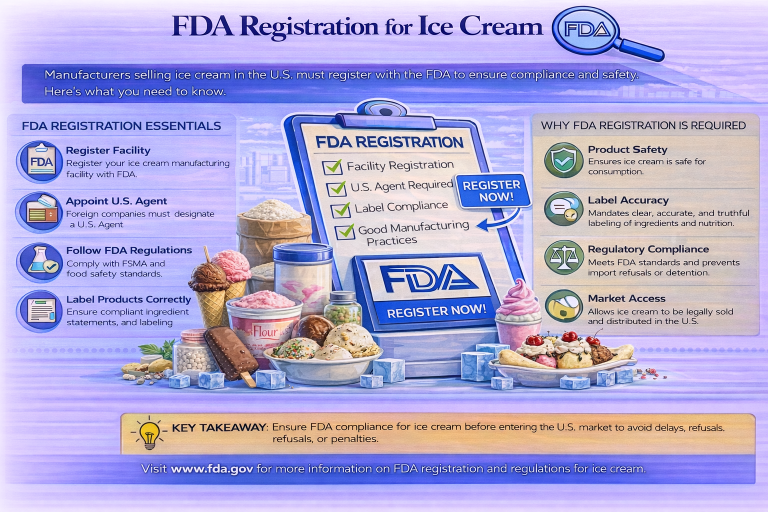
FDA Registration for Ice Cream
This guide covers FDA registration for ice cream, the standards of identity for ice cream and related frozen desserts, when you must label “frozen dairy dessert,” the Listeria and pasteurization requirements, allergens, the ⅔ cup serving size, and the most common import problems.
Can You Even Call It “Ice Cream”? The 10% Milkfat Rule
“Ice cream” is a legally defined term in the U.S. Under 21 CFR 135.110, a product must meet strict compositional minimums — most importantly at least 10% milkfat — to carry the name. Many products sold abroad as “ice cream” have lower milkfat and cannot legally use that name on a U.S. label.
Ice Cream vs. Custard vs. Sherbet vs. Sorbet vs. Mellorine
| Product | CFR | Key Compositional Rule |
|---|---|---|
| Ice Cream | 135.110 | ≥ 10% milkfat (plain), ≥ 4.5 lb/gal, ≥ 1.6 lb food solids/gal. Bulky flavors may go as low as 8%. |
| Frozen Custard / French Ice Cream | 135.110 | Ice cream with ≥ 1.4% egg yolk solids. Adds egg as an allergen. |
| Sherbet | 135.140 | 1–2% milkfat, 2–5% total milk solids; higher sweetener; fruit acidity for fruit sherbets. Still carries milk allergen. |
| Water Ices / Sorbet | 135.160 | Like sherbet but NO dairy. No milk allergen, no dairy pasteurization concern. |
| Mellorine | 135.130 | Ice-cream-like but milkfat replaced by vegetable/animal fat. Must be labeled “mellorine,” not “ice cream.” |
Each name is reserved for a product meeting its specific standard. A vegetable-fat frozen dessert labeled “ice cream,” or a low-dairy product labeled “ice cream” instead of “sherbet,” is misbranded. Non-dairy and plant-based frozen desserts (coconut, almond, oat) are not “ice cream” either — they’re labeled “non-dairy frozen dessert” and carry their own allergens.
Pasteurization and the Listeria Problem
Listeria monocytogenes — The Primary Hazard
Ice cream is a ready-to-eat dairy product with no kill step after packaging, and Listeria can grow at refrigeration temperatures and survive freezing. A contaminated production environment can introduce it into finished product — a serious risk to pregnant women, the elderly, and the immunocompromised. The 2015 Blue Bell outbreak made Listeria control in ice cream a major FDA focus. Under FSMA (21 CFR Part 117), expect a robust environmental monitoring program and strong sanitation controls.
Pasteurization Is Mandatory
As a dairy product, the ice cream mix must be pasteurized to destroy pathogens before freezing. The mix is pasteurized, cooled, aged, flavored, then frozen with air incorporation (overrun). For imports, FDA and the FSVP will consider proper pasteurization and controls preventing post-pasteurization contamination. Egg-containing frozen custard adds a Salmonella consideration.
Ice Cream Is Allergen-Rich — Declare Them All
Because ice cream carries so many mix-ins and inclusions, a single flavor change or new mix-in can introduce a new allergen — careful review is essential. Beyond allergens, the label must follow 21 CFR Part 101: correct statement of identity, net quantity by volume, 2020 Nutrition Facts at the ⅔ cup RACC (~85g) per 21 CFR 101.12, ingredient list with stabilizers/emulsifiers (guar gum, carrageenan, mono- and diglycerides) declared, color additives by FDA name (annatto, Yellow 5 — not EU E-numbers), and a U.S. address. See the full food label regulations guide.
How to Register an Ice Cream Facility with FDA
Standard-of-Identity & Label Review
We confirm whether your product qualifies as “ice cream” or must be “frozen dairy dessert,” and review allergen declarations, the ⅔ cup RACC serving size, stabilizer/emulsifier and color declarations, and 2020 Nutrition Facts format. The milkfat check alone prevents one of the most common ice cream import refusals.
FSVP for Frozen Dairy Importers
U.S. ice cream importers must maintain FSVP. We build programs focused on the real hazards: Listeria (primary — verifying environmental monitoring and pasteurization), Salmonella for egg-containing custard, allergens, and standard-of-identity/label compliance.
Ready to Get Your Ice Cream FDA-Compliant?
FDA Registration Assistance provides complete FDA compliance for ice cream and frozen dairy manufacturers and importers — Food Facility Registration with correct activity codes, U.S. Agent services, standard-of-identity and label compliance review, FSVP programs focused on Listeria and pasteurization, and Biennial Renewal management. Complete service: $858. FDA charges $0. DUNS fees separate. 1,000+ clients. 135+ countries. 15+ years of FDA regulatory experience.
Contact us at info@fdaregistrationassistance.com or call +1 (928) 275-8333.
Frequently Asked Questions — FDA Registration for Ice Cream
1. Do ice cream manufacturers need FDA registration?
Yes. Ice cream and frozen dairy desserts are conventional foods, and every facility that manufactures, processes, packs, or holds them for U.S. consumption must register under 21 U.S.C. § 350d and 21 CFR Part 1 Subpart H. Foreign manufacturers must designate a U.S. Agent. Because ice cream contains dairy, it faces additional scrutiny for pasteurization, Listeria, and standards of identity. Complete service: $858. FDA charges $0. DUNS fees separate.
2. What is the FDA standard of identity for ice cream?
Under 21 CFR 135.110, ice cream must contain at least 10% milkfat and at least 10% nonfat milk solids (plain), weigh at least 4.5 lb/gallon, and contain at least 1.6 lb total food solids/gallon. Bulky-flavored ice cream (chocolate, fruit, nuts) may have slightly lower milkfat (not less than 8% in some cases). A product that doesn’t meet these minimums cannot legally be labeled “ice cream” and must use another name, such as “frozen dairy dessert.”
3. When must a product be labeled frozen dairy dessert instead of ice cream?
When it doesn’t meet the ice cream standard under 21 CFR 135.110 — most commonly when it has less than 10% milkfat. Many products sold abroad as “ice cream” have lower milkfat and can’t use that name in the U.S. Reduced-fat, low-fat, and light versions also can’t simply be “ice cream.” This is the single most common ice cream import labeling problem — a foreign “ice cream” failing the milkfat minimum is misbranded if it keeps the name “ice cream” here.
4. What is the difference between ice cream, frozen custard, and French ice cream?
All governed by 21 CFR 135.110. Frozen custard and French ice cream are ice cream with at least 1.4% egg yolk solids (plain). Plain ice cream without that egg content can’t use those names. The egg yolk gives custard its richness — and adds egg as an allergen. A product labeled “frozen custard” must meet both the general ice cream standard (including milkfat) and the egg yolk requirement.
5. What is the standard of identity for sherbet?
Under 21 CFR 135.140, sherbet has 1–2% milkfat and 2–5% total milk solids — much less dairy than ice cream — with higher sweetener and, for fruit sherbets, a characterizing fruit flavor with minimum fruit content and acidity. It still carries milk as an allergen. A product with sherbet’s dairy content can’t be “ice cream,” and an ice-cream-standard product shouldn’t be “sherbet.”
6. What are water ices and sorbet under FDA rules?
Water ices (21 CFR 135.160) are like sherbet but contain NO milk — water, sweeteners, flavorings. Sorbet is generally a non-standardized frozen dessert that also typically has no dairy. With no dairy, they carry no milk allergen and aren’t subject to dairy pasteurization concerns — but they still need FDA facility registration, FSVP for importers, and compliant labeling. A dairy-containing dessert shouldn’t be labeled a water ice.
7. What is mellorine and how is it labeled?
Mellorine (21 CFR 135.130) is ice-cream-like but with milkfat replaced wholly or partly by vegetable or animal fat. It can’t be labeled “ice cream” — it must be “mellorine,” and has its own minimum fat and nonfat milk solids standard. Products from abroad that resemble ice cream but use vegetable oil instead of milkfat fall here. Mislabeling a vegetable-fat dessert as “ice cream” is misbranding.
8. Why is Listeria a major concern for ice cream?
Listeria monocytogenes is the primary hazard because ice cream is ready-to-eat with no kill step after packaging, and Listeria grows at refrigeration and survives freezing. A contaminated environment can introduce it into finished product — serious for pregnant women, the elderly, and the immunocompromised. The 2015 Blue Bell outbreak made it a major FDA focus. Under FSMA (21 CFR Part 117), expect a robust environmental monitoring program and strong sanitation. For importers, Listeria is the central FSVP hazard.
9. Does ice cream need to be pasteurized?
Yes. As a dairy product, the mix must be pasteurized to destroy pathogens before freezing — a fundamental safety requirement. The mix is pasteurized, cooled, aged, flavored, then frozen with air incorporation. For imports, FDA and the FSVP consider proper pasteurization and controls against post-pasteurization contamination (especially Listeria). Ice cream from unpasteurized (raw) milk raises serious safety and regulatory concerns.
10. What allergens must be declared on ice cream?
Commonly: milk (inherent); eggs (custard/French and some formulations); soy (lecithin emulsifier); tree nuts and peanuts (flavors and mix-ins); wheat (cookie dough, brownie, cone pieces); and sesame (some mix-ins, the 9th allergen since January 2023). Declared in a “Contains” statement or parenthetically. Because ice cream carries many mix-ins, a flavor change or new mix-in can introduce a new allergen — careful review is essential.
11. What is the FDA serving size (RACC) for ice cream?
Under 21 CFR Part 101.12, the RACC for ice cream and similar frozen dairy desserts is ⅔ cup (about 85g for regular ice cream). The Nutrition Facts serving size must use this RACC. Imported products frequently use a per-100mL or per-100g format that doesn’t match the U.S. RACC — a labeling violation. The serving size and nutrition must follow the FDA RACC, not a foreign standard.
12. What optional ingredients are permitted in ice cream?
Under 21 CFR 135.110: optional dairy ingredients, sweeteners, and safe and suitable stabilizers, emulsifiers, flavorings, and color additives. Common stabilizers/emulsifiers include guar gum, carrageenan, locust bean gum, and mono- and diglycerides — all declared in the ingredient list. Colors must be declared by FDA name (annatto, Yellow 5), not EU E-numbers. Optional ingredients allow varied formulations as long as the product still meets the ice cream minimums.
13. What is overrun and why does the minimum weight requirement matter?
Overrun is the air incorporated during freezing, giving ice cream its light texture and increasing volume. Since air has no weight, a maker could whip in excessive air to stretch the product. To prevent this, 21 CFR 135.110 requires at least 4.5 lb/gallon and 1.6 lb food solids/gallon. These ensure a product called “ice cream” contains genuine food and isn’t mostly air. Too light to meet the minimum weight = can’t be “ice cream.”
14. What labeling is required on ice cream for the U.S. market?
Under 21 CFR Part 101 and Part 135: correct statement of identity (“ice cream” only if it meets the standard, else “frozen dairy dessert”); net quantity by volume and weight where applicable; 2020 Nutrition Facts at the ⅔ cup RACC; ingredient list in descending order; allergen declarations (milk, eggs, soy, nuts, wheat, sesame as applicable); and manufacturer/distributor U.S. address. Colors by FDA name, not E-numbers. All required info in English.
15. How should imported ice cream be handled for the cold chain?
It must stay frozen throughout shipping and storage. At the port, FDA may examine frozen products for evidence of temperature abuse (thawing and refreezing), which compromises safety and standard-of-identity characteristics. Any U.S. facility holding it frozen (cold storage) may need to be registered. The FSVP and importer controls should address temperature integrity across the cold chain. A frozen dessert with temperature abuse may be detained.
16. What FSVP requirements apply to ice cream importers?
Under 21 CFR Part 1 Subpart L: FSVP for each foreign supplier. The hazard analysis should address Listeria (primary — verifying environmental monitoring, sanitation, and pasteurization), Salmonella for egg-containing custard, undeclared allergens, and standard-of-identity/labeling compliance. Verification should confirm the foreign maker’s pasteurization, Listeria program, and label accuracy.
17. Do foreign ice cream manufacturers need a U.S. Agent?
Yes. Foreign manufacturers must register and designate a U.S. Agent with a physical U.S. address under 21 CFR Part 1 Subpart H. The U.S. Agent receives FDA communications for the facility. FDA Registration Assistance provides U.S. Agent services for foreign ice cream and frozen dairy manufacturers.
18. How are reduced-fat and low-fat frozen desserts regulated?
A reduced-milkfat dessert can’t simply be “ice cream” (it fails the 10% milkfat standard). Such products are labeled “reduced fat,” “light,” or “low fat” frozen dairy desserts, and those terms are subject to nutrient content claim rules (21 CFR 101.13, 101.56) defining what each means relative to a reference food. The product must meet the specific claim definition. The standard of identity and the claim rules together determine naming and labeling.
19. What is the $858 complete service?
FDA Registration Assistance charges $858 — U.S. Agent designation for foreign manufacturers, activity code selection, food product category selection, registration submission through FURLS, and Biennial Renewal management. FDA charges $0. DUNS fees are separate.
20. What are the most common reasons ice cream imports are detained?
Labeling a product “ice cream” when it doesn’t meet the 10% milkfat standard (should be “frozen dairy dessert”); missing/incorrect allergens (milk, egg, soy, nuts, wheat, sesame); FDA registration expired; wrong serving size (not ⅔ cup RACC); Listeria or pasteurization concerns; evidence of temperature abuse; EU E-number colors; pre-2020 Nutrition Facts format; and foreign-language-only labels.
21. What activity codes should an ice cream manufacturer select?
Manufacture/Process (producing ice cream from the mix); Pack (packaging finished product); Hold (if cold-storing finished product). A facility that produces and cold-stores must select both Manufacture/Process and Hold. Under 21 CFR 1.234, update within 60 days when activities change.
22. Are non-dairy and plant-based frozen desserts regulated the same as ice cream?
Non-dairy and plant-based desserts (coconut, almond, oat, soy) are not “ice cream” (no milkfat) and can’t use that name — typically labeled “non-dairy frozen dessert” or similar. They still need FDA registration, FSVP for importers, and compliant labeling, and carry their own allergens (soy, tree nuts including coconut/almond, wheat). The Listeria concern still applies to many as ready-to-eat foods. Naming and allergens differ, but registration and labeling obligations are comparable.
23. What Biennial Renewal requirements apply to ice cream registrations?
FDA Food Facility Registration renews every two years — October 1 through December 31 of even-numbered years. A lapsed registration triggers OASIS detention of every subsequent shipment. FDA Registration Assistance manages Biennial Renewal automatically.
24. How does FDA Registration Assistance help ice cream manufacturers and importers?
Complete FDA compliance: Food Facility Registration with correct activity codes; U.S. Agent for foreign manufacturers; standard-of-identity and label review (confirming “ice cream” vs. “frozen dairy dessert,” allergens, ⅔ cup RACC, colors, 2020 Nutrition Facts); FSVP focused on Listeria and pasteurization; Biennial Renewal. $858 service. FDA charges $0. 1,000+ clients. 135+ countries.
25. How do I get started with FDA registration for my ice cream business?
Contact FDA Registration Assistance at info@fdaregistrationassistance.com or call +1 (928) 275-8333. Provide your facility name and address, the frozen desserts you make (ice cream, custard, sherbet, water ices, non-dairy), their milkfat content and key ingredients, the allergens present, whether domestic or foreign, and any existing FDA registration. We confirm whether your product qualifies as “ice cream,” complete your registration, and review your labeling. Complete service: $858. FDA charges $0. DUNS fees separate.