FDA Registration for Military Food Suppliers
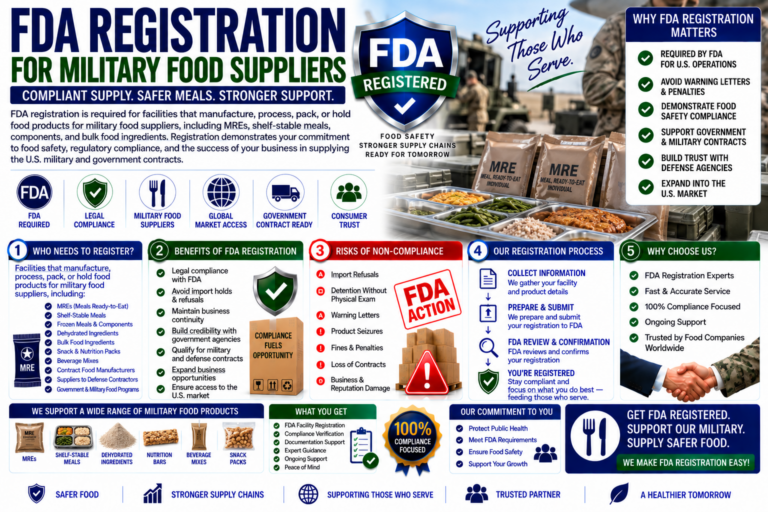
The FDA baseline, plus the three defense-procurement layers — with the Berry Amendment as the make-or-break one.
Key Takeaways
- FDA registration is the baseline — necessary, but not enough to sell to the military.
- Berry Amendment: 100% U.S.-origin food — for DoD-funded troop feeding.
- Foreign suppliers are largely excluded — from troop feeding, by domestic sourcing.
- Seafood is stricter — U.S.-flagged vessels or U.S. waters, processed domestically.
- DLA sanitary approval — listing in the Worldwide Directory under MIL-STD-3006.
- Products meet military specs — specifications or Commercial Item Descriptions.
The Three Military Layers
FDA facility registration makes you a compliant food business — but selling to the military adds a separate defense-procurement stack. All three of these sit on top of the FDA baseline:
| Layer | What it requires | Basis |
|---|---|---|
| Berry Amendment (domestic sourcing) | Food bought with DoD funds must be 100% U.S.-origin — no foreign content | 10 U.S.C. 4862 |
| DLA sanitary approval | Establishment listed in the military's Worldwide Directory, meeting the DoD sanitation standard | VETCOM Cir 40-1 · MIL-STD-3006 |
| Military specifications | Products meet the applicable military specs or Commercial Item Descriptions for the SPV catalogs | DLA SPV program |
The Berry Amendment: Food Must Be American
The Berry Amendment (10 U.S.C. 4862) requires that certain items bought with Department of Defense appropriated funds — food included — be 100% domestic in origin. For covered food purchases there's no foreign content allowed, no percentage threshold, and no price-preference escape: if DoD is buying the food to feed troops, it has to be U.S.-grown and U.S.-produced.
DLA Sanitary Approval & the Worldwide Directory
Establishments and distributors furnishing food under DLA Troop Support contracts are subject to sanitation approval and surveillance by the military medical service. In practice, your facility generally has to be listed in the:
- Worldwide Directory of Sanitarily Approved Food Establishments for Armed Forces Procurement — maintained under Army Veterinary Command Circular 40-1
- Meeting MIL-STD-3006 — the DoD's sanitation requirements for food establishments, verified by audit
- With ongoing surveillance — and a duty to notify the contracting officer if your facility loses its approval or listing
Specs, Rations & the Commissary Difference
Assess Your Path to Military Food Supply
FDA Registration Assistance handles the FDA baseline — facility registration and U.S. Agent, labeling, and process filing for shelf-stable rations — and helps you weigh the defense-procurement layers: whether your food can meet Berry Amendment domestic sourcing (the make-or-break question for foreign suppliers), the DLA sanitary approval and Worldwide Directory pathway, and the military specifications.
Contact us at info@fdaregistrationassistance.com or call +1 (928) 275-8333. Food Facility Registration is available starting at $858. Trusted by companies across 135+ countries, with 15+ years of experience.
Frequently Asked Questions
1. Do military food suppliers need FDA registration?
Yes — a company that manufactures, processes, packs, or holds food to supply the military is a food facility and must be registered with FDA, the same as any food business. But FDA registration is only the baseline. Supplying the U.S. military adds a defense-procurement layer on top: the Berry Amendment, DLA sanitary approval, and military product specifications. Registration alone doesn't make you eligible to sell to the military.
2. What is the Berry Amendment and how does it affect food?
The Berry Amendment (10 U.S.C. 4862) requires that certain items bought with Department of Defense appropriated funds — food included — be 100% domestic in origin. For covered food purchases there's no foreign content allowed, no percentage threshold, and no price-preference escape: if DoD is buying the food for troop feeding, it must be U.S.-grown and U.S.-produced. It's one of the most important, and most surprising, rules in military food supply.
3. Can a foreign company supply food to the U.S. military?
Generally not for troop feeding. Because the Berry Amendment requires food bought with DoD funds to be 100% U.S.-origin, a foreign-produced food usually can't be supplied to the military for troops, regardless of FDA registration. Rare domestic non-availability determinations exist but are hard to get. A foreign company can still register with FDA and pursue the broader U.S. commercial market — but direct DoD troop-feeding contracts are effectively closed to foreign-origin food.
4. Is seafood treated differently under the Berry Amendment?
Yes — seafood is stricter than other foods. It's excluded from the usual Berry exceptions, and seafood for the military generally must come from U.S.-flagged vessels or be harvested from U.S. waters, with processing done domestically as well. So the domestic-sourcing bar for military seafood is even higher than for other food categories, and foreign-caught or foreign-processed seafood is effectively excluded.
5. What is DLA sanitary approval?
Establishments and distributors furnishing food under DLA Troop Support contracts are subject to sanitation approval and surveillance by the military medical service. In practice, your facility generally has to be listed in the military's Worldwide Directory of Sanitarily Approved Food Establishments (maintained under Army Veterinary Command Circular 40-1), which requires compliance with DoD Military Standard 3006, the sanitation requirements for food establishments. Losing that listing has to be reported to the contracting officer.
6. What is the Worldwide Directory and MIL-STD-3006?
The Worldwide Directory of Sanitarily Approved Food Establishments for Armed Forces Procurement lists the facilities cleared to supply subsistence to the military. To be listed, an establishment must meet MIL-STD-3006, the Department of Defense's sanitation requirements for food establishments — verified through audit by the military medical service or an accepted equivalent. Being on the directory is effectively a prerequisite for many military food contracts.
7. Do military food products have to meet special specifications?
Yes. Products supplied to the military generally have to meet military specifications or Commercial Item Descriptions, and items in the Defense Logistics Agency's Subsistence Prime Vendor catalogs must comply with the applicable specs. These cover quality, nutrition, and (for rations) packaging and shelf-life performance. A commercial product often needs adjustment to meet the military's spec before it can be supplied.
8. Are combat rations regulated differently?
Combat rations (like MREs) are typically shelf-stable, thermally processed foods — often in retort pouches — which means they're usually low-acid canned foods requiring FCE registration and a scheduled process, on top of the military specifications and Berry Amendment sourcing. So a ration supplier stacks FDA process filing, defense specs, and domestic sourcing all at once. It's one of the more demanding food-supply categories.
9. Is selling to a base commissary the same as troop feeding?
No — they're different channels. A commissary or exchange sells groceries at retail to military families, and resale products there aren't procured with appropriated funds for troop feeding in the same way, so the Berry Amendment's domestic-sourcing rule generally doesn't apply to commissary resale items. Those products follow standard FDA compliance plus the commissary's own vendor-approval process. Troop-feeding procurement (rations, dining facilities) is where Berry bites hardest.
10. What happens if I falsely certify domestic origin?
It's a serious risk. Falsely certifying that food meets the Berry Amendment's domestic-origin requirement can trigger False Claims Act liability, which carries treble (triple) damages and per-claim penalties, plus contract termination and debarment. DoD periodically audits Berry compliance. Domestic sourcing isn't a box-ticking formality — it has to be genuinely true and documentable through the supply chain.
11. Does registration or DLA listing mean FDA approved my product?
No. FDA doesn't pre-approve food or facilities — registration just puts your facility on record. DLA sanitary listing is a defense-procurement approval, not an FDA approval, and neither certifies your product. You still have to meet all FDA labeling, safety, and (where relevant) process-filing requirements, plus the military's own layered requirements. They're separate systems that both apply.
12. What's the sequence to become a military food supplier?
In broad terms: register your facility with FDA and meet baseline FDA requirements; confirm your food can meet Berry Amendment domestic sourcing (this is the gating question for foreign-origin food); get your establishment sanitarily approved and listed in the Worldwide Directory under MIL-STD-3006; and ensure your products meet the applicable military specifications or CIDs. Confirming domestic sourcing early saves pursuing contracts you can't fulfill.
13. What are the common mistakes for military food suppliers?
Assuming FDA registration alone qualifies you to sell to the military; underestimating the Berry Amendment (especially foreign suppliers pursuing troop-feeding contracts they can't legally fulfill); missing DLA sanitary approval and the Worldwide Directory listing; not meeting the military specification; and treating domestic-sourcing certification casually. Most trace back to seeing only the FDA layer and missing the defense-procurement layers on top.
14. How does FDA Registration Assistance help military food suppliers?
We handle the FDA baseline — facility registration, U.S. Agent, labeling, and process filing for shelf-stable rations — and help you understand the defense-procurement layers: whether your food can meet Berry Amendment domestic sourcing (the key question for foreign suppliers), the DLA sanitary approval and Worldwide Directory pathway, and the military specification requirements. Starting at $858 for registration, for companies across 135+ countries. Contact info@fdaregistrationassistance.com or +1 (928) 275-8333.