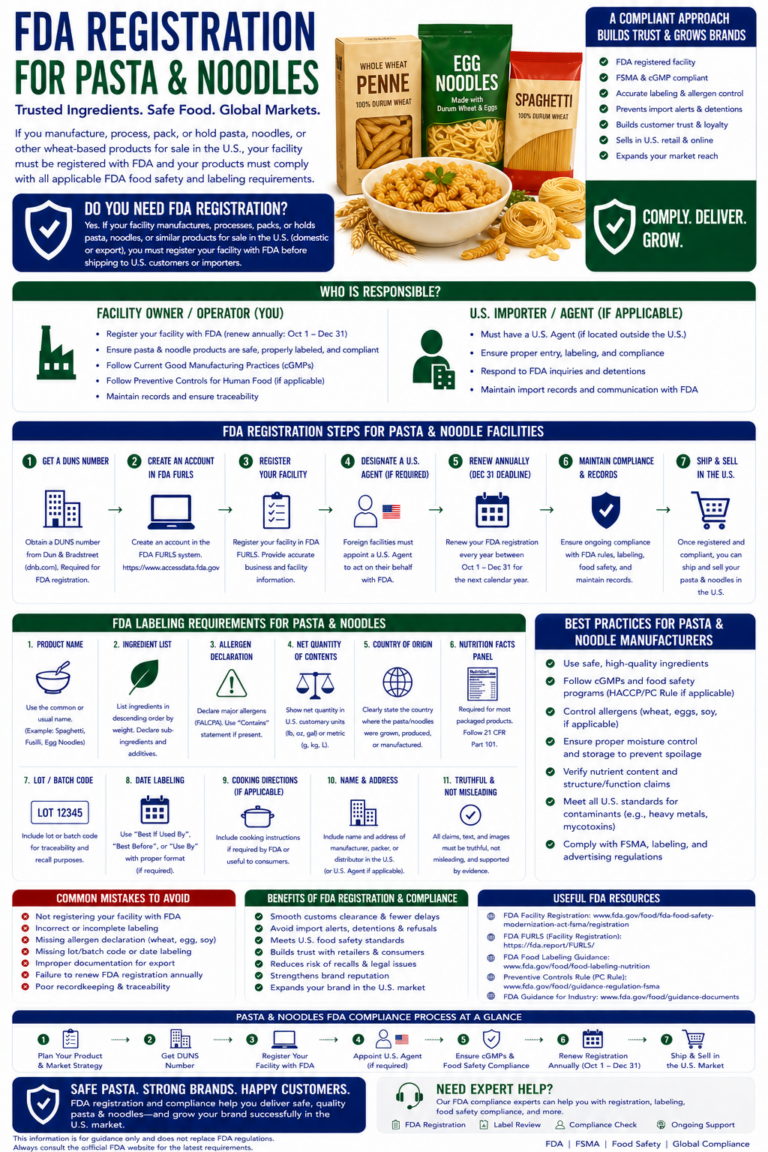
FDA Registration for Pasta & Noodles
The standard-of-identity rules that make pasta different — plus allergens, gluten-free, and dry vs fresh.
Key Takeaways
- Pasta is a standardized category — 21 CFR Part 139 defines the names.
- "Egg noodles" = at least 5.5% egg solids — or you can't use the name.
- "Enriched" means set nutrients — thiamin, riboflavin, niacin, folic acid, iron.
- Gluten-free pastas can't borrow the names — "spaghetti" assumes wheat.
- Dry pasta skips process filing — low-moisture, not LACF or acidified.
- Fresh & refrigerated differ — not shelf-stable, so a different path.
Pasta Names Are Regulated — Standards of Identity
Most foods can be named freely as long as the label isn't misleading. Pasta and noodles are different: they're a standardized category under 21 CFR Part 139, meaning FDA defines what a product called by a certain name must contain. If your product doesn't meet the standard, you can't use the name.
| Standardized name | What it requires |
|---|---|
| Macaroni, spaghetti, vermicelli | Dough of semolina, durum flour, farina, or flour + water; names set by shape and diameter §139.110 |
| Noodles / egg noodles | Not less than 5.5% egg or egg-yolk solids by weight; "noodles" are ribbon-shaped §139.150 |
| Enriched macaroni / noodles | Added thiamin, riboflavin, niacin, folic acid, and iron in set amounts per pound §139.115 / §139.155 |
| Whole wheat macaroni | Made from whole durum or whole wheat flour §139.138 |
| Vegetable noodles (spinach, tomato) | Not less than 3% vegetable solids by weight §139.160 |
"Egg Noodles" Means 5.5% Egg Solids
The most common standard-of-identity issue in this category is egg noodles. To be labeled "noodles" or "egg noodles," the product must contain not less than 5.5% egg or egg-yolk solids by weight (21 CFR 139.150).
And "enriched" is equally specific: enriched macaroni and noodle products must carry set amounts of thiamin, riboflavin, niacin, folic acid, and iron per pound. You can only call a product "enriched" if it actually meets those additions — it's a standardized term, not a marketing flourish.
Gluten-Free Pasta and the Name Problem
Gluten-free pastas — rice, corn, chickpea, lentil — raise a naming issue that catches many brands. The standardized pasta names assume a wheat-based dough (semolina, durum, flour), so a legume or rice product generally doesn't meet the standard of identity for "spaghetti" or "macaroni."
- Name it descriptively — "rice pasta," "chickpea pasta," or a spaghetti-style product, rather than plain "spaghetti"
- "Gluten-free" needs proof — under 20 ppm of gluten (21 CFR 101.91), with cross-contact controlled if you also run wheat pasta
- Watch the enrichment claim — a non-wheat pasta isn't an "enriched" standardized product just because nutrients are added
Dry vs Fresh — and Process Filing
The form your pasta takes changes the compliance path:
Bring Your Pasta & Noodles to Market
FDA Registration Assistance handles facility registration and U.S. Agent, FSVP for imports, and a full label review — including whether your product meets the applicable standard of identity (or is correctly named if it doesn't), enrichment requirements, allergen declarations, and gluten-free claims.
Contact us at info@fdaregistrationassistance.com or call +1 (928) 275-8333. Food Facility Registration is available starting at $858. Trusted by companies across 135+ countries, with 15+ years of experience.
Frequently Asked Questions
1. Do pasta and noodle products need FDA registration?
Yes. Any facility that manufactures, processes, packs, or holds pasta or noodles must be registered with FDA, domestic or foreign, and foreign facilities need a U.S. Agent. As dry products, pasta and noodles generally don't need process filing (FCE/SID), so the main focus is registration, labeling, and — uniquely for this category — the standard-of-identity rules that govern the product names.
2. What is a standard of identity, and why does it matter for pasta?
A standard of identity is an FDA definition that fixes what a food named a certain way must contain. Pasta and noodles are one of the standardized categories — 21 CFR Part 139 — so names like "macaroni," "spaghetti," "egg noodles," and "enriched" aren't just marketing; they have legal composition requirements. If your product doesn't meet the standard, you can't use the name.
3. What makes something legally "egg noodles"?
Under 21 CFR 139.150, noodle products must contain not less than 5.5 percent egg or egg-yolk solids by weight to be labeled "noodles" or "egg noodles." "Noodles" are the ribbon-shaped form. If a product has less than 5.5% egg solids, it can't legally be called egg noodles — it has to be named differently. This is the single most common standard-of-identity issue in the category.
4. What do "macaroni," "spaghetti," and "vermicelli" require?
Under 21 CFR 139.110, macaroni products are made from a dough of semolina, durum flour, farina, or flour with water, and the names distinguish shapes and sizes: macaroni is tube-shaped, spaghetti is cord-shaped within a set diameter range, and vermicelli is thinner cord-shaped. These are defined terms, so using them means meeting the shape and composition the standard sets.
5. What does "enriched" pasta or noodles mean?
Enriched macaroni and noodle products (21 CFR 139.115 and 139.155) must contain specified amounts of added nutrients per pound — thiamin, riboflavin, niacin, folic acid, and iron, each within a defined range. "Enriched" is a standardized claim, not a general one, so a product can only be called enriched if it actually meets those nutrient additions. Folic acid fortification is part of this.
6. Can a gluten-free pasta be called "spaghetti"?
Not straightforwardly. The standardized pasta names assume a wheat-based (semolina/durum/flour) dough, so a rice, corn, or legume "pasta" generally doesn't meet the standard of identity for "spaghetti" or "macaroni." These products are usually named descriptively — "rice pasta," "chickpea spaghetti-style," and so on — to be accurate. It's a naming nuance that catches many gluten-free brands.
7. Do pasta and noodles need process filing (FCE/SID)?
Dried pasta and noodles generally don't — they're shelf-stable because of low moisture, not heat or acid, so they fall outside the low-acid canned and acidified rules. Fresh or refrigerated pasta isn't shelf-stable and follows a different path with its own controls, and some filled or specialty products may raise other questions. But standard dry pasta usually avoids the process-filing burden.
8. What allergens matter for pasta and noodles?
Wheat is the primary one for traditional pasta, and egg for egg noodles and many fresh pastas. Depending on flavorings, sauces, or seasoning packets (in instant noodles), soy and others can appear. All major allergens present must be declared clearly, and any hidden in compound ingredients — like a seasoning sachet — have to be broken out.
9. Can I label my pasta "gluten-free"?
Only if it meets FDA's gluten-free standard of under 20 ppm of gluten. For a naturally wheat-free pasta (rice, corn, legume), that's usually achievable, but cross-contact in a facility that also handles wheat pasta has to be controlled and verified. And remember the naming point: gluten-free pastas generally can't use the standardized wheat-based names.
10. Do fresh and refrigerated pastas have extra requirements?
Yes. Fresh and refrigerated pastas aren't shelf-stable, so they rely on refrigeration and their own food-safety controls rather than the dry-goods approach. Filled fresh pastas (with meat or cheese) can raise additional considerations, and a meat filling above a threshold could even bring USDA into the picture. The category is broader than dried pasta alone.
11. Do imported pasta and noodles need FSVP?
Yes. If imported, the U.S. importer holds FSVP and must verify the foreign supplier meets U.S. standards, with records available to FDA. Imported pasta also has to meet the same standard-of-identity and labeling rules — a product labeled "egg noodles" abroad still needs to meet the 5.5% egg-solids standard to carry that name in the U.S.
12. Does registration mean FDA approved my pasta?
No. FDA doesn't pre-approve food or facilities — registration just puts the facility on record. It doesn't certify that your product meets a standard of identity, that your enrichment is correct, or that your claims are supported; those remain your responsibility. Registering is one required step, not an approval.
13. How long does it take to get pasta or noodles compliant?
There's no single fixed number — registration is quick, and because dry pasta usually doesn't need process filing, the timeline is driven mostly by getting the standard of identity, enrichment, allergens, and claims right on the label. Confirming your product meets (or is correctly named outside) the applicable standard is the piece worth doing first.
14. How does FDA Registration Assistance help pasta and noodle brands?
We handle facility registration and U.S. Agent, FSVP for imports, and a full label review — including whether your product meets the applicable standard of identity (or is correctly named if it doesn't), enrichment requirements, allergen declarations, and gluten-free or other claims. Starting at $858 for registration, for companies across 135+ countries. Contact info@fdaregistrationassistance.com or +1 (928) 275-8333.