FDA Registration for Private Label Food Brands
This guide breaks down exactly who registers, who is responsible for what across the supply chain, what changes when your product is imported, and the labeling rules that sit squarely on you as the brand.
Who Actually Registers — You or Your Co-Packer?
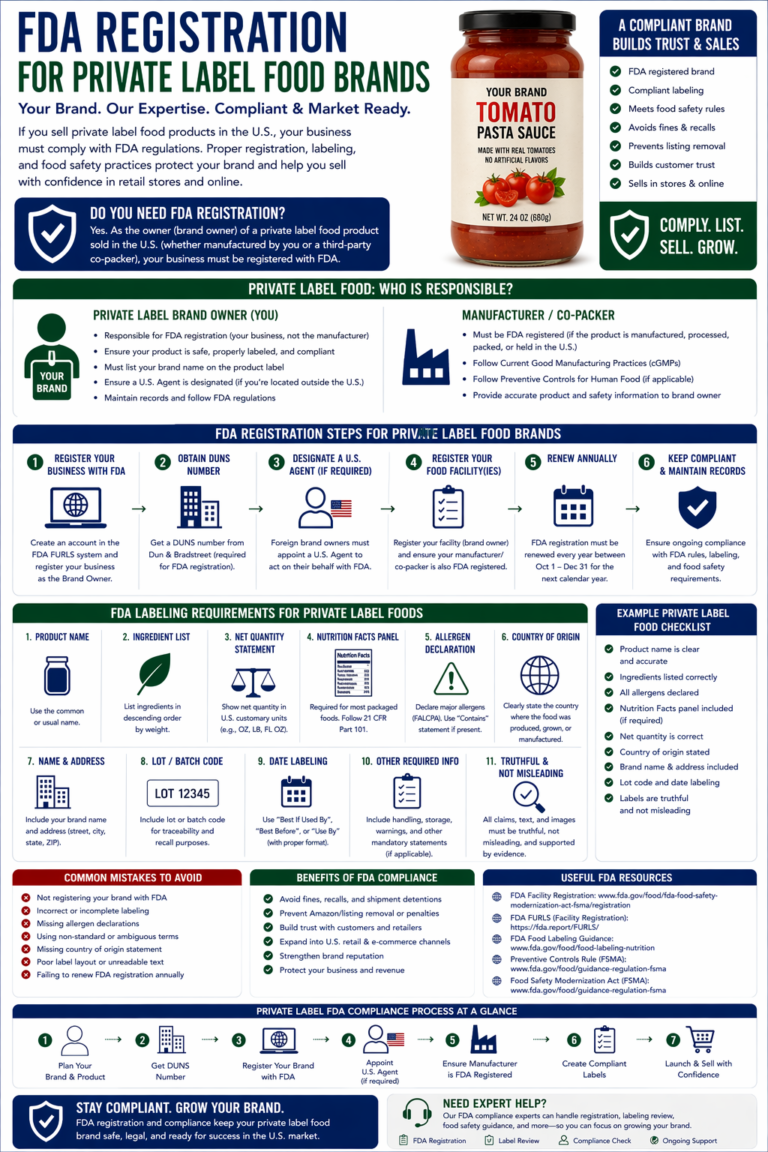
FDA food facility registration attaches to the facility, not the brand. That single fact decides most private-label questions.
Your co-packer / manufacturer
Manufactures, processes, packs, or holds the food, so it must register under 21 CFR Part 1 Subpart H and follow its food-safety plan. A foreign co-packer also needs a U.S. Agent. Always verify this registration is current.
You, the brand owner
If you only handle branding, marketing, and sales, you typically do not register a facility. You do own the label and its claims. The exception: if you operate a warehouse that holds finished product, that holding facility must register.
Who's Responsible for What
Three roles, three sets of duties. Gaps appear where the parties assume someone else has it covered.
What Changes When Your Private-Label Product Is Made Abroad
Imported private-label products carry three extra obligations that domestic ones do not. Each is checked at the border.
Labeling — the Part That's Squarely on the Brand
Because your name is on the package, label compliance is yours, even though the co-packer made the product. These are the elements that must be right under 21 CFR Part 101.
How We Support Private-Label Brands
We work the parts that are yours and coordinate the parts that are your co-packer's, scoped to your role rather than a one-size package.
Label & claim review
Ingredient list, Nutrition Facts, allergens, net quantity, responsible-firm statement, and “natural / healthy” claims checked against the actual formula.
Co-packer registration check
Verify your manufacturer's FDA registration is active and valid — and complete it if a facility you operate needs to register.
U.S. Agent for a foreign co-manufacturer
U.S. Agent service so your overseas facility has a compliant U.S. point of contact.
FSVP & Prior Notice for imports
Build the importer-side FSVP program and keep Prior Notice filed correctly for every shipment.
The underlying rules live in 21 CFR Part 101 (labeling) on eCFR and in 21 CFR Part 1 (registration, Prior Notice, and FSVP).
Launch Your Private-Label Brand With Confidence
Getting compliance right from the start — the right registration, a correct label, and FSVP and Prior Notice for imports — is the cheapest insurance against a detained shipment or a pulled listing. Trusted by 1,000+ companies across 135+ countries, with 15+ years of FDA regulatory experience. Email info@fdaregistrationassistance.com or call +1 (928) 275-8333.
Frequently Asked Questions — Private Label Food Brands & the FDA
Do private label food brands need FDA registration?
Usually not the brand owner itself — unless you operate a facility that manufactures, processes, packs, or holds the food. The facility that produces the product (your co-manufacturer or co-packer) must register under 21 CFR Part 1 Subpart H. If you also run your own warehouse that stores finished product, that holding facility must register too.
So who actually has to register — me or my co-packer?
The co-packer or contract manufacturer — the facility doing the work — registers. As a brand owner who only handles branding, marketing, and sales, you typically do not register a facility. The key exception is holding: if you store finished product at a facility you operate, that triggers registration on your side.
Who is responsible for compliance in a private-label arrangement?
Responsibility is shared. The manufacturer handles facility registration and food-safety controls; you, the brand owner, own label accuracy and claims; and if the product is imported, the U.S. importer owns FSVP and Prior Notice. All three roles must coordinate — no single party covers everything.
My manufacturer says they “handle compliance.” Is that enough?
No. Manufacturers handle their own facility registration and food-safety plan, but the label on the package — carrying your brand name — is your legal responsibility, and FSVP and Prior Notice for imports sit with the importer. Relying on “they handle it” is the most common private-label compliance failure.
Should I verify my co-packer's FDA registration?
Yes. Confirm the facility holds a current, active FDA food facility registration and ask for its status. A lapsed or invalid registration at your co-packer can stop your product at import or sale, even when your own paperwork is perfect.
What name and address go on a private-label label?
The label must show the name and place of business of the manufacturer, packer, or distributor. If your brand — rather than the actual manufacturer — is named, you must qualify it with a phrase such as “Manufactured for …” or “Distributed by …” under 21 CFR 101.5(d).
What must a compliant private-label food label include?
An accurate ingredient list (21 CFR 101.4), a Nutrition Facts panel unless exempt (101.9), clear allergen declarations, an accurate net-quantity statement, and the responsible firm's name and address. The FDA does not pre-approve labels — see FDA food label regulations for the full set.
Which allergens must be declared on a private-label food?
The nine major allergens: milk, eggs, fish, crustacean shellfish, tree nuts, peanuts, wheat, soybeans, and sesame, which became the ninth on January 1, 2023. Private-label products frequently miss sesame or an allergen introduced by the co-packer's formulation that the brand owner was unaware of.
Can I use “natural,” “healthy,” or “organic” on my private-label food?
Carefully. “Natural” follows the FDA's longstanding policy (no added color, artificial, or synthetic ingredients) and is not formally defined; “healthy” now has an updated FDA regulatory definition with nutrient criteria; and “organic” is governed by the USDA, not the FDA. Unsupported claims are a common reason private-label products are flagged.
Do I need FSVP for an imported private-label product?
Yes. If your product is manufactured outside the U.S., the U.S. importer must run a Foreign Supplier Verification Program (FSVP) — verifying the foreign supplier meets U.S. food-safety standards and keeping records available for FDA inspection. This applies even when you work with an experienced overseas manufacturer.
Does an imported private-label shipment need Prior Notice?
Yes. Every imported food shipment, including private-label products, requires FDA Prior Notice before it arrives at the U.S. port. Missing or incorrect Prior Notice causes holds, port delays, or refusal of entry — and it is separate from FSVP and from facility registration.
Does my foreign co-manufacturer need a U.S. Agent?
Yes. A foreign facility that registers with the FDA must designate a U.S. Agent as its U.S. point of contact. If your private-label product is made abroad, that facility needs both an active registration and a U.S. Agent on file.
Do imported private-label foods follow U.S. labeling rules?
Yes. Imported products must meet the same FDA labeling requirements as domestic ones — there are no exceptions for format, language, Nutrition Facts, or allergen declaration. Foreign labels usually need to be reworked for the U.S. market before import.
What are the most common private-label compliance problems?
Ingredient lists that do not match the co-packer's actual formulation, missing or inconsistent allergen declarations, unsupported “natural” or “healthy” claims, foreign labels that do not meet U.S. format, and assuming the manufacturer covers everything — see common mistakes in FDA food registration.
Is a label review mandatory?
A formal review is not legally required, but label compliance itself is — and because you own the label as the brand, a review is a reliable way to catch ingredient, allergen, Nutrition Facts, and claim errors before a costly production run or an import hold.
What happens if my private-label product is not compliant?
Shipments can be detained, delayed, or refused; you may have to relabel, recall, or provide additional documentation; and marketplaces can remove non-compliant listings. The cost of fixing problems after production usually far exceeds the cost of getting the label and registrations right first.
If I switch co-packers, does anything change?
Yes. A new co-packer means a different registered facility, a potentially different formulation and allergen profile, and a label that may need updating. Verify the new facility's registration and re-check your label against the new formula before the first run.
Do private-label dietary supplements have extra rules?
Yes. Supplements carry additional requirements — a Supplement Facts panel, DSHEA structure/function claim rules with the required disclaimer, and specific ingredient and labeling rules — on top of facility registration for the manufacturer. Treat a private-label supplement as its own category, not as a standard food.
Do I need a DUNS number?
A DUNS Number is required as the Unique Facility Identifier to register a food facility with the FDA. If you operate a facility that must register, you will need one — see DUNS request assistance. The DUNS request is handled separately from the registration, and its fees are separate.
How does selling on Amazon or other marketplaces affect this?
Marketplaces increasingly verify FDA compliance and can suppress listings for a missing registration, absent FSVP, or label problems — see FDA compliance for Amazon food sellers. The same rules apply regardless of channel.
Can the FDA hold the brand owner responsible even though a co-packer made the product?
Yes. The firm whose name appears on the label is accountable for the product's labeling and can face enforcement for misbranding, regardless of who manufactured it. Outsourcing production does not shift label responsibility away from the brand owner.
How long does it take to become compliant?
Many steps — verifying the manufacturer's registration, designating a U.S. Agent, and reviewing the label — can be completed within a few business days once information is provided. Building out an FSVP program or correcting a label can take longer depending on the gaps found.
Do I need to register if I only import and re-sell under my brand?
As an importer who does not manufacture, process, pack, or hold the food, you generally do not register a facility — but you do carry FSVP and Prior Notice obligations, and the foreign manufacturing facility must be registered with a U.S. Agent. See importing human foods into the U.S..
What records should a private-label brand keep?
Your co-packer's current registration details, the agreed formulation and specifications, label artwork versions and approvals, allergen and claim substantiation, and — for imports — FSVP records. Keeping these aligned prevents the label-versus-formula mismatches that cause refusals.
How do I get my private-label products reviewed?
Contact FDA Registration Assistance with your product, where it is manufactured, and whether it is imported. Reach our team and we verify the manufacturer's registration, set up U.S. Agent and FSVP coverage where needed, and review your label and claims. Email info@fdaregistrationassistance.com or call +1 (928) 275-8333.