FDA Registration for Salmon Products
Salmon products are among the most heavily regulated seafood imports entering the United States. Whether fresh, frozen, smoked, vacuum-sealed, or processed, salmon falls under strict oversight by the U.S. Food and Drug Administration due to food safety risks such as parasites, bacterial contamination, and environmental pollutants.
If you are manufacturing, exporting, or importing salmon products into the U.S., full FDA compliance is essential. Even minor mistakes in documentation, labeling, or supplier verification can result in shipment delays, detention, or refusal at the port of entry.
Understanding FDA Requirements for Salmon Products
The FDA does not “approve” salmon products before they enter the United States. Instead, responsibility is placed on importers and manufacturers to ensure that all regulatory requirements are met prior to shipment.
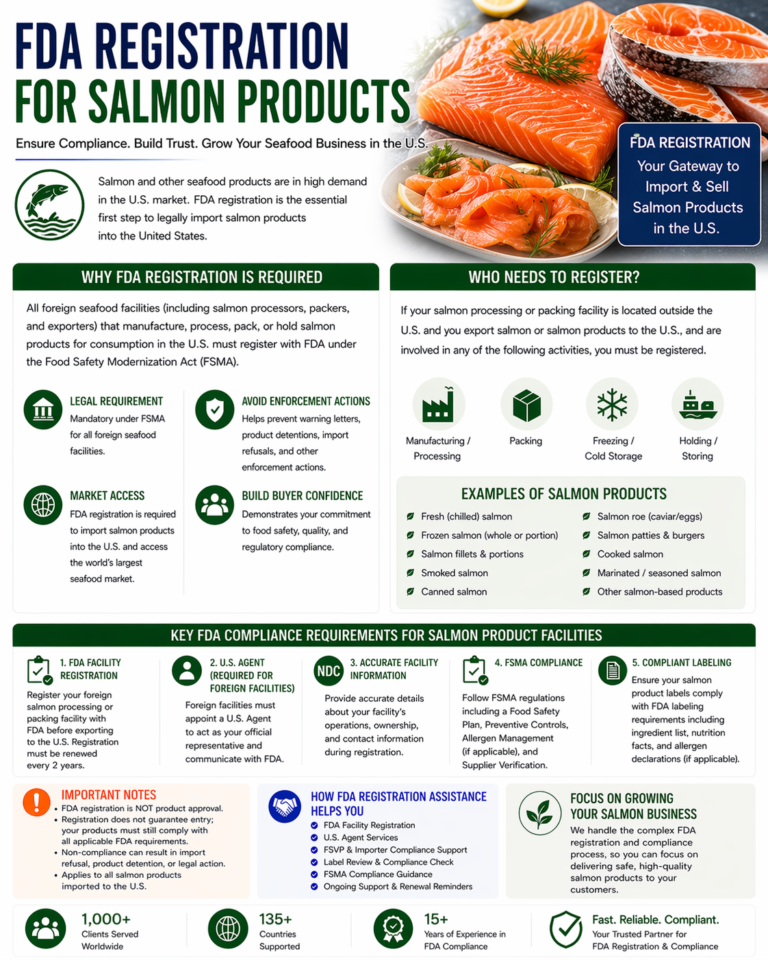
Any facility involved in processing, packaging, storing, or distributing salmon products must be registered with the FDA. Foreign facilities are also required to designate a U.S. Agent who serves as the official point of contact with the FDA.
In addition, all shipments must be submitted through Prior Notice before arrival, providing the FDA with full visibility into incoming food products.
Why Salmon Products Are Closely Monitored
Salmon is considered a high-risk food product due to biological and chemical hazards. These include parasites in raw fish, Listeria contamination in smoked salmon, and environmental contaminants such as mercury or PCBs.
Because of these risks, the FDA places strong emphasis on preventive controls and supplier verification. Salmon shipments are frequently examined and may be subject to detention without physical examination if compliance concerns arise.
This makes it critical to ensure all regulatory requirements are fully addressed before importing or distributing salmon products in the U.S.
Key FDA Requirements for Salmon Compliance
To legally import or distribute salmon products in the United States, several core FDA requirements must be met.
All facilities must maintain an active FDA Food Facility Registration.
Foreign facilities must designate a valid U.S. Agent.
Importers must have a fully compliant Foreign Supplier Verification Program (FSVP).
Salmon processors must operate under Seafood HACCP regulations.
Product labeling must meet FDA standards, including identity, net quantity, and country of origin.
Prior Notice must be filed before shipment arrival.
Failure to meet any of these requirements can result in shipment delays, detention, or refusal.
Seafood HACCP and Salmon Products
Seafood HACCP is a mandatory FDA regulation that applies to all fish and fishery products, including salmon. It requires processors to identify potential hazards such as parasites, pathogens, and chemical contaminants, and implement controls to prevent them.
For example, raw salmon intended for consumption must be properly frozen to eliminate parasites, while smoked salmon must control for Listeria monocytogenes.
Without a compliant HACCP plan, salmon shipments are at high risk of FDA enforcement actions.
FSVP: A Critical Requirement for Salmon Importers
FSVP is one of the most important FDA requirements for salmon importers. It places responsibility on the U.S. importer to verify that the foreign supplier is producing salmon products in accordance with FDA safety standards.
This includes reviewing HACCP plans, evaluating supplier performance, maintaining documentation, and conducting ongoing verification activities.
Many salmon import issues arise from incomplete or poorly maintained FSVP programs, making it essential to get this right from the start.
Common Compliance Issues with Salmon Products
Salmon products often face regulatory challenges due to their complexity.
Smoked salmon is particularly sensitive due to Listeria risks.
Raw salmon products must address parasite destruction requirements.
Improper temperature control during transportation can lead to spoilage concerns.
Labeling errors, especially regarding product identity and processing method, are common causes of delays.
Working with non-compliant suppliers is another major risk that can lead to shipment refusals.
Our Process for Salmon Product Compliance
FDA Registration Assistance provides a complete compliance solution for salmon importers and manufacturers.
We ensure your FDA Food Facility Registration is properly completed and maintained.
We act as your U.S. Agent, handling all FDA communications.
We develop and manage your FSVP program to ensure full compliance.
We review your product labels to meet FDA requirements.
We guide your shipments to minimize risk and ensure smooth entry into the U.S.
Why Choose FDA Registration Assistance
When dealing with high-risk products like salmon, experience matters.
FDA Registration Assistance has supported over 1,000 clients across 135+ countries, with more than 15 years of combined regulatory experience.
We understand the complexities of seafood compliance and provide end-to-end support to help you avoid costly delays and keep your business moving forward.
Frequently Asked Questions (FAQs)
Do salmon products require FDA approval before import?
No, salmon products do not require FDA approval prior to import. However, they must fully comply with all FDA regulations, including Food Facility Registration, HACCP, FSVP, labeling, and Prior Notice. Non-compliance can result in shipment refusal.
Is FDA registration required for salmon processors?
Yes, any facility involved in processing, packing, or holding salmon must be registered with the FDA. This applies to both domestic and foreign facilities.
What is HACCP and why is it required for salmon?
HACCP is a preventive food safety system required for all seafood products. It identifies hazards such as parasites, bacteria, and contaminants and ensures they are controlled during processing.
What is FSVP for salmon importers?
FSVP requires importers to verify that their foreign suppliers meet FDA food safety standards. It includes reviewing HACCP plans, supplier documentation, and maintaining compliance records.
Do smoked salmon products have additional requirements?
Yes, smoked salmon must address Listeria risks through strict controls, making compliance more complex than other salmon products.
Is Prior Notice required for salmon shipments?
Yes, Prior Notice must be submitted to the FDA before all food shipments arrive in the U.S.
Can salmon shipments be detained by the FDA?
Yes, salmon shipments are frequently targeted for inspection and may be detained if compliance issues are suspected.
Do I need a U.S. Agent for salmon imports?
Yes, foreign facilities must designate a U.S. Agent to communicate with the FDA.
What happens if my salmon shipment is refused?
Refused shipments must be destroyed or exported, resulting in financial losses and delays.
Is labeling important for salmon products?
Yes, labeling must clearly identify the product, processing method, and country of origin. Errors can cause shipment delays.
Do frozen salmon products still require HACCP?
Yes, all salmon products, including frozen, must comply with HACCP regulations.
How long does FDA registration take?
Typically 24–48 hours once all required information is submitted.
Do I need a DUNS number?
Yes, a DUNS number is required for FDA Food Facility Registration.
Can I import salmon from any country?
Yes, but certain countries may have additional scrutiny or restrictions based on compliance history.
Can one compliance mistake delay my shipment?
Yes, even small errors can result in detention or refusal, making proper compliance essential.
Start Importing Salmon Products with Confidence
If you are planning to import or distribute salmon products in the United States, the best step you can take is ensuring your compliance is handled correctly from the beginning.
FDA Registration Assistance provides full-service support, including FDA registration, U.S. Agent services, FSVP development, and label compliance, so your shipments move smoothly without delays or regulatory issues.
Contact FDA Registration Assistance today at info@fdaregistrationassistance.com or call +1-928-275-8333 to get started.