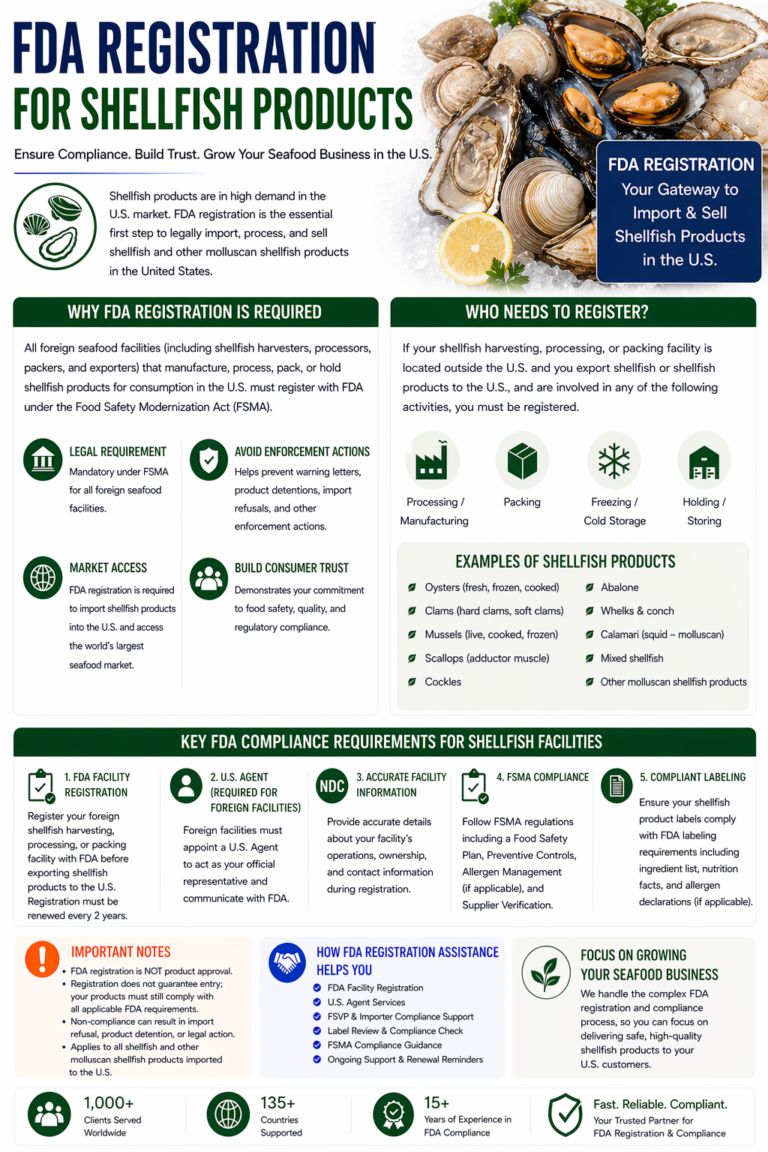
FDA Registration for Shellfish Products
This guide covers registration for every shellfish form, mandatory Seafood HACCP, the NSSP approved-source rule that blocks unapproved bivalve imports, the crustacean-vs-molluscan allergen distinction, why farmed shrimp is detained so often, and FSVP and Prior Notice for importers.
What Applies to Each Shellfish Product Form
| Product Form | FDA Registration | Seafood HACCP | NSSP (molluscan) | FCE & SID (LACF) | Key Hazard |
|---|---|---|---|---|---|
| Live bivalves in shell (oysters, clams, mussels) | Required | Required | Required | Not required | Vibrio, biotoxins (PSP/ASP/NSP/DSP), approved source |
| Shucked / frozen molluscan meat | Required | Required | Required | Not required | Biotoxins, harvest-area contamination, tagging |
| Live / raw crustaceans (shrimp, crab, lobster) | Required | Required | Not applicable | Not required | Vibrio, decomposition; drug residues (farmed shrimp) |
| Cooked ready-to-eat crustacean meat | Required | Required | Not applicable | Not required | Listeria monocytogenes, post-cook contamination |
| Shelf-stable canned shellfish (crab, clams, oysters) | Required | Required | Source rules still apply (molluscan) | FCE + SID Required (LACF) | C. botulinum (low-acid canned) |
Crustacean vs. Molluscan Shellfish
Both groups need registration and Seafood HACCP, but the controls and the label obligations diverge sharply. Knowing which group your product is in determines what you must do.
Crustaceans — shrimp, crab, lobster
Seafood HACCP applies; no NSSP. Hazards include Vibrio, decomposition, Listeria in cooked meat, and aquaculture drug residues in farmed shrimp. Crustacean shellfish is one of the nine FALCPA major allergens and must be declared on the label. See our crab & lobster guide.
Molluscan — oysters, clams, mussels, scallops
Seafood HACCP plus the NSSP regime: approved harvest waters, certified dealers, tagging, and approved-source-country rules for imports. Hazards center on biotoxins and Vibrio. Molluscan shellfish is NOT a FALCPA major allergen, though many declare it voluntarily.
Imported Oysters, Clams & Mussels Need an Approved Source
For molluscan shellfish, registration and HACCP are not enough. Under the NSSP and 21 CFR 123.28, bivalve molluscan shellfish must come from a controlled, approved source — and that includes the exporting country itself.
If you are sourcing molluscan shellfish abroad, confirming the country's approved status and the dealer's certification is the first step — before any shipment is arranged.
Aquaculture Drug Residues & Import Alerts
Farmed shrimp is one of the most frequently detained seafood products at the U.S. border. The reason is chemical, not microbial.
For shrimp importers, antibiotic testing and tight supplier control are the core of an effective FSVP, and the way to stay off — or get off — an import alert.
How to Register a Shellfish Facility With FDA
| Step | What Happens |
|---|---|
| 1. Facility & DUNS | Confirm the facility details and obtain the DUNS Number (the required Unique Facility Identifier; fees separate). |
| 2. Registration + U.S. Agent | File the food facility registration under 21 CFR Part 1 Subpart H; foreign facilities designate us as U.S. Agent. Typically 24–48 hours. |
| 3. Seafood HACCP | Develop or review the HACCP plan for your species and product form under 21 CFR Part 123. |
| 4. Source & import setup | For bivalves, confirm approved-source eligibility; for importers, build FSVP and set up Prior Notice. For canned shellfish, file FCE & SID. |
The governing rules are at 21 CFR Part 123 (Seafood HACCP) on eCFR, with registration, Prior Notice, and FSVP in 21 CFR Part 1.
Get Your Shellfish Products FDA-Compliant
From a single oyster lot to a full shrimp import program, we handle registration, U.S. Agent service, Seafood HACCP, FSVP, and approved-source verification so your shipments clear instead of sitting at the port. Trusted by 1,000+ companies across 135+ countries, with 15+ years of FDA regulatory experience. Email info@fdaregistrationassistance.com or call +1 (928) 275-8333.
Frequently Asked Questions — FDA Registration for Shellfish Products
Do shellfish products require FDA registration?
Yes. Any facility that processes, packs, stores, or holds shellfish for U.S. consumption must register with the FDA under 21 CFR Part 1 Subpart H, and all seafood processors must operate under mandatory Seafood HACCP under 21 CFR Part 123. The FDA charges $0 to register; our complete service is $858.
What counts as “shellfish” to the FDA?
Two groups: crustaceans (shrimp, crab, lobster, crayfish) and molluscan shellfish (oysters, clams, mussels, scallops). Both are seafood under Seafood HACCP, but molluscan shellfish carry an extra layer of controls under the National Shellfish Sanitation Program (NSSP).
How does regulation differ between crustaceans and molluscan shellfish?
Both need facility registration and a Seafood HACCP plan. Molluscan shellfish (bivalves) add the NSSP regime: approved harvest waters, certified shippers, tagging, and — critically for imports — sourcing only from countries with an FDA agreement. Crustaceans do not go through NSSP but face their own hazards such as Vibrio and aquaculture drug residues.
Can I import oysters, clams, or mussels from any country?
No. This is the single biggest molluscan-shellfish issue. Fresh and frozen bivalve molluscan shellfish may generally only be imported from countries that have a Memorandum of Understanding (MOU) or equivalent agreement with the FDA and appear on the approved list, shipped by certified dealers. Bivalves from non-listed sources are refused at entry.
What is the NSSP and when does it apply?
The National Shellfish Sanitation Program governs molluscan (bivalve) shellfish — oysters, clams, mussels, and scallops, whether in the shell or shucked. It sets harvest-area classification, certified-dealer, tagging, and traceability requirements. It does not apply to crustaceans such as shrimp, crab, and lobster.
Does shellfish require a Seafood HACCP plan?
Yes. Every shellfish processor must have a written HACCP plan under 21 CFR Part 123 that identifies and controls the species- and process-specific hazards. There is no exemption for frozen, live, or “simple” products.
What hazards do shellfish HACCP plans control?
For molluscan shellfish: pathogens such as Vibrio, harvest-water biotoxins (paralytic, amnesic, neurotoxic, and diarrhetic shellfish poisoning), and harvest-area contamination. For crustaceans: Vibrio, time-temperature abuse and decomposition, Listeria in cooked ready-to-eat meat, and aquaculture drug residues in farmed shrimp.
Is shellfish a food allergen that must be declared?
Crustacean shellfish (shrimp, crab, lobster) is one of the nine major allergens and must be declared on the label. Molluscan shellfish (clams, oysters, mussels, scallops) is NOT a FALCPA major allergen, although many companies declare it voluntarily. Getting this distinction right on the label matters.
Why is imported shrimp so often detained?
Farmed shrimp is a frequent target for aquaculture drug residues — nitrofurans, chloramphenicol, and similar banned veterinary drugs — which drive import alerts and detention without physical examination (DWPE) for certain producers and countries. Antibiotic testing and supplier control are central to shrimp FSVP — see import refusal & detention help.
Do shellfish importers need FSVP?
Yes. The U.S. importer must run a Foreign Supplier Verification Program (FSVP) under 21 CFR Part 1 Subpart L, verifying the foreign supplier controls the relevant hazards — biotoxins and approved sourcing for bivalves, drug residues for shrimp — and keeping the records available for FDA inspection.
Is Prior Notice required for shellfish shipments?
Yes. Every imported shellfish shipment requires FDA Prior Notice before arrival at the U.S. port. For molluscan shellfish, the shipment must also trace back to an approved, certified source, or it will be refused regardless of Prior Notice.
Does a foreign shellfish facility need a U.S. Agent?
Yes. A foreign facility that registers with the FDA must designate a U.S. Agent as its U.S. point of contact. For molluscan shellfish, the foreign dealer must also be certified under the exporting country's NSSP-equivalent program.
What labeling applies to shellfish?
Accurate species or market name from the FDA Seafood List, ingredient and net-quantity statements, the crustacean-shellfish allergen declaration where applicable, and the responsible firm's name and address. Molluscan shellfish in the shell or shucked must also carry harvest tags or labels showing the source and date.
What is shellfish tagging and why does it matter?
Molluscan shellfish must carry a durable tag identifying the harvester or dealer, the harvest location, and the date, kept through the distribution chain. Missing or incomplete tags are a leading cause of molluscan-shellfish rejection at both retail and import.
Do canned or shelf-stable shellfish have extra requirements?
Yes. Shelf-stable canned shellfish — such as canned crab, clams, or oysters — are low-acid canned foods. The facility must also obtain an FCE number and file SID information under 21 CFR Part 113, on top of registration and HACCP — see requirements for low-acid canned foods.
Are crab and lobster covered here too?
Yes — crab and lobster are crustacean shellfish covered by the same Seafood HACCP and registration rules. For the crustacean-specific detail (Listeria in cooked crab meat, canned-crab LACF, species naming), see our crab & lobster registration guide.
Does the FDA approve shellfish before import?
No. The FDA does not approve or pre-clear shellfish. The burden is on the importer and the supply chain to be registered, HACCP-compliant, sourced from an approved area (for bivalves), and properly documented — all verified at the border rather than approved in advance.
What happens if my shellfish shipment is refused?
Refused shipments must be re-exported or destroyed within the allowed window, at the importer's cost, and the firm or product may be added to an import alert that subjects future shipments to DWPE. Correct sourcing and documentation up front is far cheaper than a refusal.
Do live and raw shellfish still need HACCP?
Yes. Live and raw shellfish need a HACCP plan just as much as cooked product. The hazards differ — Vibrio and biotoxins dominate for raw and live shellfish — but the requirement to have a compliant plan is the same.
How long does FDA facility registration take?
Typically 24 to 48 hours once we have your facility information. Building the HACCP plan, the FSVP, and — for bivalves — confirming approved-source eligibility take additional time depending on your products and suppliers.
Do I need a DUNS number for shellfish registration?
Yes. A DUNS Number is the required Unique Facility Identifier for FDA food facility registration. DUNS fees are separate from our $858 service — see DUNS request assistance.
What does the $858 cover?
Our $858 service covers your FDA food facility registration, including U.S. Agent service and biennial renewal management. The FDA itself charges $0 for registration. HACCP plan development, FSVP, FCE and SID for canned products, and the DUNS request are scoped separately.
Do domestic shellfish facilities have the same rules?
Domestic processors register with the FDA and follow Seafood HACCP and, for bivalves, NSSP through their state shellfish-control authority. They do not need a U.S. Agent (that is a foreign-facility requirement) or FSVP (an importer requirement), but registration and HACCP still apply.
Can one compliance gap delay my shellfish shipment?
Yes. A lapsed registration, missing Prior Notice, an unapproved bivalve source, a drug-residue hit on shrimp, or incomplete FSVP can each hold or refuse a shipment. Shellfish is one of the most scrutinized seafood categories at the U.S. border.
How do I get my shellfish products FDA-compliant?
Contact FDA Registration Assistance with your species, your product form (live, raw, cooked, or canned), and whether you import or process domestically. Reach our team and we handle registration ($858), U.S. Agent service, HACCP, FSVP, and source verification. Email info@fdaregistrationassistance.com or call +1 (928) 275-8333.