
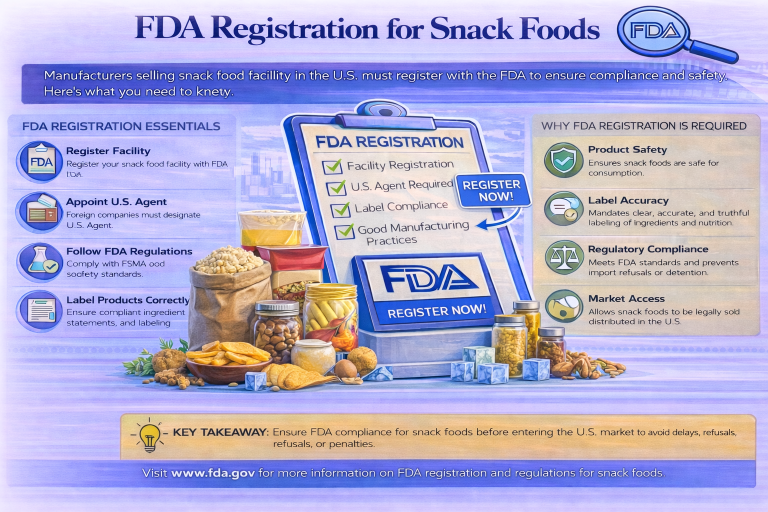
FDA Registration for Snack Foods
This guide covers FDA registration for snack foods, the different RACC serving sizes by snack type, the dense snack allergen profile and sesame, acrylamide in fried and baked snacks, the protein-bar claims and dietary-supplement line, additive declarations, and the most common import problems.
Each Snack Type Has Its Own Serving Size (RACC)
A bag of chips, a granola bar, and a trail mix are all “snack foods,” but FDA assigns each a different Reference Amount Customarily Consumed (RACC) under 21 CFR 101.12 — and the Nutrition Facts serving size must use the right one. Imported snacks routinely use a per-100g or whole-bag format, which is a labeling violation.
| Snack Type | RACC | Notes |
|---|---|---|
| Chips / Crisps / Pretzels / Popcorn | 30 g | Salty snacks |
| Crackers | 30 g | Including flatbread crackers |
| Granola / Cereal / Snack Bars | 40 g | Includes most protein bars |
| Trail Mix / Nuts / Seeds | 30 g | Aflatoxin & Salmonella concerns |
| Dried Fruit Snacks | 40 g | Low-moisture |
| Jerky / Meat Snacks | 30 g | May be USDA jurisdiction by species |
Snacks Are Allergen-Dense, and Coatings Hide Allergens
Acrylamide and the Protein-Bar Claims Line
Acrylamide in Fried & Baked Starchy Snacks
Acrylamide forms in starchy foods cooked at high temperatures — potato chips, fried potato/corn snacks, crackers, baked snacks. FDA has issued guidance to reduce it, and it’s listed under California Proposition 65 (which can require a warning for products sold in California). There’s no FDA maximum, but importers of fried and baked starchy snacks should be aware of both the FDA guidance and Prop 65 — a snack-specific chemical issue competitor pages never mention.
Protein Bars & Functional Snacks — The Claims Risk
“High protein” / “good source of fiber” are nutrient content claims (21 CFR 101.13, 101.54) with strict thresholds. “Supports energy” / “helps build muscle” are structure/function claims needing substantiation. “Boosts immunity to prevent illness” is a disease claim that can make the product an unapproved drug. And some bars are positioned as dietary supplements — which use a Supplement Facts panel and different rules entirely.
Safety Hazards and Ingredient Declarations
Aflatoxin
Peanut, nut, and corn-based snacks can carry aflatoxin. FDA action level: 20 ppb total aflatoxins. A chemical hazard for FSVP on nut and corn snacks.
Salmonella (low-moisture)
Salmonella survives (without growing) in nuts, seeds, and low-moisture snacks — ready-to-eat, no kill step before eating. A documented recall/outbreak cause.
Additives & PHOs
Antioxidants (BHA, BHT, TBHQ) declared with function; colors by FDA name (not E-numbers); MSG declared. Partially hydrogenated oils are no longer GRAS — must not be present.
How to Register a Snack Food Facility with FDA
Snack Label & Claims Review
We review snack labels for: the correct RACC serving size for your snack type; allergen declarations including sesame and hidden coating allergens; nutrient content claims (“high protein,” “baked not fried”); the conventional-food vs. dietary-supplement classification for bars; preservative and color declarations; and 2020 Nutrition Facts format. See our full food label regulations guide.
FSVP for Snack Importers
U.S. snack importers must maintain FSVP. We build programs focused on the real snack hazards: undeclared allergens (primary), aflatoxin in nut/corn snacks, Salmonella in low-moisture snacks, and additive compliance.
Ready to Get Your Snack Foods FDA-Compliant?
FDA Registration Assistance provides complete FDA compliance for snack food manufacturers and importers — Food Facility Registration with correct activity codes, U.S. Agent services, label and claims review (RACC, allergens including sesame, nutrient content claims, food-vs-supplement), FSVP programs, and Biennial Renewal management. Complete service: $858. FDA charges $0. DUNS fees separate. 1,000+ clients. 135+ countries. 15+ years of FDA regulatory experience.
Contact us at info@fdaregistrationassistance.com or call +1 (928) 275-8333.
Frequently Asked Questions — FDA Registration for Snack Foods
1. Do snack food manufacturers need FDA registration?
Yes. Chips, crackers, popcorn, pretzels, granola and protein bars, trail mixes, nuts, and packaged ready-to-eat items are conventional foods. Every facility that manufactures, processes, packs, or holds them for U.S. consumption must register under 21 U.S.C. § 350d and 21 CFR Part 1 Subpart H. Foreign manufacturers must designate a U.S. Agent. FDA reviews snacks frequently because of ingredient complexity, allergens, and labeling. Complete service: $858. FDA charges $0. DUNS fees separate.
2. What types of products count as snack foods?
Potato/corn/tortilla chips; crackers and pretzels; popcorn and puffed snacks; granola, cereal, and protein bars; trail mixes, nuts, and seeds; dried fruit snacks; jerky and meat snacks (jerky may involve USDA jurisdiction by species); rice cakes; and other packaged ready-to-eat items. All are conventional foods requiring registration — but each subtype has its own RACC, allergen profile, and hazards, so the specific requirements vary by snack.
3. What is the FDA serving size (RACC) for snack foods?
Under 21 CFR Part 101.12: chips/crisps/pretzels/popcorn 30g; crackers 30g; granola/cereal/snack bars 40g; trail mix/nuts/seeds 30g; dried fruit snacks 40g; jerky 30g. The Nutrition Facts serving size must use the applicable RACC. Imported snacks frequently use a per-100g or whole-bag format that doesn’t match the RACC — a violation. Wrong RACC is one of the most common snack labeling errors.
4. What allergens must be declared on snack foods?
Wheat (crackers, pretzels, chips, bars); milk (cheese flavors, coatings, bars); soy (oil, lecithin, protein); peanuts and tree nuts (trail mixes, bars, coatings); eggs (some bars/baked snacks); sesame (9th allergen since January 2023, in many crackers, coatings, and seasonings); and occasionally fish/shellfish in certain flavored or imported snacks. Declared in a “Contains” statement or parenthetically. Flavored coatings hide allergens, and shared lines create cross-contact risk controlled under FSMA.
5. Why is sesame a concern for snack foods?
Sesame became the 9th major allergen (FASTER Act, January 1, 2023) and appears in many snacks: seeds on crackers, breadsticks, snack mixes; tahini in hummus-style snacks; sesame in za'atar and everything-bagel seasonings; sesame oil in flavored snacks. Any snack with sesame in any form must declare it. Many makers haven’t updated labels, especially when sesame is in a seasoning or coating. A missing declaration is misbranding under 21 U.S.C. § 343.
6. What is acrylamide and why does it matter for snacks?
Acrylamide forms in starchy foods cooked at high temperatures — potato chips, fried potato/corn snacks, crackers, baked snacks. FDA has issued guidance to reduce it, and it’s listed under California Proposition 65 (which can require a warning for products sold in California). There’s no FDA maximum level, but importers of fried/baked starchy snacks should be aware of both the FDA guidance and Prop 65. A snack-specific chemical consideration many importers overlook.
7. How are protein bars and functional snacks regulated?
Generally as conventional foods, but claims need care. “High protein” / “good source of fiber” are nutrient content claims (21 CFR 101.13, 101.54) with specific thresholds. “Supports energy” / “helps build muscle” are structure/function claims needing substantiation. “Boosts immunity to prevent illness” is a disease claim that can make the product an unapproved drug. Some bars are positioned as dietary supplements (Supplement Facts, different rules). Determining food vs. supplement is an important early decision.
8. What is the difference between a snack food and a dietary supplement?
A conventional snack is eaten as food and uses Nutrition Facts. A dietary supplement supplements the diet, contains dietary ingredients, is labeled as a supplement, and uses a Supplement Facts panel under different rules. Some bars straddle this line (e.g., a protein bar with supplement-style claims). Classification depends on formulation, labeling, and marketing. The two have different labeling, claim rules, and frameworks, so determine the category before finalizing labels.
9. What additive and preservative declarations apply to snacks?
Antioxidant preservatives (BHA, BHT, TBHQ) in fried snacks and oils must be declared with function (e.g., “BHT (preservative)”). Colors by FDA name (Yellow 5, Red 40), not EU E-numbers. Flavor enhancers like MSG declared. Partially hydrogenated oils (PHOs), the main artificial trans fat source, are no longer GRAS and shouldn’t be present. All additives, flavorings, and preservatives disclosed in the ingredient list, with function statements where required under 21 CFR 101.22.
10. What mycotoxin hazards apply to snack foods?
Snacks made from nuts, peanuts, and corn can carry mycotoxins, primarily aflatoxins. Peanut snacks, tree nuts, corn chips, and corn snacks are the main concerns. FDA action level: 20 ppb total aflatoxins. For importers of nut/corn snacks, the FSVP hazard analysis should consider aflatoxin with supplier verification on the nut/grain supply and storage. Mycotoxin contamination is a recognized cause of detentions for nut and corn snacks.
11. Does Salmonella pose a risk in snack foods?
Yes, especially in low-moisture snacks. Salmonella survives (without growing) in nuts, seeds, peanut-based snacks, and some baked/dried products, and has caused recalls and outbreaks. Since snacks are ready-to-eat with no kill step before eating, contamination is serious. Under FSMA (21 CFR Part 117), makers using nuts/seeds should address Salmonella with supplier verification, validated roasting where applicable, and sanitation. For importers, Salmonella in low-moisture snack ingredients is an important FSVP hazard.
12. What labeling is required on snack foods?
Under 21 CFR Part 101: statement of identity; net quantity in U.S. and metric units; 2020 Nutrition Facts with the correct RACC for the snack type; ingredient list in descending order (preservatives/additives with function where required); allergen declarations including sesame; and manufacturer/distributor U.S. address. Colors by FDA name, not E-numbers. Dual-column labeling may apply under 21 CFR 101.9(b). All required text in English.
13. When is dual-column labeling required on snacks?
Under 21 CFR 101.9(b), for certain packages with more than one serving that could reasonably be consumed in one sitting (or in the range where a consumer might eat the whole package or one serving). For snacks, this commonly applies to larger single packages like a multi-serving chip bag. The dual-column format shows nutrition both “per serving” and “per package.” Whether it applies depends on package size relative to the RACC.
14. Are partially hydrogenated oils (PHOs) allowed in snacks?
No. PHOs, the main source of artificial trans fat, are no longer Generally Recognized as Safe for human food — FDA removed them from GRAS, and they shouldn’t be present in snacks. Older formulations and some imports may still contain PHOs, which is a compliance problem. Confirm your fried and baked snacks don’t contain partially hydrogenated oils. Artificial trans fat from PHOs is not permitted.
15. Do foreign snack food manufacturers need a U.S. Agent?
Yes. Foreign manufacturers must register and designate a U.S. Agent with a physical U.S. address under 21 CFR Part 1 Subpart H. The U.S. Agent receives FDA communications for the facility. FDA Registration Assistance provides U.S. Agent services for foreign snack food manufacturers.
16. What FSVP requirements apply to U.S. snack importers?
Under 21 CFR Part 1 Subpart L: FSVP for each foreign supplier. The hazard analysis should address undeclared allergens (primary for most snacks — verifying controls and label accuracy, especially sesame and coating allergens); aflatoxin in nut/corn snacks; Salmonella in low-moisture snacks; and additives that may not meet U.S. rules. Verification should confirm the foreign maker’s allergen management, mycotoxin controls, and label compliance.
17. What is the $858 complete service?
FDA Registration Assistance charges $858 — U.S. Agent designation for foreign manufacturers, activity code selection, food product category selection, registration submission through FURLS, and Biennial Renewal management. FDA charges $0. DUNS fees are separate.
18. What are the most common reasons snack imports are detained?
Missing/incorrect allergens (including sesame and hidden coating allergens); wrong serving size (not the correct RACC); FDA registration expired; pre-2020 Nutrition Facts format; EU E-number colors; preservatives/additives not declared with function; aflatoxin in nut/corn snacks; Salmonella in low-moisture snacks; presence of PHOs; and foreign-language-only labels.
19. What activity codes should a snack food manufacturer select?
Manufacture/Process (frying, baking, mixing, forming bars); Pack (packaging finished snacks); Hold (if warehousing finished products). A facility that produces and warehouses must select both Manufacture/Process and Hold. Under 21 CFR 1.234, update within 60 days when activities change.
20. Do nut-based and seed-based snacks have special considerations?
Yes. First, allergens: tree nuts and peanuts are major allergens requiring precise declaration (including tree nut types), with cross-contact between nuts controlled. Second, hazards: nuts and seeds can carry aflatoxin and harbor Salmonella that survives in the low-moisture product. These snacks should have a hazard analysis addressing aflatoxin and Salmonella, with supplier verification and validated roasting where applicable. Importers should focus FSVP on these hazards.
21. How are jerky and meat snacks regulated?
There’s a jurisdictional nuance. Meat snacks from USDA-jurisdiction species (beef, pork, poultry) are generally regulated by USDA’s FSIS, not FDA — though there are exceptions. Jerky/meat snacks from non-USDA species (certain game, exotic meats, some fish/seafood) fall under FDA. The path depends on species and product. A jerky maker should determine whether USDA or FDA jurisdiction applies. FDA-regulated meat/protein snacks require FDA facility registration; USDA-regulated products follow USDA’s system.
22. What nutrient content claims rules apply to snacks?
Defined under 21 CFR 101.13 and the specific claim regulations (101.54–101.69). “Low fat,” “reduced fat,” “high protein,” “good source of fiber,” “low sodium,” “baked not fried” each have specific definitions. “High” or “excellent source of” requires ≥ 20% of the Daily Value per serving; “good source” requires 10–19%. A snack making a claim it doesn’t meet is misbranded. Protein and “better-for-you” snacks should verify claims against the definitions.
23. What Biennial Renewal requirements apply to snack registrations?
FDA Food Facility Registration renews every two years — October 1 through December 31 of even-numbered years. A lapsed registration triggers OASIS detention of every subsequent shipment. FDA Registration Assistance manages Biennial Renewal automatically.
24. How does FDA Registration Assistance help snack manufacturers and importers?
Complete FDA compliance: Food Facility Registration with correct activity codes; U.S. Agent for foreign manufacturers; label and claims review (correct RACC, allergens including sesame and hidden coating allergens, nutrient content claims, food-vs-supplement, colors, 2020 Nutrition Facts); FSVP focused on allergen, aflatoxin, and Salmonella hazards; Biennial Renewal. $858 service. FDA charges $0. 1,000+ clients. 135+ countries.
25. How do I get started with FDA registration for my snack business?
Contact FDA Registration Assistance at info@fdaregistrationassistance.com or call +1 (928) 275-8333. Provide your facility name and address, the snacks you make (chips, crackers, bars, trail mix, etc.), the allergens present (including whether any contain sesame), whether any product is positioned as a dietary supplement, whether domestic or foreign, and any existing FDA registration. Complete service: $858. FDA charges $0. DUNS fees separate.