
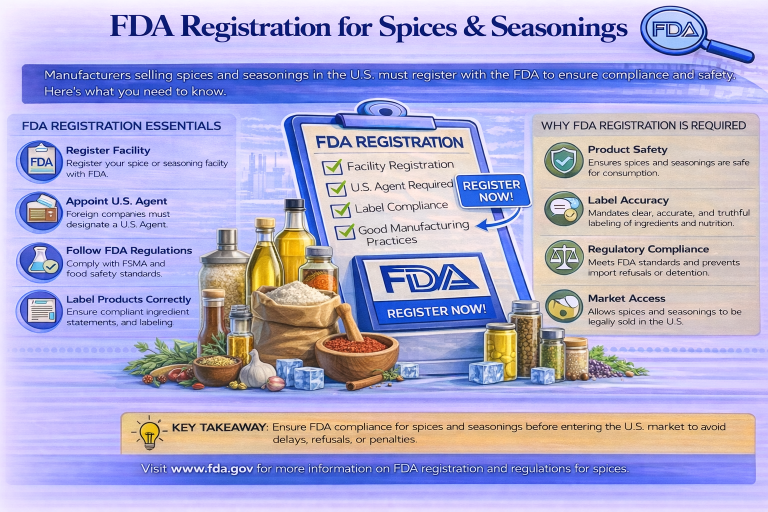
FDA Registration for Spices & Seasonings
This guide covers FDA registration for spices and seasonings, the GRAS spice list and collective “spices” ingredient declaration, Salmonella controls and Import Alert 99-23, lead and heavy metal contamination, food fraud hazards, the 1/4 teaspoon RACC, sesame allergen (FASTER Act 2023), and irradiation labeling requirements.
Which Spices Can Be Declared Collectively as “Spices” on an Ingredient List
The Four FSVP Hazards Every Spice Importer Must Address
Key Spice Labeling Requirements That Imported Products Most Commonly Fail
The Nutrition Facts panel for most ground spices must use 1/4 teaspoon (approximately 0.6g) as the serving size basis. Many imported spice products use European-style per-100g comparison formats or other home country serving sizes that do not satisfy FDA’s RACC framework. Using the wrong RACC serving size is misbranding under 21 U.S.C. § 343.
Sesame Allergen — January 2023
Sesame is the 9th major U.S. allergen since January 1, 2023 (FASTER Act). Spice blends and seasoning mixes containing sesame seeds, sesame oil, or any sesame-derived ingredient must declare sesame as an allergen: “Contains: Sesame” or bold “sesame” in the ingredient list. Many spice blend manufacturers have not yet updated U.S. labels. Note: Mustard and celery are NOT U.S. major allergens despite being EU allergens.
Irradiation Disclosure — Required
Irradiation is an FDA-approved Salmonella treatment for spices under 21 CFR Part 179. If a spice has been irradiated, the label must carry the radura symbol (international irradiation symbol) AND the statement “treated with radiation” or “treated by irradiation.” An irradiated spice without this disclosure is misbranded. Many spice importers use irradiation as their Salmonella control but omit the required label disclosure.
Garlic, Onion & Celery — Not “Spices”
Under 21 CFR 101.22(a)(2), onion, garlic, and celery are excluded from the FDA definition of “spice.” They must be declared individually by name in the ingredient list — cannot be lumped under “spices.” A seasoning blend containing garlic powder and cumin must list “garlic powder” individually while cumin can be included in “spices.” This is a common labeling violation for spice blends.
How to Register a Spice and Seasoning Manufacturing Facility with FDA
Label Review
FDA Registration Assistance reviews spice and seasoning labels for: GRAS spice collective declaration accuracy; garlic, onion, celery individual declaration; 1/4 teaspoon RACC serving size; sesame allergen (FASTER Act January 2023); irradiation disclosure; paprika/turmeric color additive declaration where applicable; and 2020 Nutrition Facts format.
FSVP for Spice Importers
U.S. spice importers must maintain FSVP for each foreign supplier. FDA Registration Assistance develops FSVP programs addressing all four spice-specific hazards: Salmonella (pathogen reduction verification), lead and heavy metals (periodic testing from higher-risk origins), economically motivated adulteration (species identity and fraud testing), and aflatoxin (for susceptible categories).
Ready to Get Your Spices and Seasonings FDA-Compliant?
FDA Registration Assistance provides complete FDA compliance for spice and seasoning manufacturers and importers — Food Facility Registration with correct activity codes, U.S. Agent services, label compliance review, FSVP programs covering all spice-specific hazards, and Biennial Renewal management. Complete service: $858. FDA charges $0. DUNS fees separate. 1,000+ clients. 135+ countries. 15+ years of FDA regulatory experience.
Contact us at info@fdaregistrationassistance.com or call +1 (928) 275-8333.
Frequently Asked Questions — FDA Registration for Spices & Seasonings
1. Do spice and seasoning manufacturers need FDA registration?
Yes. All facilities must register under 21 U.S.C. § 350d and 21 CFR Part 1 Subpart H. Foreign manufacturers must designate a U.S. Agent. Spices are one of FDA’s highest-scrutiny import categories due to Salmonella contamination, heavy metals, and food fraud. Complete service: $858. FDA charges $0. DUNS fees separate.
2. What is the FDA GRAS spice list and what does it include?
Under 21 CFR Part 182.10: allspice, anise, basil, bay leaves, caraway seed, cardamom, celery seed, chervil, cinnamon, cloves, coriander, cumin, dill, fennel, fenugreek, ginger, horseradish, mace, marjoram, mustard flour, nutmeg, oregano, paprika, parsley, pepper (black, white, red), rosemary, saffron, sage, savory, star anise, tarragon, thyme, turmeric, and vanilla. Spices from this list may be collectively declared as “spices” in ingredient lists.
3. Can a spice blend label just say “spices” without naming each spice?
Yes — for spices from the GRAS list (21 CFR Part 182.10). Under 21 CFR 101.22(h), these may be collectively listed as “spice” or “spices” — trade secret protection for proprietary blends. Exceptions that must be declared individually: onion, garlic, celery (excluded from FDA’s spice definition); paprika and turmeric when used primarily for coloring.
4. What is the FDA definition of “spice” under 21 CFR 101.22?
Under 21 CFR 101.22(a)(2): any aromatic vegetable substance in whole, broken, or ground form (except substances traditionally regarded as foods like onion, garlic, celery) whose significant function is seasoning rather than nutrition, that is true to name, and from which no volatile oil has been removed. Onion, garlic, and celery are explicitly excluded and must be declared individually.
5. Is Salmonella a concern for spice imports?
Yes — it is the primary biological hazard. FDA’s survey found ~7% of imported spices contaminated with Salmonella. High-risk categories: black and red pepper, cumin, oregano, coriander, paprika from South Asia and Central America. FSMA hazard analysis must address Salmonella as requiring validated preventive controls (heat treatment, irradiation). FSVP supplier verification must confirm the foreign supplier’s pathogen reduction process.
6. What is Import Alert 99-23 for spices?
Import Alert 99-23 covers pesticides, chemicals, and filth in food including spices. Spice products from foreign manufacturers found to contain Salmonella, excessive pesticide residues, or other contaminants are subject to Detention Without Physical Examination (DWPE) — automatic detention of every shipment from that facility. Removal requires demonstrating the underlying compliance issue has been corrected.
7. Is lead contamination a concern for imported spices?
Yes. South Asian spices — particularly turmeric, cumin, coriander, paprika — have shown elevated lead levels in FDA sampling. Turmeric is at specific risk for intentional lead chromate adulteration — a yellow pigment that has caused actual lead poisoning outbreaks. FSVP must address lead as a chemical hazard with periodic product testing from higher-risk origins.
8. What is economically motivated adulteration in spices?
Intentional fraudulent addition for economic gain. Spices are a top FDA food fraud category. Common: turmeric adulterated with lead chromate; paprika and chili powder adulterated with Sudan Red dyes (prohibited carcinogenic dyes) or fillers; saffron adulterated with synthetic colors; pepper adulterated with papaya seeds. FSVP hazard analysis must address EMA for each high-risk spice type.
9. What FSMA Preventive Controls requirements apply to spice manufacturers?
Under 21 CFR Part 117: written food safety plan; hazard analysis addressing Salmonella (biological), lead and heavy metals + aflatoxin + EMA (chemical), and physical hazards (foreign materials); preventive controls including validated Salmonella treatment and supplier controls; monitoring; corrective actions; verification; and a PCQI overseeing the food safety system.
10. What aflatoxin risks apply to spices?
Paprika, chili powder, and nutmeg are susceptible to aflatoxin from Aspergillus mold under high humidity storage. FDA action level: 20 ppb total aflatoxins for human food. Spice importers sourcing these categories should include periodic aflatoxin testing as a supplier verification activity.
11. What labeling is required on spice and seasoning products for the U.S. market?
Under 21 CFR Part 101: statement of identity in English; net quantity; Nutrition Facts in 2020 FDA format with the RACC (1/4 teaspoon for most ground spices); complete ingredient list (GRAS spices collectively as “spices”; garlic, onion, celery individually); allergen declarations including sesame (FASTER Act January 2023); irradiation disclosure if applicable; and manufacturer/distributor name and U.S. address.
12. What is the FDA RACC serving size for spices?
Under 21 CFR Part 101.12: 1/4 teaspoon (approximately 0.6g) for most ground spices. Many imported spice products use European per-100g comparison formats that do not satisfy FDA’s RACC requirement. Non-compliant serving size = misbranding under 21 U.S.C. § 343.
13. Does sesame need to be declared as an allergen in spice products?
Yes. Sesame is the 9th major U.S. allergen since January 1, 2023 (FASTER Act). Spice blends containing sesame seeds, sesame oil, tahini, or any sesame-derived ingredient must declare sesame: “Contains: Sesame” or bold “sesame” in the ingredient list. Note: mustard and celery are NOT U.S. major allergens despite being EU allergens.
14. Are irradiated spices required to disclose irradiation on the label?
Yes. Irradiation is an FDA-approved Salmonella treatment under 21 CFR Part 179. If irradiated, the label must carry the radura symbol AND the statement “treated with radiation” or “treated by irradiation.” An irradiated spice without this disclosure is misbranded. Many importers use irradiation as their Salmonella control but omit the required label disclosure.
15. What FSVP requirements apply to U.S. spice importers?
Under 21 CFR Part 1 Subpart L: FSVP for each foreign supplier. Hazard analysis must address: Salmonella (verification of validated pathogen reduction process); lead and heavy metals (periodic testing from higher-risk origins); EMA including lead chromate in turmeric and Sudan Red in paprika; aflatoxin (for susceptible categories); and pesticide residues.
16. What are the most common reasons spice shipments are detained at U.S. ports?
Salmonella contamination; facility on Import Alert 99-23; FDA registration expired; pesticide residues exceeding tolerances; lead or heavy metal contamination (South Asian spices); aflatoxin in paprika or chili; economically motivated adulteration (Sudan Red, lead chromate); missing irradiation disclosure; insect/rodent filth; labeling violations including missing Nutrition Facts or non-compliant RACC serving size.
17. Do foreign spice manufacturers need a U.S. Agent?
Yes. Must register and designate a U.S. Agent with a physical U.S. address. FDA Registration Assistance provides U.S. Agent services for foreign spice manufacturers.
18. What is the $858 complete service?
FDA Registration Assistance charges $858 — U.S. Agent designation for foreign manufacturers, activity code selection, food product category selection, registration submission through FURLS, and Biennial Renewal management. FDA charges $0. DUNS fees are separate.
19. How should paprika and turmeric be declared on a spice blend ingredient list?
When used primarily for flavor: may be included in the collective “spices” declaration (both are on the GRAS list). When used primarily for coloring: should be declared as a color additive (“paprika color” or “turmeric” as a color) — the primary function determines the declaration. Under 21 CFR 101.22(a)(2), a spice is a substance whose significant function is seasoning rather than coloring.
20. Are onion, garlic, and celery regulated as spices under FDA rules?
No. Under 21 CFR 101.22(a)(2), onion, garlic, and celery are explicitly excluded from the FDA spice definition. When used in a spice blend, they must be declared individually by name — garlic powder, onion powder, celery seed. Cannot be included under the collective “spices” declaration.
21. What Biennial Renewal requirements apply to spice registrations?
FDA Food Facility Registration renews every two years — October 1 through December 31 of even-numbered years. A lapsed registration triggers OASIS detention of every subsequent shipment. FDA Registration Assistance manages Biennial Renewal automatically.
22. What pesticide residue requirements apply to imported spices?
Imported spices must comply with EPA pesticide tolerances for the specific pesticide/spice combination. Import Alert 99-23 covers pesticide residue violations. Some pesticides used in foreign countries are not registered for U.S. spice crops — residues without an applicable U.S. tolerance result in automatic import refusal. FSVP should include periodic residue testing for higher-risk origins.
23. What are the most common FDA compliance failures for spice blend manufacturers?
Missing sesame allergen declaration (FASTER Act, January 2023); including garlic, onion, or celery under “spices” (must be declared individually); non-compliant serving size (per-100g format instead of 1/4 teaspoon RACC); missing irradiation disclosure for irradiated spices; missing Nutrition Facts panel; no FDA facility registration; no FSVP for imported spice components.
24. How does FDA Registration Assistance help spice and seasoning manufacturers and importers?
Complete FDA compliance: Food Facility Registration with correct activity codes; U.S. Agent for foreign manufacturers; label compliance review (GRAS collective declaration, sesame allergen, irradiation disclosure, 1/4 tsp RACC); FSVP programs covering all spice-specific hazards; Biennial Renewal. $858 service. FDA charges $0. 1,000+ clients. 135+ countries.
25. How do I get started with FDA registration for my spice or seasoning facility?
Contact FDA Registration Assistance at info@fdaregistrationassistance.com or call +1 (928) 275-8333. Provide your facility name and address, spice and seasoning products you manufacture, whether domestic or foreign, and any existing FDA registration information. Complete service: $858. FDA charges $0. DUNS fees separate.