FDA Registration for Sports Drinks
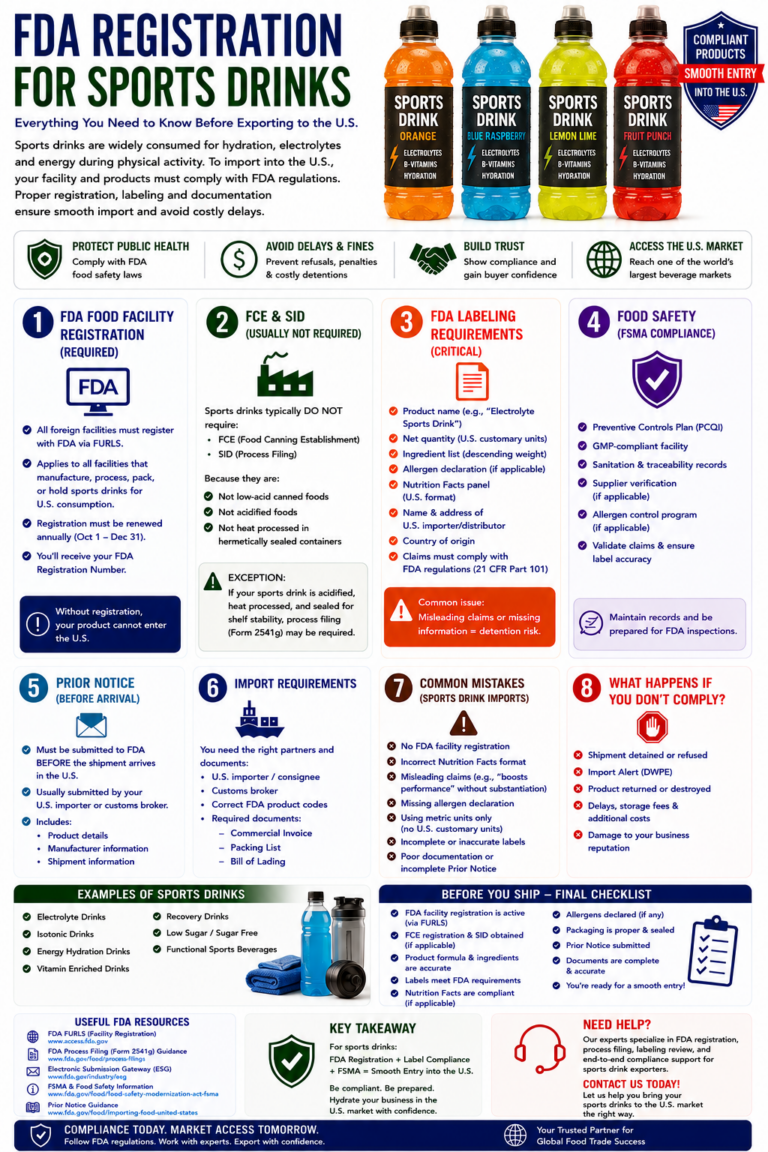
This guide covers FDA registration requirements for sports drinks, the three-way classification decision, the 240 mL RACC, Added Sugars labeling, electrolyte nutrient content claim thresholds, the drug claim trap, ingredients with regulatory status issues, and why sports drink shipments get detained.
Is Your Sports Drink a Conventional Food, Dietary Supplement, or Drug?
FDA Serving Size (RACC) for Beverages — 240 mL, Not 500 mL
Most imported sports drinks come in 500 mL, 600 mL, or 1 L containers. Many manufacturers label the Nutrition Facts based on the full container volume or on a 500 mL home-country serving — neither satisfies FDA’s RACC. The serving size declaration must be based on 240 mL (8 fl oz), and the Nutrition Facts values must reflect that amount. A 600 mL sports drink would typically declare “About 2.5 servings” per container with a per-serving basis of 240 mL. Using the wrong RACC is misbranding under 21 U.S.C. § 343.
What Most Imported Sports Drinks Use — Wrong
✗ Nutrition Facts based on 500 mL (home-country serving)
✗ Nutrition Facts based on 100 mL (nutritional comparison format)
✗ “1 bottle” as serving size for a 600 mL container
✗ Per-100g/mL comparison format used in EU and Australia
✗ Pre-2020 Nutrition Facts format (missing Added Sugars, old Daily Values)
What the FDA Nutrition Facts Panel Requires — Correct
✓ Serving size: “1 cup (240 mL)” or “8 fl oz (240 mL)”
✓ Calories in large bold type (2020 FDA format)
✓ Total Sugars AND Added Sugars as separate mandatory lines
✓ Sodium, Potassium % Daily Values
✓ % Daily Values based on 2020 FDA reference daily intakes
✓ Net quantity on PDP: “20 FL OZ (591 mL)” — both units required
Sports Drink Claims That Are Permitted vs. Claims That Create a Drug Classification Risk
| Claim Type | Example | Status | Why |
|---|---|---|---|
| Nutrient content claim | “Good source of potassium” | ✓ Permitted | Must meet FDA threshold: ≥ 10% DV (470 mg potassium per 240 mL serving). Verify before labeling. |
| General hydration claim | “Replenishes electrolytes lost through sweat” | ✓ Permitted | Describes a normal nutritional benefit, not a disease treatment. |
| Performance suggestion | “Formulated for active individuals” | ✓ Permitted | Describes the target audience, not a disease claim. |
| Structure/function (DSHEA) | “Helps support muscle recovery” | ✓ Permitted for dietary supplements with 30-day FDA notification + disclaimer | Dietary supplement structure/function claim. Not permitted on conventional beverage without supplement classification. |
| Disease treatment claim | “Treats dehydration disease” | ✗ Drug claim — OTC drug required | “Treats” + “disease” = drug under 21 U.S.C. § 321(g)(1)(B). |
| Disease prevention claim | “Prevents hyponatremia” | ✗ Drug claim — OTC drug required | Hyponatremia is a diagnosed medical condition. “Prevents” it = drug claim. |
| Symptom treatment | “Relieves muscle cramps” | ✗ Likely drug claim — depends on framing | If framed as treating a symptom of a condition. Review carefully before using. |
| CBD claim | “Contains CBD for recovery” | ✗ Prohibited — CBD not permitted in food/beverages | 21 U.S.C. § 331(ll) prohibits adding approved drug ingredient CBD to food. |
Sports Drink Ingredients That Can Trigger Classification or Compliance Issues
CBD
Not permitted in food or beverages under 21 U.S.C. § 331(ll). FDA has taken the position that CBD cannot be added to food sold in interstate commerce. CBD sports drinks are detained at U.S. ports and subject to Warning Letters. No hemp-derived or non-psychoactive framing changes this position.
Creatine
Adding creatine to a conventional beverage at supplemental doses raises food additive approval questions — creatine does not have established GRAS status for conventional food/beverage use at supplemental levels. A creatine sports drink marketed as a conventional food (Nutrition Facts panel) has significant regulatory risk. Typically triggers dietary supplement classification.
BCAAs (Branched Chain Amino Acids)
Adding leucine, isoleucine, and valine at supplemental levels (2–5g per serving) to a beverage marketed for muscle recovery typically triggers dietary supplement classification. Requires Supplement Facts panel, DSHEA disclaimer, and 21 CFR Part 111 cGMP compliance. Not appropriate for a conventional food Nutrition Facts label.
Caffeine
Caffeine must be listed in the ingredient list. FDA has not set a formal limit for conventional beverages but has issued warning letters for very high concentrations. Caffeine is not a required Nutrition Facts nutrient. Claims about caffeine’s alertness or energy effects may trigger drug claim analysis.
Taurine
Generally recognized as safe in beverages at typical concentrations used in energy and sports drinks. Must be listed in the ingredient list. No Nutrition Facts panel requirement to declare taurine separately (not a required nutrient). GRAS at typical use levels.
Electrolytes (Sodium, Potassium, Magnesium)
Electrolytes are generally recognized as safe food ingredients. Sodium is a required Nutrition Facts line item. Potassium must be declared on the Nutrition Facts panel. Electrolyte content claims (“good source of potassium”) must meet FDA quantitative thresholds. Well-understood and non-problematic at typical sports drink levels.
How to Register a Sports Drink Manufacturing Facility with FDA
Step 1 — Product Classification Assessment
Before registration, FDA Registration Assistance assesses your product’s classification: conventional sports drink (Nutrition Facts), dietary supplement (Supplement Facts + DSHEA), or mixed product. The registration activity codes and food product categories depend on the classification. Getting this right determines the entire compliance pathway.
Step 2 — Label Review
FDA Registration Assistance reviews your sports drink label for: 240 mL RACC serving size; 2020 Nutrition Facts format including Added Sugars; net quantity in fluid ounces and milliliters; ingredient list accuracy; allergen declarations; electrolyte nutrient content claim thresholds; and claims analysis for any potential drug claim language.
Step 3 — Registration Submission
FDA Food Facility Registration submitted through FURLS. For foreign manufacturers: U.S. Agent designation completed simultaneously. FDA registration number provided for use in Prior Notice filings for every sports drink shipment.
Step 4 — Biennial Renewal
Registration renews October–December of even years. FDA Registration Assistance tracks the renewal window and submits renewals automatically. A lapsed sports drink manufacturer registration triggers OASIS detention of every subsequent shipment.
Ready to Get Your Sports Drinks FDA-Compliant?
FDA Registration Assistance provides complete FDA compliance for sports drink manufacturers and importers — product classification assessment, Food Facility Registration with correct activity codes, U.S. Agent services, label compliance review (240 mL RACC, Added Sugars, claim analysis, ingredient regulatory status), FSVP programs for importers, and Biennial Renewal management. Complete service: $858. FDA charges $0. DUNS fees separate. 1,000+ clients. 135+ countries. 15+ years of FDA regulatory experience.
Contact us at info@fdaregistrationassistance.com or call +1 (928) 275-8333.
Frequently Asked Questions — FDA Registration for Sports Drinks
1. Do sports drink manufacturers need FDA registration?
Yes. Sports drink manufacturers must register under 21 U.S.C. § 350d and 21 CFR Part 1 Subpart H. Foreign manufacturers must also designate a U.S. Agent. Complete service: $858. FDA charges $0. DUNS fees separate.
2. Is a sports drink regulated as a conventional food, dietary supplement, or drug?
Depends on ingredients and claims. Conventional: Nutrition Facts panel, food cGMPs, general hydration claims. Dietary supplement: Supplement Facts panel, DSHEA disclaimer, supplement cGMPs (21 CFR Part 111), structure/function claims. Drug: Drug Facts panel, OTC drug monograph compliance, drug establishment registration. Getting the classification wrong is the #1 sports drink FDA compliance failure.
3. What is the FDA serving size (RACC) for sports drinks?
The RACC for beverages is 240 mL (8 fl oz) under 21 CFR Part 101.12. The Nutrition Facts panel must be based on this RACC. Using 500 mL, 100 mL, or the total container volume as the serving size is misbranding under 21 U.S.C. § 343.
4. What Nutrition Facts labeling requirements apply to conventional sports drinks?
2020 FDA format required: Calories in large bold type; Total Sugars and Added Sugars as mandatory separate lines; Sodium and Potassium with % Daily Values; % Daily Values based on 2020 FDA reference daily intakes. The 240 mL RACC must be used. Pre-2020 formats are non-compliant.
5. What are Added Sugars and why do they matter for sports drinks?
Added Sugars are sugars added during processing including cane sugar, HFCS, fruit juice concentrates, honey, maple syrup, and agave. Sports drinks sweetened with fruit juice concentrate must declare the juice-derived sugars as Added Sugars — many imported products fail this. The 2020 FDA format requires Added Sugars as a mandatory separate line below Total Sugars.
6. What claims are allowed on sports drink labels and what creates drug classification risk?
Permitted: nutrient content claims meeting FDA thresholds (“good source of potassium”); general hydration claims (“replenishes electrolytes”). Drug-triggering: “Treats dehydration,” “Prevents hyponatremia,” “Relieves muscle cramps” (if framed as treating a disease/condition). Once a sports drink makes a drug claim, it becomes an OTC drug requiring drug establishment registration.
7. What electrolyte content claims are allowed?
“Good source of potassium” requires ≥ 10% DV (470 mg per 240 mL serving; DV = 4,700 mg). “High in potassium” requires ≥ 20% DV (940 mg per serving). Using these claims without meeting thresholds is misbranding.
8. Is a sports drink with BCAAs or creatine a conventional food or dietary supplement?
Typically a dietary supplement if marketed with structure/function claims about muscle recovery, performance, or body composition. BCAAs at supplemental levels in a beverage require Supplement Facts panel, DSHEA disclaimer, and 21 CFR Part 111 cGMP compliance. Adding creatine to a conventional beverage raises food additive approval questions — creatine lacks established GRAS status for beverage use at supplemental doses.
9. Does CBD in a sports drink make it non-compliant?
Yes. FDA’s position under 21 U.S.C. § 331(ll) is that CBD cannot be legally added to food or beverages sold in U.S. interstate commerce. CBD sports drinks are detained at U.S. ports. No hemp-derived or non-psychoactive framing changes this.
10. What labeling is required on sports drink bottles for the U.S. market?
Under 21 CFR Part 101: statement of identity; net quantity in both FL OZ and mL in the lower 30% of the PDP; Nutrition Facts in 2020 FDA format with 240 mL RACC; ingredient list in descending order; allergen declarations if applicable; manufacturer/distributor name and U.S. address. All required text in English.
11. What is the difference between Nutrition Facts and Supplement Facts?
Nutrition Facts: required for conventional food and beverage sports drinks (21 CFR Part 101.9). Supplement Facts: required for dietary supplement sports drinks (21 CFR Part 101.36). A conventional beverage with Supplement Facts is misbranded; a dietary supplement with Nutrition Facts is also misbranded. The correct panel depends on the product’s regulatory classification.
12. Do sports drinks need to comply with dietary supplement regulations?
Only if classified as a dietary supplement under DSHEA. If classified as a supplement: facility must comply with 21 CFR Part 111 (dietary supplement cGMPs — more demanding than food cGMPs); product must have Supplement Facts panel and DSHEA disclaimer; structure/function claims must be notified to FDA within 30 days of first marketing.
13. Do foreign sports drink manufacturers need a U.S. Agent?
Yes. Foreign manufacturers must register and designate a U.S. Agent with a physical U.S. address. FDA Registration Assistance provides U.S. Agent services for foreign beverage manufacturers.
14. What Prior Notice requirements apply to sports drink importers?
Prior Notice under 21 CFR Part 1 Subpart I required before every shipment: 8 hours (ocean), 4 hours (air), 2 hours (road). Must include the foreign manufacturer’s correct FDA registration number. Errors cause port holds.
15. What is the $858 complete service?
FDA Registration Assistance charges $858 — U.S. Agent designation for foreign manufacturers, activity code selection, food product category selection, registration submission through FURLS, and Biennial Renewal management. FDA charges $0. DUNS fees are separate.
16. Why do sports drink shipments get detained at U.S. ports?
Most common causes: facility registration expired or not filed; non-compliant Nutrition Facts (pre-2020 format, wrong RACC, missing Added Sugars); drug claims on the label; prohibited or unapproved ingredients (CBD, supplement-level creatine in a conventionally labeled beverage); net quantity in metric only without FL OZ; Prior Notice errors.
17. Do zero-sugar artificially sweetened sports drinks have special labeling requirements?
Yes. List each artificial sweetener in the ingredient list. Declare 0g Total Sugars and 0g Added Sugars on the Nutrition Facts panel. If aspartame is used: mandatory PKU warning “PHENYLKETONURICS: CONTAINS PHENYLALANINE” under 21 CFR Part 101.9(d)(3). “Sugar Free” claim requires < 0.5g sugar per RACC serving.
18. Can a sports drink make “electrolyte replenishment” or “hydration” claims?
Yes — if describing general nutritional benefits. “Replenishes electrolytes lost through sweat” is generally permissible. “Treats dehydration disease” is a drug claim. “Hydrates you faster than water” is a comparative claim requiring substantiation. The line between permissible beverage marketing and drug claims is the core compliance analysis for sports drink manufacturers.
19. What FSVP requirements apply to U.S. importers of sports drinks?
U.S. sports drink importers must maintain FSVP under 21 CFR Part 1 Subpart L for each foreign supplier. Hazard analysis must address: microbiological hazards (Listeria, mold in products with no preservatives); chemical hazards (heavy metals from mineral sources; unapproved ingredients or prohibited levels); and physical hazards.
20. Does a sports drink with added vitamins need to comply with fortification policies?
FDA’s Fortification Policy discourages indiscriminate addition of nutrients to foods. Adding high-dose B vitamins to a sports drink for energy claims — while marketing it as a conventional food — raises fortification policy questions and may trigger dietary supplement classification. The dosing level and marketing claims both matter.
21. What activity codes should a sports drink manufacturer select?
Manufacture (producing the sports drink from raw ingredients — mixing, formulation, processing); Pack (filling and sealing into bottles, cans, or pouches); Hold (if the facility warehouses finished product). Under 21 CFR 1.234, update within 60 days when new product categories are added.
22. What is the Biennial Renewal for sports drink manufacturer registrations?
FDA Food Facility Registration renews every two years — October 1 through December 31 of even-numbered years. A lapsed sports drink manufacturer registration triggers OASIS detention of every subsequent shipment.
23. What ingredient regulatory status issues affect sports drinks?
CBD (prohibited); creatine at supplemental doses (no GRAS in conventional beverages — triggers supplement classification); BCAAs at supplemental levels (supplement classification); caffeine (list in ingredients; claims risk; high levels subject to Warning Letters); taurine (GRAS at typical levels); electrolytes (well-understood, non-problematic at typical concentrations).
24. How does FDA Registration Assistance help sports drink manufacturers and importers?
Product classification assessment; Food Facility Registration with correct activity codes; U.S. Agent for foreign manufacturers; label compliance review (240 mL RACC, Added Sugars, claim analysis, ingredient regulatory status); FSVP programs; Biennial Renewal management. $858 service. FDA charges $0. 1,000+ clients. 135+ countries.
25. How do I get started with FDA registration for my sports drink manufacturing facility?
Contact FDA Registration Assistance at info@fdaregistrationassistance.com or call +1 (928) 275-8333. Provide your facility name and address, sports drink products and key ingredients, claims on your labels, whether domestic or foreign, and any existing FDA registration information. Complete service: $858. FDA charges $0. DUNS fees separate.