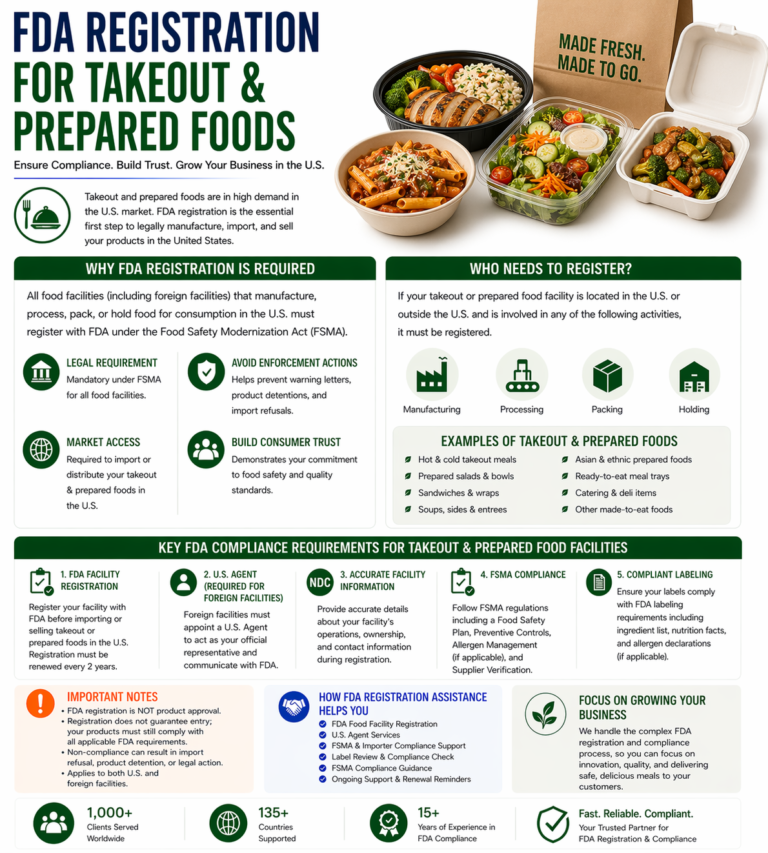
FDA Registration for Takeout & Prepared Foods
Why most takeout sellers are exempt, exactly when it flips to registration, and why food-safety law still applies either way.
Key Takeaways
- Selling direct to consumers = retail food establishment — exempt from FDA registration.
- Restaurants, delis, cafés, grab-and-go — regulated by state/local, not FDA registration.
- The FDA Food Code governs retail — via your state/local health department.
- It flips to registration at wholesale/manufacturing — the primary-function test decides.
- Exempt from registration ≠ exempt from food safety — the Food Code still applies.
- Imported prepared foods aren't exempt — the foreign facility registers, plus FSVP.
Selling to Consumers? You're Likely Exempt
There's a widespread misconception that selling prepared food to the public triggers FDA registration. It usually doesn't. Under 21 CFR 1.226(c), a retail food establishment is not required to register with FDA, and 21 CFR 1.227 defines a retail food establishment as one whose primary function is selling food directly to consumers — explicitly including establishments that cook, prepare, pack, or hold food, as long as direct-to-consumer sales are the primary function.
When It Flips to FDA Registration
Registration is required when direct-to-consumer sales stop being your primary function — i.e., when you move into wholesale or manufacturing. The 1.227 test: compare your annual food sales directly to consumers against your food sales to all other buyers.
| Your operation | FDA registration? |
|---|---|
| Restaurant / deli / café — takeout & prepared foods to consumers | Exempt (retail food establishment) — state/local + Food Code |
| Grab-and-go / ghost kitchen selling direct to consumers | Exempt (retail-like) — if direct-to-consumer is primary |
| Central kitchen / commissary supplying multiple locations or businesses | Registers (food facility) |
| Packaged prepared foods sold wholesale / to retailers | Registers (manufacturer) |
| Shipping packaged prepared foods into distribution | Registers |
| Importing prepared foods | Foreign facility registers + FSVP |
Exempt from Registration ≠ Exempt from Food Safety
Being exempt from FDA facility registration doesn't exempt you from food-safety law — it changes who regulates you. Retail food establishments answer to state and local health departments under the FDA Food Code, which carries real, enforceable obligations:
- Ready-to-eat pathogens — takeout/prepared foods are largely RTE, so Listeria monocytogenes, hot/cold holding, and cooling are central
- Date marking — refrigerated RTE foods held beyond 24 hours are date-marked (commonly a 7-day use-by at proper refrigeration)
- Temperature control & cross-contamination — the core Food Code disciplines
- Employee health & sanitation — the rest of the Food Code framework
Ghost Kitchens, Catering & Imports
- Ghost / cloud kitchens — selling directly to consumers (own app or a delivery platform) are retail-like and typically state/local-licensed; a delivery-only central production kitchen supplying other businesses registers
- Catering — preparing/serving events is generally retail; a catering commissary producing packaged food for wholesale can require registration
- Imports — imported prepared foods come from a foreign facility that must register (with a U.S. Agent), and the importer needs FSVP + prior notice — not a retail-exempt situation
- Packaged for wholesale — once packaged for distribution, full federal labeling (Nutrition Facts, allergens) applies
Get Your Takeout & Prepared Foods Compliant
FDA Registration Assistance starts by determining whether you're a retail food establishment (exempt) or a food facility that must register — applying the direct-to-consumer primary-function test to your actual operations. If you're expanding into wholesale, packaged goods, a commissary, or imports, we handle facility registration, U.S. Agent, labeling for packaged products, and FSVP — and we flag the state/local Food Code obligations that apply regardless.
Contact us at info@fdaregistrationassistance.com or call +1 (928) 275-8333. Food Facility Registration is available starting at $858. Trusted by companies across 135+ countries, with 15+ years of experience.
Frequently Asked Questions
1. Do takeout and prepared foods require FDA registration?
Usually not, if you sell directly to consumers. A restaurant, deli, café, or grab-and-go that sells takeout and prepared foods directly to consumers as its primary business is a "retail food establishment," and retail food establishments are exempt from FDA facility registration under 21 CFR 1.226. You're regulated instead by your state/local health department under the FDA Food Code. FDA registration only applies if you cross into wholesale or manufacturing — see the next questions.
2. What is a retail food establishment?
Under 21 CFR 1.227, a retail food establishment is one whose primary function is selling food directly to consumers — and that includes establishments that cook, prepare, pack, or hold food, as long as selling directly to consumers is the primary function. "Primary function" is measured by sales: if your direct-to-consumer food sales exceed your sales to all other buyers (wholesalers, retailers, other businesses), you're a retail food establishment. Restaurants, delis, cafés, and most takeout operations fit this definition.
3. So a restaurant doing takeout doesn't register with FDA?
Correct — a restaurant (including its takeout and delivery) is a retail food establishment and is exempt from FDA facility registration. It's licensed and inspected by state or local health authorities under the FDA Food Code, not registered with FDA. This is one of the most common misconceptions: selling prepared food to the public doesn't, by itself, trigger FDA registration. Manufacturing or wholesaling packaged food does.
4. When does a prepared-foods business have to register with FDA?
When direct-to-consumer sales stop being the primary function — in other words, when you move into wholesale or manufacturing. You register if you sell packaged prepared foods to other businesses or retailers, run a central kitchen or commissary that supplies multiple locations or other businesses, ship packaged prepared foods into commercial distribution, or otherwise sell more food to other buyers than directly to consumers. At that point you're a food facility, not just a retail establishment.
5. What's the exact test between exempt and registered?
The "primary function" test in 21 CFR 1.227: compare the annual value of your food sales directly to consumers against your food sales to all other buyers. If direct-to-consumer sales are greater, you're a retail food establishment (exempt). If sales to other businesses are greater, you're a food facility (register). A café that also wholesales its packaged sauces has to look at which side of that line it's on — and can be a retail establishment for one part and a registered facility for another.
6. Does "exempt from registration" mean "no food safety rules"?
No — and this is important. Being exempt from FDA facility registration doesn't exempt you from food-safety law. Retail food establishments are regulated by state and local health departments under the FDA Food Code, which covers temperature control, ready-to-eat food safety, date marking, employee health, and sanitation. So a takeout operation still has real, enforceable food-safety obligations; they just come from the Food Code and local authority rather than from FDA registration.
7. What ready-to-eat food-safety issues matter for prepared foods?
Prepared and takeout foods are largely ready-to-eat, so the key hazards are pathogens like Listeria monocytogenes (which grows in refrigeration), temperature abuse in the hot/cold holding and cooling steps, and cross-contamination. The Food Code addresses these with hot/cold holding temperatures, cooling requirements, and date marking for refrigerated ready-to-eat foods held more than 24 hours (a common rule is a 7-day use-by at proper refrigeration). These apply whether or not you register with FDA.
8. Are ghost kitchens and delivery-only operations exempt too?
Generally yes, if they sell directly to consumers. A ghost/cloud kitchen that cooks and sells meals directly to consumers (via its own app or a delivery platform) functions like a retail food establishment and is typically state/local-licensed rather than FDA-registered. But a delivery-only operation that's really a central production kitchen supplying other businesses is a food facility that registers. As always, it's the direct-to-consumer primary-function test that decides.
9. What about catering?
A caterer that prepares and serves food for events is generally treated like a restaurant/retail operation — state/local regulated, exempt from FDA registration. But if the catering business runs a central commissary that also produces packaged food for wholesale or supplies other businesses, that production side can require registration. The dividing line is the same: serving/selling directly to consumers vs supplying other businesses. See our large-scale meal providers guide for the full breakdown.
10. Do imported prepared foods follow the same exemption?
No. The retail exemption is for establishments selling directly to U.S. consumers. Imported prepared foods come from a foreign facility that manufactures/processes/packs/holds them — that facility must register with FDA and have a U.S. Agent, and the U.S. importer needs FSVP with prior notice for each shipment. So importing prepared foods is a registered-facility situation, not a retail-exempt one.
11. What labeling applies to packaged prepared foods?
Foods prepared and packaged at a retail establishment for direct sale to consumers have retail labeling requirements (identity, ingredients, allergens, and often net quantity), though some retail-prepared items have specific exemptions from full Nutrition Facts. Once you package prepared foods for wholesale or distribution, full federal packaged-food labeling (including Nutrition Facts and allergen declarations) applies. Allergen accuracy is essential either way, given how many ingredients prepared foods contain.
12. Does FDA approve takeout or prepared foods?
No. FDA doesn't pre-approve food, whether or not the establishment registers. For retail takeout, oversight comes from state/local health authorities under the Food Code; for registered facilities, FDA enforces compliance at the facility and (for imports) at the border. In neither case is there an FDA "approval" of the food — there's compliance with the applicable rules.
13. What are the most common mistakes with takeout and prepared foods?
On the registration side: assuming FDA registration is required when the business is actually retail-exempt, or — the opposite — assuming retail status while quietly building a wholesale/packaged-goods business that does need to register. On the safety side: weak temperature control and date marking for ready-to-eat foods, and allergen errors. Getting the retail-vs-facility classification right first prevents both over- and under-compliance.
14. How does FDA Registration Assistance help with takeout and prepared foods?
We start by determining whether you're a retail food establishment (exempt) or a food facility that must register — applying the direct-to-consumer primary-function test to your actual operations. If you're expanding into wholesale, packaged goods, a commissary, or imports, we handle facility registration, U.S. Agent, labeling for packaged products, and FSVP. And we flag the state/local Food Code obligations that apply regardless. Starting at $858 for registration, for companies across 135+ countries. Contact info@fdaregistrationassistance.com or +1 (928) 275-8333.