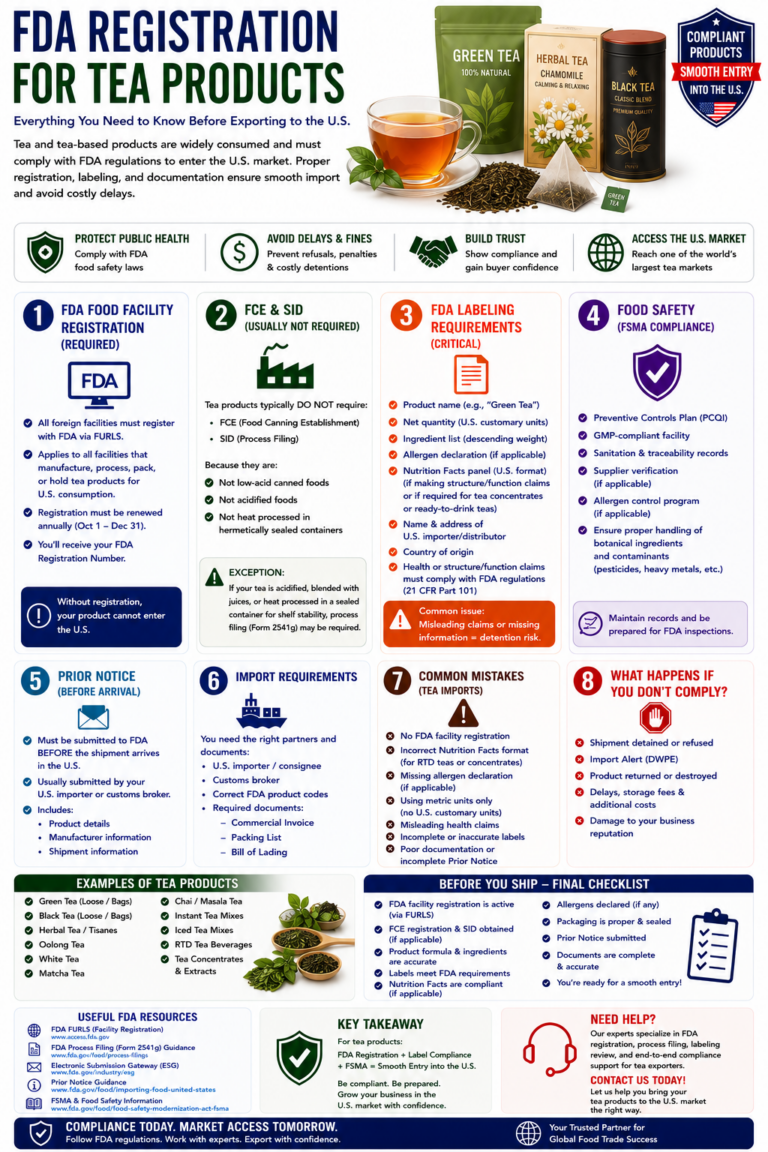
FDA Registration for Tea Products
This guide covers FDA Food Facility Registration for every tea product type, the drug claim trap, conventional food vs. dietary supplement classification, restricted herbal ingredients, RTD tea Nutrition Facts RACC requirements, and pesticide residue FSVP compliance.
How FDA Classifies Different Tea Products — and What Each Requires
Classification determines labeling format, cGMPs, claim rules, and whether NDI notifications apply:
| Tea Product Type | FDA Classification | Labeling Format | Key Compliance Requirements |
|---|---|---|---|
| Traditional tea (green, black, oolong, white, pu-erh from Camellia sinensis) | Conventional food | Nutrition Facts (or exemption for single-ingredient tea with no claims) | Facility registration; cGMPs under 21 CFR Part 117; no disease claims; ingredient list; country of origin |
| Herbal tea — conventional food (chamomile, peppermint, hibiscus sold with Nutrition Facts) | Conventional food | Nutrition Facts | Facility registration; GRAS status required for each botanical; cGMPs; allergen declarations; no drug claims |
| Herbal tea — dietary supplement (sold with Supplement Facts and structure/function claims) | Dietary supplement | Supplement Facts | Facility registration; dietary supplement cGMPs under 21 CFR Part 111; NDI notification for post-1994 botanical ingredients; structure/function claim disclaimer required; no disease claims |
| Ready-to-drink (RTD) tea (bottled, canned, or carton tea) | Conventional food beverage | Nutrition Facts (mandatory) | Facility registration; 8 fl oz (240mL) RACC serving size; Added Sugars mandatory if sweetened; dual-column NF if over 16 fl oz; pasteurization or thermal process |
| Functional / wellness tea (tea with added vitamins, minerals, or botanicals) | Conventional food or dietary supplement depending on claims and label panel | Supplement Facts or Nutrition Facts | Classification must be determined first; drug claims prohibited regardless; GRAS or approved additive status for each added ingredient |
| Shelf-stable RTD tea in hermetically sealed containers with pH > 4.6 | Possible low-acid canned food (LACF) | Nutrition Facts | FCE registration + Scheduled Process (SID) filing may be required under 21 CFR Part 113. Evaluate before production. |
The Drug Claim Trap — Why Tea Companies Receive FDA Warning Letters
Drug Claims — NOT Permitted on Any Tea Product
These claim types have triggered FDA Warning Letters for tea companies and may convert a tea product into an unapproved new drug:
“Reduces inflammation” · “Fights cancer” · “Lowers blood pressure” · “Treats arthritis” · “Cures insomnia” · “Prevents diabetes” · “Reverses aging” · “Detoxifies the liver” · “Prevents heart disease” · “Kills viruses and bacteria”
Structure/Function Claims — Permitted on Dietary Supplement Tea Only
Structure/function claims describe how an ingredient affects body structure or function without referencing disease. Permitted on dietary supplement tea with the required disclaimer:
“This statement has not been evaluated by the Food and Drug Administration. This product is not intended to diagnose, treat, cure, or prevent any disease.”
Examples: “Supports immune function” · “Promotes relaxation” · “Supports healthy digestion”
Website content, social media posts, Amazon listing text, and packaging inserts are all considered labeling for FDA regulatory purposes. A tea brand can receive a Warning Letter for drug claims that appear only on its website — even if the product label itself is compliant.
Restricted and Prohibited Herbal Ingredients in Tea Products
Not every botanical common in tea-producing countries is permitted in U.S. food products. The following have FDA restrictions or safety concerns:
- ⚠Comfrey (Symphytum officinale) — Contains hepatotoxic pyrrolizidine alkaloids. FDA has issued a Consumer Advisory advising against internal use of comfrey in food products.
- ⚠Ephedra / Ma Huang (Ephedra sinica) — Banned in dietary supplements under 21 CFR Part 119. Restricted in conventional food. Not a permitted tea ingredient.
- ⚠Kava (Piper methysticum) — FDA issued a Consumer Advisory in 2002 warning of potential severe liver injury associated with kava-containing products.
- ⚠Aristolochic acid — Found in some Aristolochia species. Nephrotoxic and carcinogenic — banned by FDA. Products containing or contaminated with aristolochic acid are subject to import refusal.
- ⚠Whole-leaf / crude stevia extract — Not permitted as a food additive. Only high-purity steviol glycoside extracts (≥95% purity) are GRAS under 21 CFR Part 582.
- ⚠Pennyroyal (Mentha pulegium) — Contains pulegone and related toxic terpenes. Not safe for use in tea for internal consumption.
FDA Registration Assistance reviews the GRAS status and regulatory standing of every botanical ingredient in a tea blend before registration and shipment.
Pesticide Residues — The Most Critical Tea Importer FSVP Hazard
U.S. tea importers must maintain an FSVP under 21 CFR Part 1 Subpart L for each foreign tea supplier. The tea FSVP hazard analysis must address:
Pesticide Residues
FDA actively monitors imported tea for pesticide residues and has detained shipments from major producing countries. Tea importer FSVPs must include pesticide residue as a chemical hazard and typically require third-party pesticide residue testing or supplier certificates of analysis as verification activities.
Heavy Metals
Lead and arsenic contamination are documented concerns for certain tea origins. Heavy metal testing is an increasingly important supplier verification activity for tea importers — particularly for tea from areas with known soil contamination. FDA monitors heavy metals in tea as part of its Closer to Zero initiative.
Pathogen and Foreign Material
Biological hazards (Salmonella from field contamination) and physical hazards (foreign material from harvest or processing) must also be addressed in the tea FSVP hazard analysis. Each hazard must be evaluated for likelihood and severity for each specific supplier and tea type.
How to Register a Tea Facility with FDA
Step 1 — Classify Your Tea Product
FDA Registration Assistance classifies each tea product — conventional food or dietary supplement — based on the label panel and claims made. Drug claim language in labels, websites, and marketing is reviewed before any registration or shipment proceeds.
Step 2 — Review Herbal Ingredients
Every botanical ingredient is reviewed for GRAS status (conventional food tea) or NDI notification status (dietary supplement tea). Restricted or prohibited ingredients are identified before FDA sees the product at import.
Step 3 — Register the Facility
FDA Food Facility Registration submitted through FURLS with correct activity codes and food product categories. U.S. Agent designation completed simultaneously for foreign facilities. FDA registration number provided upon confirmation.
Step 4 — FSVP and Ongoing Compliance
For U.S. tea importers, FDA Registration Assistance builds the FSVP program including pesticide residue hazard analysis and supplier verification activities. Biennial Renewal managed automatically. Label review against 21 CFR Part 101 completed before first shipment.
Ready to Sell Tea in the United States?
FDA Registration Assistance provides complete FDA compliance for tea manufacturers and importers — Food Facility Registration, U.S. Agent, drug claim assessment, herbal ingredient GRAS review, FSVP with pesticide hazard analysis, label review, and Prior Notice guidance. Complete registration: $858. FDA charges $0. DUNS fees separate. 1,000+ clients. 135+ countries. 15+ years of FDA regulatory experience.
Contact us at info@fdaregistrationassistance.com or call +1 (928) 275-8333.
Frequently Asked Questions — FDA Registration for Tea Products
1. Do tea manufacturers need FDA registration?
Yes. Any facility manufacturing, processing, packing, or holding tea for U.S. consumption must register under 21 U.S.C. § 350d and 21 CFR Part 1 Subpart H. Applies to loose-leaf manufacturers, tea bag producers, herbal blenders, and RTD tea processors — domestic and foreign. Foreign facilities must designate a U.S. Agent. Complete service: $858. FDA charges $0. DUNS fees separate.
2. How are tea products classified by FDA?
Traditional tea (Camellia sinensis) and herbal tea sold with Nutrition Facts and no structure/function claims are conventional foods. Herbal tea sold with a Supplement Facts panel and structure/function claims is a dietary supplement. RTD tea is a conventional food beverage. Classification determines labeling format, cGMPs, and NDI notification obligations.
3. What is the drug claim trap for tea products?
A tea product becomes an unapproved new drug under 21 U.S.C. § 321(g) if intended to diagnose, cure, treat, mitigate, or prevent a disease. Claims like “reduces inflammation,” “fights cancer,” “lowers blood pressure,” “treats arthritis,” or “prevents diabetes” trigger FDA Warning Letters — even when made only on a website or social media, not on the label.
4. What is the difference between conventional food tea and dietary supplement tea?
Conventional food tea uses Nutrition Facts, is subject to food cGMPs under 21 CFR Part 117, and cannot make structure/function claims. Dietary supplement tea uses Supplement Facts, is subject to dietary supplement cGMPs under 21 CFR Part 111, may make structure/function claims with the required disclaimer, and may require NDI notifications for post-1994 botanical ingredients.
5. What are the GRAS requirements for herbal tea ingredients?
For herbal teas marketed as conventional foods, each botanical must be GRAS under 21 U.S.C. § 321(s). Common ingredients with established GRAS or safe-use history: chamomile, peppermint, spearmint, hibiscus, ginger, rose hips. FDA Registration Assistance reviews GRAS status for each botanical ingredient.
6. Are there restricted or prohibited botanical ingredients in tea?
Yes. Comfrey (hepatotoxic pyrrolizidine alkaloids — FDA advises against internal use); ephedra/ma huang (banned in dietary supplements under 21 CFR Part 119); kava (FDA Consumer Advisory for liver toxicity); aristolochic acid (banned — nephrotoxic and carcinogenic); whole-leaf/crude stevia extract (not permitted — only high-purity steviol glycoside extracts are GRAS); pennyroyal (toxic pulegone).
7. What Nutrition Facts requirements apply to RTD tea beverages?
RTD tea must use the 2020 FDA Nutrition Facts format. The RACC serving size is 8 fl oz (240mL) under 21 CFR Part 101.12 — not the full bottle. Containers over 16 fl oz may require dual-column Nutrition Facts. Added Sugars mandatory if sweetened. Pre-2020 format and wrong serving sizes are the most common RTD tea labeling failures.
8. Do dry loose-leaf tea or tea bag products need a Nutrition Facts panel?
Most packaged tea requires a Nutrition Facts panel. A narrow exemption under 21 CFR Part 101.9(j)(7) may apply to single-ingredient plain tea with insignificant amounts of all nutrients and no claims. Most branded teas that make any claim do not qualify.
9. What are the pesticide residue compliance requirements for imported tea?
FDA actively monitors imported tea for pesticide residues and has detained shipments from major producing countries. U.S. tea importers must include pesticide residue as a chemical hazard in their FSVP hazard analysis and implement supplier verification activities — typically pesticide residue certificates of analysis or third-party testing.
10. Does the FSVP requirement apply to tea importers?
Yes. U.S. tea importers must maintain an FSVP under 21 CFR Part 1 Subpart L for each foreign tea supplier — covering pesticide residues, heavy metals (lead, arsenic), pathogen contamination, and foreign material as documented hazards with corresponding verification activities.
11. What Prior Notice requirements apply to tea shipments?
FDA Prior Notice is required for every tea import — filed before arrival: 8 hours for ocean, 4 hours for air, 2 hours for road. Must include the FDA registration number of the manufacturing or packing facility and the correct FDA product code.
12. What labeling requirements apply to tea products?
Under 21 CFR Part 101: statement of identity on the PDP; net quantity in U.S. and metric units; Nutrition Facts in 2020 FDA format; ingredient list in descending order; allergen declarations for all nine FALCPA/FASTER Act allergens (milk for chai blends, sesame since January 2023); manufacturer or distributor name and address with qualification (“Imported by,” “Distributed by”); all required text in English.
13. Do chai tea blends with milk ingredients need allergen declarations?
Yes. Chai blends with milk powder or any milk-derived ingredient must declare milk as a major allergen. Tree nut blends must declare the specific nut. Sesame in chai or spice blends must be declared since January 2023 under the FASTER Act. Either a “Contains:” statement or bold parenthetical in the ingredient list is required.
14. What are the most common FDA compliance problems for tea products?
Most common: drug claims on wellness teas triggering Warning Letters; pesticide residue detentions from inadequate supplier verification; facility not registered before first shipment; RTD tea using wrong RACC serving size; pre-2020 Nutrition Facts format; foreign-language-only labels; herbal ingredient not GRAS; missing allergen declarations on chai blends.
15. Does FDA registration mean FDA has approved the tea product?
No. FDA Food Facility Registration means the facility is in FDA’s regulatory system as required by law — not that the tea is FDA-approved or endorsed. FDA does not pre-approve food products including tea. Registration enables traceability and inspection authority.
16. Do tea bag manufacturers need separate registration from the tea blender?
Yes — if they are separate facilities. Each facility that manufactures, packs, or holds tea must be FDA-registered independently. A tea blender and tea bag manufacturer at separate locations are separate food facilities requiring separate registrations.
17. Do herbal teas require NDI notifications?
NDI notifications under 21 U.S.C. § 350b may be required when herbal teas are marketed as dietary supplements and contain botanical ingredients introduced after October 15, 1994 without a U.S. dietary supplement safe-use history. For herbal teas marketed as conventional foods, GRAS status — not NDI notification — applies.
18. Is FCE or SID registration required for tea products?
Not for dry tea products. FCE registration and Scheduled Process under 21 CFR Part 113 are required for low-acid canned foods (pH above 4.6). Refrigerated and hot-filled RTD teas typically do not require FCE/SID. Hermetically sealed, shelf-stable RTD tea with pH above 4.6 should be evaluated before production.
19. What is the RACC serving size for RTD tea beverages?
The RACC for RTD tea is 8 fl oz (240mL) under 21 CFR Part 101.12. A 16 fl oz bottle contains 2 servings. Containers over 16 fl oz may require dual-column Nutrition Facts. Using the full bottle as the serving size is one of the most common RTD tea labeling failures.
20. What is the $858 complete service for tea registration?
FDA Registration Assistance charges $858 for the complete service — U.S. Agent designation for foreign tea facilities, activity code selection, food product category selection, registration submission through FURLS, and Biennial Renewal management. FDA charges $0. DUNS Number fees are separate.
21. Can tea companies make “antioxidant” claims on their labels?
Antioxidant nutrient content claims under 21 CFR Part 101.54 require the nutrient to have an established Daily Value. Tea polyphenols and catechins (EGCG) do not have established Daily Values in FDA’s nutrient database, making a general “high in antioxidants” claim technically a non-compliant nutrient content claim. FDA Registration Assistance reviews all claim language before product launch.
22. Does country of origin labeling apply to tea products?
Yes. Country of origin marking is required for imported tea under CBP rules at 19 U.S.C. § 1304 — a CBP requirement, not FDA. The country of origin must be clearly marked (e.g., “Product of China,” “Product of India”). Amazon and most U.S. retailers also enforce it.
23. What is the Biennial Renewal requirement for tea facilities?
FDA Food Facility Registration renews every two years — October 1 through December 31 of every even-numbered year. Missing the window causes automatic cancellation and blocks all tea shipments from that facility. FDA Registration Assistance manages Biennial Renewal automatically.
24. How does FDA Registration Assistance help tea manufacturers and importers?
Complete FDA compliance: Food Facility Registration with U.S. Agent and Biennial Renewal; product classification review; drug claim assessment; herbal ingredient GRAS review; FSVP with pesticide hazard analysis; label review; Prior Notice guidance. $858 service. FDA charges $0. DUNS fees separate. 1,000+ clients. 135+ countries.
25. How do I get started with FDA registration for my tea business?
Contact FDA Registration Assistance at info@fdaregistrationassistance.com or call +1 (928) 275-8333. Provide your tea facility name and address, tea product types, botanical ingredients, label claims, and any existing FDA registration information. Complete service: $858. FDA charges $0. DUNS fees separate.