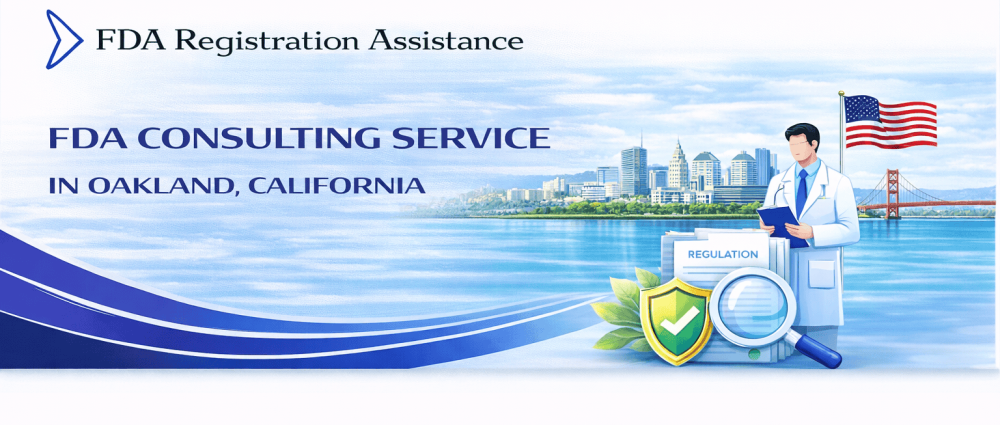
FDA Consulting Services in Oakland, California
Trusted by 1,000+ companies across 135+ countries, with 15+ years of FDA regulatory experience. Below: what each FDA category needs in the Bay Area, the producer-vs-importer split, and how California's own rules add a layer.

FDA Compliance for Every Category in the Bay Area
Oakland and the Bay Area span all four FDA-regulated industries — from craft and plant-based food to biotech and medtech. Each category has its own registration and rules, and we handle every one under a single firm.
Food & Beverage
Specialty and plant-based food, coffee roasters, chocolate, kombucha and beverages, supplements. Needs food facility registration (21 CFR Part 1 Subpart H), labeling, and GRAS review for novel ingredients. See food & beverage.
Cosmetics (MoCRA)
Bay Area clean and natural beauty brands. Needs facility registration and product listing under MoCRA, a Responsible Person, and compliant labeling. See cosmetics & MoCRA.
Drugs & Pharma
Bay Area biotech, pharma, and OTC makers. Needs drug establishment registration, NDC listing, and cGMP (new drugs and biologics have their own approval pathways). See drugs & pharma.
Medical Devices
Silicon Valley and Bay Area medtech. Needs establishment registration and device listing, QMSR, and 510(k) for Class II. See medical devices.
Two Roles, Two Rule Sets
The biggest source of confusion in Oakland is whether you're a domestic producer or an importer — because the FDA expects very different things from each.
| Your role in Oakland | What the FDA expects |
|---|---|
| Producer / manufacturer Bay Area food, beverage, supplement, cosmetic, biotech, device | Domestic FDA registration (no U.S. Agent — that's foreign-only), U.S.-compliant labeling, and category-specific compliance (HACCP, MoCRA, cGMP, or QMSR). |
| Importer / distributor goods via the Port of Oakland | FSVP for each foreign supplier, confirmation that the supplier is FDA-registered with a U.S. Agent, and Prior Notice for each food shipment. |
| Brand owner selling DTC or nationwide | Ensure the manufacturing facility is registered and that products and labels are compliant for the category — plus Prop 65 for California sales. |
A Major Port and a Center of Food and Health Innovation
Oakland is home to the Port of Oakland, one of the busiest container ports on the U.S. West Coast and a major gateway for trans-Pacific imports and California agricultural exports. It also anchors a Bay Area economy dense with food innovators, supplement and beverage brands, biotech and pharmaceutical companies, and medical device firms — which is why Oakland businesses so often need compliance across several FDA categories at once.
We map the right path for each: domestic registration for Bay Area producers, and import compliance (FSVP, foreign-supplier registration, Prior Notice) for importers moving goods through the port.

What Has to Be in Place
Ready to Get FDA-Compliant in Oakland, California?
Tell us your role — Bay Area producer or Port of Oakland importer — and what you make or bring in, and we'll confirm exactly which FDA programs apply and handle registration, FSVP, labeling, and the category-specific compliance. Email info@fdaregistrationassistance.com or call +1 (928) 275-8333.
Frequently Asked Questions — FDA Consulting in Oakland, California
Do businesses in Oakland need FDA registration?
In most cases, yes. Oakland is in the U.S. and fully subject to FDA rules. Facilities that manufacture, process, pack, or hold FDA-regulated products generally must register, and importers have their own obligations. The exact requirement depends on your role and product.
Do Oakland facilities need a U.S. Agent?
No. A U.S. Agent is required only for foreign facilities. Oakland businesses are domestic U.S. facilities, so they register without a U.S. Agent. The U.S. Agent requirement applies to the foreign suppliers that Oakland importers buy from.
What's the difference between an Oakland producer and an importer for FDA purposes?
A producer or manufacturer — a Bay Area food, beverage, supplement, cosmetic, biotech, or device company — registers as a domestic facility and handles labeling and any HACCP. An importer bringing goods through the Port of Oakland must run FSVP, confirm the foreign supplier is FDA-registered with a U.S. Agent, and file Prior Notice.
Which FDA categories do you handle for Oakland businesses?
All four: food and beverage, cosmetics (MoCRA), drugs and pharmaceuticals, and medical devices — for Bay Area producers, importers, distributors, and brand owners alike.
Do Bay Area food and beverage makers need FDA registration?
Yes. Domestic facilities that manufacture, process, pack, or hold food for the U.S. market must register under 21 CFR Part 1 Subpart H, unless exempt — see food facility registration. This includes craft food makers, coffee roasters, beverage and kombucha companies, and plant-based brands.
How does the FDA handle plant-based and alternative-protein foods?
They are regulated as foods, and some novel ingredients require a GRAS determination or premarket review. Labeling — including how plant-based “milk” or “meat” style products are named and described — must be truthful and not misleading. Facility registration still applies.
Is FSVP required for imports through the Port of Oakland?
Often yes. If you import food from a foreign supplier through the Port of Oakland, you are typically the FSVP importer responsible for verifying that supplier and keeping records. We evaluate each supply chain.
Is Prior Notice required for food imported into Oakland?
Yes. Food imported into the U.S. through the Port of Oakland requires FDA Prior Notice before arrival. Missing or incorrect Prior Notice causes holds and delays at the port.
How does California's Prop 65 interact with FDA rules?
They are two separate layers. The FDA governs federal food, drug, cosmetic, and device requirements; California's Proposition 65 separately requires warnings for products that expose people to listed chemicals (for example, acrylamide in some foods and coffee). A product sold in California often must satisfy both.
Do Oakland cosmetic makers need MoCRA compliance?
Yes. Bay Area cosmetic and personal-care brands need facility registration and product listing under MoCRA, a Responsible Person, and compliant labeling — plus Prop 65 for California sales.
Do Bay Area biotech and pharma companies need FDA registration?
Yes. Drug and active-ingredient makers must complete FDA drug establishment registration and listing (with an NDC) and follow cGMP. New drugs and biologics also have their own approval pathways.
Do Bay Area medical device companies need FDA registration?
Yes. Device makers need FDA establishment registration and device listing, the QMSR, and 510(k) clearance for Class II devices — see our medical device services.
Are dietary supplements made in the Bay Area regulated?
Yes. Supplements register through the food facility system and need a Supplement Facts panel, compliant labeling and claims, and sometimes a New Dietary Ingredient notification.
What about CBD or hemp products?
The FDA currently does not permit CBD to be added to conventional foods or marketed as a dietary supplement, and CBD labeling and claims are closely scrutinized. This is a high-risk area, and we can help you understand the current FDA position and your options.
Does FDA registration mean FDA approval?
No. Registration and listing are regulatory requirements, not approval. The FDA does not approve most foods, cosmetics, or supplements; devices are cleared or exempt (not “approved”) unless they are Class III.
Can you act as our U.S. Agent or FSVP Agent?
Yes. For Oakland importers, we can serve as the FSVP Agent, and we can serve as the U.S. Agent for the foreign suppliers you source from, since those foreign facilities need one. Oakland's own domestic facilities do not need a U.S. Agent.
What does a compliant U.S. food or supplement label need?
FDA-compliant Nutrition or Supplement Facts, ingredient and allergen declarations, net quantity, and truthful claims — plus, for California sales, any required Prop 65 warning.
How quickly can registration be completed?
Food facility registration is often completed within a few business days once information and a valid DUNS Number are provided. Drug, device, and cosmetic registrations vary by category, and a 510(k) for a Class II device takes substantially longer.
Do I need a DUNS Number?
For food facility registration, yes — the DUNS Number is the required Unique Facility Identifier. We help you obtain it if you don't already have one so it does not delay the filing.
Can you help if my imported shipment is held at the Port of Oakland?
Yes. We assist with FDA holds, detentions, and import alerts, including the corrective actions and documentation needed to resolve them and restore entry.
Do online sellers and DTC brands in Oakland need FDA compliance?
Yes. Selling food, supplements, or cosmetics online or direct-to-consumer does not change FDA requirements; the product must still come from a registered facility and carry compliant labeling.
Do you serve businesses beyond Oakland in the Bay Area?
Yes. We serve businesses across the Bay Area and California — San Francisco, San Jose, Berkeley, Hayward, and the Central Valley — and nationwide, as a U.S.-based FDA consulting firm.
Does the FDA inspect facilities in California?
Yes. As U.S. facilities, California food, drug, and device establishments are subject to FDA inspection. Maintaining registration, records, and good manufacturing practices supports inspection readiness.
What information do you need to start?
Your role — producer, importer, distributor, or brand owner — your product categories, and your timeline. We confirm which FDA programs apply and begin the filings.
How do I get started with FDA compliance in Oakland?
Contact FDA Registration Assistance with your products and your role. Reach our team and we confirm what applies and handle registration, FSVP, labeling, and category-specific compliance. Email info@fdaregistrationassistance.com or call +1 (928) 275-8333.