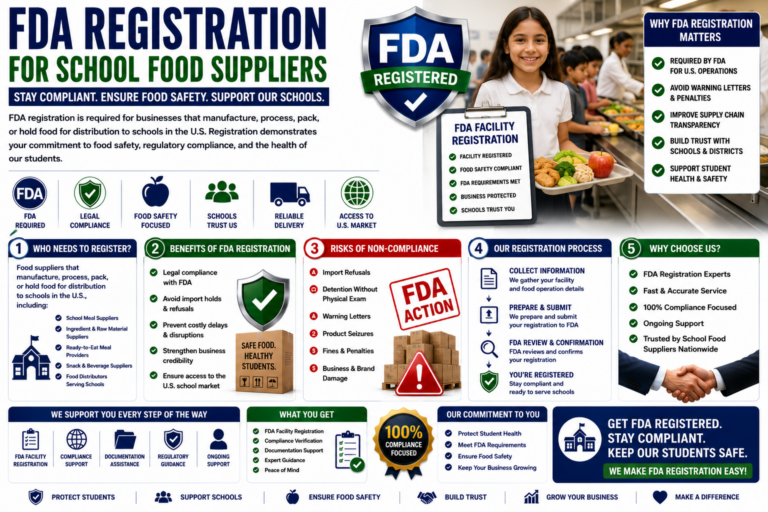
FDA Registration for School Food Suppliers
This guide covers FDA registration requirements for all school food supply chain participants — manufacturers, food service distributors, and foreign suppliers — plus the CN label vs. FDA labeling distinction, allergen controls for school food, and FSVP for importers.
FDA Registration Requirements Across the School Food Supply Chain
| Entity in the School Food Supply Chain | FDA Registration Required? | Notes |
|---|---|---|
| Food manufacturer supplying schools (canned goods, frozen entrees, bread products, dairy products, protein items) | Required | Manufactures or processes food for U.S. distribution — must register under 21 CFR Part 1 Subpart H. Biennial renewal required. Activity codes: Manufacture, Pack. |
| Foreign food manufacturer supplying U.S. schools through distributors or direct contracts | Required + U.S. Agent | Same FDA registration obligation as domestic manufacturers plus mandatory U.S. Agent designation. No exemption for school or institutional destination. |
| Food service distributor with its own warehouse (holds food before delivering to schools) | Warehouse May Need Registration | A food holding facility (warehouse, distribution center) used for school food distribution must register if it holds food for U.S. distribution. Activity code: Hold. |
| Food service distributor as importer of school food | FSVP Required | If the distributor is the U.S. importer of record for foreign school food products, it is the FSVP importer and must maintain FSVP under 21 CFR Part 1 Subpart L. |
| School district (prepares food for students in cafeteria) | Not Required | Retail food establishment exemption under 21 CFR 1.226(c) — sells food directly to consumers (students) for immediate consumption on-site. |
| Food broker or purchasing cooperative (arranges orders, no physical food handling) | Not Required (typically) | Does not physically manufacture or hold food. Manufacturer’s and distributor’s own registrations are the relevant facilities. |
CN Label vs. FDA Food Labeling — Two Completely Separate Programs
A school food product can carry a valid USDA CN label and simultaneously be in violation of FDA regulations — and vice versa. Both programs must be satisfied independently.
Why Allergen Controls Are Critical for School Food Suppliers
All 9 Allergens Must Be Declared on School Food Products
Milk — cheese, yogurt, cream sauces, baked goods
Eggs — baked goods, pasta, egg-based entrees
Fish — seafood entrees (species name required)
Shellfish — seafood products (species name required)
Tree Nuts — specific nut name required (almond, walnut, cashew...)
Peanuts — particularly critical in school settings
Wheat — bread products, pasta, battered items
Soybeans — including soy lecithin, soy protein, textured soy protein
⚠ Sesame — since January 2023 — sesame seeds, oil, tahini, paste
What School Districts Require from Suppliers
School districts and food service management companies typically require from food suppliers:
✓ Current FDA Food Facility Registration number and proof of active status
✓ Allergen information sheets for each product (all 9 FALCPA/FASTER Act allergens)
✓ Nutrition Facts information for NSLP menu planning
✓ Food safety documentation (FSMA plan summary or third-party audit results)
FDA Registration Assistance helps school food suppliers obtain and maintain the FDA registration documentation required for school district supplier qualification.
FSMA Preventive Controls and FSVP for the School Food Supply Chain
FSMA Preventive Controls — Manufacturer
School food manufacturers must maintain full FSMA Preventive Controls under 21 CFR Part 117: written food safety plan; hazard analysis; allergen controls (required type); sanitation controls; process controls; PCQI; monitoring and corrective actions. Key hazards: allergen cross-contact (multiple allergen products on shared equipment); Listeria in ready-to-eat components; Salmonella in poultry and egg-based items.
FSVP — Importer of School Food Products
A food service distributor importing school food products is the FSVP importer under 21 CFR Part 1 Subpart L. Must maintain FSVP for each foreign school food supplier including hazard analysis, supplier verification activities, corrective actions, and 2-year recordkeeping. The school destination does not change or reduce the FSVP obligation.
Prior Notice — Imported School Food
Prior Notice under 21 CFR Part 1 Subpart I is required before every imported school food shipment arrives: 8 hours (ocean), 4 hours (air), 2 hours (road). Must include the foreign manufacturer’s correct FDA registration number. Errors cause port holds that disrupt school food supply chain deliveries.
How to Register a School Food Manufacturing Facility with FDA
What Gets Registered
Manufacture — producing food from ingredients. Pack — packaging into institutional formats (bulk cases, #10 cans, multi-pack). Hold — if the facility also warehouses finished product. Under 21 CFR 1.234, update within 60 days when new food product categories are added.
Label Review for School Food Products
FDA Registration Assistance reviews school food labels for 2020 Nutrition Facts compliance, correct RACC serving sizes, allergen declarations including sesame (FASTER Act January 2023), ingredient list accuracy, and English language requirements — for both consumer-pack and institutional-size products.
Foreign Manufacturer Support
Foreign school food manufacturers must designate a U.S. Agent with a physical U.S. address. FDA Food Facility Registration submitted through FURLS. FDA registration number provided for use in Prior Notice filings and school district supplier qualification documentation.
Biennial Renewal
Registration renews October–December of even years. A lapsed school food manufacturer registration triggers OASIS detention of imported shipments and can disrupt school district supplier qualification status. FDA Registration Assistance manages all renewals automatically.
Ready to Register Your School Food Facility with FDA?
FDA Registration Assistance provides complete FDA compliance for school food manufacturers and suppliers — Food Facility Registration with correct activity codes, U.S. Agent services for foreign manufacturers, label compliance review including allergen declarations, FSVP programs for importers, and Biennial Renewal management. Complete service: $858. FDA charges $0. DUNS fees separate. 1,000+ clients. 135+ countries. 15+ years of FDA regulatory experience.
Contact us at info@fdaregistrationassistance.com or call +1 (928) 275-8333.
Frequently Asked Questions — FDA Registration for School Food Suppliers
1. Do school food suppliers need FDA registration?
Yes. School food suppliers that manufacture, process, pack, or hold food must register under 21 U.S.C. § 350d and 21 CFR Part 1 Subpart H. The school destination creates no FDA exemption. Complete service: $858. FDA charges $0. DUNS fees separate.
2. Does supplying food to schools create any exemption from FDA registration?
No. There is no FDA registration exemption for school food suppliers. The destination of the food — school cafeteria, school district food service, institutional buyer — does not affect the manufacturer’s FDA Food Facility Registration obligation.
3. What is the difference between a USDA CN label and FDA food labeling?
Completely separate programs. A USDA CN label (USDA AMS) certifies that a product meets NSLP/SBP meal pattern contribution requirements. FDA food labeling (21 CFR Part 101) covers Nutrition Facts, allergen declarations, ingredient list, manufacturer identification, and net quantity. A product can carry a CN label and be simultaneously non-compliant with FDA labeling requirements. Both must be satisfied independently.
4. Why are allergen controls especially critical for school food suppliers?
Children are a primary consumer population with high rates of food allergies. Schools rely entirely on accurate allergen declarations from manufacturers. Under FSMA Preventive Controls (21 CFR Part 117), allergen controls are a required preventive control type. All nine allergens must be controlled and declared — including sesame since January 2023 (FASTER Act). Missing allergen declarations on school food products can result in serious adverse health events for students.
5. Does a food service distributor supplying schools need FDA registration?
A food service distributor that holds food in its own warehouse before delivering to schools may need to register that facility as a food holding facility under 21 CFR Part 1 Subpart H. A distributor that arranges orders without physically holding food typically does not need to register its office address.
6. What FSMA Preventive Controls requirements apply to school food manufacturers?
Full FSMA Preventive Controls under 21 CFR Part 117: written food safety plan; hazard analysis; allergen controls (required type — critical for school food); sanitation controls; process controls; PCQI; monitoring and corrective actions. Key hazards: allergen cross-contact, Listeria in ready-to-eat components, Salmonella in poultry/egg items.
7. What FSVP requirements apply to importers of school food products?
A food service distributor importing school food products is the FSVP importer under 21 CFR Part 1 Subpart L and must maintain FSVP for each foreign school food supplier — hazard analysis, supplier verification activities, corrective actions, 2-year recordkeeping. The school destination does not reduce the FSVP obligation.
8. Do foreign manufacturers supplying U.S. school districts need FDA registration?
Yes. Foreign manufacturers producing food for export to U.S. school districts must register with FDA under 21 CFR Part 1 Subpart H and designate a U.S. Agent. No exception for institutional, school, or government food service markets.
9. What activity codes should a school food manufacturer select?
Manufacture (producing food — baking, cooking, processing, assembling); Pack (packaging into institutional formats — #10 cans, bulk bags, individual serving containers); Hold (if the facility warehouses finished products). Update within 60 days when new food product categories are added under 21 CFR 1.234.
10. What labeling is required on institutional-size school food products?
Under 21 CFR Part 101: statement of identity; net quantity; Nutrition Facts in 2020 FDA format with correct RACC; ingredient list in descending order; allergen declarations for all nine allergens including sesame (January 2023); and manufacturer/distributor name and U.S. address. Large institutional pack sizes are not exempt from Nutrition Facts labeling.
11. What allergens must be declared on school food products under FASTER Act 2023?
All nine: milk, eggs, fish (species name), shellfish (species name), tree nuts (specific nut), peanuts, wheat, soybeans, and sesame (effective January 1, 2023). Sesame is particularly relevant for school food — sesame seeds, sesame oil, and sesame paste appear in many institutional food products. Missing sesame declaration = misbranding violation and school district supply chain risk.
12. Is a CN label sufficient for FDA compliance?
No. A USDA CN label certifies NSLP/SBP meal pattern compliance — it does not satisfy any FDA requirement. FDA Food Facility Registration, FSMA Preventive Controls, FDA labeling compliance, and FSVP are all independent FDA obligations. A product with a CN label can still be non-compliant with FDA regulations.
13. What is the $858 complete service for school food manufacturer registration?
FDA Registration Assistance charges $858 — U.S. Agent designation for foreign manufacturers, activity code selection, food product category selection, registration submission through FURLS, and Biennial Renewal management. FDA charges $0. DUNS fees are separate.
14. What are the most common FDA compliance gaps for school food suppliers?
Most common: manufacturer not registered; missing sesame allergen declaration since January 2023; food service distributor warehouses not registered as food holding facilities; no FSVP for food service distributors importing school food; institutional-size products with non-compliant Nutrition Facts labels; missing Biennial Renewal causing registration cancellation.
15. Does a school district need FDA registration?
No. A school district that prepares food for students in its cafeteria is a retail food establishment exempt under 21 CFR 1.226(c) — it sells food directly to consumers (students) for immediate consumption on-site.
16. What Prior Notice requirements apply to school food importers?
Prior Notice under 21 CFR Part 1 Subpart I is required before every imported school food shipment: 8 hours (ocean), 4 hours (air), 2 hours (road). Must include the foreign manufacturer’s correct FDA registration number. Errors cause port holds that disrupt school food supply chain deliveries.
17. What food safety hazards are most relevant for school food manufacturers?
Allergen cross-contact (highest priority — multiple allergen products on shared equipment); Listeria monocytogenes in ready-to-eat meal components; Salmonella in poultry and egg-based components; E. coli O157:H7 in ground beef components; and pesticide residues in fresh fruits and vegetables included in NSLP produce components.
18. How does the Biennial Renewal affect school food supply contracts?
A school food supplier whose FDA registration lapses loses active registration status. For imported school food, every subsequent shipment will be detained at U.S. ports. School district procurement managers who require proof of current FDA registration as part of supplier qualification will flag the lapsed registration. FDA Registration Assistance manages Biennial Renewal to prevent this disruption.
19. Do school food product labels need to comply with USDA and FDA simultaneously?
Yes — through separate regulatory frameworks. USDA requirements (CN label, NSLP/SBP meal pattern, whole grain documentation) are administered by USDA FNS and AMS. FDA requirements (Nutrition Facts, allergen declarations, manufacturer identification, net quantity) are administered by FDA under 21 CFR Part 101. Both apply independently. FDA Registration Assistance handles the FDA labeling component.
20. What types of school food products require FDA registration?
All manufactured school food products: canned fruits and vegetables; frozen entrees and meal components; bread and grain products; dairy products (cheese, yogurt); protein products (processed chicken, turkey, beef patties, bean-based protein); condiments, dressings, and sauces; snack items (crackers, granola bars); and all other manufactured food supplied to school food service programs.
21. Can a school food manufacturer get a waiver from FDA registration?
No. FDA does not issue waivers from food facility registration for school food suppliers. The only relevant exemptions are for retail food establishments, farms for raw agricultural commodities, and restaurants — none typically apply to commercial school food manufacturers. A very small manufacturer may qualify for the Qualified Facility Exemption from full FSMA Preventive Controls but still must register the facility.
22. What FDA documentation do school districts request from food suppliers?
School districts typically request: current FDA Food Facility Registration number and proof of active status; allergen information sheets for each product (all nine FALCPA/FASTER Act allergens); Nutrition Facts information for menu planning; and food safety documentation. FDA Registration Assistance helps school food suppliers maintain the FDA registration documentation required for school district supplier qualification.
23. Does FSMA apply differently to school food vs. other food categories?
No. FSMA Preventive Controls under 21 CFR Part 117 apply the same way to school food manufacturers as to any other food manufacturer. The school destination does not change or reduce FSMA obligations. Allergen controls are particularly emphasized for school food because of the student population, but the regulatory requirement is the same regardless of the food’s ultimate destination.
24. How does FDA Registration Assistance help school food manufacturers and suppliers?
Complete FDA compliance: Food Facility Registration with correct activity codes; U.S. Agent for foreign manufacturers; label compliance review including all allergen declarations (sesame since January 2023); FSVP programs for food service distributor importers; distributor warehouse registration assessment; Biennial Renewal management. $858 service. FDA charges $0. 1,000+ clients. 135+ countries.
25. How do I get started with FDA registration for my school food manufacturing facility?
Contact FDA Registration Assistance at info@fdaregistrationassistance.com or call +1 (928) 275-8333. Provide your facility name and address, the school food product types you manufacture or supply, whether domestic or foreign, and any existing FDA registration information. Complete service: $858. FDA charges $0. DUNS fees separate.